Automotive Audio DSP Chipset Market Size, Share & Trends Analysis Report By Chipset Type (Standalone Audio DSP Chipsets, Integrated Audio DSP Chipsets), By Application (Infotainment & Premium Audio, In-Car Voice Processing, Active Noise Cancellation), By Vehicle Type (Passenger Vehicles, Commercial Vehicles), By Sales Channel (OEM, Aftermarket) Forecasts, 2026–2034
USD 3950
Automotive Audio DSP Chipset Market Size
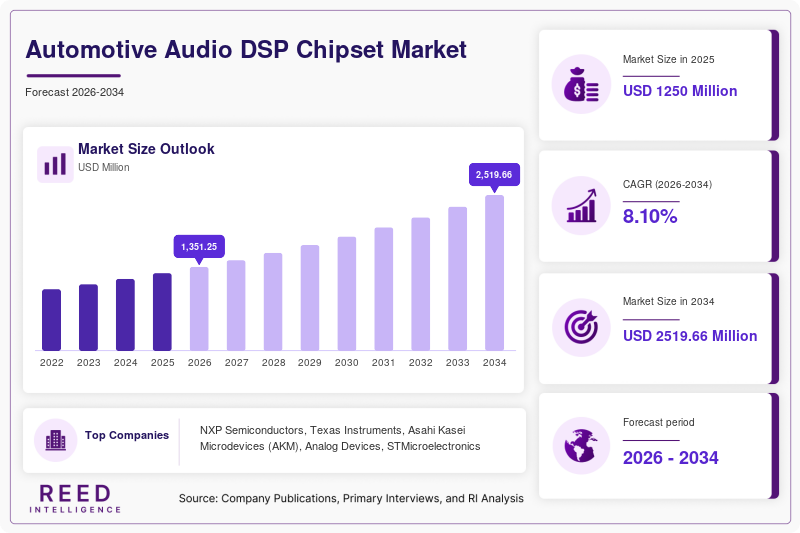
The Automotive Audio DSP Chipset Market was valued at USD 1,250 million in 2025 and is estimated at USD 1,320 million in 2026. Based on the supplied forecast, the market is projected to reach USD 2,519.66 million by 2034.
The supplied CAGR is 8.10% for 2026–2034. However, growth from USD 1,320 million in 2026 to USD 2,650 million in 2034 implies a CAGR of approximately 9.10%. Growth from USD 1,250 million in 2025 to USD 2,650 million in 2034 implies approximately 8.72% CAGR. The supplied market values and stated CAGR are retained, with this mathematical inconsistency clearly noted.
Automotive audio digital signal processor (DSP) chipsets process digital sound signals within vehicle infotainment and acoustic systems. They support equalization, crossover management, time alignment, multichannel audio, voice processing, active noise cancellation and increasingly sophisticated cabin sound experiences.
Demand is shifting from basic sound reproduction toward software-configurable, multichannel and AI-assisted acoustic processing. NXP's SAF9xxx family, for example, combines audio DSP processing with neural-network capabilities and hardware acceleration to support active noise cancellation and software-defined vehicle audio.
The market's growth will depend on how rapidly automakers add advanced audio capabilities across vehicle price categories, whether DSP functions remain standalone or become integrated into larger computing platforms, and how effectively suppliers meet automotive reliability, power and cost requirements.
Automotive audio DSP chipsets are specialized semiconductor devices that process audio signals in real time. They may operate as dedicated processors within an amplifier or infotainment system, or as part of a more integrated automotive computing platform.
Automotive Audio DSP Chipset Market Drivers
Advanced In-Car Audio Is Becoming a Differentiating Vehicle Feature
Audio quality has become part of the broader digital-cockpit experience. Automakers use speaker configuration, sound tuning, immersive audio and cabin acoustics to differentiate vehicle models and premium trims.
DSP chipsets enable these features by controlling the digital signal path between audio sources, amplifiers, microphones and speakers. This creates demand for processors capable of handling more channels, complex filtering and multiple simultaneous processing tasks.
The market mechanism is especially relevant for OEMs seeking to offer distinct sound profiles across vehicle platforms without developing entirely separate electronics architectures for every trim.
Voice Interfaces and Hands-Free Communication Increase Processing Requirements
Modern infotainment systems support voice assistants, hands-free calling, navigation prompts and conversational interfaces. These features depend on processing clean microphone signals in environments affected by road noise, wind, music and passenger conversation.
DSPs support echo cancellation, beamforming, noise suppression and voice enhancement. These functions become more demanding when multiple microphones and simultaneous audio streams are used.
The commercial implication is that audio DSP capability is increasingly linked to the usability of the vehicle's wider infotainment and voice-interaction system.
Active Noise Cancellation Expands DSP Applications
Active noise cancellation uses microphones, signal-processing algorithms and vehicle audio hardware to counter unwanted sound in the cabin. Applications include road-noise cancellation, engine-order reduction and mitigation of selected wind or tire noise.
NXP's SAF9xxx family is designed for real-time active cancellation of engine, road, wind and tire noise, illustrating how automotive DSP chipsets can serve acoustic functions beyond conventional music playback.
As manufacturers seek quieter cabins and improved passenger comfort, DSPs with predictable low-latency performance and adequate input/output capacity become more valuable.
Software-Defined Vehicle Architectures Encourage Programmable Audio Platforms
Software-defined vehicle designs place greater emphasis on reusable software, configurable computing and centralized management of vehicle functions.
Programmable audio DSPs can support software-based tuning and the deployment of new features across multiple models. Integrated platforms can also reduce component count and simplify communication between infotainment, voice-processing and audio subsystems.
This creates opportunities for chipset vendors that provide not only silicon but also development tools, algorithm libraries, reference designs and long-term automotive support.
Electric Vehicles Create New Cabin-Acoustic Requirements
Electric vehicles typically have less combustion-engine noise, making other sound sources—including tire, road, wind and motor-related noise—more noticeable to occupants.
EV platforms also provide opportunities for new sound experiences, including cabin-zone audio and personalized acoustic settings. DSPs can support these functions through adaptive equalization, noise cancellation and multichannel processing.
However, electrification does not automatically guarantee higher DSP spending in every vehicle. Adoption depends on the vehicle's price category, audio package, architecture and the extent to which processing is integrated into other chips.
Automotive Audio DSP Chipset Market Restraints
Automotive Qualification and Reliability Requirements Increase Development Costs
Automotive chipsets must operate reliably across wide temperature ranges, electrical disturbances, vibration and long product lifecycles. Qualification, validation and vehicle-program approval can take substantial time.
A chipset must also remain compatible with the vehicle's hardware, software, safety and cybersecurity requirements. These factors increase development costs and can slow the adoption of new architectures.
Price Sensitivity Limits Advanced DSP Adoption in Entry-Level Vehicles
Premium audio functions may justify higher semiconductor costs in luxury vehicles, but mass-market programs are more sensitive to bill-of-materials constraints.
Manufacturers must balance processing capability, channel count, memory, power consumption and software flexibility against the cost of each vehicle's audio system.
Integration into a larger infotainment or cockpit chip can reduce component count, but it may also increase software complexity and create trade-offs in performance allocation.
Long Automotive Design Cycles Delay Commercial Returns
DSP vendors typically need to secure design wins before their products generate sustained production revenue. Once selected, a chipset may remain in a vehicle program for several years.
This supports long-term supply relationships but can delay the financial return on research and development. It also means that technical superiority alone may not translate immediately into market share.
Semiconductor Supply and Platform Concentration Create Risks
Automotive audio DSP supply depends on semiconductor manufacturing, packaging, testing and component availability. Disruptions can affect vehicle production schedules or require costly redesigns.
OEMs may also be reluctant to depend on a single supplier for critical audio functions. Multi-source strategies and long-term supply agreements can therefore influence chipset selection.
Automotive Audio DSP Chipset Market Opportunities
AI-Enabled Audio Processing
AI-assisted noise suppression, voice enhancement and acoustic classification offer an opportunity to differentiate next-generation chipsets.
The key commercial requirement is to run these functions with predictable latency and acceptable power consumption. Solutions that combine dedicated DSP processing with neural-network acceleration can help allocate workloads more efficiently.
Integrated DSP and Infotainment Platforms
Combining audio DSP functions with infotainment or cockpit processors can reduce system complexity and support more coordinated software development.
AMD and DSP Concepts announced a collaboration in March 2026 to bring the Audio Weaver embedded audio framework to AMD Ryzen AI Embedded P100 processors. The architecture combines CPU, DSP and neural-network processing resources for automotive audio workloads.
This illustrates an opportunity for vendors that can support multiple computing resources through a common audio software environment.
Advanced Cabin-Zone and Immersive Audio
Increasing speaker counts and personalized listening experiences create demand for processors with higher channel capacity and flexible routing.
Applications include immersive audio, independent audio zones, rear-seat entertainment, focused voice communication and customized sound profiles.
The strongest commercial potential lies in platforms that scale across multiple vehicle classes while allowing OEMs to differentiate the user experience through software.
Aftermarket DSP Upgrades
The aftermarket provides a separate opportunity for dedicated audio processors used to improve sound quality in existing vehicles.
Demand depends on enthusiast spending, installation economics, compatibility with factory head units and the availability of user-friendly tuning tools. This segment is distinct from OEM chipset revenue and should be defined carefully when estimating the total market.
Growing Automotive Electronics Content in APAC
APAC combines large vehicle-manufacturing operations with expanding domestic demand for connected and feature-rich vehicles. The region also includes significant automotive electronics and semiconductor supply chains.
For DSP vendors, opportunities depend on winning local OEM and Tier-1 programs, meeting cost requirements and providing technical support close to vehicle development centers.
Segmental Analysis
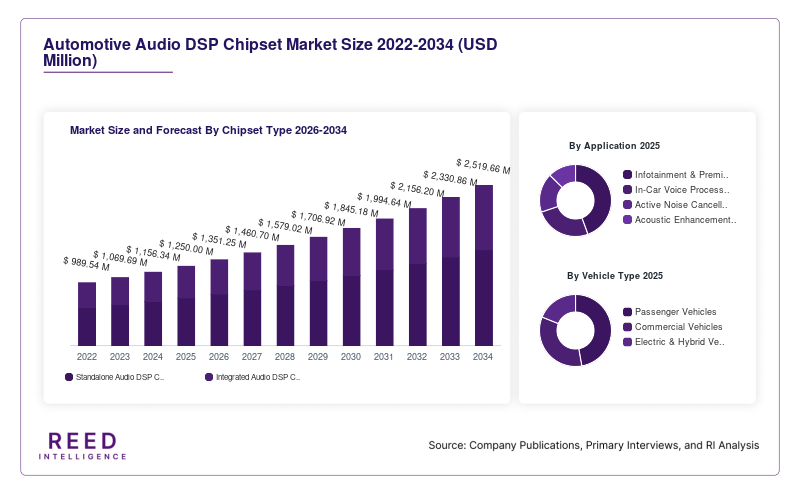
The segment shares, values, growth rates and 2034 values below are internal analytical allocations, not independently published market estimates. They are designed to provide a consistent planning framework for the supplied market forecast.
By Chipset Type
Standalone Audio DSP Chipsets represent approximately 44% of the 2025 market, equivalent to about USD 550 million under the internal allocation. The segment is modeled at approximately 7.7% CAGR through 2034, producing an indicative value of around USD 1.08 billion by 2034. Standalone processors remain relevant when audio performance, flexible channel configuration and independent tuning are priorities.
Integrated Audio DSP Chipsets represent approximately 56% of the 2025 market, equivalent to about USD 700 million. The segment is modeled at approximately 8.4% CAGR, reaching around USD 1.44 billion by 2034. Integrated solutions benefit from reduced component count, tighter coordination with infotainment hardware and the potential to share processing and connectivity resources.
By Application
Infotainment & Premium Audio represents approximately 48% of the 2025 market, equivalent to about USD 600 million. It is modeled at approximately 8.0% CAGR, reaching an indicative USD 1.20 billion by 2034. Demand is linked to multichannel audio, premium sound systems, equalization, speaker tuning and immersive cabin experiences.
In-Car Voice Processing represents approximately 22% of the 2025 market, equivalent to about USD 275 million. The segment is modeled at approximately 8.8% CAGR, reaching around USD 577 million by 2034. Voice assistants and hands-free communication increase the need for echo cancellation, microphone-array processing and robust noise suppression.
Active Noise Cancellation represents approximately 18% of the 2025 market, equivalent to about USD 225 million. It is modeled at approximately 9.2% CAGR, reaching approximately USD 498 million by 2034. The relatively high modeled growth reflects opportunities in road-noise reduction, cabin comfort and adaptive acoustic control.
Acoustic Enhancement & Other Applications represent approximately 12% of the 2025 market, equivalent to about USD 150 million. The segment is modeled at approximately 7.3% CAGR, reaching around USD 283 million by 2034. This category includes specialized sound processing and other DSP functions that do not fall within the principal application categories.
By Vehicle Type
Passenger Vehicles represent approximately 76% of the 2025 market, equivalent to about USD 950 million. The segment is modeled at approximately 8.1% CAGR, reaching approximately USD 1.91 billion by 2034. Passenger vehicles provide the broadest application base for infotainment, premium audio, voice processing and acoustic personalization.
Commercial Vehicles represent approximately 14% of the 2025 market, equivalent to about USD 175 million. It is modeled at approximately 7.2% CAGR, reaching around USD 331 million by 2034. Demand comes from infotainment, hands-free communication, navigation and driver-focused audio systems.
Electric & Hybrid Vehicles represent approximately 10% of the 2025 market, equivalent to about USD 125 million. The segment is modeled at approximately 10.0% CAGR, reaching around USD 295 million by 2034. This is a separate vehicle-technology allocation for analytical purposes; in actual vehicle sales, EVs and hybrids overlap with passenger and commercial categories. The faster modeled growth reflects new cabin-acoustic requirements and increasing digital-cockpit content, not a claim that every electrified vehicle uses a separate DSP chipset.
By Sales Channel
OEM represents approximately 92% of the 2025 market, equivalent to about USD 1.15 billion. The segment is modeled at approximately 8.2% CAGR, reaching around USD 2.31 billion by 2034. OEM supply is supported by factory-installed infotainment, premium audio and voice systems integrated into vehicle production programs.
Aftermarket represents approximately 8% of the 2025 market, equivalent to about USD 100 million. It is modeled at approximately 7.0% CAGR, reaching around USD 184 million by 2034. Aftermarket demand is driven by sound-system upgrades, dedicated audio processors and enthusiast installations, but growth depends on compatibility with increasingly integrated factory electronics.
Regional Analysis
North America Automotive Audio DSP Chipset Market
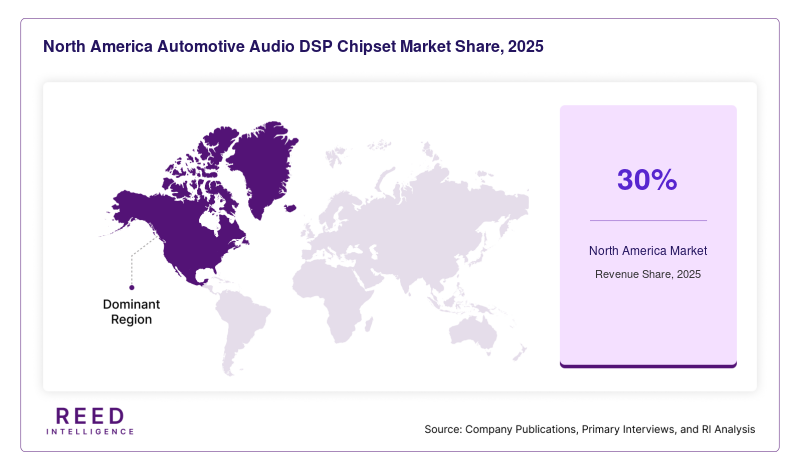
North America is modeled to represent approximately 30% of the 2025 market, equivalent to about USD 375 million. It is modeled at approximately 7.8% CAGR, reaching around USD 746 million by 2034.
The region benefits from a substantial automotive technology ecosystem, premium vehicle demand and semiconductor suppliers with established automotive audio portfolios. Opportunities include premium audio systems, software-defined cockpit platforms and AI-assisted voice processing.
Chipset vendors must compete on integration, software support, automotive qualification and long-term supply commitments. Winning OEM design programs can provide sustained revenue, although the long development cycle means that product announcements do not immediately translate into production sales.
Europe Automotive Audio DSP Chipset Market
Europe is modeled to account for approximately 25% of the 2025 market, equivalent to about USD 312.5 million. It is modeled at approximately 7.7% CAGR, reaching around USD 619 million by 2034.
The region has a strong automotive engineering base and a significant premium vehicle segment. Acoustic refinement, cabin comfort and advanced infotainment create opportunities for higher-performance DSP solutions.
European suppliers and automakers also place substantial emphasis on vehicle-level integration and quality validation. Semiconductor providers need to support long automotive lifecycles and cooperate closely with Tier-1 audio-system developers.
APAC Automotive Audio DSP Chipset Market
APAC is modeled to account for approximately 32% of the 2025 market, equivalent to about USD 400 million. It is modeled at approximately 9.0% CAGR, the highest regional rate in this allocation, reaching around USD 870 million by 2034.
The region benefits from large vehicle-production bases, expanding connected-car adoption and the presence of automotive electronics suppliers. China, Japan, South Korea and India provide different growth pathways, ranging from advanced cockpit electronics to increasing feature adoption in mass-market vehicles.
Local suppliers can compete through cost-effective chipsets and software ecosystems, while global vendors compete for premium and high-volume OEM programs. The ability to offer scalable designs across multiple price tiers will be important.
Middle East and Africa Automotive Audio DSP Chipset Market
Middle East and Africa are modeled to represent approximately 5% of the 2025 market, equivalent to about USD 62.5 million. The segment is modeled at approximately 7.5% CAGR, reaching around USD 121 million by 2034.
Demand is linked primarily to vehicle imports, premium vehicle purchases and the gradual spread of connected infotainment features. Local semiconductor demand is smaller than in major vehicle-manufacturing regions, so much of the market is reached through global OEM platforms and imported vehicles.
The main commercial challenge is the limited scale of local vehicle production and the need to support diverse vehicle models and configurations.
LATAM Automotive Audio DSP Chipset Market
LATAM is modeled to represent approximately 8% of the 2025 market, equivalent to about USD 100 million. It is modeled at approximately 7.6% CAGR, reaching around USD 195 million by 2034.
Demand is supported by passenger-vehicle production, imported vehicle technology and the adoption of infotainment and hands-free features across vehicle segments.
Cost remains a major factor. DSP solutions that balance audio performance with competitive component pricing are likely to have broader adoption potential than designs requiring expensive premium audio architectures.
Competitive Landscape
The market is shaped by semiconductor suppliers that compete on audio-processing performance, automotive qualification, power consumption, integration, software tools and long-term supply support.
NXP Semiconductors has developed the SAF9xxx family for automotive audio processing, combining DSP cores with AI/ML acceleration, audio interfaces and connectivity. Its approach targets scalable audio capabilities for software-defined vehicles.
Texas Instruments offers automotive processing platforms including the AM62D-Q1 and AM275x-Q1 families, which combine DSP capability with CPU resources and automotive-oriented interfaces. These products illustrate the convergence of audio processing with broader embedded computing.
Key Market Players
- NXP Semiconductors
- Texas Instruments
- Asahi Kasei Microdevices (AKM)
- Analog Devices
- STMicroelectronics
- Infineon Technologies
- Renesas Electronics
- Cirrus Logic
- Microchip Technology
- Qualcomm Technologies
- AMD
- DSP Concepts
Recent Market Developments
- In March 2026, AMD and DSP Concepts announced that Audio Weaver would support AMD Ryzen AI Embedded P100 Series processors for automotive applications. The architecture brings together CPU, DSP and neural-network processing resources to support immersive audio, low-latency signal processing and digital-cockpit functions. Audio processing is increasingly being integrated into broader computing platforms. Chipset suppliers may compete through software portability, processing flexibility and the ability to deploy audio functions across multiple computing resources.
- In October 2025, NXP's SAF9100 product documentation described a one-chip automotive audio solution incorporating two HiFi 5 DSPs, neural-network accelerators, an embedded microcontroller and PCIe or Gigabit Ethernet connectivity options. Integration of DSP, control and connectivity functions can reduce system complexity and support a broader range of audio features. Product availability and adoption remain dependent on customer qualification and vehicle-program schedules.
Automotive Audio DSP Chipset Market Segments
By Chipset Type
- Standalone Audio DSP Chipsets
- Integrated Audio DSP Chipsets
By Application
- Infotainment & Premium Audio
- In-Car Voice Processing
- Active Noise Cancellation
- Acoustic Enhancement & Other Applications
By Vehicle Type
- Passenger Vehicles
- Commercial Vehicles
- Electric & Hybrid Vehicles
By Sales Channel
- OEM
- Aftermarket
By Region
- North America
- Europe
- APAC
- Middle East and Africa
- LATAM