Automotive Augmented Reality HUD Market Size, Share & Demand Report By Component (Projection Units, Software Platforms, Sensors, Control Units), By Vehicle Type (Passenger Vehicles, Commercial Vehicles, Electric Vehicles), By Display Technology (Windshield-based HUD, Combiner HUD, Holographic AR HUD), By Region & Segment Forecasts, 2026–2034
USD 3950
Market Overview
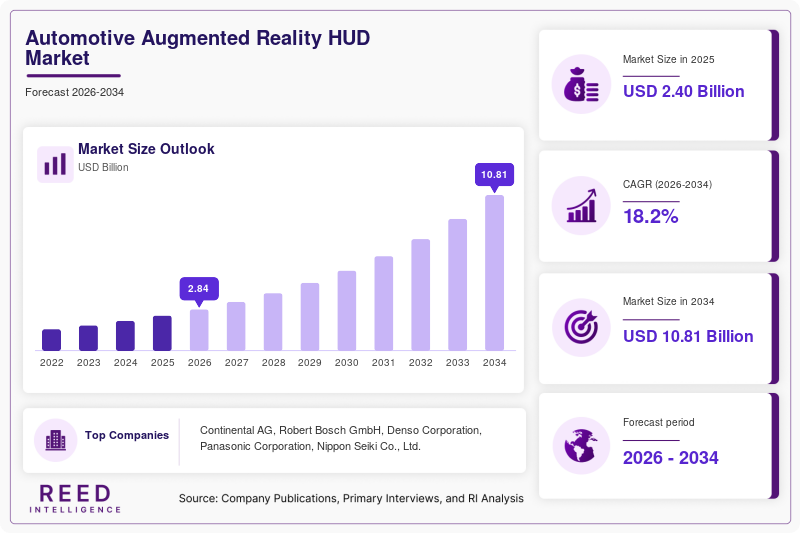
The Automotive Augmented Reality HUD Market was valued at approximately USD 2.4 billion in 2026 and is projected to reach USD 9.1 billion by 2034, expanding at a compound annual growth rate (CAGR) of 18.2% during 2026–2034. This growth trajectory reflects the increasing integration of advanced driver assistance systems (ADAS) and the rising demand for enhanced in-vehicle safety and immersive driving experiences. Automotive augmented reality head-up displays (AR HUDs) project contextual information such as navigation cues, hazard warnings, and speed data directly onto the windshield, reducing driver distraction and improving situational awareness.
A key global factor supporting market growth is the rapid digital transformation of the automotive industry, driven by advancements in connectivity, artificial intelligence, and sensor technologies. Automakers are increasingly incorporating AR-based visualization systems to align with evolving consumer expectations for smart, intuitive vehicle interfaces. Regulatory emphasis on road safety and driver assistance technologies has also accelerated adoption across both premium and mid-range vehicle segments.
Key Highlights
- North America dominated the market with a 33.8% share in 2025.
- Asia Pacific is expected to grow at the fastest CAGR of 19.6% during 2026–2034.
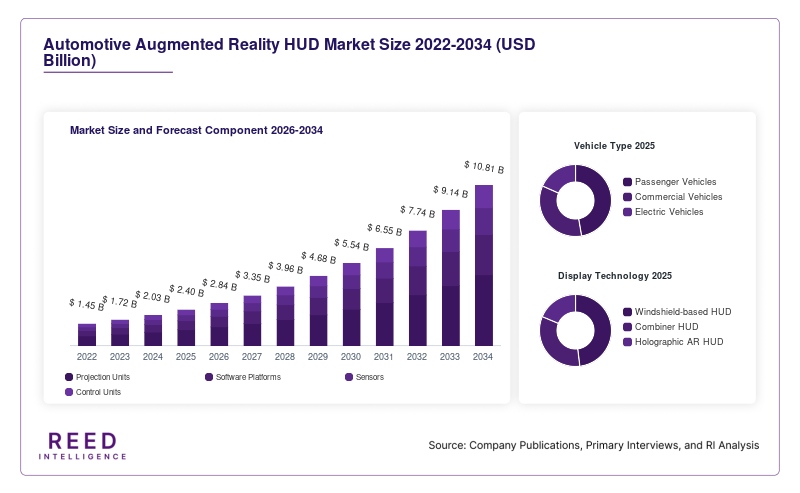
- By component, projection units accounted for the largest share of 36.9%.
- while software platforms are projected to grow at a CAGR of 20.8%.
- By vehicle type, passenger vehicles led with a 72.4% share, whereas electric vehicles are expected to expand at a CAGR of 21.3%.
- The United States remained the dominant country, with market values of USD 620 million in 2024 and USD 690 million in 2025.
Market Trends
Integration of AR HUDs with Advanced Driver Assistance Systems (ADAS)
A prominent trend shaping the Automotive Augmented Reality HUD Market is the deep integration of AR HUD systems with advanced driver assistance technologies. Automakers are leveraging AR HUDs to overlay real-time navigation, lane departure warnings, collision alerts, and pedestrian detection directly into the driver’s field of view. This convergence enhances safety by reducing the need for drivers to shift focus between the road and dashboard displays. As ADAS adoption increases globally, AR HUDs are becoming a critical interface layer that translates complex sensor data into intuitive visual cues. The growing complexity of semi-autonomous systems further reinforces the importance of AR visualization, as it improves driver understanding of vehicle behavior and surrounding environments.
Expansion into Mid-Range and Electric Vehicle Segments
Another notable trend is the expansion of AR HUD technology beyond luxury vehicles into mid-range and electric vehicle categories. Initially limited to premium models due to high costs, advancements in display technologies and economies of scale have made AR HUDs more accessible. Electric vehicle manufacturers, in particular, are adopting AR HUDs to differentiate their offerings and enhance digital user experiences. The integration of AR displays complements the futuristic design and connected features of EVs, aligning with consumer expectations. This trend is expected to broaden the addressable market and drive higher unit shipments over the forecast period.
Market Drivers
Increasing Demand for Enhanced Driving Safety and Reduced Distraction
One of the primary drivers of the Automotive Augmented Reality HUD Market is the growing emphasis on road safety and the need to minimize driver distraction. AR HUDs provide critical information directly in the driver’s line of sight, eliminating the need to glance at instrument clusters or infotainment screens. This feature significantly reduces reaction time and enhances situational awareness, especially in high-speed or complex driving scenarios. Governments and regulatory bodies are promoting technologies that improve driver focus, further supporting the adoption of AR HUD systems. As road traffic increases globally, the demand for such safety-enhancing technologies is expected to rise steadily.
Technological Advancements in Display and Sensor Systems
Rapid advancements in display technologies, such as laser projection, waveguides, and holographic optics, are significantly driving the growth of the market. These innovations enable larger field-of-view displays, improved brightness, and higher resolution, enhancing the overall user experience. Additionally, improvements in sensors, cameras, and real-time data processing allow AR HUDs to deliver precise and dynamic visual overlays. The integration of artificial intelligence and machine learning further enhances system capabilities by enabling predictive alerts and contextual information delivery. These technological developments are reducing system costs and improving scalability, making AR HUDs more viable for mass-market adoption.
Market Restraint
High Cost and Technical Complexity of AR HUD Systems
Despite strong growth prospects, the Automotive Augmented Reality HUD Market faces a significant restraint in the form of high system costs and technical complexity. AR HUD systems require advanced hardware components, including high-resolution projectors, complex optical systems, and powerful processing units. These components increase the overall cost of vehicle integration, limiting adoption primarily to premium and high-end models. Additionally, the development and calibration of AR HUDs involve complex engineering processes, including precise alignment with the windshield and real-time data synchronization.
The complexity of integrating AR HUDs with existing vehicle architectures and ensuring compatibility with various sensors and software platforms also poses challenges for manufacturers. For example, achieving accurate depth perception and real-world alignment requires sophisticated algorithms and extensive testing. These factors can lead to longer development cycles and increased production costs. As a result, smaller automakers and cost-sensitive markets may face barriers to adoption, slowing overall market penetration. Addressing these challenges through cost optimization and standardization will be crucial for broader market expansion.
Market Opportunities
Growth of Autonomous and Semi-Autonomous Vehicles
The rise of autonomous and semi-autonomous vehicles presents a significant opportunity for the Automotive Augmented Reality HUD Market. As vehicles become more automated, the need for intuitive human-machine interfaces increases. AR HUDs can play a vital role in communicating vehicle decisions, navigation paths, and environmental awareness to drivers. This capability enhances trust and understanding, which are critical for the adoption of autonomous technologies. Automakers are investing in AR-based visualization systems to improve user engagement and safety, creating new growth avenues for market participants.
Emerging Markets and Localization Strategies
Emerging markets in Asia, Latin America, and the Middle East offer substantial growth potential for AR HUD adoption. Rising disposable incomes, urbanization, and increasing vehicle ownership are driving demand for advanced automotive technologies in these regions. Manufacturers are focusing on localization strategies, including cost-effective designs and region-specific features, to cater to diverse consumer needs. Additionally, government initiatives promoting smart mobility and digital transformation are supporting the adoption of AR technologies. These factors create opportunities for market expansion beyond traditional developed regions.
Segmental Analysis
By Component
The projection units segment dominated the Automotive Augmented Reality HUD Market in 2024, accounting for approximately 36.9% of the total market share. These units are responsible for projecting high-quality images onto the windshield, making them a critical component of AR HUD systems. The demand for advanced projection technologies, such as laser-based and digital light processing systems, has increased due to their ability to deliver clear and bright images under various lighting conditions. Automakers prioritize high-performance projection units to enhance user experience and ensure accurate visualization of information.
The software platforms segment is expected to grow at the fastest CAGR of 20.8% during the forecast period. This growth is driven by the increasing importance of data processing, real-time rendering, and system integration. Software solutions enable AR HUDs to interpret data from multiple sensors and deliver context-aware information to drivers. The integration of artificial intelligence and machine learning further enhances system capabilities, enabling predictive analytics and personalized user experiences. As vehicles become more connected and autonomous, the demand for advanced software platforms is expected to rise significantly.
By Vehicle Type
Passenger vehicles dominated the market in 2024, holding a share of 72.4%. The high adoption rate of AR HUD systems in this segment is attributed to strong consumer demand for enhanced safety and convenience features. Premium and luxury vehicle manufacturers have been early adopters of AR HUD technology, integrating it into their flagship models. The increasing availability of AR HUDs in mid-range vehicles is further driving growth in this segment, expanding the market base.
Electric vehicles are projected to be the fastest-growing subsegment, with a CAGR of 21.3% during the forecast period. The rapid adoption of EVs globally, driven by environmental concerns and government incentives, is creating new opportunities for AR HUD integration. EV manufacturers focus on advanced digital interfaces to differentiate their offerings, making AR HUDs a key feature. The combination of futuristic design and advanced technology aligns with consumer expectations, driving demand for AR HUD systems in electric vehicles.
By Display Technology
Conventional windshield-based AR HUDs dominated the market in 2024, accounting for a significant share due to their widespread adoption in premium vehicles. These systems project information directly onto the windshield, providing a seamless viewing experience. The reliability and established technology of conventional HUDs make them a preferred choice for automakers looking to integrate AR capabilities into their vehicles.
Holographic AR HUDs are expected to witness the fastest growth, with a CAGR exceeding 22% during the forecast period. This growth is driven by advancements in holographic display technologies, which offer enhanced depth perception and more immersive visual experiences. Holographic systems can project complex 3D images, improving the clarity and effectiveness of information displayed. As technology matures and costs decrease, holographic AR HUDs are expected to gain wider adoption across various vehicle segments.
Regional Analysis
North America
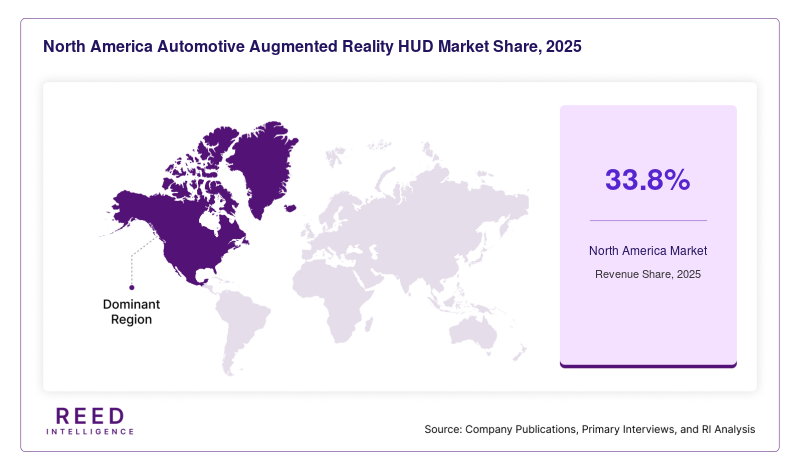
North America accounted for approximately 33.8% of the global Automotive Augmented Reality HUD Market share in 2025 and is expected to grow at a CAGR of 17.5% during the forecast period. The region’s growth is driven by strong demand for advanced automotive technologies and high adoption rates of ADAS systems. The presence of leading automotive manufacturers and technology providers further supports innovation and product development.
The United States dominates the regional market, supported by high consumer demand for premium vehicles and advanced safety features. A unique growth factor is the strong regulatory framework promoting vehicle safety technologies. Government initiatives encouraging the adoption of driver assistance systems have accelerated the integration of AR HUDs in both luxury and mid-range vehicles.
Europe
Europe held a significant share of around 27.4% in 2025 and is projected to grow at a CAGR of 16.9% through 2034. The region’s focus on vehicle safety, environmental sustainability, and technological innovation drives market growth. European automakers are at the forefront of integrating AR HUD systems into their vehicle portfolios.
Germany leads the European market, driven by its strong automotive manufacturing base and emphasis on engineering excellence. A unique growth factor is the region’s stringent safety regulations, which encourage the adoption of advanced driver assistance technologies. This regulatory environment fosters continuous innovation and integration of AR HUD systems.
Asia Pacific
Asia Pacific is expected to witness the fastest growth, with a CAGR of 19.6% during the forecast period, while holding a 25.1% market share in 2025. Rapid urbanization, increasing vehicle production, and growing consumer demand for advanced features contribute to market expansion. The region is becoming a key hub for automotive innovation and manufacturing.
China dominates the Asia Pacific market due to its large automotive industry and strong focus on electric vehicles. A unique growth factor is government support for smart mobility and connected vehicle technologies. Policies promoting innovation and digitalization are accelerating the adoption of AR HUD systems across various vehicle segments.
Middle East & Africa
The Middle East & Africa region accounted for approximately 7.2% of the market share in 2025 and is projected to grow at a CAGR of 15.3%. Growth is driven by increasing investments in automotive infrastructure and rising demand for luxury vehicles. The adoption of advanced technologies is gradually increasing across the region.
The United Arab Emirates leads the regional market, supported by high demand for premium vehicles and technological advancements. A unique growth factor is the region’s focus on smart city initiatives, which promote the adoption of connected and intelligent vehicle systems, including AR HUDs.
Latin America
Latin America held a market share of around 6.5% in 2025 and is expected to grow at a CAGR of 14.8% during the forecast period. Economic development and increasing vehicle ownership are key factors driving market growth. The adoption of advanced automotive technologies is gradually gaining traction.
Brazil dominates the Latin American market, driven by its large automotive industry and growing consumer base. A unique growth factor is the increasing investment in automotive manufacturing and technology adoption, which supports the integration of AR HUD systems in new vehicle models.
Competitive Landscape
The Automotive Augmented Reality HUD Market is characterized by intense competition and continuous innovation among key players. Leading companies focus on developing advanced AR technologies, improving display quality, and enhancing system integration capabilities. Strategic partnerships, mergers, and acquisitions are common as companies aim to strengthen their market positions and expand their product portfolios.
The market leader, Continental AG, has established a strong presence through its advanced AR HUD solutions and extensive collaborations with major automakers. A recent development includes the launch of next-generation AR HUD systems with improved field-of-view and enhanced image resolution. Other key players are investing in research and development to introduce innovative products and maintain competitive advantages. The competitive landscape is expected to remain dynamic, with ongoing technological advancements shaping market growth.
Key Players List
- Continental AG
- Robert Bosch GmbH
- Denso Corporation
- Panasonic Corporation
- Nippon Seiki Co., Ltd.
- Visteon Corporation
- Valeo SA
- Hyundai Mobis
- Garmin Ltd.
- Pioneer Corporation
- Yazaki Corporation
- Aptiv PLC
- Magna International Inc.
- Texas Instruments Incorporated
- LG Electronics Inc.
Recent Developments
- In 2025, Continental AG introduced an advanced AR HUD system with expanded field-of-view for enhanced driver visibility.
- In 2024, Bosch launched a new AR HUD platform integrating AI-based predictive navigation features.
- In 2025, Hyundai Mobis developed a holographic windshield display capable of projecting full-width augmented reality visuals.
Automotive Augmented Reality HUD Market Segments
Component
- Projection Units
- Software Platforms
- Sensors
- Control Units
Vehicle Type
- Passenger Vehicles
- Commercial Vehicles
- Electric Vehicles
Display Technology
- Windshield-based HUD
- Combiner HUD
- Holographic AR HUD
By Region
- North America
- Europe
- APAC
- Middle East and Africa
- LATAM