Automotive Blow Heater Market Size, Share & Demand Report By Vehicle Type (Passenger Vehicles, Commercial Vehicles, Electric Vehicles), By Type (PTC Heaters, Heat Pump Systems, Resistive Heaters), By Component (Heating Element, Blower Motor, Control Unit), By Sales Channel (OEM, Aftermarket), By Region & Segment Forecasts, 2025–2034
USD 3950
Market Overview
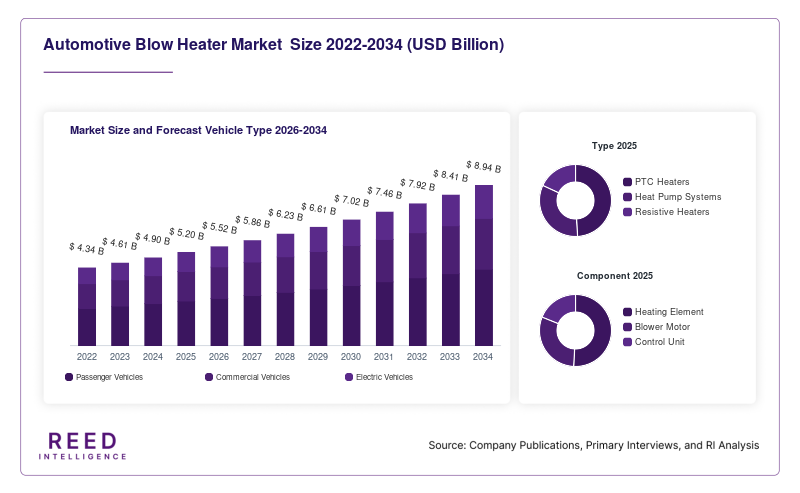
The Automotive Blow Heater Market size was valued at approximately USD 5.2 billion in 2025 and is projected to reach USD 8.9 billion by 2034, expanding at a CAGR of 6.2% during the forecast period (2025–2034). Automotive blow heaters, essential components in vehicle HVAC systems, are widely used to regulate cabin temperature and improve passenger comfort across passenger cars, commercial vehicles, and electric vehicles.
A key global factor supporting market growth has been the steady increase in vehicle production combined with heightened consumer expectations for enhanced in-cabin comfort. Rising urbanization, longer commute durations, and demand for climate-controlled interiors have encouraged automakers to integrate advanced heating technologies, particularly in cold climate regions. Additionally, technological advancements in energy-efficient HVAC systems are further contributing to the Automotive Blow Heater Market growth.
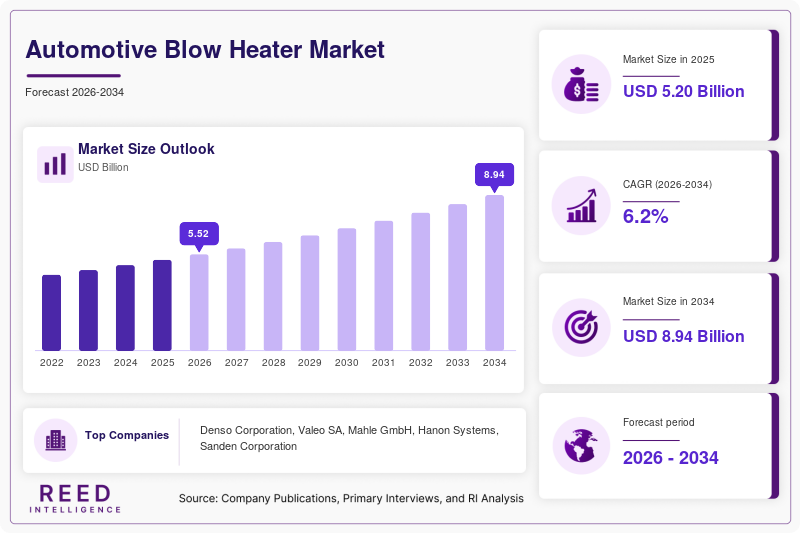
Key Highlights:
- Asia Pacific dominated the market with a 42% share in 2025, while it is expected to be the fastest-growing region with a CAGR of 7.1%.
- By vehicle type, passenger vehicles led with a 58% share, while electric vehicles are projected to grow fastest at a CAGR of 8.4%.
- By type, PTC (Positive Temperature Coefficient) heaters held the largest share at 46%, whereas heat pump-based blow heaters are expected to grow at a CAGR of 9.2%.
- China remained the dominant country, with market values of USD 1.4 billion in 2024 and USD 1.5 billion in 2025.
Market Trends
Integration of Energy-Efficient Heating Systems
A notable trend in the Automotive Blow Heater Market is the growing adoption of energy-efficient heating technologies, particularly in electric and hybrid vehicles. Traditional heating systems rely heavily on engine heat, but with electrification, automakers are shifting toward PTC heaters and heat pump systems. These solutions reduce energy consumption while maintaining optimal cabin comfort. The shift is aligned with global sustainability goals and stricter emission regulations, encouraging manufacturers to innovate in thermal management technologies.
Smart Climate Control and Connected Systems
Another emerging trend is the integration of smart HVAC systems with connected vehicle platforms. Automotive blow heaters are increasingly being paired with sensors and AI-driven climate control modules that automatically adjust cabin temperature based on occupancy and environmental conditions. This trend enhances passenger comfort while optimizing energy usage. The rising adoption of connected cars and in-vehicle digital ecosystems is expected to accelerate the demand for advanced blow heater systems across premium and mid-range vehicles.
Market Drivers
Rising Demand for Passenger Comfort and Convenience
Increasing consumer preference for enhanced driving experiences has significantly driven the Automotive Blow Heater Market. Modern consumers prioritize comfort features such as automatic climate control, quick cabin heating, and uniform temperature distribution. This demand is particularly strong in regions experiencing extreme winters, where efficient blow heaters are essential. Automakers are incorporating advanced heating technologies to differentiate their offerings, thereby fueling market growth.
Growth in Electric and Hybrid Vehicle Adoption
The rapid expansion of electric and hybrid vehicle adoption has become a key driver for the Automotive Blow Heater Market. Unlike conventional vehicles, electric vehicles lack engine-generated heat, necessitating dedicated heating systems. This has led to increased demand for advanced blow heaters such as PTC and heat pump systems. Government incentives and stringent emission norms are accelerating EV adoption, indirectly boosting the demand for efficient automotive heating solutions.
Market Restraint
High Energy Consumption Impacting EV Efficiency
One of the major restraints in the Automotive Blow Heater Market is the high energy consumption associated with heating systems, particularly in electric vehicles. Blow heaters, especially resistive types, can significantly reduce battery range by consuming substantial power. This poses a challenge for automakers aiming to optimize vehicle efficiency and extend driving range.
Despite technological advancements such as heat pumps and improved thermal insulation, the issue of energy consumption remains a critical concern. Consumers are increasingly sensitive to vehicle range, especially in electric vehicles, where heating usage can reduce efficiency during colder months. Additionally, integrating advanced heating systems often increases vehicle cost, which may limit adoption in price-sensitive markets.
Manufacturers are actively working on innovations to address these challenges; however, balancing energy efficiency, cost, and performance continues to restrain the overall growth potential of the Automotive Blow Heater Market.
Market Opportunities
Expansion of Electric Vehicle Ecosystem
The expanding global electric vehicle ecosystem presents a significant opportunity for the Automotive Blow Heater Market. As EV adoption continues to rise, the demand for specialized heating systems will increase. This creates opportunities for manufacturers to develop innovative, energy-efficient blow heaters tailored for electric platforms. Integration with battery thermal management systems further enhances growth prospects.
Emerging Markets and Cold Climate Regions
Emerging economies and cold climate regions offer untapped opportunities for the Automotive Blow Heater Market. Countries in Eastern Europe, Central Asia, and parts of South America are witnessing increasing vehicle ownership along with rising demand for comfort features. As automotive penetration grows in these regions, the demand for reliable heating systems is expected to rise. Manufacturers can capitalize on this opportunity by offering cost-effective and durable blow heater solutions tailored to regional needs.
Segmental Analysis
By Vehicle Type
Passenger vehicles dominated the Automotive Blow Heater Market in 2024, accounting for approximately 58% of the total share. This dominance was attributed to the high production volume of passenger cars and increasing consumer demand for enhanced in-cabin comfort features.
Electric vehicles are expected to be the fastest-growing subsegment, with a projected CAGR of 8.4% during the forecast period. The growth factor lies in the increasing adoption of EVs, which require dedicated heating systems due to the absence of engine heat. This shift will significantly boost demand for advanced blow heaters.
By Type
PTC (Positive Temperature Coefficient) heaters held the largest share of around 46% in 2024. Their dominance was due to their efficiency, safety, and ability to provide rapid heating, making them suitable for modern vehicles.
Heat pump-based blow heaters are projected to grow at the fastest CAGR of 9.2%. Their unique growth factor is energy efficiency, as they consume less power compared to traditional systems. This makes them particularly attractive for electric vehicles, where energy conservation is critical.
By Component
Heating elements dominated the market with a share of approximately 40% in 2024. These components are essential for generating heat and are widely used across all types of blow heaters.
Control units are expected to witness the fastest growth, with a CAGR of 7.8%. The growth factor is the increasing integration of smart and automated climate control systems, which require advanced control units for efficient operation.
By Sales Channel
OEMs accounted for the largest share of around 72% in 2024, driven by the integration of blow heaters during vehicle manufacturing. Automakers prefer factory-installed systems for better performance and reliability.
The aftermarket segment is projected to grow at a CAGR of 6.9%. The growth factor lies in the rising demand for replacement and upgrade of heating systems, particularly in older vehicles and regions with extreme weather conditions.
Regional Analysis
North America
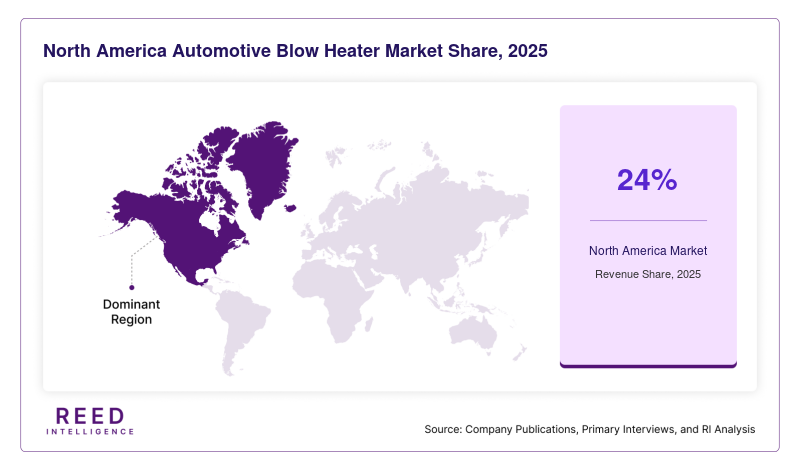
North America accounted for approximately 24% of the Automotive Blow Heater Market share in 2025 and is projected to grow at a CAGR of 5.8% during the forecast period. The region’s growth will be driven by high demand for advanced automotive technologies and strong adoption of electric vehicles.
The United States dominated the regional market due to increasing integration of advanced HVAC systems in vehicles. A key growth factor has been the high demand for luxury and premium vehicles equipped with automatic climate control systems. Additionally, the presence of leading automotive manufacturers and continuous technological innovation supports steady demand for blow heaters.
Europe
Europe held around 22% of the Automotive Blow Heater Market share in 2025 and is expected to expand at a CAGR of 6.0% through 2034. The region’s growth will be supported by stringent emission regulations and increasing electrification of vehicles.
Germany emerged as the dominant country due to its strong automotive manufacturing base. The growth factor lies in the rapid transition toward electric mobility and the integration of energy-efficient heating systems in vehicles. The focus on sustainability and innovation in thermal management systems continues to drive demand in the region.
Asia Pacific
Asia Pacific led the Automotive Blow Heater Market with a 42% share in 2025 and is anticipated to grow at the fastest CAGR of 7.1% over the forecast period. The region’s growth will be driven by high vehicle production and increasing consumer demand for comfort features.
China dominated the market due to its large automotive production capacity and rapid adoption of electric vehicles. A key growth factor is government support for EV manufacturing and infrastructure development, which has accelerated the adoption of advanced heating systems in vehicles.
Middle East & Africa
The Middle East & Africa accounted for approximately 6% of the Automotive Blow Heater Market share in 2025 and is projected to grow at a CAGR of 5.2% during the forecast period. Growth in this region will be supported by increasing vehicle sales and infrastructure development.
Saudi Arabia dominated the market due to rising automotive demand and improving economic conditions. The key growth factor is the increasing adoption of vehicles equipped with advanced HVAC systems, particularly in regions with fluctuating temperature conditions.
Latin America
Latin America held about 6% of the Automotive Blow Heater Market share in 2025 and is expected to grow at a CAGR of 5.5% through 2034. The region’s growth will be driven by rising vehicle ownership and gradual adoption of advanced automotive technologies.
Brazil led the regional market due to its expanding automotive industry. A significant growth factor is the increasing demand for passenger vehicles with improved comfort features, which is driving the adoption of blow heaters across the region.
Competitive Landscape
The Automotive Blow Heater Market is characterized by moderate competition, with key players focusing on innovation, product efficiency, and strategic partnerships. Leading companies are investing in research and development to enhance energy efficiency and integrate smart technologies into blow heater systems.
A prominent market leader is Denso Corporation, which continues to expand its product portfolio through advanced thermal management solutions. The company recently introduced an energy-efficient heat pump system designed specifically for electric vehicles, strengthening its position in the market.
Other major players are also focusing on expanding their global presence and improving product offerings to cater to evolving consumer demands. Strategic collaborations with automotive manufacturers and investments in emerging markets remain key strategies adopted by industry participants.
Key Players List
- Denso Corporation
- Valeo SA
- Mahle GmbH
- Hanon Systems
- Sanden Corporation
- Eberspächer Group
- BorgWarner Inc.
- Gentherm Incorporated
- Keihin Corporation
- Mitsubishi Heavy Industries Ltd.
- Webasto Group
- Delphi Technologies
- Modine Manufacturing Company
- Marelli Holdings Co., Ltd.
- Calsonic Kansei Corporation
Recent Developments
- 2025: Denso Corporation launched an advanced heat pump system for electric vehicles to improve energy efficiency.
- 2024: Valeo SA expanded its production capacity for automotive HVAC components in Asia Pacific.
- 2024: Hanon Systems introduced a compact blow heater designed for electric vehicle platforms.
- 2023: Mahle GmbH developed a new PTC heater with enhanced thermal performance.
- 2023: BorgWarner Inc. partnered with EV manufacturers to supply integrated thermal management systems.
Automotive Blow Heater Market Segments
Vehicle Type
- Passenger Vehicles
- Commercial Vehicles
- Electric Vehicles
Type
- PTC Heaters
- Heat Pump Systems
- Resistive Heaters
Component
- Heating Element
- Blower Motor
- Control Unit
Sales Channel
- OEM
- Aftermarket
By Region
- North America
- Europe
- APAC
- Middle East and Africa
- LATAM