Automotive Boot Release Cable Market Size, Share & Demand Report By Material (Steel Cables, Coated Cables, Other Materials), By Application (Passenger Vehicles, Commercial Vehicles, Electric Vehicles), By Sales Channel (OEM, Aftermarket), By Cable Type (Single-Core, Multi-Core), By Region & Segment Forecasts, 2025–2034
USD 3950
Market Overview
The Automotive Boot Release Cable Market was valued at approximately USD 2.4 billion in 2025 and is projected to reach USD 3.8 billion by 2034, expanding at a CAGR of 5.2% during the forecast period (2025–2034). The market growth is primarily driven by the steady rise in global vehicle production and the increasing demand for enhanced vehicle safety and convenience features. Automotive boot release cables play a critical role in enabling manual and remote trunk access, making them essential components in both passenger and commercial vehicles.
One key global factor supporting market expansion is the continuous growth of the automotive aftermarket sector. As vehicle lifecycles extend, demand for replacement components such as boot release cables has increased, especially in emerging economies where maintenance and repair activities are rising. Additionally, evolving consumer expectations for improved ergonomics and vehicle accessibility continue to influence product design and adoption.
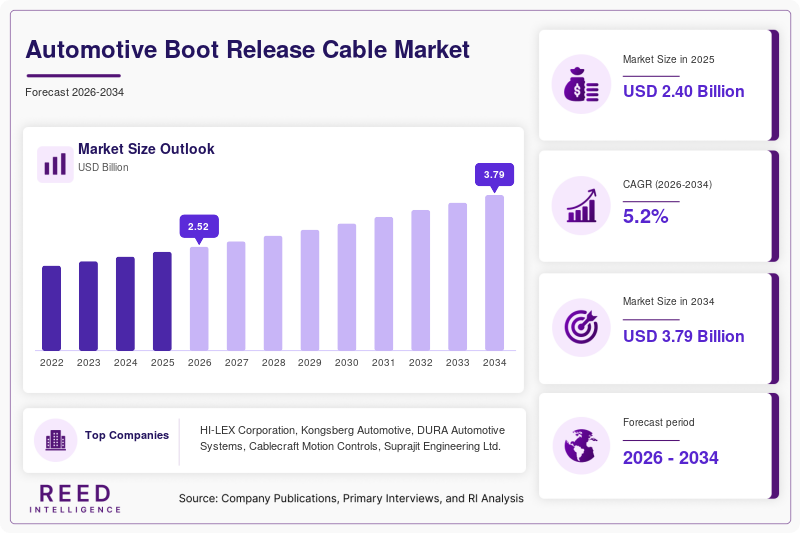
Key Highlights:
- Asia Pacific dominated the market with a 38% share, while Latin America is expected to grow at the fastest CAGR of 6.3%.
- Passenger vehicles led the application segment with a 65% share, while electric vehicles are projected to grow at a CAGR of 6.8%.
- Steel cables dominated the material segment with a 70% share, while coated cables are expected to grow at a CAGR of 5.9%.
- China remained the dominant country, with market values of USD 480 million in 2024 and USD 505 million in 2025.
Market Trends
Integration of Smart Release Mechanisms
The Automotive Boot Release Cable Market is witnessing a shift toward integration with smart and electronic release systems. While traditional mechanical cables remain widely used, manufacturers are increasingly designing hybrid systems that combine mechanical reliability with electronic activation. This trend is driven by consumer demand for convenience features such as remote trunk opening and keyless entry systems. The integration enhances user experience while maintaining system redundancy, ensuring reliability in case of electronic failure.
Increasing Focus on Lightweight Materials
Automotive manufacturers are placing greater emphasis on reducing vehicle weight to improve fuel efficiency and comply with emission standards. As a result, there is growing adoption of lightweight materials and optimized cable designs in boot release systems. Innovations in coated cables and high-strength polymers are gaining traction, offering durability with reduced mass. This trend is particularly prominent in electric vehicles, where weight reduction directly impacts battery efficiency and driving range.
Market Drivers
Rising Global Vehicle Production
The consistent increase in vehicle production across both developed and emerging economies is a key driver of the Automotive Boot Release Cable Market. As automotive manufacturing expands, the demand for essential mechanical components, including boot release cables, continues to grow. The rise in passenger car ownership and commercial fleet expansion has further strengthened the need for reliable trunk release systems.
Growth of Automotive Aftermarket Services
The expansion of the automotive aftermarket industry significantly contributes to market growth. As vehicles age, components such as boot release cables experience wear and require replacement. Increasing awareness of vehicle maintenance and the availability of cost-effective aftermarket solutions are encouraging consumers to replace worn-out components, thereby driving steady demand in the replacement segment.
Market Restraint
Shift Toward Fully Electronic Trunk Systems
One of the major restraints in the Automotive Boot Release Cable Market is the gradual shift toward fully electronic trunk release systems that eliminate the need for mechanical cables. Advanced vehicles, particularly in the premium segment, are increasingly adopting इलेक्ट्रॉनिक actuators and sensor-based systems for trunk operation. These systems offer seamless functionality and integration with smart vehicle ecosystems, reducing reliance on traditional cable-based mechanisms.
As automotive technology evolves, the adoption of cable-less solutions is expected to increase, especially in developed markets. This transition may limit the growth potential of conventional boot release cables, particularly in high-end vehicle categories. However, the continued presence of mechanical backup systems in many vehicles partially offsets this challenge.
Market Opportunities
Expansion in Emerging Automotive Markets
Emerging economies present significant growth opportunities for the Automotive Boot Release Cable Market. Rapid urbanization, rising disposable incomes, and increasing vehicle ownership in countries across Asia, Africa, and Latin America are driving demand for affordable and reliable automotive components. The preference for cost-effective mechanical systems in these regions supports the continued adoption of boot release cables.
Development of Hybrid Mechanical-Electronic Systems
The development of hybrid systems that combine mechanical cables with electronic controls offers a promising opportunity. These systems provide enhanced reliability and safety while catering to modern consumer preferences. Manufacturers focusing on innovation in hybrid designs can gain a competitive advantage by addressing both traditional and advanced vehicle segments.
Segmental Analysis
By Material
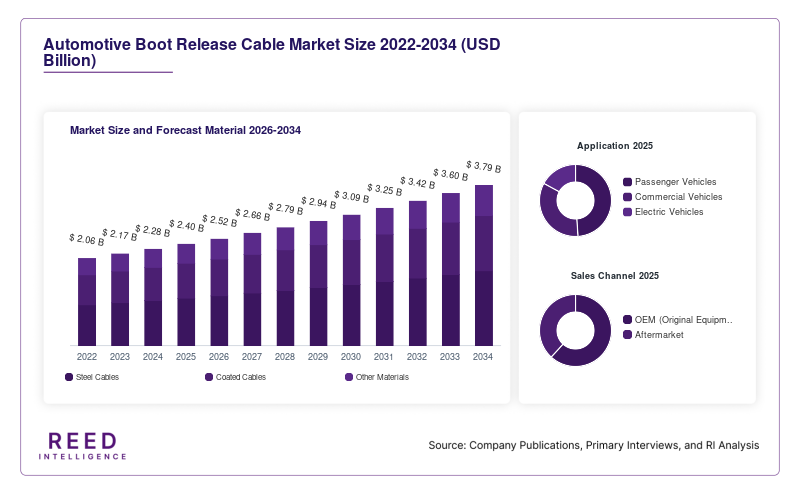
Steel cables dominated the Automotive Boot Release Cable Market, accounting for approximately 70% share in 2024. Their widespread use is attributed to high tensile strength, durability, and cost-effectiveness. Steel cables are commonly used across various vehicle types due to their ability to withstand repeated mechanical stress.
Coated cables are projected to be the fastest-growing subsegment, with a CAGR of 5.9% during the forecast period. Their growth will be driven by enhanced corrosion resistance and improved longevity, making them suitable for modern vehicles operating in diverse environmental conditions.
By Application
Passenger vehicles held the largest share of around 65% in 2024, driven by high production volumes and widespread adoption of trunk access systems. The increasing demand for convenience features in personal vehicles has contributed to this dominance.
Electric vehicles are expected to be the fastest-growing subsegment, expanding at a CAGR of 6.8%. The growth will be fueled by rising adoption of EVs and the need for lightweight and efficient components that align with advanced vehicle architectures.
By Sales Channel
OEMs accounted for the dominant share of approximately 60% in 2024, as boot release cables are installed during vehicle manufacturing. Strong partnerships between component suppliers and automakers have supported this segment.
The aftermarket segment is anticipated to grow at the fastest CAGR of 6.1%, driven by increasing vehicle age and rising demand for replacement parts. The expansion of service centers and online distribution channels will further boost this segment.
By Cable Type
Single-core cables dominated the market with a 55% share in 2024, due to their simplicity and cost efficiency. These cables are widely used in standard vehicle models where basic functionality is sufficient.
Multi-core cables are expected to grow at a CAGR of 5.6%, supported by their enhanced flexibility and strength. Their adoption will increase in vehicles requiring more complex routing and improved durability.
Regional Analysis
North America
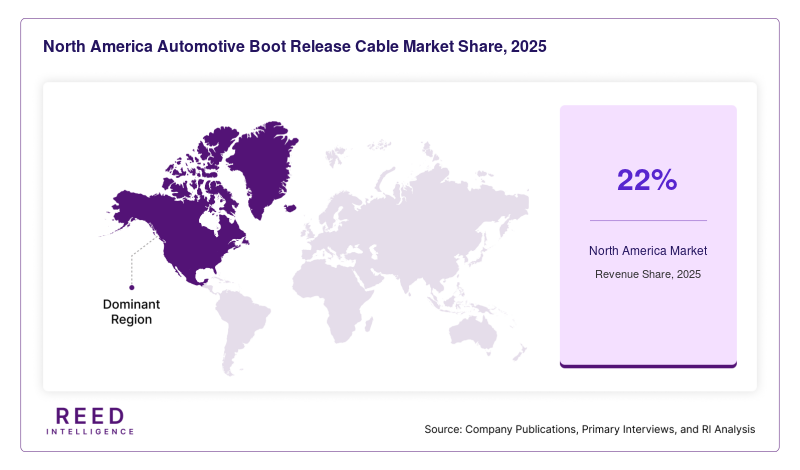
North America accounted for approximately 22% of the Automotive Boot Release Cable Market share in 2025 and is projected to grow at a CAGR of 4.8% through 2034. The region’s mature automotive industry and high vehicle ownership rates have historically supported steady demand for automotive components.
The United States dominated the regional market due to its large vehicle parc and well-established aftermarket sector. A key growth factor in the country is the increasing demand for replacement components driven by aging vehicles. The strong presence of automotive service networks further supports consistent demand for boot release cables.
Europe
Europe held around 20% market share in 2025 and is expected to expand at a CAGR of 4.6% during the forecast period. The region’s focus on engineering precision and safety standards has contributed to stable demand for high-quality automotive components.
Germany emerged as the dominant country, driven by its strong automotive manufacturing base. A distinct growth factor is the emphasis on durable and high-performance components, which supports the adoption of advanced cable materials and designs in vehicles produced within the country.
Asia Pacific
Asia Pacific led the Automotive Boot Release Cable Market with a 38% share in 2025 and is anticipated to grow at a CAGR of 5.7% through 2034. The region’s dominance is attributed to high vehicle production volumes and expanding automotive industries.
China was the leading country, supported by large-scale automotive manufacturing and increasing domestic demand. A key growth factor is the rapid expansion of the passenger vehicle segment, which continues to drive demand for essential components such as boot release cables.
Middle East & Africa
The Middle East & Africa region accounted for 10% of the market share in 2025 and is projected to grow at a CAGR of 5.1%. The market growth is supported by increasing vehicle imports and infrastructure development.
Saudi Arabia led the regional market, with growth driven by rising vehicle ownership and expanding transportation networks. The demand for reliable automotive components is increasing as consumers prioritize vehicle maintenance and performance.
Latin America
Latin America held approximately 10% share in 2025 and is expected to register the fastest CAGR of 6.3% during the forecast period. The region is witnessing steady growth in automotive sales and aftermarket activities.
Brazil dominated the regional market, supported by its growing automotive industry. A key growth factor is the increasing demand for cost-effective replacement parts, which drives the adoption of boot release cables in the aftermarket segment.
Competitive Landscape
The Automotive Boot Release Cable Market is moderately fragmented, with several global and regional players competing based on product quality, durability, and pricing. Leading companies focus on innovation, material improvements, and expanding their distribution networks to strengthen market presence.
One of the key market leaders is HI-LEX Corporation, known for its extensive product portfolio and strong relationships with automotive manufacturers. The company recently introduced advanced coated cable solutions designed to improve corrosion resistance and extend product lifespan.
Other notable players are actively investing in research and development to enhance product performance and cater to evolving industry requirements. Strategic collaborations and expansion into emerging markets remain common approaches among competitors.
Key Players List
- HI-LEX Corporation
- Kongsberg Automotive
- DURA Automotive Systems
- Cablecraft Motion Controls
- Suprajit Engineering Ltd.
- Ficosa International SA
- Orscheln Products LLC
- Ningbo Gaofa Automotive Control System Co., Ltd.
- Grand Rapids Controls Company
- Trelleborg AB
- SKF Group
- Tokai Rika Co., Ltd.
- Leopold Kostal GmbH & Co. KG
- Aptiv PLC
- Continental AG
Recent Developments
- In 2025, HI-LEX Corporation launched a new range of corrosion-resistant boot release cables for enhanced durability.
- Suprajit Engineering expanded its production capacity to meet rising global demand.
- Kongsberg Automotive introduced lightweight cable solutions targeting electric vehicles.
- DURA Automotive Systems invested in advanced manufacturing technologies to improve product precision.
- Continental AG strengthened its aftermarket distribution network across emerging economies.
Automotive Boot Release Cable Market Segments
Material
- Steel Cables
- Coated Cables
- Other Materials
Application
- Passenger Vehicles
- Commercial Vehicles
- Electric Vehicles
Sales Channel
- OEM (Original Equipment Manufacturer)
- Aftermarket
Cable Type
- Single-Core Cables
- Multi-Core Cables
By Region
- North America
- Europe
- APAC
- Middle East and Africa
- LATAM