Automotive Cabin Air Quality Sensor Installation Market Size, Share & Demand Report By Component Type (Sensors, Integrated Air Quality Management Systems), By Vehicle Type (Passenger Vehicles, Commercial Vehicles, Electric Vehicles), By Sales Channel (OEM, Aftermarket) By Region & Segment Forecasts, 2026–2034
USD 3950
Market Overview
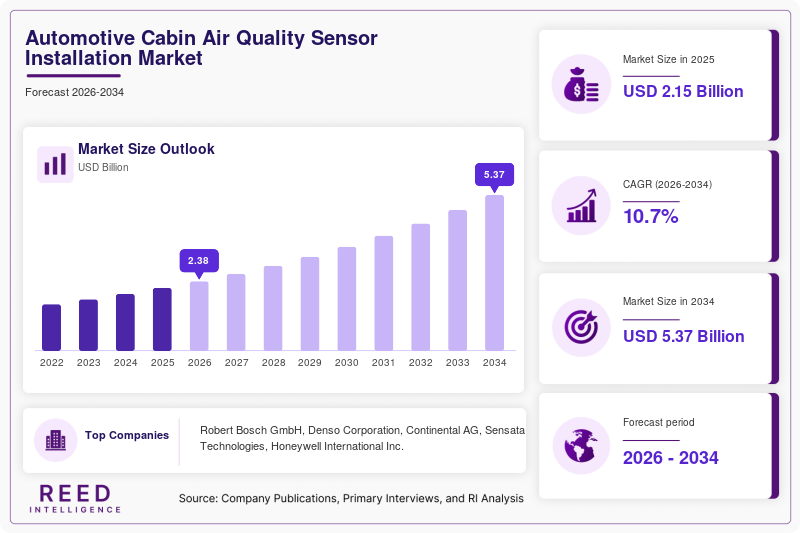
The Automotive Cabin Air Quality Sensor Installation Market size was valued at approximately USD 2.15 billion in 2026 and is projected to reach USD 4.85 billion by 2034, expanding at a CAGR of 10.7% during the forecast period (2026–2034). The steady growth trajectory is supported by rising consumer awareness of in-vehicle health and comfort, along with increasing integration of advanced electronic systems in modern vehicles. As urban air pollution levels continue to rise globally, automakers are prioritizing cabin air quality solutions to enhance passenger safety and driving experience.
One of the key global factors supporting market expansion is the growing emphasis on health-centric automotive features. Governments and regulatory bodies are encouraging the adoption of air quality monitoring systems in vehicles, especially in densely populated urban areas where pollution levels are high. Additionally, the increasing penetration of electric vehicles and premium vehicles has further accelerated the adoption of cabin air quality sensors, as these segments typically incorporate advanced environmental monitoring technologies.
Key Highlights
- North America dominated the market with a 33.8% share in 2025.
- Asia Pacific is expected to grow at the fastest CAGR of 11.5% during 2026–2034.
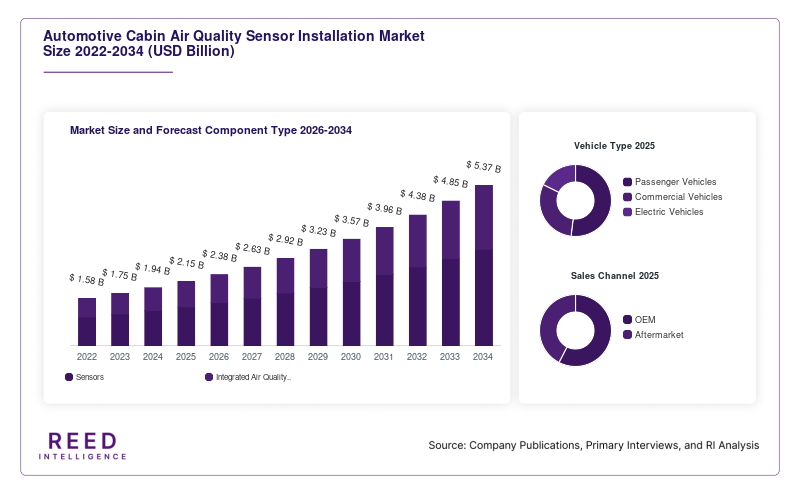
- By component type, sensors accounted for the largest share of 42.6%, while integrated air quality management systems are projected to grow at a CAGR of 12.2%.
- By vehicle type, passenger vehicles led with a 68.4% share, whereas electric vehicles are expected to expand at a CAGR of 12.8%.
- The United States remained the dominant country, with market values of USD 540 million in 2024 and USD 590 million in 2025.
Market Trends
Integration of Smart HVAC and Air Purification Systems
Automotive manufacturers are increasingly integrating cabin air quality sensors with smart HVAC and air purification systems to provide real-time air monitoring and automatic adjustments. These systems detect pollutants such as particulate matter, carbon dioxide, and volatile organic compounds, enabling the vehicle to adjust airflow and filtration levels accordingly. This trend reflects the broader shift toward intelligent vehicle environments where multiple systems work in coordination to enhance passenger comfort and safety.
The demand for seamless integration is particularly strong in mid-range and premium vehicles, where consumers expect advanced features as standard. Automakers are also leveraging sensor data to optimize energy consumption, especially in electric vehicles where battery efficiency is critical. As a result, integrated systems are becoming a central component of next-generation automotive design, driving sustained growth in the installation of cabin air quality sensors across global markets.
Rising Adoption in Electric and Autonomous Vehicles
The increasing adoption of electric and autonomous vehicles is shaping the demand for advanced cabin monitoring systems, including air quality sensors. Electric vehicles often operate in urban environments where pollution levels are higher, making air quality monitoring a key feature. Additionally, autonomous vehicles are designed to provide a more comfortable and health-conscious passenger experience, further emphasizing the importance of cabin air quality.
Automakers are incorporating advanced sensor technologies that can communicate with onboard systems and external data networks to predict and manage air quality conditions. This trend is supported by advancements in sensor miniaturization and cost efficiency, allowing manufacturers to integrate these features without significantly increasing production costs. As electric and autonomous vehicles gain market share, the demand for cabin air quality sensor installations is expected to rise steadily.
Market Drivers
Increasing Awareness of Health and In-Cabin Air Quality
Growing consumer awareness regarding the impact of air pollution on health is a major driver for the Automotive Cabin Air Quality Sensor Installation Market. With rising levels of urban pollution, passengers are becoming more concerned about the quality of air inside vehicles, particularly during long commutes. This awareness has led to increased demand for vehicles equipped with air quality monitoring and purification systems.
Automakers are responding by integrating advanced sensors that can detect harmful pollutants and provide real-time feedback to passengers. These features not only enhance passenger comfort but also serve as a key differentiator in a competitive market. The trend is further supported by marketing strategies that highlight health and wellness benefits, making air quality sensors an essential component in modern vehicle design.
Stringent Emission and Safety Regulations
Government regulations aimed at reducing emissions and improving vehicle safety are driving the adoption of cabin air quality sensors. Regulatory bodies in various regions are implementing standards that encourage or mandate the inclusion of air quality monitoring systems in vehicles. These regulations are particularly stringent in developed regions, where environmental concerns are a priority.
Automotive manufacturers are investing in research and development to comply with these regulations while maintaining cost efficiency. The integration of cabin air quality sensors helps manufacturers meet regulatory requirements and enhance their brand image. As regulations continue to evolve, the demand for these sensors is expected to increase, contributing significantly to market growth.
Market Restraint
High Installation and Integration Costs
One of the primary challenges facing the Automotive Cabin Air Quality Sensor Installation Market is the high cost associated with sensor installation and system integration. Advanced air quality sensors require precise calibration and integration with existing vehicle systems, which can increase manufacturing complexity and costs. This is particularly challenging for entry-level and budget vehicle segments, where cost sensitivity is high.
The high cost of advanced sensors and integrated systems can limit their adoption in emerging markets, where consumers prioritize affordability over advanced features. Additionally, the need for regular maintenance and potential replacement of sensors adds to the overall cost burden for vehicle owners. These factors can slow down market penetration, especially in regions with lower purchasing power. However, ongoing advancements in sensor technology and economies of scale are expected to gradually reduce costs over time.
Market Opportunities
Expansion in Emerging Markets
Emerging markets present significant growth opportunities for the Automotive Cabin Air Quality Sensor Installation Market. Rapid urbanization and industrialization in countries across Asia, Latin America, and Africa have led to increased air pollution levels, creating a strong demand for air quality monitoring solutions. As disposable incomes rise, consumers in these regions are becoming more willing to invest in vehicles equipped with advanced features.
Automotive manufacturers are focusing on introducing cost-effective sensor solutions tailored to these markets. Localization of production and strategic partnerships with regional suppliers are helping reduce costs and improve accessibility. As awareness of health and environmental issues continues to grow, the adoption of cabin air quality sensors in emerging markets is expected to accelerate, driving overall market expansion.
Technological Advancements in Sensor Design
Advancements in sensor technology are creating new opportunities for market growth. Innovations such as miniaturization, improved sensitivity, and enhanced durability are making cabin air quality sensors more efficient and cost-effective. These advancements enable manufacturers to integrate sensors into a wider range of vehicle models without significantly increasing costs.
The development of multi-functional sensors that can detect multiple pollutants simultaneously is also gaining traction. These sensors reduce the need for multiple components, simplifying system design and lowering costs. Additionally, advancements in connectivity and data analytics are enabling real-time monitoring and predictive maintenance, enhancing the value proposition of these systems. As technology continues to evolve, it is expected to drive increased adoption across various vehicle segments.
Segmental Analysis
By Component Type
Sensors dominated the Automotive Cabin Air Quality Sensor Installation Market in 2024, accounting for approximately 42.6% of the total market share. These sensors play a critical role in detecting pollutants such as particulate matter, carbon dioxide, and volatile organic compounds within vehicle cabins. The widespread adoption of these sensors is driven by their ability to provide real-time data, enabling automatic adjustments in HVAC systems to maintain optimal air quality. Automotive manufacturers are increasingly incorporating these sensors as standard features in mid-range and premium vehicles to enhance passenger comfort and safety. Additionally, advancements in sensor technology, including improved sensitivity and durability, have further strengthened their dominance in the market.
Integrated air quality management systems are expected to be the fastest-growing subsegment, with a projected CAGR of 12.2% during the forecast period. These systems combine multiple sensors with advanced software to provide comprehensive air quality monitoring and control. The growth of this subsegment is driven by the increasing demand for intelligent vehicle systems that can automatically adjust air filtration and ventilation based on real-time data. The integration of these systems with other vehicle technologies, such as infotainment and navigation systems, is also contributing to their rapid adoption. As automakers continue to focus on enhancing the overall driving experience, the demand for integrated air quality management systems is expected to rise significantly.
By Vehicle Type
Passenger vehicles accounted for the largest share of the market in 2024, with a share of approximately 68.4%. The dominance of this segment is attributed to the high volume of passenger vehicle production and the increasing demand for advanced features among consumers. Cabin air quality sensors are becoming a standard feature in many passenger vehicles, particularly in urban areas where air pollution is a major concern. Automakers are focusing on integrating these sensors to enhance passenger comfort and differentiate their offerings in a competitive market. The growing trend of connected and smart vehicles is also contributing to the widespread adoption of cabin air quality sensors in this segment.
Electric vehicles are expected to be the fastest-growing subsegment, with a CAGR of 12.8% during the forecast period. The growth of this segment is driven by the increasing adoption of electric vehicles globally, supported by government incentives and environmental concerns. Electric vehicles often operate in urban environments with high pollution levels, making air quality monitoring a critical feature. Additionally, the integration of advanced technologies in electric vehicles provides an ideal platform for incorporating cabin air quality sensors. As the adoption of electric vehicles continues to rise, the demand for these sensors is expected to grow significantly.
By Sales Channel
Original equipment manufacturers (OEMs) dominated the market in 2024, accounting for a significant share of approximately 61.3%. OEMs integrate cabin air quality sensors during the vehicle manufacturing process, ensuring seamless functionality and compatibility with other vehicle systems. This approach allows automakers to offer advanced features as part of the standard or optional equipment, enhancing the overall value proposition of their vehicles. The strong presence of OEMs in the market is supported by their ability to leverage economies of scale and invest in research and development to improve sensor technology. As a result, OEMs continue to play a crucial role in driving the adoption of cabin air quality sensors.
The aftermarket segment is expected to be the fastest-growing subsegment, with a CAGR of 11.4% during the forecast period. The growth of this segment is driven by the increasing demand for retrofitting older vehicles with advanced air quality monitoring systems. Consumers are becoming more aware of the benefits of cabin air quality sensors and are seeking to upgrade their vehicles accordingly. The availability of cost-effective aftermarket solutions is also contributing to the growth of this segment. Additionally, the expansion of e-commerce platforms has made it easier for consumers to access and purchase these products, further driving market growth.
Regional Analysis
North America
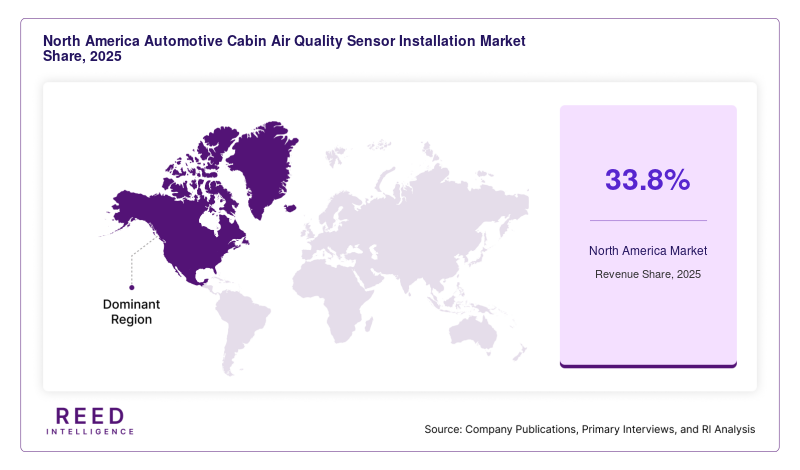
North America accounted for approximately 33.8% of the global Automotive Cabin Air Quality Sensor Installation Market in 2025 and is expected to grow at a CAGR of 10.1% during the forecast period. The region’s strong market position is attributed to high consumer awareness, advanced automotive infrastructure, and the presence of leading automotive manufacturers. The demand for premium vehicles equipped with advanced features is also contributing to market growth.
The United States remains the dominant country in this region, driven by strong regulatory frameworks and high adoption of advanced automotive technologies. A key growth factor is the increasing demand for electric vehicles, which often include advanced air quality monitoring systems as standard features. This trend is expected to sustain market growth in the coming years.
Europe
Europe held a significant share of the market in 2025, accounting for around 28.5%, and is projected to grow at a CAGR of 10.3% during the forecast period. The region’s focus on environmental sustainability and stringent emission regulations are key factors driving the adoption of cabin air quality sensors. European consumers also prioritize health and comfort, further supporting market growth.
Germany stands out as the dominant country in the European market, supported by its strong automotive industry and technological innovation. A unique growth factor in this region is the integration of advanced sensor technologies in luxury vehicles, which are highly popular among European consumers. This trend is expected to continue driving demand for cabin air quality sensors.
Asia Pacific
Asia Pacific is expected to be the fastest-growing region, with a CAGR of 11.5% during the forecast period, and accounted for approximately 24.7% of the market in 2025. Rapid urbanization, increasing vehicle production, and rising pollution levels are key factors driving market growth in this region. The growing middle-class population is also contributing to increased demand for advanced vehicle features.
China is the dominant country in the Asia Pacific market, driven by its large automotive industry and high pollution levels in urban areas. A key growth factor is government initiatives promoting electric vehicles and environmental sustainability. These initiatives are encouraging the adoption of advanced air quality monitoring systems in vehicles, boosting market growth.
Middle East & Africa
The Middle East & Africa region accounted for approximately 6.5% of the market in 2025 and is expected to grow at a CAGR of 9.2% during the forecast period. The market is driven by increasing urbanization and rising awareness of air quality issues. The growing automotive sector in the region is also contributing to the adoption of advanced sensor technologies.
Saudi Arabia is the leading country in this region, supported by its expanding automotive market and government initiatives to improve air quality. A unique growth factor is the increasing demand for luxury vehicles equipped with advanced features, including cabin air quality sensors. This trend is expected to drive market growth in the region.
Latin America
Latin America held a market share of around 6.5% in 2025 and is projected to grow at a CAGR of 9.5% during the forecast period. The region’s growth is supported by increasing vehicle ownership and rising awareness of health and environmental issues. Economic development and urbanization are also contributing to market expansion.
Brazil is the dominant country in the Latin American market, driven by its large automotive industry and growing consumer base. A key growth factor is the increasing adoption of advanced automotive technologies in mid-range vehicles. This trend is expected to boost the demand for cabin air quality sensors in the region.
Competitive Landscape
The Automotive Cabin Air Quality Sensor Installation Market is characterized by the presence of several global and regional players focusing on innovation and strategic partnerships. Leading companies are investing in research and development to enhance sensor accuracy, reduce costs, and improve integration with advanced vehicle systems. The competitive landscape is moderately fragmented, with key players striving to strengthen their market position through product differentiation and technological advancements.
A prominent leader in the market is Bosch, known for its advanced sensor technologies and strong global presence. The company has recently introduced next-generation air quality sensors with enhanced detection capabilities and improved durability, catering to the evolving needs of the automotive industry. Other major players are also focusing on expanding their product portfolios and entering new markets to capitalize on emerging opportunities.
Key Players
- Robert Bosch GmbH
- Denso Corporation
- Continental AG
- Sensata Technologies
- Honeywell International Inc.
- Amphenol Corporation
- Valeo SA
- Paragon GmbH & Co. KGaA
- Figaro Engineering Inc.
- AMS AG
- Siemens AG
- Panasonic Corporation
- TDK Corporation
- Renesas Electronics Corporation
- Infineon Technologies AG
Recent Developments
- A leading sensor manufacturer introduced a multi-functional air quality sensor capable of detecting multiple pollutants simultaneously, improving system efficiency and reducing component costs.
- An automotive company partnered with a technology provider to integrate advanced air quality monitoring systems into its electric vehicle lineup, enhancing passenger comfort.
- A major supplier expanded its production capacity in Asia Pacific to meet the growing demand for cabin air quality sensors in emerging markets.
Automotive Cabin Air Quality Sensor Installation Market Segments
Component Type
- Sensors
- Integrated Air Quality Management Systems
Vehicle Type
- Passenger Vehicles
- Commercial Vehicles
- Electric Vehicles
Sales Channel
- OEM
- Aftermarket
By Region
- North America
- Europe
- APAC
- Middle East and Africa
- LATAM