Automotive Camera Based Side Mirror Market Size, Share & Demand Report By Component (Camera Units, Display Systems, Control Units), By Vehicle Type (Passenger Cars, Commercial Vehicles, Electric Vehicles), By Application (OEM, Aftermarket) By Region & Segment Forecasts, 2026–2034
USD 3950
Market Overview
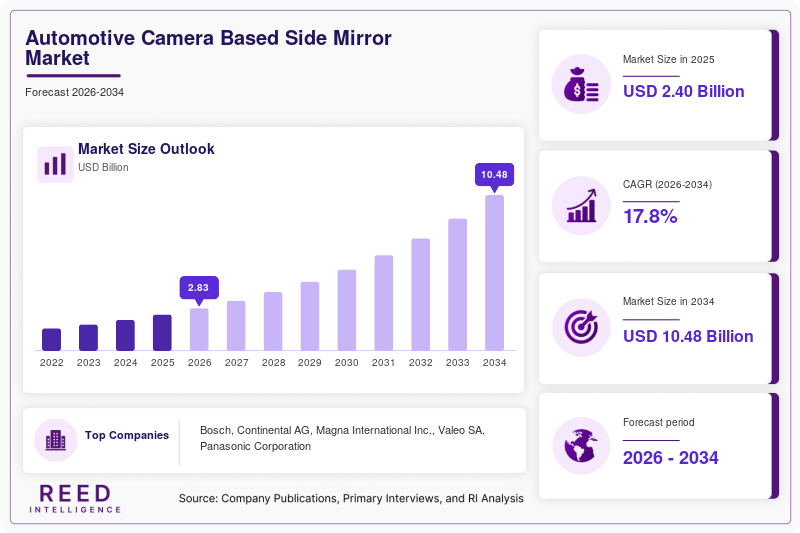
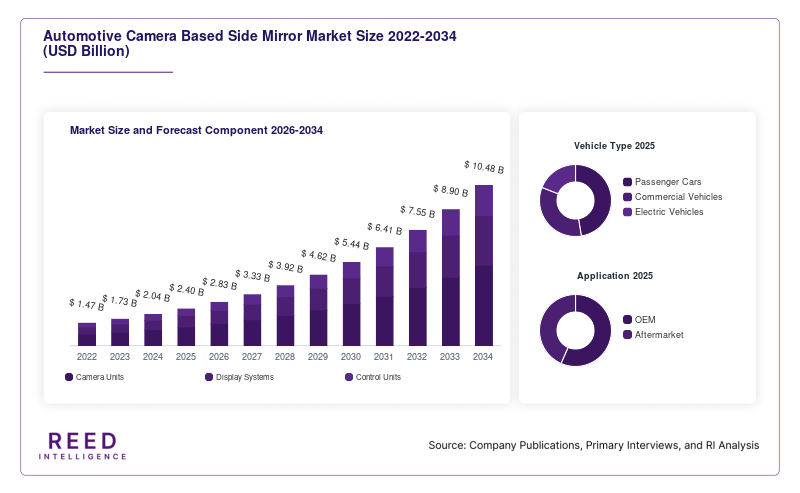
The global Automotive Camera Based Side Mirror Market size was valued at approximately USD 2.4 billion in 2026 and is projected to reach USD 8.9 billion by 2034, expanding at a CAGR of 17.8% during the forecast period (2026–2034). The transition from traditional optical mirrors to camera-based systems is gaining traction due to increasing emphasis on vehicle safety, aerodynamics, and design optimization. These systems, often referred to as digital side mirrors or camera monitoring systems (CMS), provide enhanced visibility, reduce blind spots, and improve overall driving efficiency.
A significant global factor supporting market growth is the tightening of vehicle safety regulations across developed and emerging economies. Governments are promoting advanced driver assistance systems (ADAS), which integrate camera-based mirror technologies to enhance road safety and reduce accidents. Additionally, automotive manufacturers are adopting these systems to meet fuel efficiency targets, as camera-based mirrors reduce drag compared to conventional mirrors.
Key Highlights
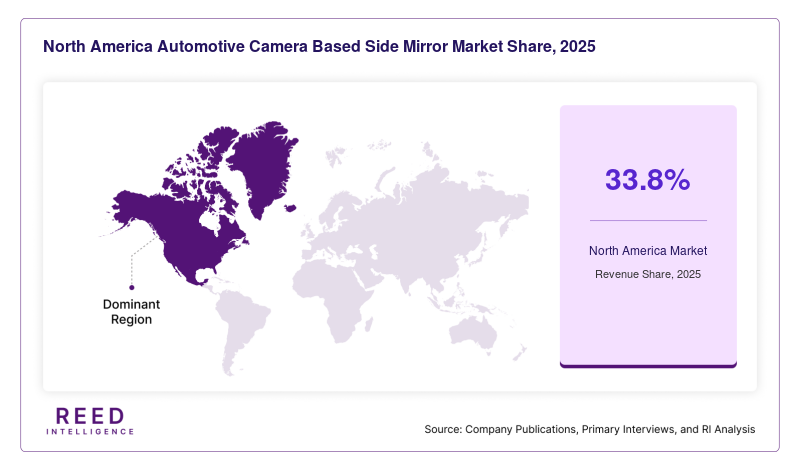
- North America dominated the market with a 33.8% share in 2025.
- Asia Pacific is expected to grow at the fastest CAGR of 18.9% during 2026–2034.
- By component, camera units accounted for the largest share of 36.7%.
- while display systems are projected to grow at a CAGR of 19.5%.
- By vehicle type, passenger cars led with a 62.4% share, whereas electric vehicles are expected to expand at a CAGR of 20.3%.
- The United States remained the dominant country, with market values of USD 540 million in 2024 and USD 590 million in 2025.
Market Trends
Integration of Advanced Driver Assistance Systems (ADAS)
The increasing integration of ADAS features in modern vehicles is a key trend shaping the Automotive Camera Based Side Mirror Market. Automakers are focusing on enhancing driver awareness through digital visualization systems that offer wider fields of view and eliminate blind spots. Camera-based mirrors seamlessly integrate with lane departure warnings, collision avoidance systems, and parking assistance technologies. This integration enables real-time data processing and improved safety performance. As consumers demand more intelligent vehicles, manufacturers are prioritizing these systems as part of standard or premium offerings. The shift toward autonomous driving further supports this trend, as camera-based mirrors play a crucial role in environmental sensing and vehicle perception systems.
Rising Adoption in Electric and Luxury Vehicles
Another notable trend is the growing adoption of camera-based side mirrors in electric and luxury vehicles. Electric vehicle manufacturers are leveraging these systems to enhance aerodynamics and extend driving range by reducing wind resistance. Luxury vehicle brands are incorporating digital mirrors as a premium feature, offering enhanced aesthetics and advanced functionality. The combination of sleek design and improved performance aligns with consumer preferences for technologically advanced vehicles. Additionally, as production costs gradually decrease, these systems are expected to become more accessible in mid-range vehicles, further driving market expansion across broader segments.
Market Drivers
Increasing Focus on Vehicle Safety and Regulatory Compliance
The rising focus on vehicle safety and compliance with stringent regulations is a primary driver of the Automotive Camera Based Side Mirror Market. Regulatory bodies in regions such as North America and Europe are encouraging or mandating the adoption of advanced safety technologies, including camera monitoring systems. These systems significantly reduce blind spots and improve visibility under various driving conditions, contributing to accident prevention. Automakers are responding by integrating camera-based mirrors into new vehicle models to meet regulatory requirements. This trend is expected to continue as governments prioritize road safety and introduce stricter standards for vehicle design and performance.
Demand for Improved Aerodynamics and Fuel Efficiency
Another major driver is the growing demand for improved aerodynamics and fuel efficiency in vehicles. Traditional side mirrors contribute to aerodynamic drag, which negatively impacts fuel consumption and vehicle performance. Camera-based systems offer a streamlined alternative, reducing drag and enhancing overall efficiency. This is particularly important for electric vehicles, where energy efficiency directly affects driving range. Automakers are increasingly adopting these systems to meet environmental regulations and consumer expectations for sustainable mobility. The combination of performance benefits and environmental advantages is accelerating the adoption of camera-based side mirrors across various vehicle segments.
Market Restraint
High Initial Costs and Technological Complexity
Despite the promising growth prospects, the Automotive Camera Based Side Mirror Market faces challenges related to high initial costs and technological complexity. The development and integration of camera-based systems require advanced hardware components, sophisticated software, and extensive testing to ensure reliability and safety. These factors contribute to higher production costs compared to traditional mirrors. As a result, adoption has been slower in cost-sensitive markets and entry-level vehicle segments. Additionally, maintenance and repair costs for these systems can be higher, which may deter consumers. The complexity of integrating these systems with existing vehicle architectures also poses challenges for manufacturers, particularly in retrofitting older models. This restraint highlights the need for cost optimization and technological advancements to make camera-based mirrors more accessible and widely adopted.
Market Opportunities
Expansion in Emerging Markets
The expansion of automotive production and sales in emerging markets presents significant opportunities for the Automotive Camera Based Side Mirror Market. Countries in Asia Pacific, Latin America, and the Middle East are experiencing rapid urbanization and increasing demand for advanced vehicles. As consumers in these regions become more aware of safety features and technological advancements, the adoption of camera-based mirrors is expected to rise. Governments are also implementing stricter safety regulations, creating a favorable environment for market growth. Automakers can capitalize on these opportunities by introducing cost-effective solutions tailored to the needs of emerging markets, thereby expanding their customer base and driving revenue growth.
Advancements in Display and Sensor Technologies
Technological advancements in display and sensor technologies offer another major opportunity for the market. Innovations such as high-resolution cameras, low-light imaging, and augmented reality displays are enhancing the performance and functionality of camera-based mirrors. These advancements improve visibility and provide additional information to drivers, such as navigation cues and hazard alerts. The integration of artificial intelligence and machine learning further enhances system capabilities, enabling real-time object detection and predictive analysis. As technology continues to evolve, manufacturers can develop more advanced and reliable systems, increasing consumer acceptance and driving market expansion.
Segmental Analysis
By Component
The camera units segment held the largest share of the Automotive Camera Based Side Mirror Market in 2024, accounting for approximately 36.7% of the total market. These units are the core components of camera-based mirror systems, capturing real-time images and transmitting them to display screens inside the vehicle. The dominance of this segment is attributed to the increasing demand for high-resolution cameras that provide clear and accurate visuals under various driving conditions. Automakers are investing in advanced camera technologies with features such as wide-angle lenses, night vision capabilities, and weather resistance. These advancements enhance driver visibility and safety, making camera units a critical component of modern vehicles.
The display systems segment is expected to be the fastest-growing subsegment, with a CAGR of 19.5% during the forecast period. The growth is driven by advancements in display technologies, including high-definition screens and augmented reality features. These systems provide drivers with enhanced visual information, improving situational awareness and driving comfort. The integration of touchscreens and customizable interfaces further enhances user experience. As consumer demand for advanced in-car technologies continues to rise, the adoption of sophisticated display systems is expected to accelerate, contributing to overall market growth.
By Vehicle Type
Passenger cars dominated the market in 2024, accounting for a share of 62.4%. The widespread adoption of camera-based mirrors in this segment is driven by increasing consumer demand for advanced safety features and enhanced driving experiences. Automakers are incorporating these systems into mid-range and premium passenger vehicles to differentiate their offerings and attract tech-savvy consumers. The growing popularity of connected cars and the integration of digital technologies further support the adoption of camera-based mirrors in this segment.
Electric vehicles are expected to be the fastest-growing subsegment, with a CAGR of 20.3% during the forecast period. The growth is driven by the need for improved aerodynamics and energy efficiency in EVs. Camera-based mirrors help reduce drag, thereby extending driving range and improving overall performance. Additionally, government incentives and policies promoting EV adoption are encouraging manufacturers to integrate advanced technologies, including camera-based mirrors. This trend is expected to drive significant growth in the EV segment.
By Application
The OEM segment held the largest share of the market in 2024, accounting for 68.9%. Original equipment manufacturers are increasingly integrating camera-based mirror systems into new vehicle models as standard or optional features. The dominance of this segment is driven by the growing demand for advanced safety technologies and the need to comply with regulatory requirements. Automakers are focusing on developing innovative solutions that enhance vehicle performance and safety, contributing to the growth of the OEM segment.
The aftermarket segment is expected to grow at the fastest CAGR of 18.2% during the forecast period. The growth is driven by increasing consumer interest in upgrading existing vehicles with advanced technologies. Aftermarket solutions provide cost-effective options for consumers who want to enhance their vehicles’ safety and functionality. The availability of plug-and-play systems and easy installation processes further supports the growth of this segment. As awareness of camera-based mirror systems increases, the aftermarket segment is expected to experience significant growth.
Regional Analysis
North America
North America held a significant share of the Automotive Camera Based Side Mirror Market in 2025, accounting for approximately 33.8% of the global market. The region is expected to grow at a CAGR of 16.9% during the forecast period. The presence of major automotive manufacturers and a strong focus on technological innovation contribute to market growth. Additionally, favorable regulatory frameworks supporting the adoption of advanced safety systems are driving demand for camera-based mirrors.
The United States dominates the North American market, driven by high consumer awareness and demand for advanced vehicle features. A key growth factor is the increasing adoption of electric vehicles, which prioritize aerodynamic efficiency and advanced technologies. This trend is expected to sustain market growth in the region.
Europe
Europe accounted for a substantial share of the market in 2025, with a share of 28.6% and a projected CAGR of 17.2% during 2026–2034. The region’s strong automotive industry and emphasis on safety and environmental standards support market growth. European automakers are at the forefront of adopting innovative technologies, including camera-based mirror systems.
Germany is the leading country in the European market, driven by its robust automotive manufacturing sector. A unique growth factor is the region’s stringent emission regulations, which encourage the adoption of aerodynamic solutions such as camera-based mirrors. This focus on sustainability is expected to drive continued growth.
Asia Pacific
Asia Pacific is the fastest-growing region in the Automotive Camera Based Side Mirror Market, with a CAGR of 18.9% during the forecast period. The region held a market share of 24.7% in 2025. Rapid industrialization, increasing vehicle production, and rising consumer demand for advanced technologies are key factors driving growth.
China dominates the Asia Pacific market due to its large automotive industry and growing adoption of electric vehicles. A unique growth factor is government support for EV adoption, which promotes the use of energy-efficient technologies such as camera-based mirrors. This trend is expected to significantly boost market growth.
Middle East & Africa
The Middle East & Africa region accounted for a smaller share of 7.1% in 2025 but is expected to grow at a CAGR of 15.8% during the forecast period. The market is driven by increasing vehicle sales and growing awareness of advanced safety features.
The United Arab Emirates is a key market in the region, driven by high demand for luxury vehicles. A unique growth factor is the preference for premium automotive technologies, which supports the adoption of camera-based mirrors. This trend is expected to drive market expansion in the region.
Latin America
Latin America held a market share of 5.8% in 2025 and is projected to grow at a CAGR of 16.3% during 2026–2034. The region’s automotive market is gradually evolving, with increasing demand for technologically advanced vehicles.
Brazil is the dominant country in the Latin American market, supported by its large automotive industry. A unique growth factor is the growing focus on vehicle safety standards, which encourages the adoption of advanced technologies such as camera-based mirrors. This trend is expected to support market growth.
Competitive Landscape
The Automotive Camera Based Side Mirror Market is characterized by intense competition, with several global and regional players focusing on innovation and product development. Leading companies are investing in research and development to enhance system performance and reliability. Strategic partnerships and collaborations with automakers are also common, enabling companies to expand their market presence.
A leading player in the market is Bosch, known for its advanced automotive technologies and strong global presence. The company recently introduced an upgraded camera monitoring system with improved image processing capabilities and enhanced durability. This development reflects the ongoing efforts of market players to innovate and meet evolving consumer demands. Other companies are also focusing on expanding their product portfolios and entering new markets to strengthen their competitive positions.
Key Players List
- Bosch
- Continental AG
- Magna International Inc.
- Valeo SA
- Panasonic Corporation
- Denso Corporation
- Samsung Electro-Mechanics
- Gentex Corporation
- Ficosa International SA
- Stoneridge Inc.
- Mitsubishi Electric Corporation
- Aptiv PLC
- ZF Friedrichshafen AG
- NXP Semiconductors
- Omnivision Technologies
Recent Developments
- Several companies have introduced new camera-based mirror systems with enhanced image quality and wider viewing angles to improve driver safety.
- Automakers have partnered with technology providers to integrate advanced camera monitoring systems into next-generation electric vehicles.
- Innovations in AI-based image processing have enabled real-time object detection and improved system performance, driving adoption across various vehicle segments.
Automotive Camera Based Side Mirror Market Segments
Component
- Camera Units
- Display Systems
- Control Units
Vehicle Type
- Passenger Cars
- Commercial Vehicles
- Electric Vehicles
Application
- OEM
- Aftermarket
By Region
- North America
- Europe
- APAC
- Middle East and Africa
- LATAM