Automotive Camera Washer Market Size, Share & Demand Report By Component (Nozzle Systems, Pumps, Reservoirs, Electronic Control Units), By Vehicle Type (Passenger Cars, Commercial Vehicles, Electric Vehicles), By Application (Rear-View Cameras, Front Cameras, Surround-View Systems, Autonomous Driving Cameras), By Sales Channel (OEM, Aftermarket), By Region & Segment Forecasts, 2025–2034
USD 3950
Market Overview
The Automotive Camera Washer Market size was valued at approximately USD 620 million in 2025 and is projected to reach USD 1.78 billion by 2034, expanding at a CAGR of 12.4% from 2025 to 2034. The market is gaining traction due to the rapid integration of advanced driver-assistance systems (ADAS) and autonomous driving technologies, where camera clarity plays a critical role in ensuring vehicle safety and performance.
A key global factor supporting the growth of the Automotive Camera Washer Market is the increasing regulatory emphasis on vehicle safety standards. Governments across major automotive markets are mandating the integration of ADAS features such as rear-view cameras, surround-view systems, and lane departure warning systems. These technologies rely heavily on camera performance, thereby driving the demand for effective cleaning systems that maintain visibility under adverse environmental conditions such as dust, rain, and snow.
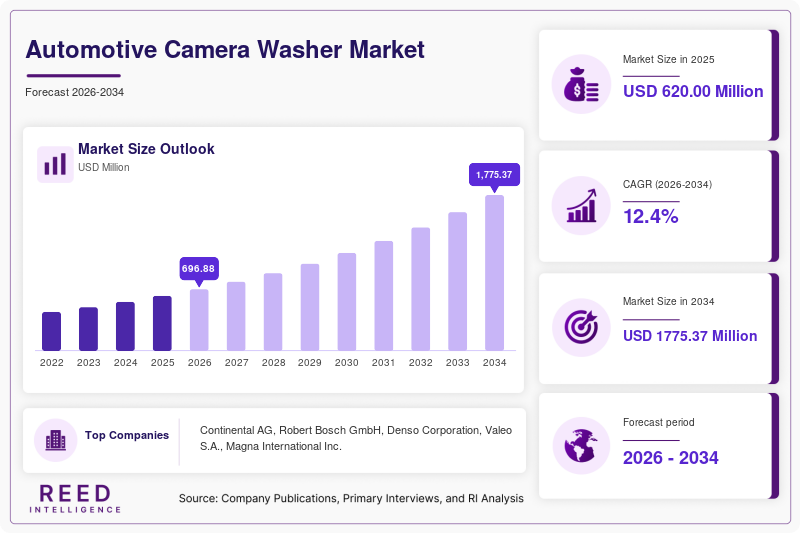
Key Highlights:
- Europe dominated the Automotive Camera Washer Market with approximately 34% share in 2025, while Asia Pacific is expected to grow fastest at a CAGR of 13.6%.
- By component, nozzle systems led the market, while electronic control units (ECUs) are projected to grow fastest at a CAGR of 14.2%.
- By vehicle type, passenger cars held the largest share, whereas electric vehicles are anticipated to grow at a CAGR of 15.1%.
- Germany remained the dominant country, with a market value of USD 110 million in 2025 and an estimated USD 123 million in 2026.
Market Trends
Integration with Advanced Driver-Assistance Systems (ADAS)
The Automotive Camera Washer Market is witnessing increased integration with ADAS technologies. As vehicles incorporate multiple cameras for functions such as parking assistance, blind-spot monitoring, and autonomous navigation, the need for maintaining camera cleanliness has become essential. Manufacturers are designing washer systems that operate automatically based on sensor inputs, ensuring uninterrupted camera visibility. This trend is expected to expand as ADAS adoption becomes more widespread across vehicle segments.
Development of Compact and Energy-Efficient Systems
Automakers are focusing on compact and energy-efficient camera washer systems to align with vehicle design constraints and sustainability goals. Innovations in nozzle design, fluid optimization, and low-power pumps are enabling manufacturers to reduce system size and energy consumption. This is particularly relevant for electric vehicles, where energy efficiency is a critical consideration. The trend is expected to enhance product adoption in both new vehicle production and aftermarket installations.
Market Drivers
Rising Demand for Vehicle Safety and Visibility
The increasing focus on road safety and accident prevention is a major driver for the Automotive Camera Washer Market. Camera-based systems are essential for modern safety features, and their performance depends on clear visibility. Camera washers ensure optimal functioning in challenging weather conditions, thereby supporting their adoption across vehicle categories.
Growth of Autonomous and Electric Vehicles
The rapid development of autonomous and electric vehicles is driving demand for camera washer systems. These vehicles rely heavily on sensors and cameras for navigation and decision-making. As the number of cameras per vehicle increases, the need for reliable cleaning systems also rises, supporting market growth.
Market Restraint
High Integration and Maintenance Costs
The Automotive Camera Washer Market faces challenges related to high integration and maintenance costs. The installation of camera washer systems requires additional components such as pumps, nozzles, reservoirs, and control units, which increase overall vehicle cost.
In addition, maintenance requirements such as fluid refilling and potential system failures can deter adoption, particularly in cost-sensitive markets. Automakers must balance functionality with affordability to ensure wider adoption. While premium vehicles can absorb these costs, entry-level segments may face limitations, restricting market penetration.
Market Opportunities
Expansion in Emerging Automotive Markets
Emerging economies in Asia Pacific and Latin America present significant opportunities for the Automotive Camera Washer Market. Increasing vehicle production and rising consumer awareness of safety features are driving demand. As regulatory frameworks evolve, the adoption of ADAS technologies is expected to increase, creating a favorable environment for camera washer systems.
Integration with Autonomous Vehicle Ecosystems
The advancement of autonomous driving technologies offers substantial growth potential. Camera washer systems are becoming integral components of sensor maintenance solutions in autonomous vehicles. Manufacturers can leverage this opportunity by developing advanced systems with automated cleaning and diagnostic capabilities, enhancing their value proposition.
Segmental Analysis
By Component
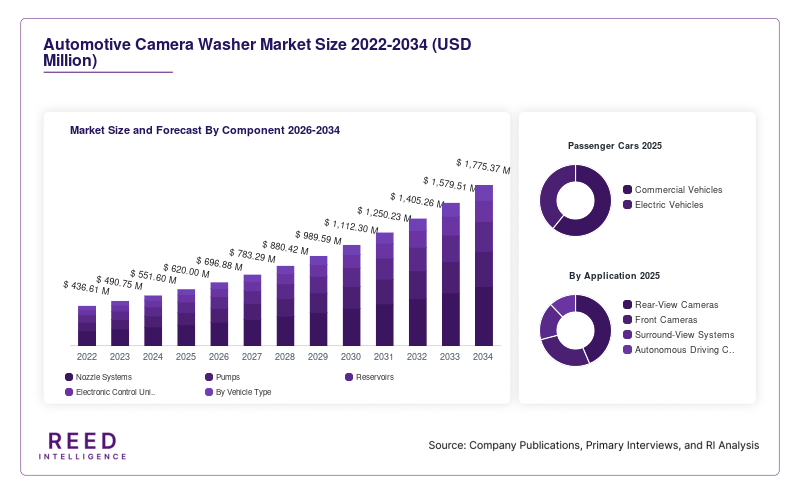
Nozzle systems dominated the Automotive Camera Washer Market in 2025, accounting for approximately 42% of the total share. Their essential role in delivering cleaning fluid directly onto camera lenses has made them a critical component. Manufacturers have focused on optimizing nozzle design for efficient fluid distribution.
Electronic control units (ECUs) are expected to be the fastest-growing subsegment, registering a CAGR of 14.2%. The growth factor lies in the increasing integration of smart systems that automate cleaning processes based on sensor inputs. This enhances system efficiency and reduces manual intervention.
By Vehicle Type
Passenger cars held the largest share of approximately 64% in 2025, driven by high production volumes and the increasing adoption of ADAS features. The integration of camera systems in passenger vehicles has significantly boosted demand for washer systems.
Electric vehicles are projected to grow at the fastest rate, with a CAGR of 15.1%. The rising adoption of EVs and their reliance on advanced sensor technologies are expected to drive demand for camera washer systems.
By Application
Rear-view camera systems accounted for the largest share of approximately 48% in 2025, as they are widely used across vehicle segments. Regulatory mandates for rear-view cameras have supported their dominance.
Surround-view systems are expected to grow at the fastest CAGR of 13.9%. The increasing adoption of 360-degree camera systems in modern vehicles is driving demand for multiple camera washer units, enhancing overall market growth.
By Sales Channel
OEMs dominated the market with a share of around 70% in 2025, as camera washer systems are increasingly integrated during vehicle manufacturing. Automakers are focusing on offering these systems as standard or optional features.
The aftermarket segment is anticipated to grow at a CAGR of 12.7%. The growth factor is the increasing demand for retrofitting older vehicles with advanced safety features, including camera washer systems.
Regional Analysis
North America
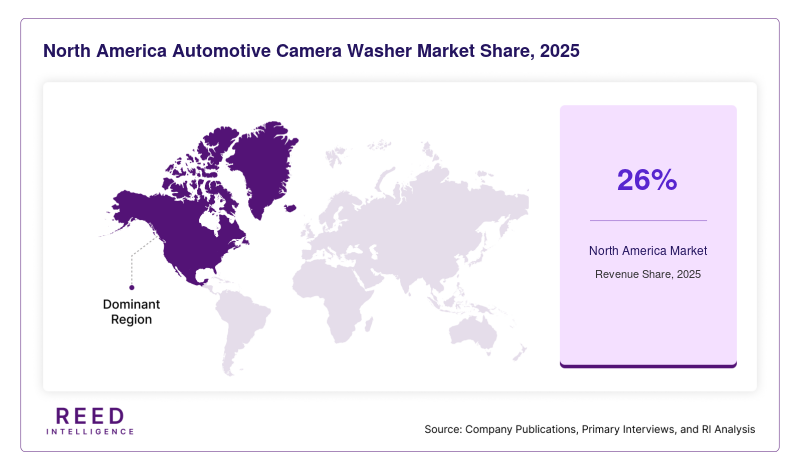
North America accounted for approximately 26% of the Automotive Camera Washer Market share in 2025 and is expected to grow at a CAGR of 11.8% during the forecast period. The region’s strong automotive industry and increasing adoption of advanced safety technologies have supported market growth.
The United States dominated the regional market due to the widespread implementation of ADAS features in passenger and commercial vehicles. The presence of leading automotive manufacturers and technology providers has facilitated the integration of camera washer systems into vehicle designs.
Europe
Europe held nearly 34% share of the Automotive Camera Washer Market in 2025 and is projected to grow at a CAGR of 12.1%. Stringent safety regulations and the high adoption of premium vehicles have driven demand for advanced automotive technologies.
Germany emerged as the dominant country, supported by its strong automotive manufacturing base. The growth factor in this country has been the integration of advanced safety features in both luxury and mid-range vehicles, driving demand for camera washer systems.
Asia Pacific
Asia Pacific represented around 24% of the market share in 2025 and is anticipated to grow at the fastest CAGR of 13.6%. Rapid industrialization, increasing vehicle production, and rising consumer awareness of safety features have contributed to market expansion.
China led the regional market, driven by its large automotive production capacity and growing adoption of electric vehicles. The expansion of domestic manufacturers and government initiatives supporting vehicle safety have further accelerated growth.
Middle East & Africa
The Middle East & Africa accounted for approximately 8% share in 2025 and is expected to grow at a CAGR of 10.2%. The market is gradually developing due to increasing vehicle imports and growing awareness of safety technologies.
The United Arab Emirates dominated the region, supported by demand for premium vehicles and advanced automotive features. The growth factor has been the rising preference for technologically advanced vehicles among consumers.
Latin America
Latin America held nearly 8% share of the Automotive Camera Washer Market in 2025 and is projected to grow at a CAGR of 11.0%. The region is experiencing steady growth due to increasing vehicle ownership and improving economic conditions.
Brazil emerged as the dominant country, driven by its expanding automotive industry. The adoption of safety technologies in new vehicles has supported demand for camera washer systems in the region.
Competitive Landscape
The Automotive Camera Washer Market is characterized by the presence of established automotive component manufacturers and specialized technology providers. Companies are focusing on innovation, product integration, and strategic partnerships to strengthen their market position.
Continental AG is a leading player in the market, leveraging its expertise in automotive safety systems. The company has recently introduced advanced camera cleaning solutions integrated with ADAS platforms, enhancing system performance and reliability.
Other players are investing in research and development to create compact, efficient, and cost-effective solutions. Collaborations with automakers and technology firms are also common strategies to expand market reach and improve product offerings.
Key Players List
- Continental AG
- Robert Bosch GmbH
- Denso Corporation
- Valeo S.A.
- Magna International Inc.
- Aptiv PLC
- HELLA GmbH & Co. KGaA
- ZF Friedrichshafen AG
- Hyundai Mobis
- Ficosa International S.A.
- Stoneridge Inc.
- Gentex Corporation
- Hitachi Astemo Ltd.
- NSK Ltd.
- Texas Instruments Incorporated
Recent Developments
- Continental AG launched an automated camera cleaning system integrated with ADAS sensors.
- Valeo S.A. developed compact washer modules for electric vehicles.
- Denso Corporation introduced energy-efficient pump systems for camera washers.
- Bosch expanded its ADAS-compatible camera maintenance solutions portfolio.
- Magna International partnered with automakers to integrate advanced washer systems in next-generation vehicles.
Automotive Camera Washer Market Segments
By Component
- Nozzle Systems
- Pumps
- Reservoirs
- Electronic Control Units
- By Vehicle Type
Passenger Cars
- Commercial Vehicles
- Electric Vehicles
By Application
- Rear-View Cameras
- Front Cameras
- Surround-View Systems
- Autonomous Driving Cameras
By Sales Channel
- OEM
- Aftermarket
By Region
- North America
- Europe
- APAC
- Middle East and Africa
- LATAM