Automotive Camless Piston Engine Market Size, Share & Demand Report By Valve Actuation Type (Electro-Hydraulic Camless Systems), By Vehicle Type (Passenger Vehicles, Commercial Vehicles, Hybrid Commercial Vehicles), By Fuel Type (Gasoline Engines, Diesel Engines, Alternative Fuel Engines, Hybrid Engine Systems), By End-Use (OEM Integration, Aftermarket Applications) & Regional Forecasts, 2026–2034
USD 3950
Market Overview
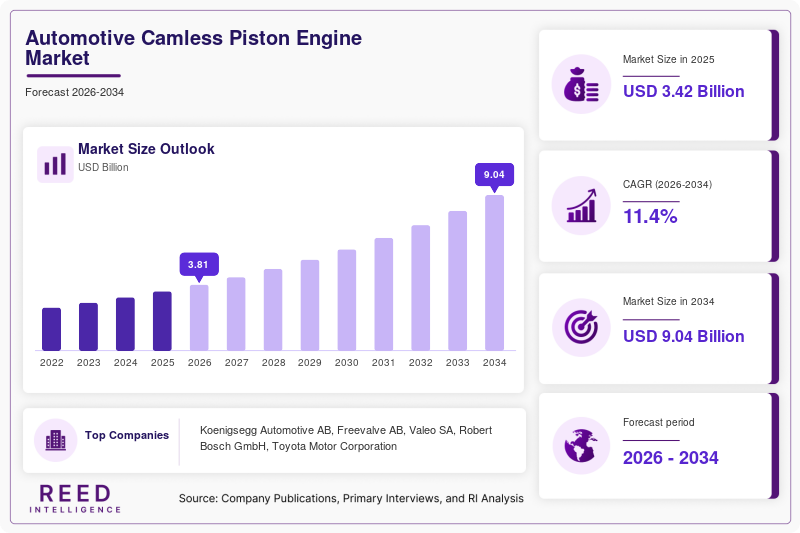
The Automotive Camless Piston Engine Market was valued at approximately USD 3.42 billion in 2026 and is projected to reach USD 8.14 billion by 2034, expanding at a CAGR of 11.4% during 2026–2034. The market is witnessing substantial growth due to increasing demand for fuel-efficient automotive technologies, rising investment in advanced engine systems, and growing pressure on automakers to reduce emissions while maintaining engine performance. Camless piston engines are gaining attention because they eliminate traditional camshaft systems and use electronically controlled valve actuation, improving combustion efficiency and fuel economy.
A major global factor supporting the growth of the Automotive Camless Piston Engine Market is the increasing implementation of stringent emission regulations across major automotive manufacturing economies. Governments and environmental agencies are continuously introducing regulations focused on reducing vehicle emissions and improving fuel efficiency standards. Automotive manufacturers are increasingly exploring advanced internal combustion technologies capable of supporting hybrid powertrain systems and reducing mechanical energy losses. Camless piston engine systems provide improved valve timing flexibility, optimized combustion control, and enhanced engine efficiency, making them an attractive solution for future vehicle platforms.
Key Highlights
- Europe dominated the Automotive Camless Piston Engine Market with a market share of 35.2% in 2025.
- Asia Pacific is projected to register the fastest growth with a 12.6% CAGR during 2026–2034.
- By valve actuation type, electro-hydraulic camless systems held the dominant share of 47.8% in 2025.
- By valve actuation type, electromagnetic valve actuation systems are expected to grow at a 13.1% CAGR during the forecast period.
- By vehicle type, the passenger vehicle segment accounted for the largest market share in 2025.
- By vehicle type, the hybrid commercial vehicle segment is forecast to expand at a 12.9% CAGR through 2034.
- Germany remained the dominant country in Europe with market values of approximately USD 488 million in 2024 and USD 541 million in 2025.
Market Trends
Integration of Intelligent Electronic Valve Control Systems
The increasing adoption of electronically controlled engine technologies is emerging as a major trend shaping the Automotive Camless Piston Engine Market. Automotive manufacturers are integrating intelligent valve actuation systems capable of dynamically adjusting valve timing, lift, and duration based on engine load and driving conditions. This technology helps improve combustion efficiency, reduce fuel consumption, and optimize engine performance.
Modern electronic control units are increasingly supporting advanced predictive engine management functions, enabling real-time valve operation adjustments. Automakers are focusing on software-driven powertrain optimization to improve driving dynamics and comply with tightening environmental standards. This trend is expected to accelerate the commercial adoption of camless piston engines across advanced vehicle platforms.
Rising Development of Hybrid-Compatible Combustion Technologies
The growing popularity of hybrid vehicles is creating significant momentum for the Automotive Camless Piston Engine Market. Hybrid powertrains require highly efficient combustion systems capable of operating seamlessly alongside electric propulsion technologies. Camless piston engines are increasingly viewed as suitable solutions because they provide precise combustion control and lower pumping losses.
Automotive manufacturers are increasingly developing compact and fuel-efficient hybrid engines equipped with advanced valve actuation systems. The ability of camless technology to improve engine flexibility and thermal efficiency is encouraging integration into future hybrid passenger and commercial vehicle architectures.
Market Drivers
Increasing Demand for Fuel-Efficient Powertrain Technologies
The growing consumer demand for fuel-efficient vehicles is a major factor driving the Automotive Camless Piston Engine Market. Rising fuel costs and increasing awareness regarding environmental sustainability are encouraging automotive manufacturers to invest in advanced engine technologies capable of reducing fuel consumption without compromising performance.
Camless piston engines improve combustion precision and reduce mechanical friction by eliminating conventional camshaft components. These advantages help manufacturers achieve improved mileage and lower emissions, supporting the adoption of camless engine systems in modern vehicles.
Expansion of Automotive Research and Development Activities
Automotive OEMs and technology providers are significantly increasing investments in advanced propulsion research, which is supporting the growth of the Automotive Camless Piston Engine Market. Manufacturers are exploring innovative engine architectures capable of improving performance, durability, and operational efficiency.
The growing collaboration between automotive companies and electronic component suppliers is accelerating technological advancements in electronically controlled valve systems. Increased R&D funding is expected to support commercialization of next-generation camless engine platforms during the forecast period.
Market Restraint
High Engineering Complexity and Development Costs
One of the major restraints affecting the Automotive Camless Piston Engine Market is the high complexity associated with developing electronically controlled valve systems. Camless engine technologies require advanced sensors, actuators, software integration, and precise calibration processes, resulting in elevated production and development costs. The need for extensive testing and long-term durability validation can also slow large-scale commercialization.
Market Opportunities
Growing Adoption in Performance and Luxury Vehicles
The increasing demand for premium and high-performance vehicles presents a significant opportunity for the Automotive Camless Piston Engine Market. Luxury vehicle manufacturers are increasingly seeking advanced engine technologies capable of delivering higher power output, improved throttle response, and better fuel economy.
Camless piston engines can support customized valve operation strategies that enhance engine responsiveness and driving performance. This opportunity is expected to encourage adoption among premium automotive brands focused on performance-oriented engineering.
Expansion of Advanced Commercial Vehicle Platforms
Commercial vehicle manufacturers are increasingly focusing on fuel-efficient and low-emission engine systems, creating opportunities for the Automotive Camless Piston Engine Market. Fleet operators are seeking technologies capable of reducing operating costs and improving long-distance fuel efficiency.
The ability of camless piston engines to optimize combustion efficiency and support hybrid integration is expected to drive future demand within commercial transportation applications, especially in logistics and urban delivery fleets.
Segmental Analysis
By Valve Actuation Type
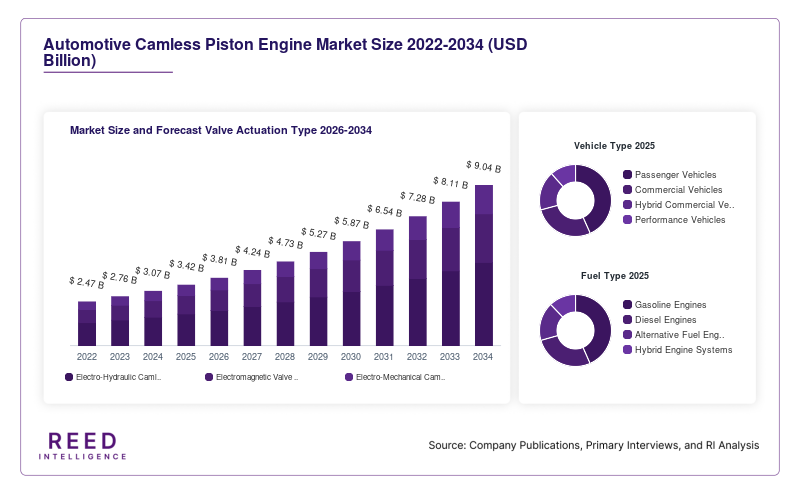
Electro-hydraulic camless systems dominated the Automotive Camless Piston Engine Market with a market share of 47.8% in 2025. These systems gained widespread adoption because they provide improved valve response accuracy, stable operation, and compatibility with high-performance engine architectures.
Electromagnetic valve actuation systems are projected to register the fastest CAGR of 13.1% during 2026–2034. Increasing advancements in electronic control technologies and compact actuator design are expected to support segment growth. These systems offer faster response times and enhanced engine control flexibility.
By Vehicle Type
Passenger vehicles accounted for the largest share of 56.3% in 2025 within the Automotive Camless Piston Engine Market. Rising demand for fuel-efficient sedans, SUVs, and hybrid vehicles significantly contributed to segment dominance.
Hybrid commercial vehicles are projected to expand at a 12.9% CAGR through 2034 due to increasing demand for low-emission transportation solutions and fuel-efficient fleet operations. Logistics companies are increasingly seeking advanced powertrain technologies to improve operational efficiency.
By Fuel Type
Gasoline-powered camless piston engines held the dominant market share of 51.7% in 2025 because of their widespread integration in passenger vehicle platforms and strong compatibility with electronically controlled valve systems.
Alternative fuel engine systems are expected to witness the fastest growth at a 12.4% CAGR during the forecast period due to rising interest in sustainable transportation technologies and cleaner combustion systems.
By End-Use
OEM integration represented the dominant segment with a market share of 68.9% in 2025 in the Automotive Camless Piston Engine Market. Automotive manufacturers increasingly integrated camless technologies during vehicle production to improve performance and regulatory compliance.
The aftermarket segment is projected to grow at a 10.7% CAGR through 2034 due to increasing demand for performance upgrades and advanced engine modification technologies among automotive enthusiasts and commercial fleet operators.
Regional Analysis
North America
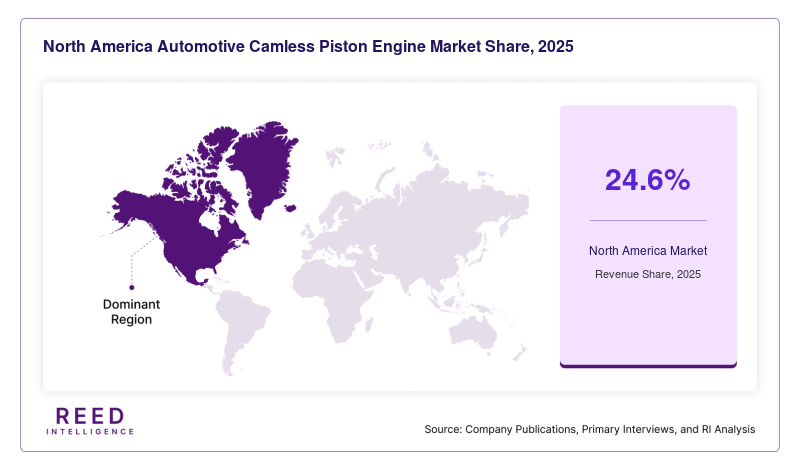
North America accounted for approximately 24.6% of the Automotive Camless Piston Engine Market in 2025 and is projected to grow at a 10.8% CAGR during 2026–2034. The United States dominated the regional market due to strong automotive innovation capabilities and increasing investment in advanced engine technologies.
The region benefits from the presence of major automotive manufacturers and research institutions focused on fuel-efficient powertrain systems. Increasing adoption of hybrid vehicles and rising demand for advanced automotive engineering solutions continue to support regional market expansion.
Europe
Europe held the largest market share of 35.2% in 2025 and is anticipated to expand at a 10.5% CAGR through 2034. Germany remained the dominant country because of its highly developed automotive manufacturing industry and extensive investment in engine research technologies.
European automakers are increasingly focusing on reducing vehicle emissions while maintaining driving performance standards. The region also benefits from strong regulatory support for advanced low-emission vehicle technologies and hybrid powertrain development.
Asia Pacific
Asia Pacific represented 28.1% of the global Automotive Camless Piston Engine Market in 2025 and is forecast to register the fastest CAGR of 12.6% during 2026–2034. China dominated the regional market due to rapid automotive production expansion and rising investment in intelligent vehicle technologies.
The region continues to witness strong demand for fuel-efficient passenger vehicles and hybrid mobility solutions. Increasing automotive manufacturing capacity across China, Japan, South Korea, and India is expected to strengthen demand for advanced engine systems.
Middle East & Africa
The Middle East & Africa accounted for 6.3% of the Automotive Camless Piston Engine Market in 2025 and is projected to grow at a 9.4% CAGR during the forecast period. The United Arab Emirates remained the dominant country due to increasing adoption of premium automotive technologies and rising investment in smart mobility infrastructure.
The region is also witnessing increased demand for fuel-efficient luxury vehicles and technologically advanced transportation solutions. Government initiatives supporting sustainable mobility are contributing to regional market development.
Latin America
Latin America held approximately 5.8% market share in 2025 and is expected to expand at a 9.1% CAGR through 2034. Brazil dominated the regional market because of increasing automotive production activities and growing adoption of hybrid vehicle technologies.
Automotive manufacturers across the region are increasingly focusing on improving fuel efficiency standards and reducing vehicle operating costs. Rising investment in advanced automotive manufacturing technologies is supporting market expansion.
Competitive Landscape
The Automotive Camless Piston Engine Market remains highly technology-focused, with companies emphasizing advanced engine research, software integration, and strategic automotive partnerships.
Koenigsegg Automotive AB emerged as a major market leader through its Freevalve technology platform, which focuses on fully camless engine systems with electronically controlled valve actuation. The company recently expanded development partnerships with automotive manufacturers to accelerate commercialization of advanced combustion technologies.
Freevalve AB continues to focus on intelligent valve control technologies for high-efficiency engines. Valeo SA is investing in advanced automotive electronic systems supporting next-generation powertrain integration. Robert Bosch GmbH remains active in intelligent engine control solutions and actuator technologies. Toyota Motor Corporation continues to explore hybrid-compatible combustion technologies utilizing advanced valve timing systems.
Key Players List
- Koenigsegg Automotive AB
- Freevalve AB
- Valeo SA
- Robert Bosch GmbH
- Toyota Motor Corporation
- Hyundai Motor Company
- Honda Motor Co., Ltd.
- Cummins Inc.
- Eaton Corporation plc
- BorgWarner Inc.
- AVL List GmbH
- MAHLE GmbH
- Schaeffler AG
- Mitsubishi Heavy Industries Ltd.
- Ricardo plc
Recent Developments
- In 2025, multiple automotive manufacturers expanded investment in electronically controlled valve actuation technologies for hybrid vehicle platforms.
- Koenigsegg Automotive AB strengthened commercialization efforts for Freevalve engine systems through new automotive development partnerships.
- Automotive component suppliers increased R&D activities focused on compact electromagnetic valve actuators and intelligent engine control systems.
- Several OEMs introduced prototype hybrid engines equipped with advanced camless combustion technologies to improve fuel efficiency.
- Automotive engineering firms expanded software-driven engine management capabilities to support real-time valve timing optimization and predictive performance monitoring.
Automotive Camless Piston Engine Market Segments
Valve Actuation Type
- Electro-Hydraulic Camless Systems
- Electromagnetic Valve Actuation Systems
- Electro-Mechanical Camless Systems
Vehicle Type
- Passenger Vehicles
- Commercial Vehicles
- Hybrid Commercial Vehicles
- Performance Vehicles
Fuel Type
- Gasoline Engines
- Diesel Engines
- Alternative Fuel Engines
- Hybrid Engine Systems
End-Use
- OEM Integration
- Aftermarket Applications
- Research & Prototype Development
By Region
- North America
- Europe
- APAC
- Middle East and Africa
- LATAM