Automotive Clutch Rotor Market Size, Share Demand Report By Vehicle Type (Passenger Cars, Light Commercial Vehicles, Heavy Commercial Vehicles), By Material Type (Cast Iron, Steel, Composite Alloys), By Transmission Type (Manual Transmission, Automated Manual Transmission, Hybrid Clutch Systems), By Sales Channel (OEM, Aftermarket), By Application (Utility Vehicles, Passenger Mobility, Performance Vehicles, Industrial Vehicles), By Region & Segment Forecasts, 2026–2034
USD 3950
Market Overview
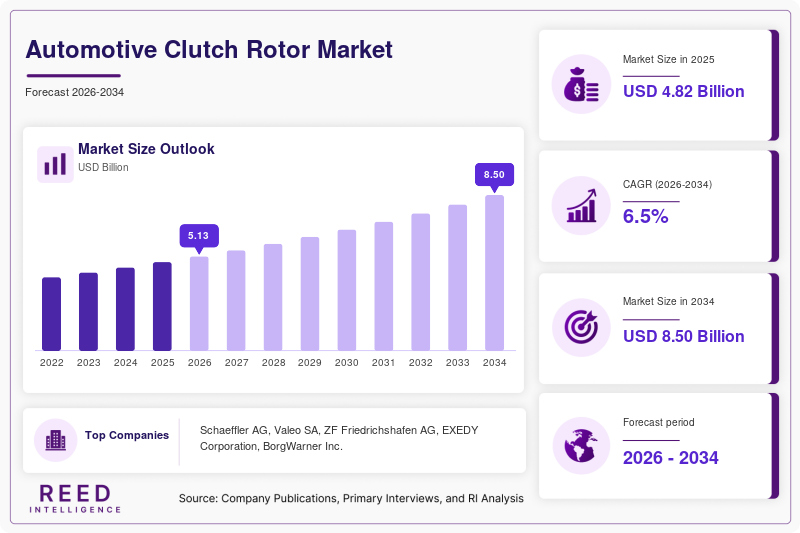
The global Automotive Clutch Rotor Market size was valued at USD 4.82 billion in 2026 and is projected to reach USD 7.96 billion by 2034, expanding at a CAGR of 6.5% during 2026–2034. The market is witnessing steady expansion due to the continued production of manual transmission and hybrid vehicles across emerging and developed economies. Automotive clutch rotors remain critical drivetrain components that ensure smooth torque transfer, heat dissipation, and reliable clutch engagement in passenger cars, commercial vehicles, and performance vehicles.
One major global factor supporting market growth has been the rising average vehicle age worldwide. As vehicles remain in operation for longer periods, demand for replacement clutch systems and clutch rotors has increased through the aftermarket channel. Fleet operators and private vehicle owners are prioritizing drivetrain maintenance to improve fuel efficiency and extend vehicle life, creating stable demand for durable clutch rotor products.
Key Highlights
- Asia Pacific held the dominant regional share of 41.8% in 2025, while Latin America is expected to register the fastest CAGR of 7.2% through 2034.
- By vehicle type, Passenger Cars led with 56.4% share in 2025, while Light Commercial Vehicles are projected to grow fastest at 7.1% CAGR.
- By material, Cast Iron dominated with 48.9% share, while Composite Alloys are forecast to expand at 7.8% CAGR.
- By sales channel, OEM remained dominant with 62.3% share, while Aftermarket is expected to grow at 6.9% CAGR.
- China, the leading country, recorded a market value of USD 1.26 billion in 2024 and USD 1.34 billion in 2025.
Market Trends
Lightweight Rotor Engineering
Manufacturers are shifting toward lighter clutch rotor assemblies using aluminum blends, composite coatings, and optimized structural geometry. These designs improve drivetrain efficiency and reduce rotational mass.
Rise of Performance and Utility Vehicles
Demand for SUVs, pickups, and utility vehicles has increased the need for higher torque-handling clutch rotor systems. This trend is encouraging suppliers to launch reinforced and heat-resistant products.
Market Drivers
Growth in Vehicle Parc and Replacement Demand
The expanding global vehicle parc has created sustained need for clutch replacement components. Older vehicles require rotor servicing, supporting recurring aftermarket revenue.
Expansion of Manual and Hybrid Transmission Platforms
Several markets continue to favor manual transmissions for cost efficiency, while hybrid vehicles use specialized clutch systems, increasing rotor demand across multiple drivetrain formats.
Market Restraint
Shift Toward Full Battery Electric Vehicles
Pure electric vehicles generally do not require conventional clutch rotor systems. Faster EV adoption in selected countries may reduce long-term demand from passenger car applications.
Market Opportunities
Advanced Coated Rotor Surfaces
Ceramic-coated and heat-treated rotor surfaces offer longer operating life and lower wear. Suppliers investing in premium durability solutions may gain higher margins.
Fleet Maintenance Contracts
Commercial fleets increasingly seek scheduled maintenance partnerships. Rotor manufacturers offering bundled replacement programs can secure recurring business.
Segmental Analysis
By Vehicle Type
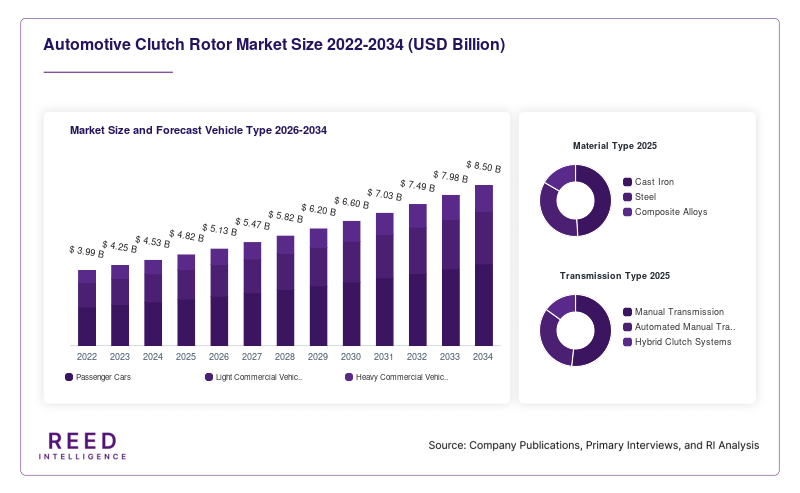
Passenger Cars accounted for 56.4% share in 2025. High ownership volumes and widespread use of manual or semi-manual systems in developing markets sustained demand. Compact hatchbacks and sedans formed the largest installed base.
Light Commercial Vehicles are expected to grow fastest at a 7.1% CAGR through 2034. Expansion of e-commerce delivery fleets and urban cargo transport will drive replacement frequency.
By Material Type
Cast Iron led with 48.9% share in 2025 due to durability, thermal stability, and cost efficiency. It remained the preferred option for mass-market vehicles.
Composite Alloys are forecast to expand at 7.8% CAGR. Their lower weight and improved wear resistance will support adoption in premium and performance vehicles.
By Transmission Type
Manual Transmission applications held 61.7% share in 2025. Many markets continued to prefer manual vehicles because of affordability and easier maintenance.
Automated Manual Transmission systems are expected to grow at 7.0% CAGR. These systems use clutch modules requiring precise rotor integration, especially in commercial fleets.
By Sales Channel
OEM sales captured 62.3% share in 2025. Vehicle production contracts and long-term supplier agreements supported this segment.
Aftermarket sales are projected to rise at 6.9% CAGR through 2034. Aging vehicles and routine drivetrain servicing will continue to generate repeat purchases.
By Application
Standard Utility Driving represented 46.8% share in 2025, covering daily commuting, city transport, and general mobility vehicles.
Performance Applications are expected to grow at 7.4% CAGR as sports cars, modified vehicles, and enthusiast demand increase. These systems require high-friction and heat-resistant rotor solutions.
By End Use
Private Vehicle Ownership dominated with 58.1% share in 2025 because of large passenger car volumes worldwide.
Fleet Operators are forecast to grow at 7.3% CAGR due to scheduled maintenance cycles and higher annual mileage, which accelerates clutch wear.
By Rotor Design
Single Plate Rotor systems held 52.7% share in 2025 because they are widely used in passenger vehicles and light-duty transport.
Multi-Plate Rotor systems are expected to grow at 7.6% CAGR owing to their suitability for high torque vehicles and advanced drivetrain systems.
Regional Analysis
North America
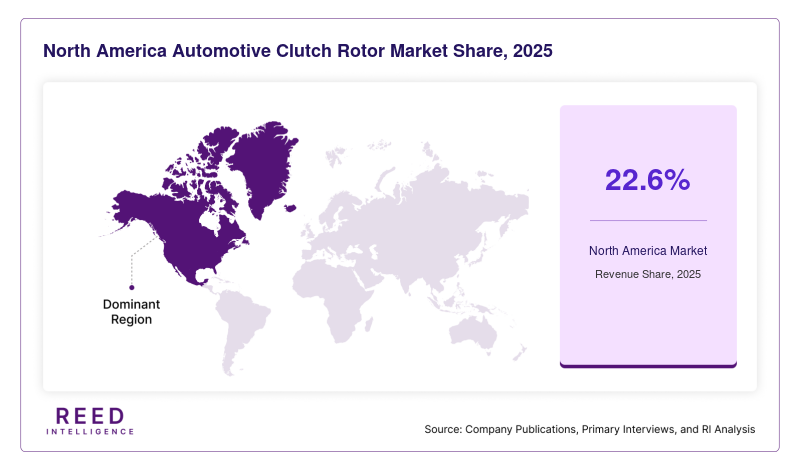
North America accounted for 22.6% of the Automotive Clutch Rotor Market in 2025. The region benefited from strong demand in pickup trucks, agricultural equipment, and commercial transport vehicles that rely on durable clutch assemblies. A mature automotive service ecosystem also supported replacement sales through workshops, dealer networks, and independent garages.
The United States remained the dominant country in the region. Growth was driven by rising demand for heavy-duty trucks and utility vehicles used in construction, logistics, and regional transport. These vehicle classes require high-load clutch rotor systems capable of sustained torque transmission. Manufacturers in the country also focused on precision-machined components for performance vehicles and motorsport applications.
Canada contributed through demand in industrial fleets and winter-use commercial vehicles where drivetrain reliability is essential. Mexico supported regional production through automotive manufacturing exports and component assembly hubs.
North America is expected to grow at a CAGR of 5.8% during 2026–2034 as fleet modernization and replacement demand continue.
Europe
Europe held 24.1% share of the Automotive Clutch Rotor Market in 2025. The region maintained a balanced mix of OEM production and aftermarket demand. Manual transmission vehicles remained common in several countries, supporting stable clutch rotor consumption.
Germany led the European market due to its large automotive manufacturing base and strong engineering ecosystem. Premium vehicle makers required precision-balanced clutch rotors for passenger cars, sports vehicles, and commercial vans. Demand for durable components with noise reduction properties also supported product upgrades.
France, Italy, Spain, and Eastern European countries added market volume through compact cars and commercial fleets. Europe’s regulatory focus on efficiency encouraged lightweight rotor innovation rather than only traditional cast components.
Europe is forecast to expand at a CAGR of 5.6% through 2034 as replacement demand and specialty vehicle production remain stable.
Asia Pacific
Asia Pacific represented 41.8% of the Automotive Clutch Rotor Market in 2025, making it the largest regional market. High vehicle production volumes, large populations of manual transmission vehicles, and expanding transport networks supported growth.
China dominated the region. The country benefited from large-scale passenger car manufacturing, rising domestic spare parts demand, and broad supplier networks. Growing use of delivery vans and light trucks further increased clutch rotor consumption. Chinese manufacturers also expanded exports of competitively priced drivetrain parts.
India contributed strongly through its large manual car market and expanding two-tier city mobility demand. Japan and South Korea supported advanced engineering and premium rotor manufacturing.
Southeast Asia remained important for compact cars, motorcycles with related clutch systems, and commercial utility vehicles used in logistics and agriculture.
Asia Pacific is projected to grow at a CAGR of 6.8% during 2026–2034 due to rising vehicle ownership and expanding replacement cycles.
Middle East & Africa
The Middle East & Africa held 6.1% share in 2025. Demand was concentrated in commercial vehicles, SUVs, off-road vehicles, and industrial fleets operating in demanding environments. Harsh terrain and high temperatures increased wear rates for clutch systems, supporting aftermarket demand.
Saudi Arabia was the leading country due to strong vehicle imports, commercial transport activity, and infrastructure projects requiring fleet vehicles. Utility vehicles used in desert and construction settings needed robust clutch rotor systems with heat resistance.
The UAE added premium vehicle demand, while South Africa supported automotive servicing and regional distribution. Mining vehicles and utility fleets in parts of Africa also created steady replacement needs.
The region is expected to grow at a CAGR of 6.1% through 2034 with continued infrastructure activity and rising fleet ownership.
Latin America
Latin America captured 5.4% share of the Automotive Clutch Rotor Market in 2025. The market benefited from long vehicle ownership cycles and strong aftermarket purchasing behavior. Vehicle owners often maintain existing vehicles rather than replace them, increasing component replacement frequency.
Brazil led the region because of its large passenger vehicle base and extensive agricultural transport sector. Pickup trucks, utility vehicles, and compact cars generated broad clutch rotor demand. Local remanufacturing and service networks also supported availability.
Argentina, Chile, and Colombia contributed through commercial transport and urban mobility fleets. Price-sensitive consumers favored durable aftermarket rotor options.
Latin America is anticipated to register the fastest regional CAGR of 7.2% from 2026 to 2034 as economic recovery and vehicle maintenance spending improve.
Competitive Landscape
The Automotive Clutch Rotor Market remains moderately fragmented with global and regional component manufacturers competing on durability, pricing, metallurgy, and supply reliability. Leading companies focus on OEM contracts, aftermarket branding, and product line expansion. Strategic priorities include lightweight materials, precision machining, and geographic distribution networks.
Schaeffler AG remained a market leader due to its broad clutch technology portfolio and strong OEM relationships. The company recently expanded its drivetrain component production capacity for Asian markets. Valeo strengthened its aftermarket offerings through extended service kits. ZF Friedrichshafen AG focused on commercial vehicle clutch systems. EXEDY Corporation advanced precision clutch modules for Japanese and export vehicles. BorgWarner enhanced hybrid drivetrain integration through clutch component upgrades.
Smaller suppliers continue to compete through localized pricing and fast replacement part availability.
Key Players List
- Schaeffler AG
- Valeo SA
- ZF Friedrichshafen AG
- EXEDY Corporation
- BorgWarner Inc.
- AISIN Corporation
- F.C.C. Co., Ltd.
- NSK Ltd.
- Eaton Corporation
- Clutch Auto Ltd.
- Tenneco Inc.
- LuK GmbH
- Setco Automotive Ltd.
- Raybestos Powertrain
- Sachs Performance
Recent Developments
- Schaeffler AG expanded clutch rotor manufacturing lines in Asia in 2025.
- Valeo launched upgraded aftermarket clutch service kits with rotor assemblies.
- EXEDY introduced lightweight rotor systems for compact performance vehicles.
- ZF Friedrichshafen AG expanded commercial vehicle drivetrain solutions.
- BorgWarner developed clutch modules compatible with hybrid vehicle platforms.
Automotive Clutch Rotor Market Segments
Vehicle Type
- Passenger Cars
- Light Commercial Vehicles
- Heavy Commercial Vehicles
Material Type
- Cast Iron
- Steel
- Composite Alloys
Transmission Type
- Manual Transmission
- Automated Manual Transmission
- Hybrid Clutch Systems
Sales Channel
- OEM
- Aftermarket
Application
- Utility Vehicles
- Passenger Mobility
- Performance Vehicles
- Industrial Vehicles
By Region
- North America
- Europe
- APAC
- Middle East and Africa
- LATAM