Automotive Clutch Slave Cylinder Market Size, Share & Demand Report By Product Type (External Clutch Slave Cylinders, Concentric Clutch Slave Cylinders), By Material Type (Aluminum-Based Slave Cylinders, Cast Iron Slave Cylinders), By Vehicle Type (Passenger Vehicles, Light Commercial Vehicles, Heavy Commercial Vehicles), By Sales Channel (OEMs, Aftermarket) By Region & Segment Forecasts, 2026–2034
USD 3950
Market Overview
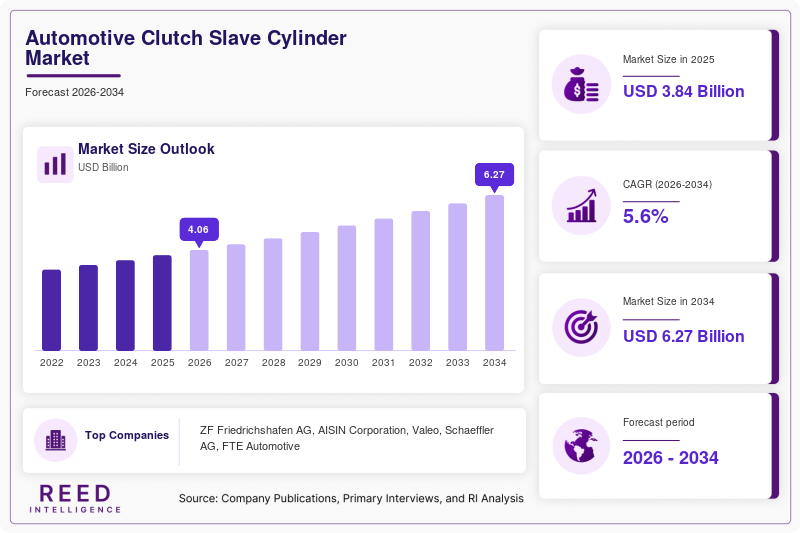
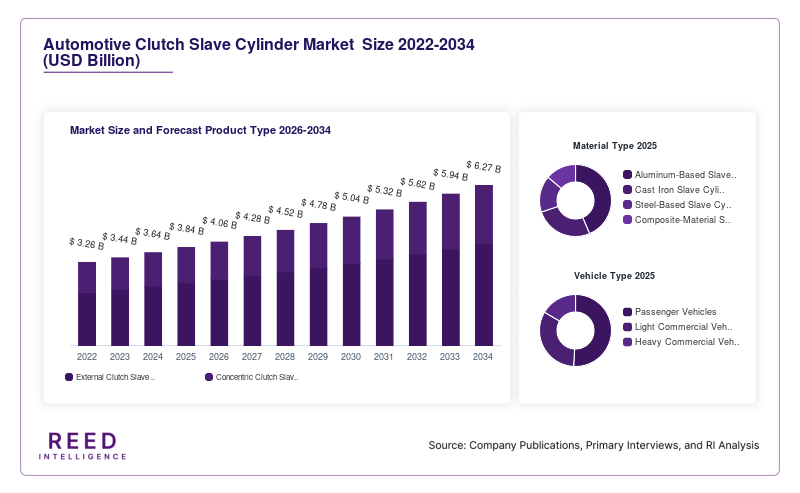
The Automotive Clutch Slave Cylinder Market size was valued at USD 3.84 billion in 2026 and is projected to reach USD 5.92 billion by 2034, expanding at a CAGR of 5.6% during the forecast period of 2026–2034. The global Automotive Clutch Slave Cylinder Market growth has been supported by rising global vehicle production and increasing demand for improved transmission efficiency across passenger and commercial vehicles. Automotive manufacturers continue to focus on enhancing driving comfort and transmission responsiveness, which has accelerated the adoption of advanced hydraulic clutch systems globally.
Automotive clutch slave cylinders are essential components in manual and semi-automatic transmission systems. These cylinders convert hydraulic pressure into mechanical movement, enabling smooth clutch engagement and disengagement. The increasing demand for reliable transmission performance, reduced pedal effort, and longer component durability has significantly contributed to market expansion. Automotive manufacturers are increasingly integrating lightweight and corrosion-resistant clutch slave cylinders to improve operational efficiency and vehicle performance.
Key Highlights
- Asia Pacific accounted for 42.9% of the global Automotive Clutch Slave Cylinder Market share in 2025, while Latin America is projected to witness the fastest CAGR of 6.4% during 2026–2034.
- By product type, external clutch slave cylinders held the dominant share of 58.2% in 2025, whereas concentric clutch slave cylinders are anticipated to grow at the fastest CAGR of 6.1%.
- By material type, aluminum-based slave cylinders represented the leading segment with 46.8% share in 2025, while composite-material slave cylinders are expected to expand at a CAGR of 6.5%.
- By vehicle type, passenger vehicles accounted for 63.4% of the market share in 2025, whereas light commercial vehicles are projected to register a CAGR of 5.9%.
- By sales channel, OEMs dominated with 61.7% share in 2025, while aftermarket sales are forecast to grow at a CAGR of 6.3%.
- China remained the dominant country market and was valued at USD 648.5 million in 2024 and USD 691.8 million in 2025.
Market Trends
Increasing Adoption of Lightweight Hydraulic Components
The growing focus on vehicle weight reduction has become a major trend shaping the Automotive Clutch Slave Cylinder Market. Automotive manufacturers are increasingly utilizing lightweight materials such as aluminum alloys and reinforced composites in hydraulic clutch components.
Lightweight clutch slave cylinders help improve fuel efficiency and overall vehicle performance. This trend is becoming more important as automotive companies seek to comply with fuel economy and emission reduction targets across major markets.
Rising Integration of Concentric Slave Cylinder Systems
The automotive industry is increasingly adopting concentric clutch slave cylinder systems to improve clutch operation efficiency and reduce installation complexity. These systems combine the release bearing and slave cylinder into a single compact unit.
Concentric systems reduce mechanical wear, improve hydraulic response, and minimize maintenance requirements. Vehicle manufacturers are increasingly deploying these systems in modern passenger vehicles and commercial fleets to enhance transmission reliability.
Market Drivers
Expansion of Global Vehicle Production
The continued expansion of passenger and commercial vehicle production worldwide has significantly driven the Automotive Clutch Slave Cylinder Market. Developing economies continue to experience increasing vehicle ownership, which supports transmission component demand.
Automotive manufacturers are expanding production capacities to meet growing transportation needs across urban and industrial sectors. Manual transmission vehicles continue to maintain substantial market presence in emerging economies, contributing to steady demand for clutch slave cylinders.
Growing Demand for Durable Transmission Systems
The increasing consumer preference for durable and low-maintenance transmission systems has accelerated the adoption of advanced hydraulic clutch components. Automotive clutch slave cylinders help improve clutch responsiveness and operational reliability.
Fleet operators and commercial vehicle users increasingly prioritize transmission durability to reduce maintenance costs and operational downtime. This has encouraged manufacturers to develop improved sealing technologies and wear-resistant hydraulic systems.
Market Restraint
Rising Adoption of Electric Vehicles
The growing penetration of electric vehicles remains a major restraint for the Automotive Clutch Slave Cylinder Market. Fully electric vehicles do not require traditional manual clutch systems, which reduces the demand for clutch slave cylinders.
As governments continue promoting electric mobility and emission reduction initiatives, the gradual decline in internal combustion engine vehicle production may limit long-term market expansion in developed economies.
Market Opportunities
Growth of Automotive Aftermarket Services
The expanding automotive aftermarket industry presents significant opportunities for the Automotive Clutch Slave Cylinder Market. Increasing vehicle age and rising maintenance requirements are driving replacement demand for clutch hydraulic systems.
Independent repair workshops and aftermarket component suppliers are expanding product availability to support growing repair and maintenance activities across passenger and commercial vehicle segments.
Increasing Commercial Vehicle Fleet Expansion
The rapid expansion of logistics and transportation industries is creating new opportunities for clutch slave cylinder manufacturers. Commercial vehicle fleets continue to increase across freight transportation, construction, and industrial sectors.
Heavy-duty and light commercial vehicles require reliable transmission systems capable of handling demanding operational conditions. This is expected to strengthen demand for high-performance hydraulic clutch components during the forecast period.
Segmental Analysis
By Product Type
Based on product type, the Automotive Clutch Slave Cylinder Market is segmented into external clutch slave cylinders and concentric clutch slave cylinders.
External clutch slave cylinders dominated the market with a 58.2% share in 2025 owing to their widespread use in conventional manual transmission systems. These systems offered easier maintenance and lower replacement costs for automotive repair operations.
Concentric clutch slave cylinders are expected to witness the fastest CAGR of 6.1% during the forecast period. Their compact design, improved hydraulic efficiency, and reduced mechanical complexity will support increasing adoption across modern passenger vehicles.
By Material Type
Based on material type, the market is categorized into aluminum-based slave cylinders, cast iron slave cylinders, steel-based slave cylinders, and composite-material slave cylinders.
Aluminum-based slave cylinders accounted for the leading market share of 46.8% in 2025 due to their lightweight properties and corrosion resistance. Automotive manufacturers increasingly adopted aluminum components to improve fuel efficiency and reduce overall vehicle weight.
Composite-material slave cylinders are projected to grow at a CAGR of 6.5% during 2026–2034. Improved durability and resistance to hydraulic wear will support rising utilization of advanced composite materials in automotive hydraulic systems.
By Vehicle Type
Based on vehicle type, the Automotive Clutch Slave Cylinder Market is segmented into passenger vehicles, light commercial vehicles, and heavy commercial vehicles.
Passenger vehicles held the dominant share of 63.4% in 2025 due to large-scale global passenger car production and strong demand for manual transmission systems in developing markets. Increasing urban transportation demand further contributed to segment growth.
Light commercial vehicles are expected to register the fastest CAGR of 5.9% during the forecast period. Expanding logistics services and rising e-commerce delivery operations will continue supporting growth in light commercial vehicle production.
By Sales Channel
Based on sales channel, the market is divided into OEMs and aftermarket.
OEMs dominated the market with a 61.7% share in 2025 because automotive manufacturers increasingly integrated advanced hydraulic clutch systems during vehicle assembly operations. Stable production demand supported OEM segment growth.
Aftermarket sales are projected to witness the fastest CAGR of 6.3% during the forecast period. Increasing vehicle lifespan and rising replacement frequency for transmission components will continue driving aftermarket demand globally.
Regional Analysis
Asia Pacific
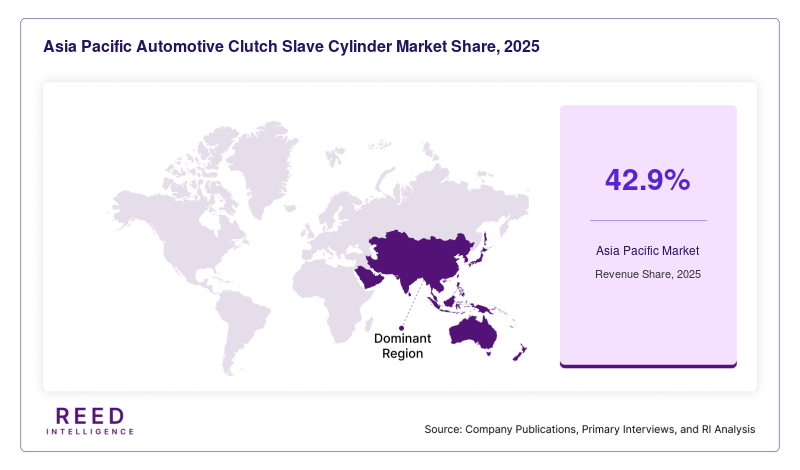
Asia Pacific accounted for 42.9% of the global Automotive Clutch Slave Cylinder Market share in 2025 and is projected to expand at a CAGR of 5.8% during 2026–2034. The region maintained its leading position due to strong automotive manufacturing activities and increasing vehicle ownership.
China remained the dominant country market because of large-scale vehicle production and expanding domestic automotive demand. The presence of major automotive manufacturers and component suppliers further strengthened regional market growth.
North America
North America represented 24.6% of the global Automotive Clutch Slave Cylinder Market share in 2025 and is anticipated to grow at a CAGR of 5.1% during the forecast period. The region benefited from strong aftermarket demand and expanding commercial transportation activities.
The United States dominated the regional market owing to rising replacement demand for transmission components and increasing commercial vehicle fleet operations. Growth in pickup truck and light commercial vehicle sales further supported market demand.
Europe
Europe captured 21.3% of the global Automotive Clutch Slave Cylinder Market share in 2025 and is expected to grow at a CAGR of 4.8% during the forecast period. The region experienced stable demand due to the presence of established automotive manufacturers and advanced transmission technologies.
Germany led the regional market because of its strong automotive engineering industry and continued production of premium passenger vehicles. Expanding exports of automotive components also contributed to regional growth.
Middle East & Africa
Middle East & Africa accounted for 6.1% of the global Automotive Clutch Slave Cylinder Market share in 2025 and is projected to witness a CAGR of 5.4% during 2026–2034. Rising commercial transportation activities and infrastructure development supported market expansion.
Saudi Arabia remained the dominant country market owing to increasing logistics operations and growing demand for commercial vehicles in industrial and construction sectors. Expanding vehicle maintenance services also supported aftermarket growth.
Latin America
Latin America held 5.1% of the global Automotive Clutch Slave Cylinder Market share in 2025 and is forecast to register the fastest CAGR of 6.4% during the study period. Increasing automotive production and expanding transportation industries supported regional development.
Brazil emerged as the dominant country market due to growing domestic vehicle manufacturing and increasing demand for replacement automotive components. Rising urban transportation activities further strengthened regional market demand.
Competitive Landscape
The Automotive Clutch Slave Cylinder Market remains moderately fragmented with global automotive component manufacturers focusing on hydraulic efficiency improvements, lightweight materials, and product durability. Companies continue expanding production capabilities and strengthening partnerships with automotive OEMs to improve market presence.
ZF Friedrichshafen AG remained a leading market participant due to its strong automotive transmission portfolio and global manufacturing network. The company recently expanded its hydraulic clutch system production capacity to support increasing demand from passenger and commercial vehicle manufacturers.
AISIN Corporation continued investing in compact hydraulic clutch technologies for fuel-efficient vehicles, while Valeo focused on lightweight transmission component innovations. Schaeffler AG strengthened its aftermarket distribution capabilities for clutch hydraulic products, and FTE Automotive emphasized advanced concentric slave cylinder technologies for modern vehicle platforms.
Key Players List
- ZF Friedrichshafen AG
- AISIN Corporation
- Valeo
- Schaeffler AG
- FTE Automotive
- BorgWarner Inc.
- Exedy Corporation
- Sachs Automotive
- Magneti Marelli
- WABCO Holdings Inc.
- LUK GmbH & Co. KG
- Rheinmetall Automotive
- Nissin Kogyo Co., Ltd.
- Hitachi Astemo
- JTEKT Corporation
Recent Developments
- In 2025, ZF Friedrichshafen AG expanded hydraulic clutch system manufacturing operations to support rising automotive OEM demand.
- In 2024, AISIN Corporation introduced lightweight concentric clutch slave cylinder technologies for compact passenger vehicles.
- In 2025, Valeo strengthened aftermarket distribution networks for transmission hydraulic components across Europe.
- In 2024, Schaeffler AG invested in advanced sealing technologies for durable clutch hydraulic systems.
- In 2025, Hitachi Astemo expanded automotive transmission component production capabilities in Asia Pacific.
Automotive Clutch Slave Cylinder Market Segments
Product Type
- External Clutch Slave Cylinders
- Concentric Clutch Slave Cylinders
Material Type
- Aluminum-Based Slave Cylinders
- Cast Iron Slave Cylinders
- Steel-Based Slave Cylinders
- Composite-Material Slave Cylinders
Vehicle Type
- Passenger Vehicles
- Light Commercial Vehicles
- Heavy Commercial Vehicles
Sales Channel
- OEMs
- Aftermarket
By Region
- North America
- Europe
- APAC
- Middle East and Africa
- LATAM