Automotive Communication Protocol Market Size, Share, Growth Report By Protocol Type (CAN, LIN, FlexRay, Automotive Ethernet, MOST), By Application (Infotainment Systems, ADAS & Safety Systems, Powertrain Systems, Body Electronics, Telematics & Connectivity Systems), By Vehicle Type (Passenger Vehicles, Commercial Vehicles, Electric Vehicles, Hybrid Vehicles, Autonomous Vehicles) By Region & Segment Forecasts, 2026–2034
USD 3950
Market Overview
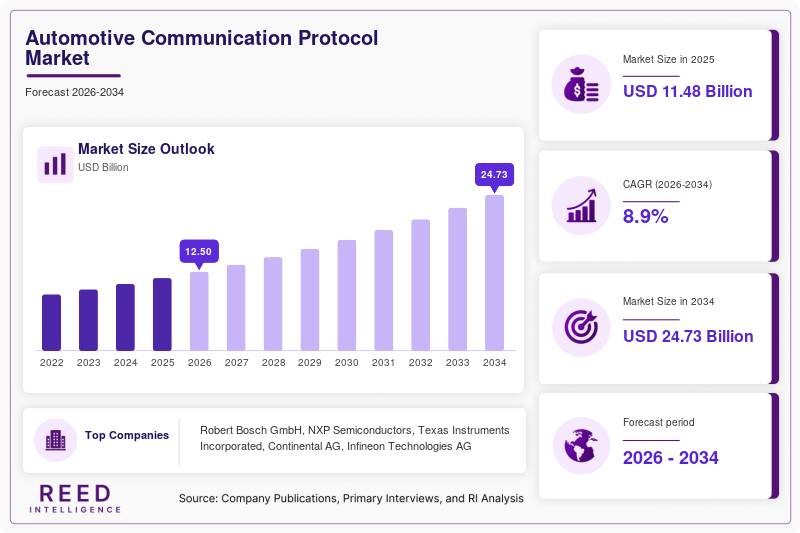
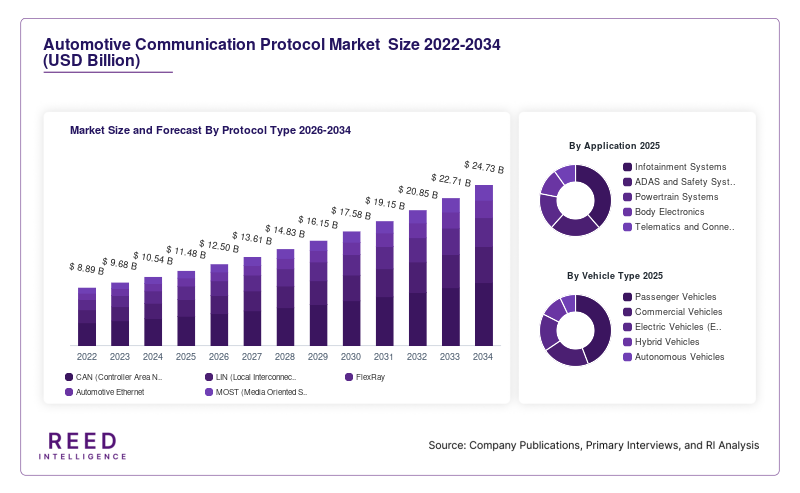
The Automotive Communication Protocol Market size is projected to reach approximately USD 12.5 billion in 2026 and is expected to expand to nearly USD 24.8 billion by 2034, registering a compound annual growth rate (CAGR) of 8.9% during the forecast period of 2026–2034. This growth reflects the increasing complexity of in-vehicle electronics, rising adoption of connected mobility systems, and the continuous shift toward software-defined vehicles. Automotive communication protocols such as CAN, LIN, FlexRay, and Ethernet are becoming essential for enabling real-time data exchange between electronic control units (ECUs), ensuring safety, performance, and infotainment integration across modern vehicles.
A major global factor supporting market expansion is the rapid advancement of vehicle electrification and autonomous driving technologies. As electric vehicles (EVs) and advanced driver-assistance systems (ADAS) gain traction, the number of sensors and control modules in vehicles is increasing significantly. This has created strong demand for high-speed, reliable communication protocols capable of handling large data volumes with low latency. Additionally, regulatory emphasis on vehicle safety standards and cybersecurity is accelerating the adoption of next-generation automotive communication architectures.
Key Highlights
- North America dominated the market with a 34.2% share in 2025.
- while Asia Pacific is expected to grow at the fastest CAGR of 11.2% during 2026–2034.
- By protocol type, CAN (Controller Area Network) accounted for the largest share of 39.6%.
- while Automotive Ethernet is projected to grow at a CAGR of 13.1%.
- By application, infotainment systems led with a 36.4% share.
- whereas ADAS communication systems are expected to expand at a CAGR of 12.7%.
- The United States remained the dominant country, with market values of USD 1.85 billion in 2024 and USD 2.05 billion in 2025.
Market Trends
Shift Toward Automotive Ethernet Adoption in High-Speed Data Systems
The automotive industry is witnessing a strong shift toward Ethernet-based communication protocols due to increasing demand for high-bandwidth data transmission. Traditional protocols such as CAN and LIN are becoming insufficient for advanced applications like autonomous driving, real-time sensor fusion, and high-definition infotainment systems. Automotive Ethernet enables gigabit-level data transfer, which supports centralized computing architectures and reduces wiring complexity. This transition is particularly evident in premium and electric vehicles, where multiple ECUs must communicate simultaneously with minimal latency. Manufacturers are increasingly adopting Time-Sensitive Networking (TSN) standards to ensure deterministic communication performance. As vehicle software complexity grows, Ethernet is expected to become a backbone protocol for next-generation automotive networks, enabling seamless integration of ADAS, V2X communication, and cloud connectivity systems.
Integration of Cybersecurity Protocols within In-Vehicle Communication Systems
Another major trend shaping the market is the integration of cybersecurity measures within automotive communication protocols. As vehicles become more connected and reliant on external data exchange, vulnerabilities to cyber threats have increased significantly. Automakers are embedding encryption, authentication, and intrusion detection systems directly into communication layers to ensure secure data transfer between ECUs. This trend is driven by regulatory frameworks such as UNECE WP.29, which mandates cybersecurity compliance for modern vehicles. Protocols are being redesigned to support secure boot processes and encrypted message handling without compromising latency. The increasing adoption of over-the-air (OTA) updates also requires secure communication channels to prevent unauthorized access. This evolution is pushing protocol developers to integrate security-by-design principles into automotive communication architectures.
Market Drivers
Rising Demand for Advanced Driver Assistance and Autonomous Systems
The growing adoption of ADAS and autonomous driving technologies is a key driver of the Automotive Communication Protocol Market. Modern vehicles rely on a large number of sensors, cameras, radar systems, and lidar units that generate massive volumes of real-time data. Efficient communication protocols are required to ensure seamless data transfer between these components and the central processing unit. CAN and FlexRay are widely used in current systems, but the increasing complexity of Level 3 and Level 4 autonomous vehicles is driving demand for high-speed protocols such as Automotive Ethernet. These systems require ultra-low latency communication to enable functions like collision avoidance, lane keeping assistance, and automated parking. As automotive OEMs continue investing heavily in autonomy, the demand for robust communication infrastructure is expected to rise significantly across both passenger and commercial vehicles.
Expansion of Electric Vehicle and Connected Mobility Ecosystem
The rapid growth of electric vehicles and connected mobility solutions is another major factor fueling market expansion. EVs require advanced electronic architectures for battery management, thermal control, and power distribution systems, all of which depend on reliable communication protocols. Additionally, connected mobility services such as vehicle-to-everything (V2X), fleet management, and remote diagnostics are increasing the need for real-time data exchange. Automotive communication protocols play a crucial role in ensuring seamless integration between cloud platforms and in-vehicle systems. Governments worldwide are also supporting EV adoption through incentives and infrastructure development, further boosting demand. This expansion is encouraging automakers to adopt scalable communication frameworks capable of supporting future upgrades and increasing vehicle digitalization.
Market Restraint
High Complexity and Integration Challenges in Multi-Protocol Architectures
One of the primary restraints in the Automotive Communication Protocol Market is the increasing complexity associated with integrating multiple communication protocols within a single vehicle architecture. Modern vehicles often use a combination of CAN, LIN, FlexRay, and Ethernet systems, each serving different functions. Ensuring interoperability between these protocols requires advanced gateway modules and software integration layers, which significantly increase system complexity. This also leads to higher development costs and longer design cycles for automotive manufacturers. Additionally, compatibility issues between legacy systems and modern high-speed protocols create engineering challenges, especially in mid-range and economy vehicle segments. The lack of standardization across global OEMs further complicates integration, limiting the pace of adoption for next-generation communication systems.
Market Opportunities
Growth of Software-Defined Vehicles and Centralized Architectures
The emergence of software-defined vehicles presents a significant opportunity for the Automotive Communication Protocol Market. In these vehicles, hardware functions are increasingly controlled through centralized software platforms, requiring high-speed and flexible communication protocols. This shift reduces dependency on distributed ECUs and enables more efficient data processing. Automotive Ethernet and zonal architecture-based communication systems are expected to benefit significantly from this transformation. OEMs are investing in modular vehicle platforms that allow continuous software updates and feature enhancements throughout the vehicle lifecycle. This creates strong demand for scalable communication protocols capable of supporting evolving software ecosystems and cloud integration.
Increasing Adoption of Vehicle-to-Everything (V2X) Communication Systems
Another major opportunity lies in the expansion of V2X communication technologies. These systems enable vehicles to communicate with infrastructure, pedestrians, and other vehicles to improve road safety and traffic efficiency. V2X applications require highly reliable and low-latency communication protocols capable of handling real-time data exchange. As smart city initiatives expand globally, demand for V2X-enabled vehicles is expected to rise significantly. Automotive communication protocols will play a central role in enabling these systems, particularly through the integration of 5G-enabled connectivity and edge computing technologies. This will open new growth avenues for protocol developers and semiconductor manufacturers.
Segmental Analysis
By Protocol Type
CAN (Controller Area Network) dominated the segment with a 2024 share of 39.6%, primarily due to its reliability, cost-effectiveness, and widespread adoption in traditional automotive systems. It remains the backbone of most internal vehicle networks, especially in powertrain and body control applications. Its robustness and ability to operate in harsh environments continue to support its dominance across global automotive platforms.
Automotive Ethernet is the fastest-growing subsegment, projected to expand at a CAGR of 13.1%, driven by rising demand for high-speed data transmission. The growth is supported by advanced applications such as autonomous driving, infotainment systems, and ADAS integration, which require significantly higher bandwidth compared to traditional protocols.
By Application
Infotainment systems led the segment with a 2024 share of 36.4%, driven by consumer demand for connected entertainment, navigation, and digital cockpit features. Modern vehicles increasingly integrate smartphone connectivity and cloud-based services, making infotainment a central communication hub.
ADAS communication systems are expected to grow at a CAGR of 12.7%, fueled by the increasing adoption of safety technologies. These systems require real-time data exchange between multiple sensors and control units, driving demand for high-speed and reliable communication protocols.
By Vehicle Type
Passenger vehicles accounted for a 2024 share of 62.1%, driven by mass production and rapid adoption of connected vehicle features. Increasing consumer preference for safety and convenience technologies continues to support segment dominance.
Electric and hybrid vehicles represent the fastest-growing subsegment with a CAGR of 11.9%, supported by global electrification trends. These vehicles require advanced communication systems for battery management and energy optimization.
Regional Analysis
North America
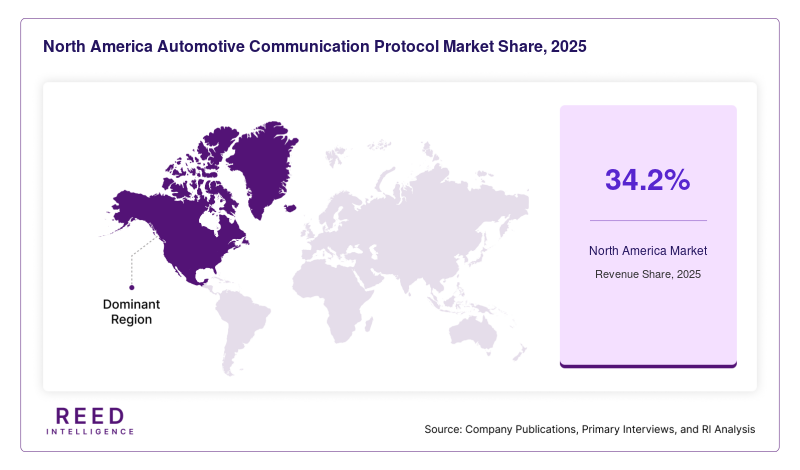
North America accounted for approximately 34.2% market share in 2025 and is projected to grow at a CAGR of 8.4% from 2026 to 2034. The region benefits from strong automotive R&D infrastructure and early adoption of advanced vehicle technologies.
The United States leads the regional market due to its strong presence of major OEMs and technology companies. Growth is supported by increasing investment in autonomous driving systems and high adoption of connected car technologies.
Europe
Europe held nearly 27.8% share in 2025, with a projected CAGR of 8.1% during the forecast period. The region is driven by strict automotive safety regulations and electrification trends.
Germany dominates the European market due to its strong automotive manufacturing base. The country’s focus on premium vehicle production and advanced engineering supports demand for high-performance communication protocols.
Asia Pacific
Asia Pacific captured around 29.6% share in 2025 and is expected to grow at the fastest CAGR of 11.2%. Rapid vehicle production and EV adoption are key drivers.
China leads the region, supported by large-scale EV manufacturing and government-backed smart mobility initiatives. Increasing demand for affordable connected vehicles further accelerates growth.
Middle East & Africa
The region accounted for approximately 4.1% share in 2025, with a CAGR of 7.6% expected through 2034. Growth is moderate due to gradual adoption of advanced automotive technologies.
The United Arab Emirates dominates the market due to smart city initiatives and rising luxury vehicle imports, supporting demand for advanced communication systems.
Latin America
Latin America held nearly 4.3% share in 2025 and is projected to grow at a CAGR of 7.9%. Automotive digitalization is gradually expanding across the region.
Brazil leads the market due to its strong automotive assembly base and increasing adoption of connected vehicle technologies in urban transport systems.
Competitive Landscape
The Automotive Communication Protocol Market is moderately consolidated, with key players focusing on protocol innovation, semiconductor integration, and strategic collaborations. Major companies include Bosch, NXP Semiconductors, Texas Instruments, Continental AG, and Vector Informatik. These companies are investing heavily in Automotive Ethernet development and secure communication architectures to support next-generation vehicle platforms.
Bosch remains a leading player due to its strong portfolio in CAN and automotive software solutions. Recent developments include advancements in zonal architecture communication systems designed to reduce vehicle wiring complexity and improve data efficiency across ECUs.
Key Players
- Robert Bosch GmbH
- NXP Semiconductors
- Texas Instruments Incorporated
- Continental AG
- Vector Informatik GmbH
- Infineon Technologies AG
- STMicroelectronics
- Renesas Electronics Corporation
- Analog Devices Inc.
- Aptiv PLC
- ZF Friedrichshafen AG
- Denso Corporation
- Hyundai Mobis
- Qualcomm Technologies Inc.
- Panasonic Automotive Systems
Recent Developments
- A leading semiconductor manufacturer introduced a next-generation Automotive Ethernet chipset designed to support multi-gigabit data transmission for autonomous driving platforms.
- An OEM announced the integration of zonal architecture in its upcoming EV lineup, reducing wiring complexity by over 30% and enhancing communication efficiency.
- A global supplier expanded its collaboration with software firms to develop secure in-vehicle communication frameworks aligned with international cybersecurity regulations.
Automotive Communication Protocol Market Segments
By Protocol Type
- CAN (Controller Area Network)
- LIN (Local Interconnect Network)
- FlexRay
- Automotive Ethernet
- MOST (Media Oriented Systems Transport)
By Application
- Infotainment Systems
- ADAS and Safety Systems
- Powertrain Systems
- Body Electronics
- Telematics and Connectivity Systems
By Vehicle Type
- Passenger Vehicles
- Commercial Vehicles
- Electric Vehicles (EVs)
- Hybrid Vehicles
- Autonomous Vehicles
By Region
- North America
- Europe
- APAC
- Middle East and Africa
- LATAM