Automotive Control Arm Market Size, Share & Demand Report By Material Type (Steel Control Arms, Aluminum Control Arms, Composite Control Arms), By Vehicle Type (Passenger Vehicles, Commercial Vehicles, Electric Vehicles), By Sales Channel (Original Equipment Manufacturers (OEM), Aftermarket), By Application (Front Suspension Systems, Rear Suspension Systems, Performance Suspension Systems), By Region & Segment Forecasts, 2026–2034
USD 3950
Market Overview
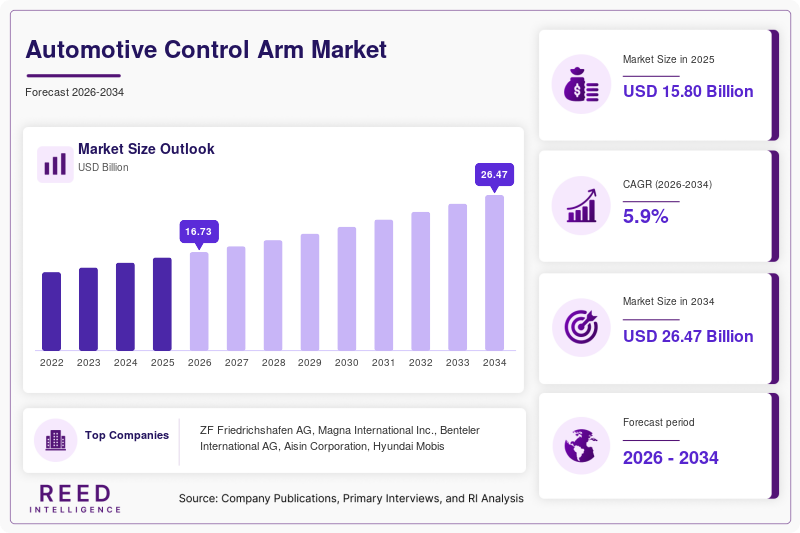
The global Automotive Control Arm Market size was valued at USD 15.8 billion in 2026 and is projected to reach USD 24.9 billion by 2034, expanding at a CAGR of 5.9% during the forecast period from 2026 to 2034. The market is witnessing stable growth due to increasing vehicle production, rising adoption of lightweight suspension systems, and continuous advancements in automotive chassis technologies. Automotive control arms are essential suspension components that connect the wheel hub to the vehicle frame and support smooth wheel movement, steering stability, and ride comfort. Growing demand for improved vehicle handling and durability is encouraging automakers to invest in advanced suspension architectures across passenger and commercial vehicles.
One of the major global factors supporting market growth is the expansion of electric vehicle production. Electric vehicles require lightweight and durable suspension systems to improve energy efficiency and optimize battery performance. As automakers focus on vehicle weight reduction, aluminum and composite control arms are gaining wider adoption across mid-range and premium vehicle categories. In addition, increasing road infrastructure investments and higher vehicle ownership in emerging economies are creating long-term opportunities for suspension component manufacturers.
Key Highlights
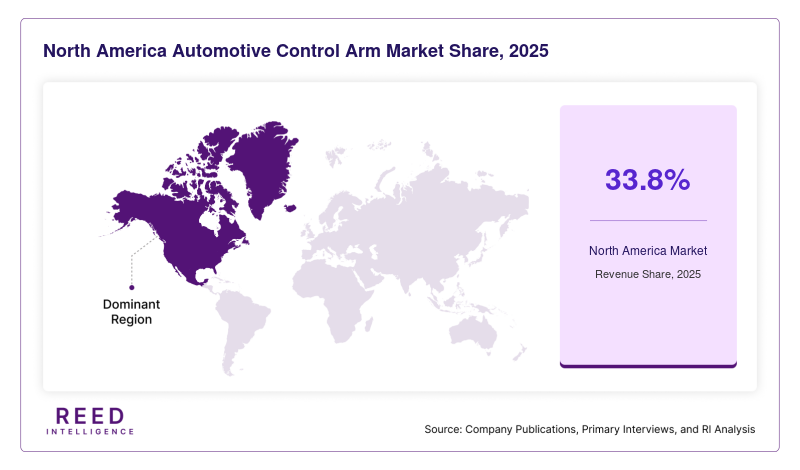
- North America dominated the market with a 33.8% share in 2025.
- Asia Pacific is expected to grow at the fastest CAGR of 7.1% during 2026–2034.
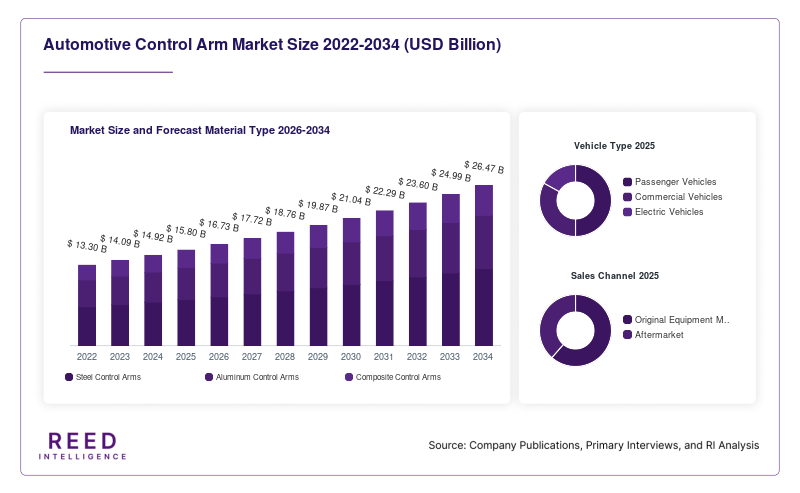
- By material type, steel control arms accounted for the largest share of 52.4%, while aluminum control arms are projected to grow at a CAGR of 7.8%.
- By vehicle type, passenger vehicles led with a 68.6% share, whereas electric vehicles are expected to expand at a CAGR of 8.4%.
- The United States remained the dominant country, with market values of USD 3.9 billion in 2024 and USD 4.2 billion in 2025.
Market Trends
Increasing Adoption of Lightweight Aluminum Components
The Automotive Control Arm Market is witnessing a strong shift toward lightweight materials, particularly aluminum-based control arms. Automakers are focusing on reducing vehicle weight to improve fuel efficiency and comply with stringent emission regulations. Aluminum control arms provide lower mass compared to traditional steel variants while maintaining structural integrity and durability. This trend is particularly visible in electric vehicles and premium passenger cars where lightweight suspension systems contribute to improved driving range and handling performance. Manufacturers are also investing in forged aluminum technologies that offer enhanced strength and corrosion resistance. As electric mobility adoption rises globally, the demand for lightweight suspension components is expected to accelerate steadily across both OEM and aftermarket channels.
Growing Integration of Advanced Suspension Architectures
The increasing use of advanced suspension systems in modern vehicles is shaping the future of the Automotive Control Arm Market. Automakers are integrating multi-link and adaptive suspension systems to improve ride comfort, vehicle stability, and steering precision. These advanced architectures require high-performance control arms capable of supporting dynamic wheel movement under different driving conditions. Luxury vehicles, sports utility vehicles, and electric crossovers are increasingly adopting sophisticated suspension setups to enhance consumer driving experience. In addition, rising consumer preference for safer and smoother rides is encouraging automotive manufacturers to improve suspension design standards. The trend is creating demand for precision-engineered control arms with higher fatigue strength and longer operational life across multiple vehicle platforms.
Market Drivers
Rising Global Vehicle Production and Ownership
The steady increase in global vehicle production is a major factor driving the Automotive Control Arm Market. Emerging economies are witnessing rising disposable incomes, urbanization, and infrastructure development, which are supporting higher passenger vehicle ownership. Increasing demand for commercial transportation and logistics vehicles is also contributing to suspension component demand. Automotive control arms play a critical role in maintaining wheel alignment and ride stability, making them essential across all vehicle categories. Growing production of SUVs and crossover vehicles is further strengthening market demand because these vehicle types require durable suspension systems capable of handling varied road conditions. Manufacturers are expanding production capacities to meet the increasing demand from original equipment manufacturers and replacement markets globally.
Expansion of Electric and Hybrid Vehicle Manufacturing
The growing production of electric and hybrid vehicles is creating significant growth opportunities for the Automotive Control Arm Market. Electric vehicles require optimized suspension systems that support battery weight while maintaining vehicle stability and energy efficiency. Automakers are increasingly using lightweight control arms to improve range performance and reduce overall vehicle mass. Government incentives supporting electric mobility adoption are accelerating vehicle electrification across developed and emerging economies. In addition, consumers are demanding vehicles with enhanced driving comfort and lower maintenance requirements, encouraging manufacturers to introduce advanced suspension solutions. The transition toward electrified mobility is expected to generate long-term demand for high-strength, lightweight, and corrosion-resistant control arm components during the forecast period.
Market Restraint
Volatility in Raw Material Prices and Manufacturing Costs
Fluctuations in raw material prices remain a key challenge for the Automotive Control Arm Market. Steel, aluminum, and composite materials used in control arm manufacturing are subject to price volatility due to changing global trade conditions, supply chain disruptions, and energy costs. Rising manufacturing expenses directly affect production margins for automotive component suppliers, especially small and medium-scale manufacturers. In addition, advanced lightweight materials require specialized forging and machining technologies, increasing operational costs. These challenges can limit the adoption of premium control arm solutions in price-sensitive vehicle segments. Supply chain instability and transportation disruptions may also delay component deliveries and affect production schedules for automotive manufacturers. As competition intensifies, companies are under pressure to balance product quality, durability, and affordability while maintaining stable profit margins in both OEM and aftermarket operations.
Market Opportunities
Growth of the Automotive Aftermarket Industry
The expanding automotive aftermarket sector is creating notable opportunities for the Automotive Control Arm Market. Increasing vehicle age across several regions is driving replacement demand for suspension components due to wear and tear from prolonged vehicle usage. Consumers are becoming more aware of vehicle maintenance practices that improve safety and driving performance. Control arms require periodic replacement to maintain wheel alignment and suspension efficiency, particularly in regions with poor road conditions. Independent repair shops and online automotive parts platforms are expanding the availability of aftermarket control arm products, supporting broader market penetration. Manufacturers are introducing cost-effective aftermarket solutions with improved durability and corrosion resistance to strengthen customer retention and increase recurring revenue opportunities.
Rising Demand for Electric SUVs and Crossovers
The growing popularity of electric SUVs and crossover vehicles is opening new avenues for market expansion. These vehicle categories require advanced suspension systems capable of handling increased vehicle weight and delivering enhanced ride comfort. Automotive manufacturers are investing in innovative control arm designs that improve handling performance while minimizing noise and vibration levels. Electric SUVs are particularly dependent on lightweight suspension components to optimize battery efficiency and driving range. The increasing launch of premium electric utility vehicles across North America, Europe, and Asia Pacific is expected to support long-term demand for high-performance control arms. Manufacturers focusing on lightweight alloys and advanced manufacturing techniques are likely to benefit from the expanding electric mobility ecosystem.
Segmental Analysis
By Material Type
Steel control arms accounted for the largest share of the Automotive Control Arm Market in 2024 due to their cost efficiency, structural strength, and widespread use across passenger and commercial vehicles. Steel remains a preferred material for suspension systems because it offers high durability and strong resistance to heavy loads and road impact conditions. Automotive manufacturers continue to utilize steel control arms in mid-range and economy vehicle segments where affordability and reliability remain important purchasing factors. The material is also widely available, enabling manufacturers to maintain stable production capacities across global markets. In addition, steel control arms provide longer operational life in heavy-duty vehicle applications, including trucks and utility vehicles operating under demanding road conditions. The dominance of steel components is further supported by strong aftermarket replacement demand across developing economies.
Aluminum control arms are expected to register the fastest CAGR of 7.8% during the forecast period due to increasing demand for lightweight automotive components. Automakers are adopting aluminum suspension parts to reduce vehicle mass, improve fuel economy, and enhance electric vehicle driving range. Aluminum control arms offer improved corrosion resistance and better heat dissipation compared to conventional steel variants. The material is increasingly used in premium passenger cars, electric vehicles, and performance-oriented SUVs where handling precision and ride comfort are important differentiators. Manufacturers are also investing in advanced forging and casting technologies to improve aluminum component strength and reduce manufacturing complexity. Growing environmental regulations focused on emission reduction are further accelerating the transition toward lightweight automotive suspension systems globally.
By Vehicle Type
Passenger vehicles held the dominant share of the Automotive Control Arm Market in 2024, accounting for a significant portion of total revenue generation. Rising urbanization, expanding middle-class populations, and increasing consumer preference for private transportation are driving passenger vehicle demand globally. Suspension performance remains an important purchasing factor among consumers seeking comfortable and stable driving experiences. Control arms are widely integrated across sedans, hatchbacks, SUVs, and crossover vehicles to improve wheel movement and steering control. Automakers are increasingly focusing on suspension refinement to enhance overall vehicle performance and ride quality. Additionally, replacement demand for suspension components in aging passenger vehicles continues to contribute significantly to aftermarket revenue across developed and emerging markets.
Electric vehicles are projected to witness the fastest growth during the forecast period with a CAGR of 8.4%. The rapid expansion of electric mobility initiatives and government incentives supporting zero-emission transportation are driving demand for advanced suspension systems. Electric vehicles require lightweight control arms to offset battery weight and improve energy efficiency. Manufacturers are developing high-strength aluminum and composite control arms specifically designed for electric platforms. Increasing launch activity in the electric SUV and crossover categories is further accelerating demand for optimized suspension architectures. In addition, consumers expect electric vehicles to provide smoother ride quality and lower cabin vibration, encouraging automakers to adopt advanced suspension technologies with improved control arm performance characteristics.
By Sales Channel
Original equipment manufacturers dominated the Automotive Control Arm Market in 2024 due to rising global vehicle production and strong partnerships between automakers and component suppliers. OEMs prioritize high-quality suspension components that meet stringent durability, safety, and performance standards. Automotive manufacturers increasingly collaborate with suspension system suppliers during vehicle design stages to optimize ride comfort and handling performance. The integration of advanced chassis technologies and lightweight materials in modern vehicles is further strengthening OEM demand for precision-engineered control arms. In addition, rising production of electric and hybrid vehicles is encouraging OEMs to invest in innovative suspension architectures that support improved energy efficiency and driving stability across multiple vehicle platforms.
The aftermarket segment is expected to grow at the fastest CAGR during the forecast period due to increasing vehicle age and rising maintenance awareness among consumers. Suspension components experience continuous stress and road impact, leading to periodic replacement requirements over a vehicle’s operational life. Expanding automotive repair networks and online spare parts distribution channels are improving aftermarket accessibility across both developed and emerging economies. Consumers are increasingly choosing aftermarket control arms with enhanced corrosion resistance and longer durability to reduce maintenance frequency. Fleet operators are also investing in timely suspension maintenance to improve fuel efficiency and vehicle safety. The growth of independent service centers and digital automotive retail platforms is expected to support sustained aftermarket expansion globally.
Regional Analysis
North America
North America accounted for 33.8% of the global Automotive Control Arm Market share in 2025 and is expected to maintain stable growth during the forecast period with a CAGR of 5.2%. The region benefits from strong automotive manufacturing infrastructure, high vehicle ownership rates, and increasing demand for sport utility vehicles and pickup trucks. Consumers in the region prioritize vehicle durability, ride quality, and safety, encouraging automakers to integrate advanced suspension technologies. Growing replacement demand for suspension components in the aftermarket sector is also supporting regional industry expansion.
The United States remained the dominant country within North America due to its large automotive production base and strong aftermarket network. Increasing adoption of electric vehicles is creating demand for lightweight aluminum control arms across passenger vehicle categories. The presence of established automotive component manufacturers and continued investments in suspension technology development are supporting market growth. In addition, rising consumer preference for high-performance vehicles is accelerating the use of advanced suspension systems that require durable control arm solutions.
Europe
Europe represented a significant share of the Automotive Control Arm Market in 2025 and is projected to grow at a CAGR of 5.4% through 2034. The regional market is supported by strict vehicle safety standards and strong demand for premium passenger vehicles. Automotive manufacturers across Europe are focusing on lightweight vehicle architectures to comply with emission reduction regulations. Increasing integration of advanced chassis systems and adaptive suspension technologies is contributing to higher demand for high-performance control arms in the region.
Germany remained the leading market within Europe due to its strong automotive engineering capabilities and large luxury vehicle production industry. German automakers are investing heavily in electric mobility and lightweight suspension systems, increasing demand for forged aluminum control arms. The country’s focus on vehicle innovation and manufacturing efficiency is supporting long-term market expansion. Additionally, the growing popularity of hybrid vehicles and luxury SUVs is creating new opportunities for suspension component suppliers operating in the region.
Asia Pacific
Asia Pacific is expected to register the fastest CAGR of 7.1% during the forecast period due to rapid vehicle production growth and expanding urbanization. The region benefits from increasing disposable income levels, improving road infrastructure, and strong demand for passenger vehicles. Countries across Asia Pacific are experiencing rapid industrialization, leading to higher logistics and transportation activities that support commercial vehicle demand. Rising automotive manufacturing investments are further strengthening the regional Automotive Control Arm Market outlook.
China dominated the Asia Pacific market due to its extensive automotive manufacturing ecosystem and rising electric vehicle production. Government incentives supporting electric mobility and local component manufacturing are encouraging suspension system innovation. Domestic automakers are increasingly adopting lightweight control arms to improve vehicle efficiency and driving comfort. In addition, the rapid expansion of automotive aftermarket services and increasing consumer awareness regarding vehicle maintenance are contributing to strong regional demand for replacement suspension components.
Middle East & Africa
The Middle East & Africa Automotive Control Arm Market is witnessing gradual expansion supported by rising vehicle imports and infrastructure development activities. The region is expected to grow at a CAGR of 4.6% during the forecast period. Increasing urban transportation requirements and growing demand for durable vehicles suited for harsh road conditions are supporting market growth. Automotive aftermarket demand is also increasing as vehicle owners prioritize replacement of worn suspension components to maintain vehicle performance and safety.
Saudi Arabia emerged as the dominant country within the region due to rising vehicle ownership and increasing investments in transportation infrastructure. Harsh climatic conditions and uneven road surfaces create higher wear rates for suspension systems, driving replacement demand for control arms. The country is also witnessing growing interest in electric mobility and premium passenger vehicles, supporting gradual adoption of advanced suspension technologies. Expansion of automotive service networks is further improving market accessibility across the region.
Latin America
Latin America held a moderate share of the Automotive Control Arm Market in 2025 and is expected to grow steadily over the forecast period at a CAGR of 4.9%. Economic recovery, increasing automotive production, and growing commercial transportation activities are supporting regional market expansion. Consumers are increasingly focusing on vehicle maintenance due to longer vehicle ownership cycles, creating stable demand for aftermarket suspension components. In addition, regional automotive manufacturers are expanding production capacities to meet rising domestic demand.
Brazil remained the leading country within Latin America due to its established automotive manufacturing sector and growing passenger vehicle demand. Increasing road transportation activities and expansion of logistics services are driving the need for reliable suspension systems across commercial vehicle fleets. The country is also witnessing increasing adoption of compact SUVs and utility vehicles that require durable control arm assemblies. Growing availability of aftermarket automotive parts through digital retail channels is supporting broader product accessibility and market growth.
Competitive Landscape
The Automotive Control Arm Market is moderately consolidated with the presence of global automotive component manufacturers competing through product innovation, lightweight material development, and strategic supply agreements. Companies are focusing on improving manufacturing efficiency and expanding regional production facilities to strengthen supply chain capabilities. Market participants are also investing in forged aluminum technologies and advanced coating solutions to enhance component durability and reduce vehicle weight.
ZF Friedrichshafen AG remained one of the leading players in the market due to its strong suspension systems portfolio and extensive partnerships with global automotive manufacturers. The company recently expanded its lightweight chassis component production capabilities to support rising electric vehicle demand. Other major companies are emphasizing mergers, product launches, and capacity expansions to strengthen competitive positioning.
Key Players
- ZF Friedrichshafen AG
- Benteler International AG
- Magna International Inc.
- Aisin Corporation
- Hyundai Mobis
- Schaeffler AG
- NHK Spring Co., Ltd.
- Rassini SAB de CV
- Mubea Group
- Tower International
- Dorman Products
- CTR Corporation
- Mando Corporation
- Tenneco Inc.
- Yorozu Corporation
Recent Developments
- In February 2026, ZF Friedrichshafen AG announced the expansion of its lightweight suspension component manufacturing facility in Europe to support increasing electric vehicle production demand.
- In September 2025, Magna International Inc. introduced a new forged aluminum control arm platform designed for electric SUVs and crossover vehicles.
- In June 2025, Hyundai Mobis partnered with a regional automaker to develop advanced suspension systems for next-generation electric vehicles.
- In January 2026, Benteler International AG announced investments in automated chassis manufacturing technologies to improve production efficiency and reduce material waste.
Automotive Control Arm Market Segments
Material Type
- Steel Control Arms
- Aluminum Control Arms
- Composite Control Arms
Vehicle Type
- Passenger Vehicles
- Commercial Vehicles
- Electric Vehicles
Sales Channel
- Original Equipment Manufacturers (OEM)
- Aftermarket
By Region
- North America
- Europe
- APAC
- Middle East and Africa
- LATAM