Automotive Crank Trigger Market Size, Share, Demand Report By Component Type (Magnetic Crank Sensors, Optical Crank Sensors, Hall Effect Sensors), By Vehicle Type (Passenger Vehicles, Commercial Vehicles, Performance & Motorsport Vehicles, Hybrid Retrofit Vehicles), By Sales Channel (OEM, Aftermarket), Industry Trends, Regional Insights & Forecasts, 2026–2034
USD 3950
Market Overview
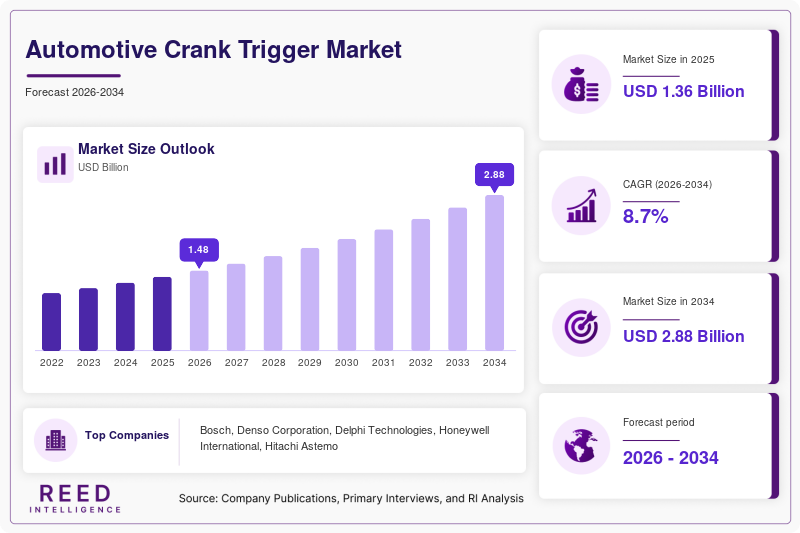
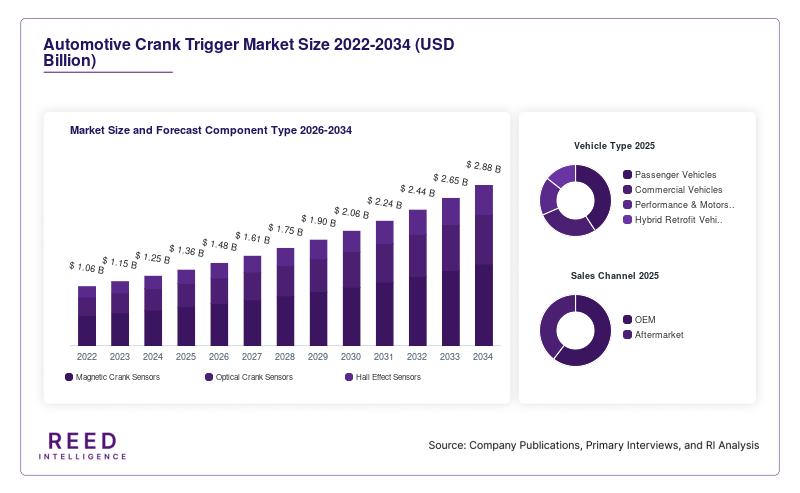
The Automotive Crank Trigger Market size is projected to reach USD 1.48 billion in 2026 and is anticipated to attain USD 2.89 billion by 2034, registering a CAGR of 8.7% during 2026–2034. The market is witnessing steady expansion due to increasing demand for high-precision engine timing systems used in both performance vehicles and modern fuel-efficient automotive platforms. Crank trigger systems play a critical role in optimizing ignition timing, improving combustion efficiency, and supporting advanced ECU-based engine management systems across passenger and commercial vehicles.
A major factor supporting market growth is the global transition toward electronically controlled internal combustion engines (ICEs) integrated with hybrid powertrains. As emission regulations tighten across major economies, automotive manufacturers are increasingly adopting crank trigger sensors with enhanced accuracy, durability, and digital compatibility. This shift is further strengthened by rising consumer demand for improved engine performance, reduced fuel consumption, and enhanced drivability, particularly in high-performance and motorsport applications.
Key Highlights
- North America dominated the market with a 34.2% share in 2025.
- Asia Pacific is expected to grow at the fastest CAGR of 11.2% during 2026–2034.
- By component type, magnetic crank sensors accounted for the largest share of 38.5%.
- while optical crank trigger systems are projected to grow at a CAGR of 10.9%.
- By vehicle type, passenger vehicles led with a 44.1% share.
- whereas electric-hybrid performance retrofit systems are expected to expand at a CAGR of 12.1%.
- The United States remained the dominant country, with market values of USD 610 million in 2024 and USD 655 million in 2025.
Market Trends
Increasing Integration of High-Resolution Crank Trigger Systems
One of the prominent trends in the Automotive Crank Trigger Market is the increasing adoption of high-resolution crank trigger systems capable of delivering ultra-precise engine positioning data. Modern engine control units require real-time, high-frequency input signals to manage ignition timing and fuel injection with minimal deviation. As a result, manufacturers are developing multi-tooth reluctor wheels and advanced Hall-effect sensors to enhance signal accuracy. This trend is particularly visible in motorsport applications and premium vehicle segments where engine responsiveness and tuning flexibility are critical performance factors.
Rising Shift Toward Hybrid and ECU-Optimized Engine Platforms
Another key trend shaping the market is the integration of crank trigger systems within hybrid and ECU-optimized engine architectures. Automotive OEMs are redesigning engine platforms to support electrification while retaining internal combustion efficiency. Crank trigger sensors are being upgraded to communicate seamlessly with advanced electronic control systems, enabling smoother engine start-stop functionality and regenerative power optimization. This trend is gaining traction in Europe and Asia Pacific, where hybrid vehicle adoption is accelerating due to regulatory pressure and fuel economy targets.
Market Drivers
Expansion of Performance and Motorsports Vehicle Production
A major driver fueling the Automotive Crank Trigger Market is the growing production and customization of performance and motorsports vehicles. These vehicles require highly accurate engine timing systems to maximize horsepower output and ensure engine stability at high RPMs. Crank trigger systems are widely used in aftermarket tuning, racing engines, and modified automotive platforms. The rising popularity of drag racing, rally sports, and track-day culture across North America and Europe is further accelerating demand. Manufacturers are focusing on lightweight, durable sensor systems capable of withstanding extreme temperature and vibration conditions.
Increasing Adoption of Advanced Engine Management Systems
The rising adoption of advanced engine management systems in modern vehicles is another key growth driver. Automotive manufacturers are increasingly incorporating electronic fuel injection and digital ignition systems that rely heavily on crank trigger inputs. These systems improve fuel efficiency, reduce emissions, and enhance engine reliability. Governments worldwide are enforcing stricter emission standards, pushing OEMs to upgrade engine components with high-precision sensing technologies. This regulatory environment, combined with consumer demand for smoother engine performance, is significantly contributing to market expansion.
Market Restraint
High Integration Complexity and Compatibility Limitations
One of the major restraints affecting the Automotive Crank Trigger Market is the complexity associated with system integration across diverse engine architectures. Crank trigger sensors must be precisely calibrated to match engine specifications, which can vary significantly between manufacturers and vehicle models. This creates compatibility challenges, especially in aftermarket applications where universal fitment is limited. Additionally, incorrect installation or calibration errors can lead to engine misfires or performance inefficiencies. These technical limitations often discourage adoption among small-scale automotive workshops and independent service providers, restricting broader market penetration despite rising demand.
Market Opportunities
Expansion of Electric-Hybrid Performance Conversion Kits
A significant opportunity in the Automotive Crank Trigger Market lies in the growing demand for electric-hybrid performance conversion kits. As automotive enthusiasts and aftermarket companies seek to modernize older combustion engines, crank trigger systems are being integrated into retrofit solutions to enable hybrid compatibility. These systems allow precise synchronization between electric motor assistance and combustion engine timing. The trend is particularly strong in regions with high vehicle modification culture, such as North America and parts of Asia Pacific. Manufacturers focusing on plug-and-play crank trigger solutions are expected to benefit from this expanding niche.
Advancements in Smart Sensor and Digital Signal Processing Technologies
Another major opportunity is the advancement of smart sensor technologies and digital signal processing capabilities. Next-generation crank trigger systems are being designed with integrated microcontrollers and adaptive calibration features that improve accuracy under varying operating conditions. These innovations allow real-time diagnostics, predictive maintenance alerts, and improved ECU communication efficiency. The integration of IoT-enabled automotive systems further enhances the value proposition of smart crank trigger solutions, creating new opportunities for suppliers to enter connected vehicle ecosystems and software-driven automotive platforms.
Segmental Analysis
By Component Type
The magnetic crank sensor segment accounted for the largest market share of 42.3% in 2024, supported by its extensive adoption across OEM and aftermarket automotive applications. Magnetic crank sensors are widely preferred because of their durability, low maintenance requirements, and ability to perform effectively under high-temperature engine conditions. These sensors are extensively used in passenger vehicles and commercial vehicles equipped with electronic ignition systems. Their compatibility with modern ECU architectures and relatively low manufacturing costs continue to strengthen their dominance across global automotive markets.
The optical crank sensor segment is projected to register the fastest CAGR of 10.6% during 2026–2034. Growth is driven by increasing demand for high-precision engine timing systems in motorsports and high-performance automotive applications. Optical crank trigger systems provide improved signal clarity and enhanced rotational accuracy compared to traditional magnetic sensors. Automotive manufacturers and performance tuning companies are increasingly adopting these systems in racing engines to achieve optimized combustion timing and improved throttle response. Rising investments in advanced automotive electronics are also accelerating the adoption of optical crank sensing technologies worldwide.
By Vehicle Type
Passenger vehicles dominated the Automotive Crank Trigger Market with a revenue share of 44.1% in 2024. The segment benefits from large-scale vehicle production and growing integration of electronically controlled ignition systems in modern passenger cars. Increasing consumer demand for fuel-efficient and low-emission vehicles has encouraged manufacturers to adopt advanced engine management technologies that rely on accurate crankshaft positioning. In addition, the widespread use of turbocharged gasoline engines and hybrid-assisted powertrains in passenger vehicles continues to create strong demand for reliable crank trigger systems across developed and emerging automotive markets.
The hybrid retrofit and performance vehicle segment is anticipated to grow at the fastest CAGR of 12.1% during the forecast period. Rising interest in vehicle electrification and aftermarket performance upgrades is supporting segment growth globally. Automotive enthusiasts and specialized tuning workshops are increasingly integrating advanced crank trigger systems into hybrid conversion kits and modified engine platforms. These systems help synchronize electric motor assistance with combustion engine timing, improving efficiency and performance. The growing popularity of racing events, performance tuning culture, and custom vehicle modification trends is expected to further drive segment expansion in the coming years.
By Sales Channel
The OEM segment held the dominant share of 61.8% in 2024 due to the increasing integration of crank trigger systems during vehicle manufacturing. Automotive OEMs are prioritizing advanced ignition timing technologies to comply with fuel efficiency regulations and emission reduction targets. Crank trigger systems are becoming standard components in modern electronically controlled engines because they support accurate fuel injection and optimized combustion timing. Strong partnerships between automotive manufacturers and sensor suppliers are also contributing to segment dominance, particularly in regions with high passenger vehicle production volumes.
The aftermarket segment is expected to expand at a CAGR of 9.8% during 2026–2034, driven by rising vehicle modification activities and increasing replacement demand for aging automotive components. Vehicle owners are increasingly upgrading ignition systems to improve engine responsiveness, fuel economy, and performance efficiency. The growing popularity of motorsports and custom automotive tuning is also supporting aftermarket sales of high-resolution crank trigger kits. In addition, expanding e-commerce distribution channels and the availability of affordable performance components are making aftermarket crank trigger systems more accessible to automotive enthusiasts and independent repair workshops globally.
Regional Analysis
North America
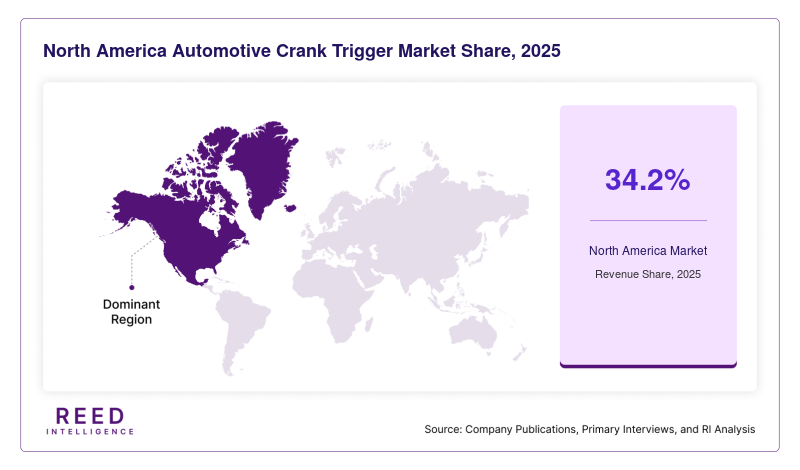
North America accounted for the largest revenue share of 34.2% in 2025 and is projected to expand at a CAGR of 8.3% during 2026–2034. The region benefits from the strong presence of automotive performance component manufacturers, advanced ECU technology adoption, and a mature motorsports ecosystem. Demand for crank trigger systems remains high across passenger vehicles, racing cars, and aftermarket tuning applications. The increasing integration of precision ignition systems in modern gasoline engines is further strengthening regional market growth.
The United States dominates the North American market due to high vehicle ownership rates and widespread adoption of advanced engine management systems. One of the major growth factors is the expanding performance vehicle customization industry, particularly in racing and aftermarket tuning communities. Automotive workshops and racing teams increasingly utilize high-resolution crank trigger systems to improve engine synchronization and fuel efficiency. Additionally, stringent emission standards are encouraging OEMs to adopt advanced ignition timing technologies in next-generation combustion and hybrid vehicles.
Europe
Europe held a market share of 27.6% in 2025 and is expected to witness a CAGR of 7.9% during the forecast period. The regional market is supported by the strong automotive manufacturing presence across Germany, France, Italy, and the United Kingdom. European automakers are increasingly focusing on fuel-efficient engine technologies and hybrid systems, driving demand for advanced crank trigger sensors. The rise in premium automotive production and growing investments in automotive electronics continue to support steady market expansion throughout the region.
Germany remains the dominant country in Europe due to its extensive automotive engineering capabilities and concentration of leading OEMs. A key growth factor is the rapid development of hybrid powertrain systems integrated with intelligent ECU technologies. Automotive manufacturers are increasingly deploying high-precision crankshaft position sensing solutions to improve combustion timing accuracy and reduce emissions. Moreover, the strong motorsports heritage in Germany and neighboring countries continues to create additional opportunities for advanced crank trigger system suppliers and aftermarket performance component manufacturers.
Asia Pacific
Asia Pacific captured 24.8% of the global Automotive Crank Trigger Market in 2025 and is anticipated to register the fastest CAGR of 11.2% during 2026–2034. The region is experiencing rapid growth due to increasing vehicle production, expanding automotive electronics manufacturing, and rising demand for fuel-efficient engines. Countries such as China, Japan, India, and South Korea are heavily investing in modern vehicle platforms integrated with advanced ignition timing systems. The increasing penetration of hybrid vehicles is also contributing significantly to market growth.
China dominates the Asia Pacific market owing to its large-scale automotive production capacity and rapidly growing aftermarket sector. One major growth factor is the rising adoption of cost-effective ECU-integrated crank trigger systems in mid-range passenger vehicles. Chinese automotive manufacturers are increasingly focusing on digital engine management technologies to improve fuel economy and emission performance. In addition, expanding domestic motorsports activities and rising consumer interest in vehicle customization are supporting demand for high-performance crank trigger solutions across the country.
Middle East & Africa
Middle East & Africa accounted for 7.1% of the global market share in 2025 and is forecast to grow at a CAGR of 6.8% over the forecast period. The regional market is gradually expanding due to increasing imports of premium vehicles and the rising popularity of automotive performance upgrades. Demand for crank trigger systems is primarily concentrated in urban automotive markets where luxury and sports vehicles have a stronger presence. Growing investments in automotive service infrastructure are also supporting market development across the region.
The United Arab Emirates leads the regional market due to high demand for luxury vehicles and motorsports-related automotive modifications. A significant growth factor is the strong culture of desert racing and high-performance automotive customization. Automotive enthusiasts in the region increasingly invest in aftermarket ECU systems and precision ignition technologies to enhance engine performance under extreme operating conditions. Additionally, the expansion of specialized automotive workshops and performance tuning centers is creating new growth opportunities for crank trigger system manufacturers.
Latin America
Latin America represented 5.3% of the Automotive Crank Trigger Market in 2025 and is expected to grow at a CAGR of 7.2% during 2026–2034. Market growth is driven by increasing automotive repair activities, expanding used vehicle fleets, and growing awareness regarding engine efficiency improvements. The aftermarket segment plays a crucial role in regional demand, as older vehicles frequently require ignition system upgrades and replacement crank trigger components. The gradual adoption of electronic engine management systems is further supporting market penetration.
Brazil dominates the Latin American market due to its extensive automotive aftermarket industry and large vehicle population. One key growth factor is the increasing demand for affordable ignition timing upgrades in aging passenger vehicles and commercial fleets. Automotive repair shops are increasingly adopting advanced crank trigger systems to improve engine reliability and fuel economy. Furthermore, the rising availability of low-cost aftermarket performance parts through regional distribution networks is helping expand market accessibility among vehicle owners and independent automotive service providers.
Competitive Landscape
The Automotive Crank Trigger Market is characterized by moderate competition with the presence of several global automotive electronics manufacturers and specialized performance component suppliers. Companies operating in the market are focusing on sensor precision, thermal durability, compact design, and ECU compatibility to strengthen their competitive positioning. Strategic collaborations with automotive OEMs and motorsport organizations remain a common growth strategy among leading participants. Market players are also investing in research and development activities to enhance signal processing capabilities and improve sensor efficiency under extreme engine operating conditions.
Bosch continues to maintain a leading position in the market due to its extensive automotive sensor portfolio, strong distribution network, and long-standing partnerships with global vehicle manufacturers. The company has focused on developing advanced crankshaft sensing technologies capable of supporting hybrid-compatible engine systems and electronically controlled ignition platforms. Other major players including Denso Corporation, Delphi Technologies, Continental AG, and Hitachi Astemo are expanding their product offerings through technological innovation and regional manufacturing expansion strategies.
Key Players
- Bosch
- Denso Corporation
- Delphi Technologies
- Honeywell International
- Hitachi Astemo
- Continental AG
- Mitsubishi Electric Corporation
- NGK Spark Plug Co.
- Robertshaw Controls
- Standard Motor Products
- AEM Electronics
- Haltech
- MSD Performance
- Sensata Technologies
- Eaton Corporation
Recent Developments
- A leading sensor manufacturer introduced a high-resolution crank trigger system designed for hybrid ICE platforms, improving ECU synchronization accuracy under variable load conditions.
- An automotive electronics company expanded its production facility in Asia Pacific to support growing demand for advanced engine timing components in mid-range passenger vehicles.
- A motorsport technology supplier launched a lightweight crank trigger kit optimized for racing engines, offering improved thermal stability and vibration resistance for extreme conditions.
Automotive Crank Trigger Market Segments
Component Type
- Magnetic Crank Sensors
- Optical Crank Sensors
- Hall Effect Sensors
Vehicle Type
- Passenger Vehicles
- Commercial Vehicles
- Performance & Motorsport Vehicles
- Hybrid Retrofit Vehicles
Sales Channel
- OEM
- Aftermarket
By Region
- North America
- Europe
- APAC
- Middle East and Africa
- LATAM