Automotive Electronic Auto Dimming Mirror Market Size, Share & Demand Report By Product Type (Interior Auto Dimming Mirrors, Exterior Auto Dimming Mirrors), By Vehicle Type (Passenger Vehicles, Commercial Vehicles, Electric Vehicles), By Technology (Electrochromic Mirrors, Camera-Integrated Smart Mirrors, Sensor-Based Auto Dimming Mirrors), By Sales Channel (OEM, Aftermarket), By Region & Segment Forecasts, 2026–2034
USD 3950
Market Overview
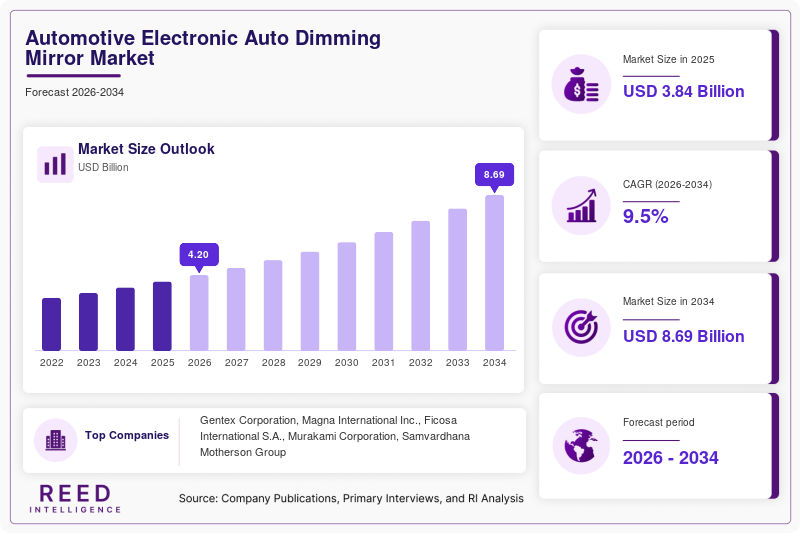
The global Automotive Electronic Auto Dimming Mirror Market size was valued at USD 3.84 billion in 2026 and is projected to reach USD 7.96 billion by 2034, expanding at a CAGR of 9.5% during the forecast period from 2026 to 2034. The market is experiencing stable growth due to the increasing integration of advanced driver assistance systems in passenger and commercial vehicles across developed and emerging economies. Automotive electronic auto dimming mirrors reduce glare from trailing vehicles during night driving, improving visibility, driving comfort, and road safety. Growing consumer preference for premium vehicle features and intelligent cabin technologies is supporting wider adoption across mid-range and luxury vehicle categories.
The increasing focus on vehicle safety regulations and driver convenience technologies has contributed significantly to market expansion. Automotive manufacturers are integrating electronic auto dimming mirrors with connected systems such as blind spot detection, rear-view cameras, telematics, rain sensors, and digital displays. Rising vehicle production in Asia Pacific and increasing demand for electric vehicles are also influencing market penetration. In addition, the growth of autonomous driving technologies is encouraging suppliers to develop multifunctional mirrors with integrated displays, sensors, and communication modules.
Key Highlights
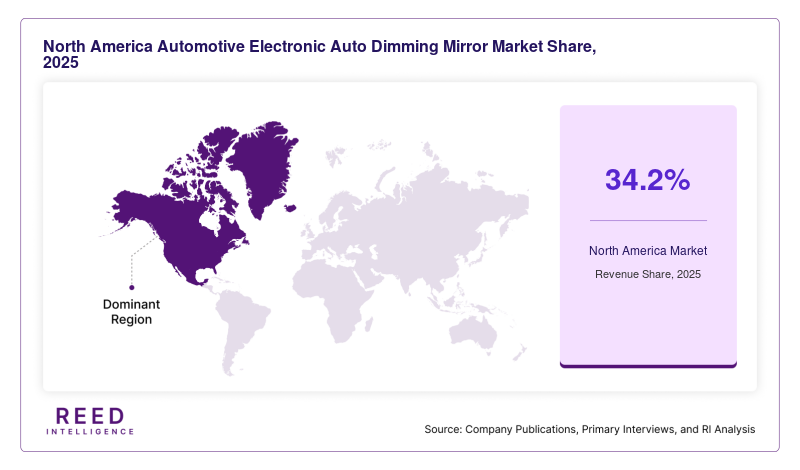
- North America dominated the market with a 34.2% share in 2025, while Asia Pacific is expected to grow at the fastest CAGR of 11.2% during 2026–2034.
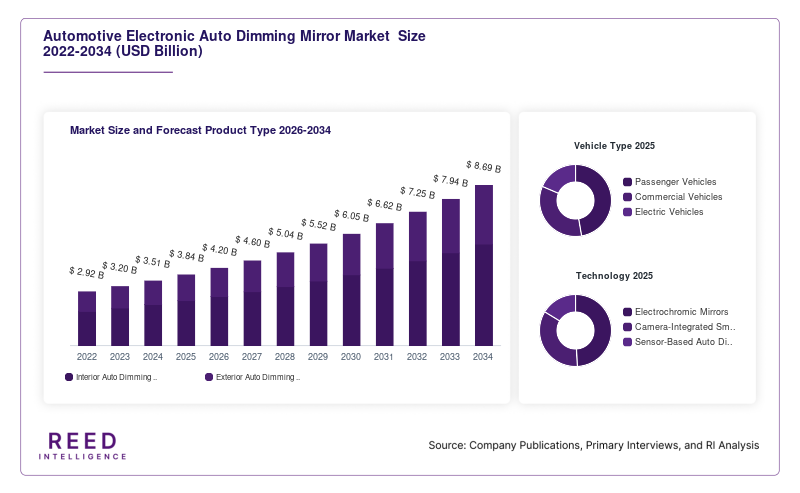
- By product type, interior auto dimming mirrors accounted for the largest share of 56.8%, while exterior auto dimming mirrors are projected to grow at a CAGR of 10.8%.
- By vehicle type, passenger vehicles led with a 72.4% share, whereas electric vehicles are expected to expand at a CAGR of 12.1%.
- By technology, electrochromic mirrors held the leading share of 63.7%, while camera-integrated smart mirrors are forecast to grow at a CAGR of 13.4%.
- The United States remained the dominant country, with market values of USD 760 million in 2024 and USD 835 million in 2025.
Market Trends
Integration of Smart Mirror Technologies with ADAS Platforms
Automotive manufacturers are increasingly integrating electronic auto dimming mirrors with advanced driver assistance systems to improve vehicle safety and driver awareness. Modern mirrors are no longer limited to glare reduction functions. They are being equipped with embedded cameras, sensors, navigation displays, and connectivity features that support lane monitoring, parking assistance, and collision alerts. This transition toward multifunctional mirror systems is creating strong demand among original equipment manufacturers seeking to improve cabin intelligence and driver convenience.
The rising adoption of semi-autonomous and connected vehicles is further accelerating this trend. Smart mirrors with digital displays and integrated monitoring systems help optimize visibility in low-light and adverse weather conditions. Luxury vehicle manufacturers are expanding the use of hybrid mirror systems that combine electrochromic technology with real-time video displays. Automotive suppliers are also developing compact and lightweight smart mirrors that support energy-efficient vehicle designs. As consumers continue to prioritize safety, convenience, and digital vehicle experiences, integrated smart mirror solutions are expected to become increasingly common across premium and mid-range vehicle categories.
Growing Adoption of Electronic Mirrors in Electric Vehicles
The rapid expansion of the electric vehicle industry is influencing the demand for automotive electronic auto dimming mirrors worldwide. Electric vehicle manufacturers are focusing on aerodynamic efficiency, advanced electronics, and intelligent cabin systems to improve vehicle range and driving performance. Electronic auto dimming mirrors align with these priorities because they support enhanced visibility while integrating seamlessly with digital vehicle architectures.
Automakers are increasingly using advanced mirror systems in electric sedans, SUVs, and commercial vehicles to strengthen premium positioning and differentiate product offerings. Digital and camera-based mirror systems are also gaining traction because they contribute to reduced aerodynamic drag compared to conventional mirror assemblies. The growth of battery electric vehicles in China, Europe, and North America is encouraging automotive suppliers to invest in innovative mirror technologies with low power consumption and high operational efficiency. As electric vehicle penetration continues to rise globally, the demand for intelligent mirror systems with connected and safety-oriented features is expected to increase steadily.
Market Drivers
Rising Demand for Vehicle Safety and Driver Comfort Features
Increasing awareness regarding road safety and driver comfort is one of the primary factors driving the Automotive Electronic Auto Dimming Mirror Market. Consumers are placing greater emphasis on technologies that improve nighttime visibility and reduce driving fatigue. Auto dimming mirrors minimize glare from headlights of trailing vehicles, helping drivers maintain better focus and visual clarity during long-distance travel. This functionality has become especially important in urban areas with dense traffic and high nighttime driving activity.
Automotive manufacturers are responding to changing consumer preferences by integrating advanced mirror systems into a wider range of vehicles. Mid-sized passenger vehicles and premium SUVs are increasingly equipped with electronic auto dimming mirrors as standard or optional features. Government initiatives supporting road safety technologies are also encouraging automakers to enhance visibility systems and accident prevention measures. The growing popularity of intelligent vehicle cabins and connected safety solutions is expected to maintain strong market momentum throughout the forecast period.
Expansion of Premium and Luxury Vehicle Production
The growth of premium and luxury vehicle production is significantly contributing to the demand for automotive electronic auto dimming mirrors. Luxury vehicles typically include advanced comfort and safety technologies, making electronic mirror systems an essential component of modern vehicle interiors. Consumers purchasing premium vehicles increasingly expect features such as electrochromic mirrors, integrated displays, ambient lighting controls, and connected driver assistance systems.
Automotive companies are expanding premium vehicle production across Asia Pacific, Europe, and North America to address rising disposable income levels and changing consumer lifestyles. High-end electric vehicles and performance-oriented SUVs are further accelerating demand for multifunctional mirror technologies. In addition, vehicle manufacturers are focusing on improving brand differentiation through enhanced cabin electronics and personalized driving experiences. As the luxury vehicle segment continues to expand globally, suppliers of automotive electronic mirror systems are expected to benefit from increased installation rates and higher average selling prices.
Market Restraint
High Manufacturing Costs and Complex Integration Requirements
The Automotive Electronic Auto Dimming Mirror Market faces challenges associated with high manufacturing costs and complex system integration processes. Electronic auto dimming mirrors require advanced electrochromic materials, sensors, control modules, and embedded electronics that increase overall production costs compared to conventional mirrors. These cost factors can limit adoption in entry-level and budget vehicle categories, particularly in price-sensitive markets where automakers prioritize affordability.
Integration challenges also create operational barriers for automotive manufacturers and component suppliers. Modern mirror systems are increasingly connected with cameras, navigation systems, blind spot monitoring, and vehicle communication platforms. Ensuring compatibility between these systems requires extensive engineering, software calibration, and testing procedures. Smaller automotive manufacturers may face difficulties in adopting advanced mirror technologies due to limited research and development resources. Supply chain disruptions affecting semiconductor availability and electronic component sourcing can also influence production timelines and pricing structures. In some emerging economies, low consumer awareness regarding the benefits of electronic auto dimming mirrors continues to restrict widespread adoption. These factors may moderate market expansion, particularly within low-cost passenger vehicle segments.
Market Opportunities
Increasing Penetration of Camera-Based Digital Mirror Systems
The growing adoption of camera-based digital mirror systems presents a strong growth opportunity for companies operating in the Automotive Electronic Auto Dimming Mirror Market. Automotive manufacturers are investing in digital visibility technologies that improve rear and side viewing capabilities while supporting advanced vehicle safety requirements. Digital mirror systems equipped with auto dimming functionality offer improved image clarity, wider viewing angles, and enhanced visibility under low-light conditions.
The transition toward autonomous and semi-autonomous driving technologies is accelerating the development of intelligent mirror systems with real-time monitoring capabilities. Governments in several regions are gradually introducing regulations supporting digital mirror replacements for traditional exterior mirrors. This regulatory shift is encouraging suppliers to develop compact, energy-efficient, and software-driven mirror platforms. Commercial vehicle manufacturers are also exploring digital mirror solutions to improve fleet safety and reduce aerodynamic resistance. As automotive electronics continue to evolve, camera-integrated auto dimming mirrors are expected to create new revenue opportunities for component manufacturers and technology providers.
Expansion of Automotive Production in Emerging Economies
Emerging economies are creating favorable opportunities for the expansion of automotive electronic auto dimming mirror technologies. Countries across Asia Pacific, Latin America, and the Middle East are witnessing increased vehicle production due to urbanization, infrastructure development, and rising middle-class populations. Automotive manufacturers are establishing new production facilities in these regions to reduce operational costs and strengthen regional supply chains.
As vehicle ownership increases, consumers in emerging markets are demonstrating greater interest in comfort, safety, and connected driving technologies. Governments are also introducing stricter vehicle safety regulations that encourage the integration of advanced visibility systems. Local automotive suppliers are collaborating with international technology providers to develop affordable electronic mirror solutions suitable for mid-range vehicle segments. The rapid growth of electric vehicle manufacturing hubs in countries such as China and India is further contributing to demand for intelligent automotive electronics. These developments are expected to create long-term growth opportunities for companies focusing on cost-effective and scalable mirror technologies.
Segmental Analysis
By Product Type
Interior auto dimming mirrors accounted for the largest share of the Automotive Electronic Auto Dimming Mirror Market in 2024, representing 56.8% of total revenue. These mirrors are widely adopted across passenger vehicles because they provide effective glare reduction and improved rear visibility during nighttime driving conditions. Automotive manufacturers continue to prioritize interior electronic mirrors because they are relatively cost-effective and easy to integrate into standard vehicle cabin designs. Increasing demand for safety-enhancing technologies in mid-range and premium vehicles is further supporting segment growth.
Interior auto dimming mirrors are also benefiting from advancements in electrochromic materials and sensor technologies. Manufacturers are integrating additional features such as compass displays, garage controls, rear-view cameras, and telematics connectivity into mirror assemblies. Consumers increasingly prefer multifunctional interior systems that improve convenience and driving comfort. The widespread use of interior electronic mirrors in luxury sedans, SUVs, and electric vehicles continues to strengthen the segment’s dominant position within the global market.
By Vehicle Type
Passenger vehicles held the largest share of the Automotive Electronic Auto Dimming Mirror Market in 2024, accounting for 72.4% of total market revenue. The segment’s dominance is primarily linked to high global production volumes and increasing consumer demand for comfort and safety features. Automotive manufacturers are integrating electronic auto dimming mirrors into sedans, hatchbacks, SUVs, and crossover vehicles to improve nighttime driving safety and premium cabin experiences. Growing urbanization and rising disposable income levels are also supporting passenger vehicle demand worldwide.
The expansion of premium passenger vehicle sales in North America, Europe, and Asia Pacific is accelerating the installation of intelligent mirror systems. Automakers are differentiating vehicle models through advanced cabin electronics and connected technologies. Interior and exterior auto dimming mirrors are increasingly integrated with infotainment systems, parking assistance technologies, and driver monitoring functions. Consumers are demonstrating stronger preference for vehicles equipped with advanced visibility features, supporting continued growth within the passenger vehicle segment.
By Technology
Electrochromic mirrors accounted for the largest share of the Automotive Electronic Auto Dimming Mirror Market in 2024, representing 63.7% of total revenue. These mirrors automatically adjust reflectivity levels in response to surrounding light conditions, reducing glare and improving driver visibility. The technology is widely used because it offers reliable performance, low power consumption, and compatibility with various vehicle categories. Automotive manufacturers continue to integrate electrochromic mirrors into passenger cars, SUVs, and commercial vehicles to enhance driver comfort and safety.
The increasing affordability of electrochromic technologies is supporting adoption across mid-range vehicle segments. Manufacturers are improving sensor accuracy and dimming response times to deliver better user experiences. Electrochromic mirrors are also being integrated with temperature sensors, digital displays, and connectivity features that improve vehicle functionality. Growing demand for intelligent safety systems and advanced cabin electronics is expected to maintain the segment’s dominant position over the forecast period.
Regional Analysis
North America
North America accounted for 34.2% of the Automotive Electronic Auto Dimming Mirror Market share in 2025 and is projected to expand at a CAGR of 8.7% during the forecast period. The region benefits from strong demand for premium vehicles, advanced driver assistance systems, and connected automotive technologies. Consumers in the United States and Canada increasingly prioritize vehicle safety and convenience features, supporting the adoption of intelligent mirror systems. Automotive manufacturers are integrating multifunctional electronic mirrors into passenger cars, electric vehicles, and commercial fleets to improve driving visibility and cabin intelligence.
The United States remained the dominant country within North America due to its strong automotive technology ecosystem and high consumer spending on advanced vehicle electronics. Increasing sales of electric vehicles and luxury SUVs are creating sustained demand for electrochromic mirrors and digital mirror systems. Automotive suppliers are investing in research and development activities to improve mirror performance, reduce energy consumption, and integrate artificial intelligence-based visibility features. The growing focus on autonomous driving technologies is further supporting market expansion across the country.
Europe
Europe represented a significant share of the Automotive Electronic Auto Dimming Mirror Market in 2025 and is expected to grow at a CAGR of 8.9% between 2026 and 2034. The region has a strong automotive manufacturing base and high penetration of premium vehicle brands. Automakers across Germany, France, Italy, and the United Kingdom are increasingly integrating intelligent mirror technologies into luxury sedans and electric vehicles. Demand for enhanced road safety systems and driver assistance technologies is also contributing to market growth.
Germany dominated the European market due to its concentration of luxury automotive manufacturers and advanced automotive electronics suppliers. The country continues to invest heavily in connected mobility and electric vehicle innovation, creating favorable conditions for electronic auto dimming mirror adoption. German automakers are incorporating digital mirrors, sensor-integrated systems, and smart cabin technologies into next-generation vehicles. Increasing environmental regulations and efforts to improve vehicle efficiency are also supporting the development of lightweight and aerodynamically optimized mirror systems.
Asia Pacific
Asia Pacific is projected to register the fastest CAGR of 11.2% in the Automotive Electronic Auto Dimming Mirror Market during the forecast period. Rapid vehicle production growth, rising disposable income, and expanding urban populations are driving demand for advanced automotive technologies throughout the region. Automotive manufacturers in China, Japan, South Korea, and India are increasingly incorporating electronic mirror systems into passenger vehicles and electric mobility platforms. The expansion of local automotive supply chains is also improving product accessibility and reducing manufacturing costs.
China emerged as the dominant country in the Asia Pacific market due to its large automotive production capacity and strong electric vehicle industry. The country is witnessing rapid adoption of connected vehicle technologies and intelligent safety systems across domestic and international automotive brands. Government incentives supporting electric mobility and smart transportation infrastructure are encouraging investments in advanced automotive electronics. Chinese automotive manufacturers are also collaborating with technology firms to develop digital mirror systems equipped with camera integration and artificial intelligence capabilities.
Middle East & Africa
The Middle East & Africa region is gradually expanding within the Automotive Electronic Auto Dimming Mirror Market and is forecast to grow at a CAGR of 7.6% from 2026 to 2034. Rising demand for luxury vehicles and increasing investments in transportation infrastructure are supporting the adoption of advanced automotive technologies across several countries. Consumers in the Gulf Cooperation Council countries are showing growing interest in premium vehicle features that improve comfort and driving convenience. The market is also benefiting from increasing imports of technologically advanced passenger vehicles.
Saudi Arabia remained the dominant country in the regional market due to rising vehicle ownership and strong demand for premium automotive models. The country is investing in smart mobility initiatives and transportation modernization projects that support the adoption of connected vehicle technologies. Expanding urban development and improving highway infrastructure are encouraging consumers to purchase vehicles equipped with enhanced safety systems. Automotive dealerships and distributors are also promoting advanced electronic features to differentiate vehicle offerings in the regional market.
Latin America
Latin America accounted for a moderate share of the Automotive Electronic Auto Dimming Mirror Market in 2025 and is expected to witness a CAGR of 7.9% during the forecast period. Increasing vehicle production and improving consumer awareness regarding automotive safety technologies are contributing to regional growth. Brazil, Mexico, and Argentina are emerging as important automotive manufacturing hubs for international vehicle brands. Demand for mid-range vehicles equipped with premium comfort and visibility features is gradually increasing among urban consumers.
Brazil dominated the Latin American market due to its established automotive manufacturing sector and growing adoption of advanced automotive electronics. Vehicle manufacturers in the country are focusing on introducing technologically upgraded passenger vehicles to address changing consumer preferences. Increasing road safety awareness and rising demand for connected vehicle systems are encouraging automakers to integrate electronic auto dimming mirrors into selected vehicle models. In addition, regional automotive suppliers are expanding partnerships with international technology companies to improve product availability and manufacturing efficiency.
Competitive Landscape
The Automotive Electronic Auto Dimming Mirror Market is moderately consolidated, with leading companies focusing on technological innovation, strategic partnerships, and product portfolio expansion to strengthen competitive positioning. Market participants are investing in electrochromic technologies, camera-integrated mirrors, and advanced sensor systems to address growing demand for intelligent automotive electronics. Companies are also expanding manufacturing facilities and regional supply networks to support increasing vehicle production across Asia Pacific and North America.
Gentex Corporation remains a leading company in the market due to its extensive product portfolio and strong partnerships with global automotive manufacturers. The company recently introduced next-generation smart mirrors with integrated driver monitoring and digital connectivity features designed for electric and autonomous vehicles. Magna International, Ficosa International, Murakami Corporation, and Samvardhana Motherson are also expanding investments in intelligent mirror systems and advanced driver assistance technologies.
Key Players
- Gentex Corporation
- Magna International Inc.
- Ficosa International S.A.
- Murakami Corporation
- Samvardhana Motherson Group
- Continental AG
- Valeo SA
- SL Corporation
- Tokai Rika Co., Ltd.
- Honda Lock Mfg. Co., Ltd.
- FLABEG Automotive Holding GmbH
- Ichikoh Industries Ltd.
- MOBIS India Limited
- Bosch Mobility Solutions
- Mitsuba Corporation
Recent Developments
- Gentex Corporation introduced an advanced auto dimming smart mirror platform in 2025 featuring integrated driver monitoring sensors and digital display capabilities for electric vehicles.
- Magna International expanded its automotive electronics manufacturing facility in Eastern Europe in 2024 to increase production capacity for intelligent mirror systems and connected vehicle components.
- Ficosa International partnered with a semiconductor technology company in 2025 to develop next-generation camera-integrated exterior mirrors designed for autonomous vehicle applications.
- Murakami Corporation launched lightweight electrochromic mirror assemblies in 2024 to support fuel-efficient and aerodynamic vehicle designs across passenger car segments.
- Samvardhana Motherson announced new investments in smart automotive electronics research in 2025 to strengthen development of sensor-enabled digital mirror technologies for premium vehicles.
Automotive Electronic Auto Dimming Mirror Market Segments
Product Type
- Interior Auto Dimming Mirrors
- Exterior Auto Dimming Mirrors
Vehicle Type
- Passenger Vehicles
- Commercial Vehicles
- Electric Vehicles
Technology
- Electrochromic Mirrors
- Camera-Integrated Smart Mirrors
- Sensor-Based Auto Dimming Mirrors
Sales Channel
- OEM
- Aftermarket
By Region
- North America
- Europe
- APAC
- Middle East and Africa
- LATAM