Automotive Event Data Recorder Market Size, Share & Demand Report By Component (Hardware Systems), By Vehicle Type (Passenger Vehicles, Commercial Vehicles), By Application (Crash Recording Systems, Driver Behavior Monitoring, Fleet Management), By Connectivity Type (Embedded Systems, Tethered Systems), By End User (Automotive Manufacturers, Fleet Operators, Insurance Providers), By Region & Segment Forecasts, 2026–2034
USD 3950
Market Overview
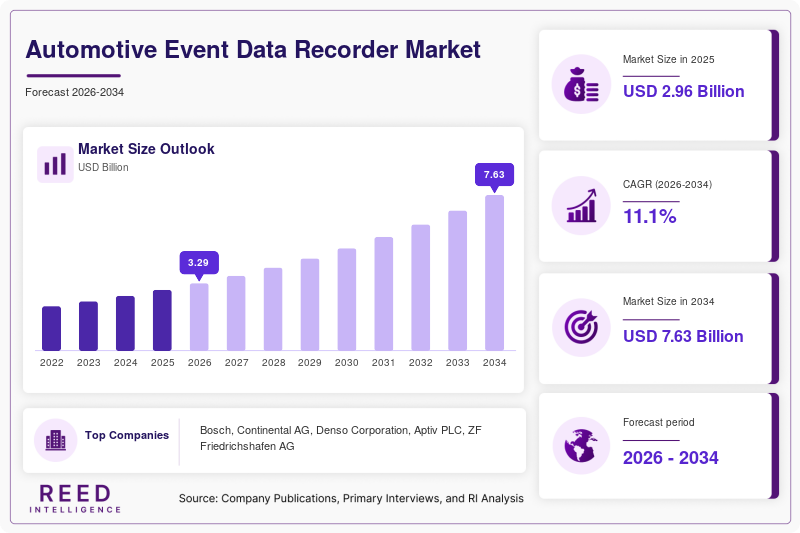
The Automotive Event Data Recorder Market Size was valued at approximately USD 2.96 billion in 2026 and is projected to reach nearly USD 6.88 billion by 2034, expanding at a CAGR of 11.1% during the forecast period from 2026 to 2034. The global Automotive Event Data Recorder Market is experiencing stable growth due to rising vehicle safety regulations, increasing deployment of advanced driver assistance systems (ADAS), and growing adoption of connected vehicle technologies across passenger and commercial vehicle segments. Automotive event data recorders are increasingly being integrated into modern vehicles to capture critical crash-related data such as braking activity, steering input, acceleration, seatbelt status, and airbag deployment information.
A major global factor supporting the growth of the Automotive Event Data Recorder Market is the increasing emphasis on road safety and accident investigation transparency. Regulatory authorities across multiple countries are strengthening automotive safety standards and encouraging the installation of event data recording technologies in vehicles to improve crash analysis and insurance claim verification. Rising integration of autonomous driving systems and vehicle telematics platforms is also contributing to market expansion. In addition, automotive manufacturers are increasingly using event data recorder systems to improve vehicle diagnostics, driver behavior monitoring, and predictive safety analysis.
Key Highlights
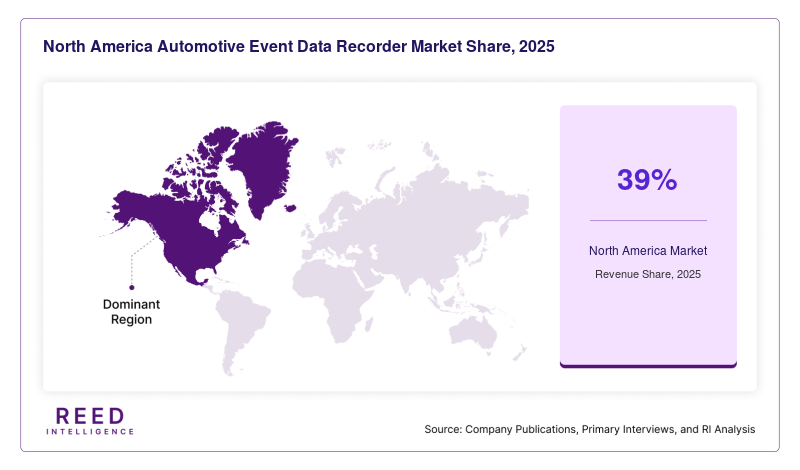
- North America dominated the market with 39% share in 2025, while Asia Pacific is projected to witness the fastest growth at a 12.4% CAGR during 2026–2034.
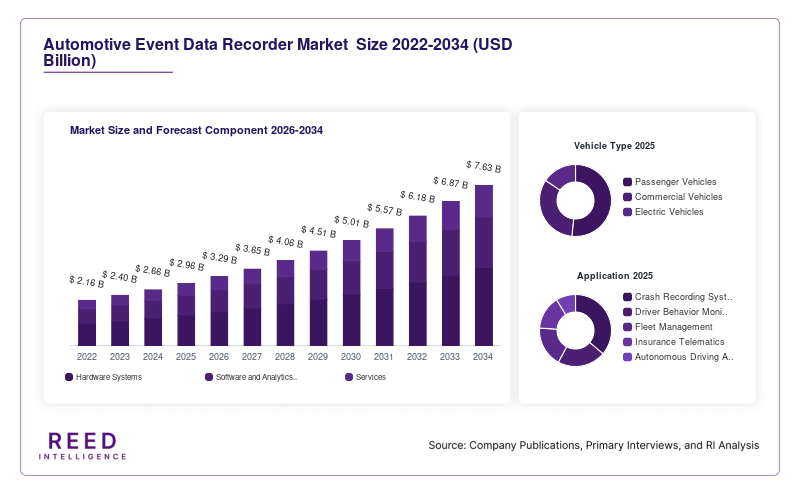
- By component, hardware systems accounted for the largest market share of 52% in 2025, while software and analytics solutions are projected to expand at a CAGR of 12.8% during the forecast period.
- By vehicle type, passenger vehicles held the dominant market share of 67% in 2025, whereas electric vehicles are anticipated to grow at a CAGR of 13.2% through 2034.
- By application, crash recording systems represented the leading segment with 44% share in 2025, while driver behavior monitoring systems are expected to witness a CAGR of 12.9% during the forecast timeline.
- The United States remained the dominant country market and was valued at approximately USD 842 million in 2024 and USD 931 million in 2025.
Market Trends
Increasing Integration of ADAS and Connected Vehicle Platforms
One of the major trends shaping the Automotive Event Data Recorder Market is the growing integration of event data recorder systems with advanced driver assistance systems and connected vehicle technologies. Modern vehicles are increasingly equipped with intelligent safety systems capable of monitoring lane position, braking activity, collision warnings, and driver attention levels. Event data recorders are becoming essential components within these systems to store operational and crash-related information for future analysis.
Automotive manufacturers are integrating cloud-based telematics and real-time vehicle monitoring platforms with event recording systems to improve fleet management and accident response efficiency. The increasing adoption of vehicle-to-everything communication technologies is expected to further strengthen the role of data recording systems in connected mobility ecosystems.
Rising Adoption of AI-Based Vehicle Safety Analytics
Another important trend in the Automotive Event Data Recorder Market is the rising use of artificial intelligence and predictive safety analytics in automotive data recording systems. Vehicle manufacturers and fleet operators are increasingly deploying AI-enabled analytics platforms to evaluate driver behavior, identify accident risks, and improve operational safety.
Advanced event data recorders now support real-time analytics, remote diagnostics, and automated incident reporting capabilities. The adoption of machine learning algorithms for accident pattern recognition and driver performance assessment is expected to support long-term market growth. This trend is becoming increasingly important across commercial transportation, ride-sharing services, and logistics fleet management operations.
Market Drivers
Expansion of Vehicle Safety Regulations
The increasing implementation of vehicle safety regulations is a major factor driving the growth of the Automotive Event Data Recorder Market. Governments and transportation authorities across multiple countries are introducing stricter automotive safety requirements aimed at reducing road fatalities and improving accident investigation processes.
Vehicle manufacturers are increasingly integrating event data recorders to comply with regulatory standards related to crash reporting, vehicle diagnostics, and emergency response systems. Growing consumer awareness regarding vehicle safety technologies is also encouraging automakers to expand deployment of advanced recording systems across passenger and commercial vehicles.
Growth of Connected and Autonomous Vehicles
Another significant driver supporting the Automotive Event Data Recorder Market is the rapid growth of connected and autonomous vehicle technologies. Modern vehicles generate large volumes of operational data that can be used to improve navigation accuracy, collision avoidance systems, and automated driving performance.
Event data recorders are becoming essential for capturing operational information required for autonomous driving validation and system troubleshooting. Increasing investments in smart mobility infrastructure and intelligent transportation systems are expected to continue supporting market expansion throughout the forecast period.
Market Restraint
Data Privacy and Cybersecurity Concerns
One of the primary restraints affecting the Automotive Event Data Recorder Market is the growing concern regarding vehicle data privacy and cybersecurity risks. Event data recorders store sensitive operational and driver-related information that may be vulnerable to unauthorized access or cyberattacks.
Consumers and regulatory authorities are increasingly focusing on data ownership, consent management, and secure storage of vehicle-generated information. Compliance with evolving cybersecurity regulations may increase implementation complexity and operational costs for automotive manufacturers and telematics service providers.
Market Opportunities
Increasing Demand for Fleet Management Solutions
The growing adoption of digital fleet management systems presents strong opportunities for the Automotive Event Data Recorder Market. Logistics companies, transportation operators, and ride-sharing service providers are increasingly deploying event data recorders to monitor driver performance, fuel efficiency, and vehicle safety compliance.
Advanced recording systems help fleet operators improve operational visibility and reduce accident-related expenses. The growing demand for intelligent transportation monitoring systems is expected to create long-term revenue opportunities for market participants.
Rising Penetration of Electric Vehicles
The increasing adoption of electric vehicles is creating additional growth opportunities for the Automotive Event Data Recorder Market. Electric vehicles require advanced monitoring systems to evaluate battery performance, driving behavior, thermal conditions, and safety incidents.
Automotive manufacturers are integrating event data recording technologies into electric vehicle platforms to support predictive maintenance and performance optimization. The global transition toward sustainable mobility solutions is expected to positively influence future market growth.
Segmental Analysis
By Component
Based on component, the Automotive Event Data Recorder Market is segmented into hardware systems, software and analytics solutions, and services. Hardware systems dominated the market with approximately 52% share in 2025 due to increasing installation of sensors, control units, memory modules, and communication interfaces in modern vehicles. Software and analytics solutions are projected to witness the fastest growth at a CAGR of 12.8% during the forecast period because automotive manufacturers and fleet operators are increasingly adopting AI-enabled data analysis platforms for driver behavior monitoring and predictive safety assessment.
By Vehicle Type
By vehicle type, the market is segmented into passenger vehicles, commercial vehicles, and electric vehicles. Passenger vehicles accounted for the largest market share of 67% in 2025 because of growing integration of safety technologies and rising consumer demand for advanced vehicle monitoring systems. Electric vehicles are expected to grow at a CAGR of 13.2% through 2034 due to increasing adoption of intelligent mobility platforms and growing emphasis on battery performance monitoring and operational safety analytics.
By Application
Based on application, the market includes crash recording systems, driver behavior monitoring, fleet management, insurance telematics, and autonomous driving analysis. Crash recording systems held the dominant share of approximately 44% in 2025 due to increasing regulatory requirements for accident data collection and emergency response analysis. Driver behavior monitoring systems are projected to witness a CAGR of 12.9% during the forecast period owing to growing demand for fleet safety optimization and insurance risk assessment solutions.
By Connectivity Type
The market is segmented into embedded systems, tethered systems, and integrated cloud-connected systems. Embedded systems accounted for the leading market share of approximately 48% in 2025 because of their high reliability and direct integration with vehicle electronic control systems. Integrated cloud-connected systems are expected to grow at a CAGR of 13.1% during the forecast period due to rising adoption of real-time vehicle monitoring and remote diagnostics technologies.
By End User
Based on end user, the market is segmented into automotive manufacturers, fleet operators, insurance providers, and government agencies. Automotive manufacturers represented the dominant segment with approximately 46% share in 2025 due to increasing integration of event data recorders in new vehicle platforms. Fleet operators are expected to witness the fastest growth at a CAGR of 12.6% during the forecast period because transportation companies are increasingly emphasizing operational safety monitoring and driver performance management.
Regional Analysis
North America
North America accounted for approximately 39% share of the Automotive Event Data Recorder Market in 2025 and is projected to grow at a CAGR of 10.7% during the forecast period. The region benefits from strong automotive safety regulations, high adoption of connected vehicles, and increasing investments in intelligent transportation systems. The United States dominated the regional market due to widespread integration of ADAS technologies and increasing deployment of telematics-enabled fleet management solutions. Growing investments in autonomous driving technologies are further supporting regional market expansion.
Europe
Europe held around 27% market share in 2025 and is expected to expand at a CAGR of 10.4% through 2034. The region is witnessing rising adoption of vehicle safety technologies and stricter automotive compliance frameworks. Germany remained the dominant country market because of strong automotive manufacturing capabilities and increasing development of connected mobility solutions. Growing emphasis on accident data transparency and electric vehicle adoption is supporting long-term regional growth.
Asia Pacific
Asia Pacific represented nearly 23% share in 2025 and is projected to witness the fastest growth at a CAGR of 12.4% during the forecast period. Rapid vehicle production growth, expanding smart mobility infrastructure, and increasing road safety awareness are supporting market expansion across the region. China remained the leading regional contributor due to significant investments in electric vehicle manufacturing and intelligent transportation systems. Rising deployment of telematics platforms in commercial transportation is accelerating regional adoption of automotive event data recorders.
Middle East & Africa
The Middle East & Africa accounted for approximately 6% share in 2025 and is expected to grow at a CAGR of 9.8% during the forecast period. Increasing investments in transportation modernization and growing adoption of connected fleet management systems are supporting regional market growth. The United Arab Emirates dominated the regional market because of rising implementation of smart mobility projects and increasing focus on road safety technologies.
Latin America
Latin America held nearly 5% market share in 2025 and is projected to expand at a CAGR of 9.4% through 2034. Brazil remained the dominant country market due to increasing automotive production activities and growing investments in fleet monitoring technologies. Rising awareness regarding vehicle safety compliance and accident data analysis is contributing to steady regional market development.
Competitive Landscape
The Automotive Event Data Recorder Market is moderately competitive with the presence of global automotive electronics manufacturers, telematics providers, and vehicle safety technology companies focusing on innovation, connectivity integration, and advanced analytics capabilities. Market participants are emphasizing strategic partnerships, software-based safety intelligence, and cloud-enabled monitoring platforms to strengthen their market positions.
Bosch remained one of the leading companies in the market due to its extensive automotive electronics portfolio and advanced event recording technologies. The company recently expanded its connected vehicle safety solutions with integrated AI-based driving analytics and cloud-enabled accident reporting systems.
Continental AG continues to strengthen its market presence through advanced telematics and autonomous driving technologies. Denso Corporation is focusing on intelligent vehicle data management systems and predictive diagnostics platforms, while Aptiv PLC and ZF Friedrichshafen AG are expanding their product portfolios with advanced safety monitoring and connected mobility solutions.
Key Players List
- Bosch
- Continental AG
- Denso Corporation
- Aptiv PLC
- ZF Friedrichshafen AG
- Valeo SA
- Magna International Inc.
- Hyundai Mobis
- Veoneer Inc.
- Visteon Corporation
- Harman International
- Panasonic Automotive Systems
- NXP Semiconductors
- Texas Instruments Incorporated
- Infineon Technologies AG
Automotive Event Data Recorder Market Segments
Component
- Hardware Systems
- Software and Analytics Solutions
- Services
Vehicle Type
- Passenger Vehicles
- Commercial Vehicles
- Electric Vehicles
Application
- Crash Recording Systems
- Driver Behavior Monitoring
- Fleet Management
- Insurance Telematics
- Autonomous Driving Analysis
Connectivity Type
- Embedded Systems
- Tethered Systems
- Integrated Cloud-Connected Systems
End User
- Automotive Manufacturers
- Fleet Operators
- Insurance Providers
- Government Agencies
By Region
- North America
- Europe
- APAC
- Middle East and Africa
- LATAM