Automotive Exhaust Manifold Market Size, Share & Trends Analysis Report By Material Type (Cast Iron, Stainless Steel, Aluminum & Other Materials), By Vehicle Type (Passenger Cars, Light Commercial Vehicles), By Engine Type (Gasoline, Diesel, Hybrid), By Manifold Type (Integrated Manifold, Tubular Manifold), By Sales Channel (OEM, Aftermarket) Forecasts, 2026–2034
USD 3950
Automotive Exhaust Manifold Market Size
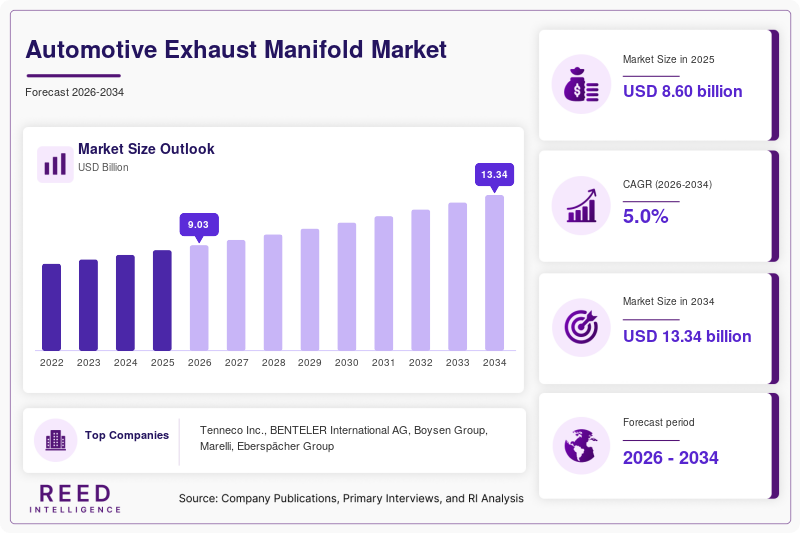
The global Automotive Exhaust Manifold Market was valued at USD 8.60 billion in 2025 and is projected to grow from USD 9.03 billion in 2026 to USD 13.34 billion by 2034, registering a CAGR of 5.00% during the forecast period from 2026 to 2034.
The market adds approximately USD 0.43 billion between 2025 and 2026 and a further USD 4.37 billion between 2026 and 2034. Demand remains tied to vehicles using internal-combustion engines, where the exhaust manifold collects and directs exhaust gases toward downstream emission-control components. At the same time, tighter emissions requirements are increasing the engineering importance of heat management, catalyst positioning, thermal durability and lightweight construction.
The Automotive Exhaust Manifold Market is being shaped by two opposing forces: continued demand for internal-combustion and hybrid powertrains, and the gradual shift toward battery-electric vehicles. Exhaust manifolds remain necessary in vehicles with combustion engines, but their design is increasingly determined by the requirements of the wider aftertreatment system rather than by exhaust routing alone.
The connection between the manifold and emissions control is particularly important because close-coupled catalysts depend on rapid heat-up after engine start. Tenneco's current Clean Air portfolio includes fabricated manifolds, close-coupled catalysts, lightweight compact systems and thermal-management technologies, showing how exhaust components are increasingly engineered as integrated systems.
Regulatory requirements continue to influence this engineering direction. The European Union's Euro 7 regulation applies to new M1/N1 vehicle types from November 29, 2026, with broader application dates extending into 2028–2029 for heavier vehicle categories. The regulation introduces stricter requirements around exhaust emissions and vehicle lifetime performance.
Automotive Exhaust Manifold Market Drivers
Stricter Emissions Requirements Increase the Engineering Value of Exhaust Manifolds
Emission regulations increasingly require combustion vehicles to control pollutants over broader operating conditions and throughout longer portions of vehicle life. The EU's Euro 7 regulation maintains and modifies exhaust-emission requirements while introducing stricter lifetime requirements, with implementation beginning for new M1/N1 vehicle types in November 2026.
The market mechanism is indirect but important: stricter emissions performance increases the need for exhaust components that can position catalysts effectively, withstand higher thermal loads and maintain dimensional stability. Tenneco's current exhaust portfolio reflects this relationship through close-coupled catalysts, fabricated manifolds and thermal-management technologies.
This supports demand for stainless-steel and other heat-resistant manifold designs, particularly in gasoline turbocharged and hybrid applications. The counterbalance is that tighter regulations can also accelerate powertrain electrification, reducing the long-term volume of vehicles requiring exhaust manifolds.
Turbocharged and Hybrid Combustion Powertrains Increase Thermal and Packaging Requirements
Modern combustion engines increasingly use compact engine-bay architectures and turbocharging, requiring exhaust manifolds to operate within demanding thermal and packaging constraints. The manifold's location relative to the turbocharger and catalytic converter affects heat retention, exhaust flow and catalyst activation.
Automotive exhaust suppliers therefore increasingly integrate manifold and aftertreatment engineering. Boysen, for example, identifies exhaust manifolds, catalytic converters and complete exhaust systems as core products and describes its portfolio across passenger cars, commercial vehicles and off-highway applications.
The commercial implication is a shift from basic cast components toward engineered systems using optimized geometry, lightweight construction and heat-resistant materials. The counterbalance is that higher-performance materials and manufacturing processes can increase component costs and production complexity.
High Vehicle Production Volumes Preserve Near-Term Exhaust Manifold Demand
The exhaust manifold remains a required component in gasoline, diesel and hybrid vehicles that retain combustion engines. This gives manufacturers an established OEM replacement cycle even as the powertrain mix changes.
The commercial mechanism is therefore linked to vehicle production and the continuing installed base of combustion-powered vehicles. Boysen continues to manufacture manifolds and complete exhaust systems for passenger cars, commercial vehicles and off-highway applications, demonstrating that the component remains embedded in several vehicle categories.
The strongest near-term demand is expected to remain in passenger vehicles, while commercial vehicles provide a longer-duration demand base because internal-combustion powertrains remain important in heavy-duty applications. However, increasing electrification limits the long-term expansion potential of the overall component category.
Automotive Exhaust Manifold Market Restraints
Electrification Reduces the Long-Term Addressable Vehicle Base
Battery-electric vehicles do not require an engine exhaust manifold because they do not produce combustion exhaust gases. As BEV penetration increases, the number of newly produced vehicles requiring exhaust manifolds declines relative to a market consisting entirely of combustion vehicles.
The European policy direction illustrates this structural pressure. EU policy sets a 100% reduction target for CO2 emissions from new passenger cars and vans from 2035, while combustion-powered heavy-duty vehicles continue to have a different transition trajectory.
This creates a split market: passenger-car manifold demand faces stronger long-term electrification pressure, while commercial and heavy-duty vehicles provide a comparatively longer combustion-engine runway. Suppliers are responding by expanding into adjacent technologies; Boysen, for example, has added battery cases and hydrogen-related technologies to its portfolio.
High-Temperature Materials and Manufacturing Requirements Increase Component Costs
Exhaust manifolds operate under severe thermal and mechanical conditions, making material selection important. Stainless-steel systems can reduce weight and heat capacity, while cast iron provides durability and cost advantages in many applications.
Marelli documentation describes manifold-converter designs using stainless-steel materials to achieve lower weight and heat capacity, supporting faster catalyst activation.
The economic trade-off is that lightweight and high-temperature-resistant materials can require more specialized forming, welding and manufacturing processes. Suppliers therefore need to balance thermal performance, weight, durability and unit cost against OEM target prices.
Automotive Exhaust Manifold Market Opportunities
Integrated Manifold-Catalyst Systems Create Higher-Value Component Architectures
A key opportunity is the integration of the exhaust manifold with catalytic-converter and thermal-management functions. The closer the catalyst is positioned to the engine, the more quickly it can reach operating temperature, making manifold geometry and thermal characteristics directly relevant to emissions performance.
Marelli has documented manifold-converter designs that integrate the manifold and catalyst while emphasizing lightweight construction and low heat capacity. Tenneco likewise identifies close-coupled catalysts and fabricated manifolds within its current Clean Air technology portfolio.
This creates an opportunity for suppliers to compete on complete hot-end systems rather than individual manifold components. The limitation is that integrated designs can increase engineering complexity and make the supplier more dependent on OEM platform specifications.
Lightweight Stainless-Steel Manifolds Can Expand in High-Temperature Applications
Stainless steel provides an opportunity where OEMs need lower weight, thermal resistance and faster catalyst activation. Marelli's exhaust-system documentation specifically describes stainless-steel manifold-converter construction as a way to reduce weight and heat capacity.
The commercial opportunity is strongest in turbocharged gasoline engines, hybrid powertrains and applications where the exhaust system must reach catalyst operating temperature quickly.
The main limitation is cost. Stainless-steel fabrication can require more sophisticated manufacturing processes than conventional cast-iron designs, making adoption dependent on the value placed on weight reduction and thermal performance.
Segmental Analysis
By Material Type
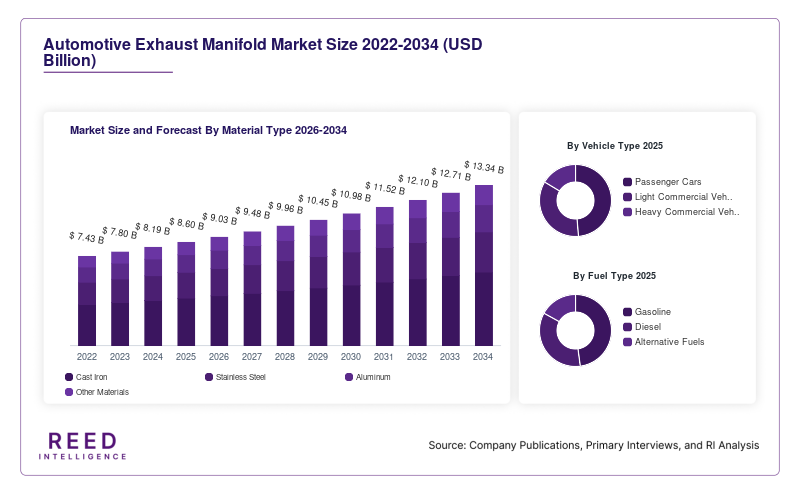
Cast iron represents the largest material segment in the internal 2025 market allocation, accounting for approximately 45% of the global market, equivalent to USD 3.87 billion. Its position is linked to its established use in combustion-engine exhaust applications, durability and comparatively economical production. The segment is modeled at approximately 4.2% CAGR through 2034.
Stainless steel accounts for approximately 35% of the 2025 market, or USD 3.01 billion, and is modeled as the faster-growing major material category at approximately 6.2% CAGR. Its growth is associated with lightweight construction, thermal performance and close-coupled catalyst requirements.
Aluminum represents approximately 10%, or USD 0.86 billion, while other materials account for the remaining 10%.
By Vehicle Type
Passenger cars represent approximately 68% of the 2025 market, equivalent to USD 5.85 billion, making them the largest vehicle category. The large installed and production base of passenger vehicles using gasoline, diesel or hybrid combustion engines supports recurring manifold demand.
Light commercial vehicles account for approximately 18%, or USD 1.55 billion, and are modeled at approximately 5.5% CAGR, while heavy commercial vehicles represent approximately 14%, or USD 1.20 billion, and are modeled at approximately 5.7% CAGR.
The higher modeled growth for commercial vehicles reflects the comparatively longer role of combustion powertrains in commercial transportation.
Regional Analysis
Asia-Pacific Automotive Exhaust Manifold Market
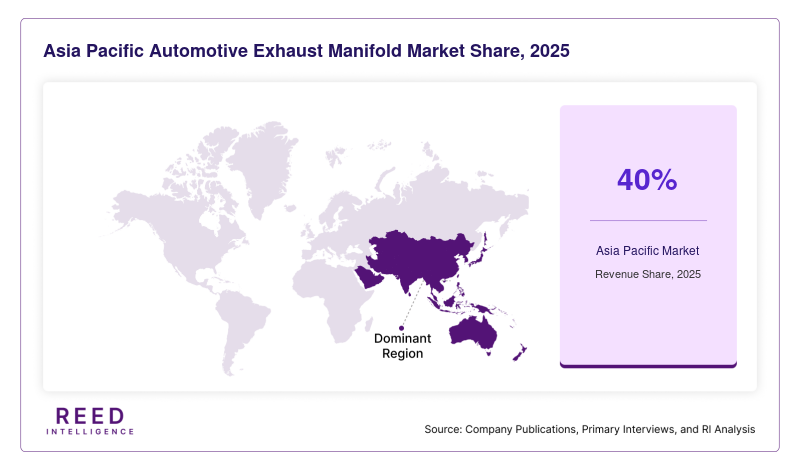
Asia-Pacific represents approximately 40% of the global Automotive Exhaust Manifold Market in 2025, equivalent to USD 3.44 billion in the internal allocation. It is also modeled as the fastest-growing region, with approximately 5.8% CAGR through 2034.
The region's market mechanism is primarily manufacturing scale combined with continued use of combustion and hybrid powertrains. China, Japan, India and South Korea have substantial automotive manufacturing ecosystems, supporting demand for locally produced exhaust components and integrated hot-end systems.
The region also has an established supplier base. BENTELER's Shanghai operation, for example, has a certified manufacturing scope covering exhaust manifolds for passenger vehicles.
The technology mix is gradually shifting toward lightweight fabricated components and integrated catalyst systems as OEMs address thermal management and emissions requirements. Stainless-steel products therefore have an opportunity to gain share where thermal performance and weight reduction justify higher manufacturing costs.
China and India provide significant commercial opportunities through vehicle production and expanding supplier ecosystems, while Japan and South Korea contribute through technologically sophisticated OEM and Tier 1 manufacturing networks.
The principal constraint is the increasing adoption of electric vehicles, particularly in passenger cars. This limits the long-term addressable base for exhaust components even while hybrid and commercial vehicles preserve near- and medium-term demand.
Europe Automotive Exhaust Manifold Market
Europe represents approximately 24% of the 2025 market, corresponding to USD 2.06 billion in the internal allocation. The market is modeled at approximately 4.5% CAGR through 2034.
The region's primary market mechanism is emissions compliance. Euro 7 introduces additional exhaust-emission and lifetime requirements, with application beginning for new M1/N1 vehicle types in November 2026 and later for heavier categories.
This creates demand for exhaust systems engineered around thermal performance and catalyst activation. The effect is particularly relevant to stainless-steel manifolds, fabricated systems and integrated manifold-converter architectures.
Europe also has a well-established exhaust-system supplier base. Boysen identifies exhaust manifolds, catalytic converters, particulate filters and complete exhaust systems among its core products.
However, the region faces a structural constraint from passenger-vehicle electrification. The EU's 2035 policy trajectory for new passenger cars and vans reduces the long-term volume of new vehicles requiring conventional exhaust manifolds.
Consequently, European suppliers are increasingly required to balance combustion-engine technology with adjacent products for electrified vehicles.
North America Automotive Exhaust Manifold Market
North America accounts for approximately 20% of the 2025 market, equivalent to USD 1.72 billion, and is modeled at approximately 4.2% CAGR.
The market benefits from passenger vehicles, pickup trucks, light commercial vehicles and heavy-duty applications. The aftermarket also provides a replacement channel independent of new-vehicle production. Tenneco's DRiV business expanded Walker exhaust product coverage and continued adding aftermarket exhaust-related components across North America.
Regulatory conditions are currently more complex than in previous years. EPA finalized new light- and medium-duty multipollutant standards in 2024, with implementation for model years 2027 onward, while the agency finalized rescission of federal GHG standards in 2026. Traditional air-pollutant regulations remain in place.
Heavy-duty applications retain regulatory relevance. EPA's 2024 Phase 3 standards established requirements for heavy-duty vehicles from model years 2027 through 2032, although the current federal regulatory environment has subsequently changed for GHG standards.
Latin America Automotive Exhaust Manifold Market
Latin America represents approximately 9% of the 2025 market, or USD 0.77 billion, and is modeled at approximately 5.0% CAGR through 2034.
The regional demand base is connected to passenger vehicles, commercial vehicles and the installed combustion-engine fleet. Mexico and Brazil represent important automotive manufacturing and component markets, while the aftermarket creates additional replacement demand.
The principal commercial mechanism is therefore not rapid technological transformation but continued operation of combustion-powered vehicles combined with periodic exhaust-system replacement.
Suppliers with regional manufacturing or distribution capabilities can reduce logistics costs and adapt components to local vehicle platforms. However, vehicle production cycles, currency conditions and uneven regulatory implementation can affect procurement patterns.
Middle East & Africa Automotive Exhaust Manifold Market
Middle East & Africa represents approximately 7% of the global market in 2025, equivalent to USD 0.60 billion, and is modeled at approximately 4.8% CAGR.
Demand is concentrated in passenger vehicles, commercial vehicles, and replacement applications. The region's climate, road conditions and vehicle operating environments can place significant durability requirements on exhaust components.
The commercial opportunity therefore favors robust manifolds capable of handling thermal cycling and demanding operating conditions. Commercial and off-highway vehicles also provide a longer-duration combustion-engine application base than passenger vehicles in markets where electrification proceeds more gradually.
However, regional vehicle production is less concentrated than in Asia-Pacific, Europe or North America, creating a greater reliance on imported components and regional distributors.
Competitive Landscape
Competition is increasingly moving toward integrated exhaust systems, lightweight materials, thermal management, emissions compliance and OEM engineering relationships.
Tenneco competes through its Clean Air portfolio, which includes fabricated manifolds, close-coupled catalysts, lightweight compact systems and cold-start thermal-management technologies. Its positioning links manifold engineering with the broader emissions-control system, increasing the value of integrated supplier relationships.
BENTELER has manufacturing capabilities for exhaust manifolds in Asia-Pacific, including certified production of exhaust manifolds for passenger vehicles at its Shanghai operation. This gives the company a regional manufacturing base close to major automotive production centers.
Boysen operates as an exhaust-system specialist producing manifolds, catalytic converters, particulate filters, silencers and complete systems. Its current product strategy also includes adjacent battery cases and hydrogen technologies, providing diversification as combustion-engine demand changes.
Key Market Players
- Tenneco Inc.
- BENTELER International AG
- Boysen Group
- Marelli
- Eberspächer Group
- Yutaka Giken Co., Ltd.
- Sango Co., Ltd.
- Sejong Industrial Co., Ltd.
- Katcon Global
- Faurecia / FORVIA
- AP Exhaust Technologies
- Bosal
Recent Market Developments
- November 2026: The European Union's Euro 7 Regulation (EU) 2024/1257 is scheduled to begin applying to new vehicle types in categories M1 and N1 from November 29, 2026. The regulation then extends to new M1 and N1 vehicles from November 2027, with heavier vehicle categories following from May 2028 and May 2029. The regulation includes exhaust-emission requirements for vehicles with internal-combustion engines.
- February 2026: The U.S. Environmental Protection Agency finalized the rescission of the 2009 Greenhouse Gas Endangerment Finding and repealed subsequent federal GHG emission standards for highway vehicles and engines. EPA stated that the action concerns GHG emissions and does not remove regulations covering traditional air pollutants.
Automotive Exhaust Manifold Market Segments
By Material Type
- Cast Iron
- Stainless Steel
- Aluminum
- Other Materials
By Vehicle Type
- Passenger Cars
- Light Commercial Vehicles
- Heavy Commercial Vehicles
By Fuel Type
- Gasoline
- Diesel
- Alternative Fuels
By Sales Channel
- OEM
- Aftermarket
By Region
- North America
- Europe
- APAC
- Middle East and Africa
- LATAM