Automotive Grab Handle Market Size, Share & Demand Report By Product Type (Roof-Mounted Grab Handles, A-Pillar Grab Handles, B-Pillar Grab Handles), By Material (Plastic Grab Handles, Metal Grab Handles, Composite Material Grab Handles), By Vehicle Type (Passenger Cars, Commercial Vehicles, Electric Vehicles, Luxury Vehicles), By Sales Channel (OEM, Aftermarket) By Region & Segment Forecasts, 2026–2034
USD 3950
Market Overview
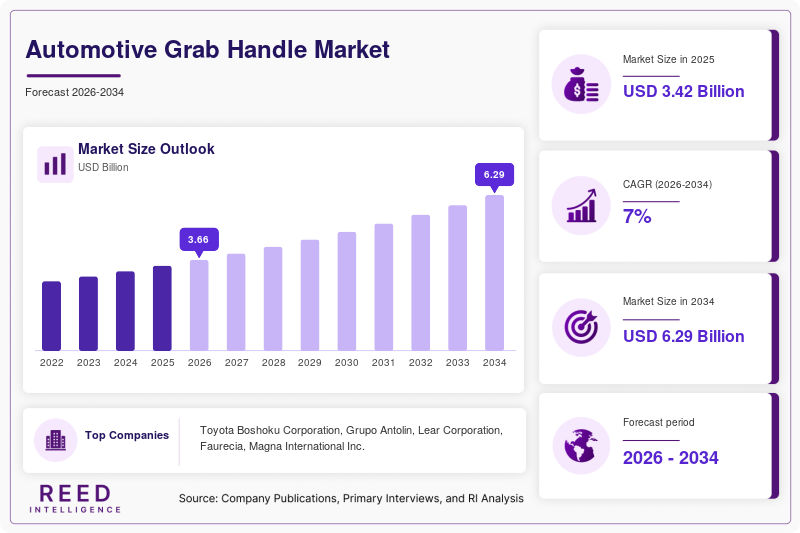
The Automotive Grab Handle Market size was valued at USD 3.42 billion in 2026 and is projected to reach USD 5.87 billion by 2034, expanding at a CAGR of 7.0% during the forecast period (2026–2034). The global Automotive Grab Handle Market growth was supported by increasing global automobile production and rising consumer demand for enhanced passenger comfort and interior safety components. Automotive manufacturers increasingly integrated ergonomically designed grab handles into passenger vehicles, SUVs, commercial vehicles, and electric vehicles to improve convenience and in-cabin functionality.
Automotive grab handles are essential interior components that provide passenger support during vehicle entry, exit, and movement across uneven road conditions. Growing emphasis on passenger safety standards and vehicle interior aesthetics significantly accelerated product demand worldwide. In addition, increasing consumer preference for premium vehicle interiors supported the adoption of advanced grab handle systems featuring soft-touch materials, integrated lighting, and multifunctional designs.
Key Highlights
- Asia Pacific accounted for 43.8% of the global Automotive Grab Handle Market share in 2025, while North America is projected to register the fastest CAGR of 7.8% during the forecast period.
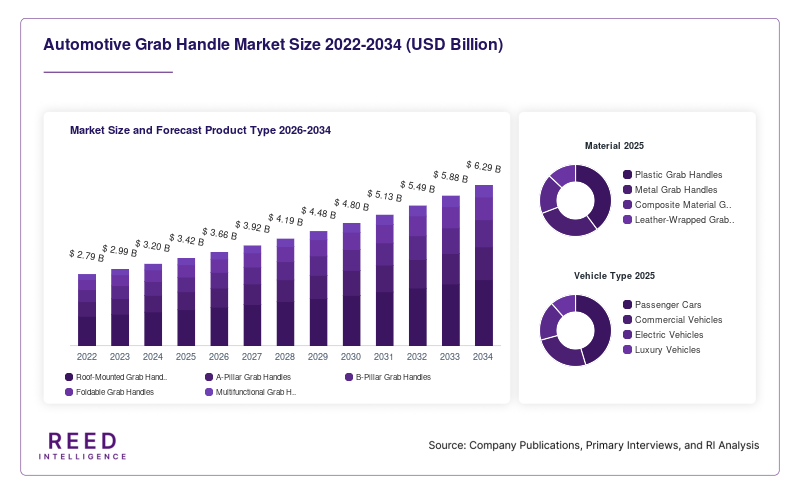
- Among product type segments, roof-mounted grab handles held the dominant share of 51.6% in 2025, whereas multifunctional grab handles are anticipated to grow at a CAGR of 8.5% through 2034.
- By material, plastic grab handles represented the leading segment with 47.2% market share in 2025, while composite material grab handles are expected to expand at a CAGR of 8.7%.
- By vehicle type, passenger cars captured 58.9% market share in 2025, whereas electric vehicles are projected to grow at a CAGR of 9.3% during the forecast period.
- The China Automotive Grab Handle Market was valued at USD 612 million in 2024 and reached USD 658 million in 2025 due to strong passenger vehicle manufacturing activities.
Market Trends
Increasing Adoption of Premium Interior Components
The increasing adoption of premium interior components emerged as a major trend shaping the Automotive Grab Handle Market. Automotive manufacturers increasingly focused on enhancing cabin aesthetics and passenger convenience through improved interior accessories and ergonomic designs.
Grab handles featuring leather finishes, integrated ambient lighting, and retractable mechanisms gained popularity in premium passenger vehicles and SUVs. Consumers increasingly preferred vehicles with sophisticated interior styling, which encouraged manufacturers to develop visually appealing and multifunctional grab handle systems.
Rising Demand for Lightweight Automotive Components
The growing demand for lightweight automotive components significantly influenced the Automotive Grab Handle Market outlook. Automakers increasingly adopted lightweight polymers and composite materials to reduce overall vehicle weight and improve fuel efficiency.
Lightweight grab handles also supported electric vehicle manufacturers seeking to optimize battery performance and driving range. This trend accelerated the use of advanced thermoplastics and reinforced composite materials across automotive interior applications.
Market Drivers
Growth in Global Passenger Vehicle Production
The increasing production of passenger vehicles worldwide significantly supported the Automotive Grab Handle Market growth. Rising urbanization, increasing disposable income, and expanding middle-class populations contributed to higher vehicle ownership rates across emerging economies.
Automotive manufacturers increased production capacity to address growing demand for passenger cars and SUVs, thereby strengthening the need for interior safety and convenience components such as grab handles. Expanding automotive assembly operations further accelerated market growth.
Increasing Focus on Passenger Safety and Comfort
The growing emphasis on passenger comfort and safety standards contributed substantially to the expansion of the Automotive Grab Handle Market. Grab handles improve passenger stability during sudden vehicle movement, cornering, and uneven road conditions.
Automotive OEMs increasingly integrated ergonomically designed handles with enhanced grip materials and structural durability to improve user experience. Rising consumer expectations regarding vehicle comfort and accessibility also supported broader product adoption.
Market Restraint
Volatility in Raw Material Prices
Fluctuating prices of plastics, metals, and composite materials restrained the growth of the Automotive Grab Handle Market. Variations in raw material costs affected manufacturing expenses and supply chain stability for automotive interior component producers.
In addition, increasing transportation and logistics costs created pricing challenges for suppliers operating in highly competitive automotive markets.
Market Opportunities
Expansion of Electric Vehicle Manufacturing
The rapid expansion of electric vehicle manufacturing is expected to create significant opportunities for the Automotive Grab Handle Market. EV manufacturers increasingly focus on lightweight interior components and modern cabin designs to enhance energy efficiency and user experience.
Advanced grab handle systems with integrated electronic features and sustainable materials are expected to witness increasing demand across electric vehicle platforms.
Growth of Automotive Interior Customization
The increasing popularity of automotive interior customization is projected to support new growth opportunities in the market. Consumers increasingly prefer personalized cabin features, premium textures, and stylish interior accessories.
Automotive aftermarket suppliers are expected to expand product portfolios offering customizable grab handles with decorative finishes, ambient lighting, and multifunctional features.
Segmental Analysis
By Product Type
Roof-Mounted Grab Handles Dominated the Market
Roof-mounted grab handles accounted for 51.6% of the global Automotive Grab Handle Market share in 2025. These grab handles gained widespread adoption due to their standard integration across passenger vehicles, SUVs, and commercial vehicles.
Automotive manufacturers increasingly preferred roof-mounted systems because they provide improved passenger support and require minimal cabin space. Their compatibility with multiple vehicle categories further strengthened segment dominance.
Multifunctional Grab Handles to Witness Fastest Growth
Multifunctional grab handles are projected to grow at a CAGR of 8.5% during the forecast period. These systems integrate additional features such as coat hooks, lighting systems, storage functions, and electronic controls.
The increasing demand for smart cabin interiors and enhanced passenger convenience is expected to support rapid adoption of multifunctional grab handle technologies.
By Material
Plastic Grab Handles Held the Largest Share
Plastic grab handles represented 47.2% of the Automotive Grab Handle Market share in 2025. Manufacturers extensively utilized plastic materials due to their lightweight properties, design flexibility, and cost efficiency.
Thermoplastic materials also allowed automotive OEMs to improve manufacturing efficiency while maintaining structural durability and aesthetic appeal.
Composite Material Grab Handles to Register Rapid Growth
Composite material grab handles are anticipated to grow at a CAGR of 8.7% during the forecast period. These materials provide enhanced strength-to-weight ratios and improved resistance to wear and environmental conditions.
The increasing focus on lightweight automotive design and sustainable material adoption is expected to accelerate segment growth globally.
By Vehicle Type
Passenger Cars Accounted for the Largest Share
Passenger cars captured 58.9% of the global Automotive Grab Handle Market share in 2025. Rising passenger car production and increasing demand for interior comfort features significantly supported segment dominance.
Automotive manufacturers increasingly integrated ergonomic and aesthetically designed grab handles into mid-range and premium passenger vehicles to enhance consumer satisfaction.
Electric Vehicles to Witness Accelerated Growth
Electric vehicles are expected to grow at a CAGR of 9.3% through 2034. EV manufacturers increasingly prioritize lightweight and technologically advanced cabin components to improve efficiency and interior design innovation.
The expansion of electric mobility infrastructure and government incentives supporting EV adoption are expected to strengthen market demand.
By Sales Channel
OEM Segment Dominated the Market
OEM sales accounted for 71.4% of the global Automotive Grab Handle Market share in 2025. Automotive manufacturers increasingly sourced customized grab handle systems directly from component suppliers for factory-installed applications.
OEM partnerships enabled consistent product quality, design integration, and large-volume production efficiency across automotive assembly operations.
Aftermarket Segment to Grow Steadily
The aftermarket segment is projected to grow at a CAGR of 7.1% during the forecast period. Increasing consumer preference for interior upgrades and replacement components is expected to support segment expansion.
Automotive accessory retailers are anticipated to expand product offerings featuring customizable and premium grab handle systems.
Regional Analysis
North America
North America accounted for 22.7% of the global Automotive Grab Handle Market share in 2025 and is projected to grow at the fastest CAGR of 7.8% during the forecast period. The region benefited from rising demand for premium SUVs, electric vehicles, and technologically advanced automotive interiors.
The United States dominated the regional market due to strong vehicle production capacity and increasing consumer preference for comfort-oriented vehicle interiors. Growing investments in electric vehicle manufacturing further supported demand for lightweight interior components.
Canada also experienced stable market growth due to increasing automotive assembly operations and adoption of advanced cabin systems.
Europe
Europe held 24.3% of the global Automotive Grab Handle Market share in 2025 and is anticipated to grow at a CAGR of 6.8% through 2034. The region maintained steady growth due to rising demand for luxury vehicles and increasing adoption of sustainable automotive materials.
Germany represented the dominant country market owing to its strong automotive manufacturing base and increasing production of premium passenger vehicles. Automotive manufacturers increasingly integrated advanced ergonomic interior systems to enhance consumer experience.
France, Italy, and the United Kingdom also contributed to regional growth through innovation in automotive interior technologies and lightweight component development.
Asia Pacific
Asia Pacific accounted for 43.8% of the global Automotive Grab Handle Market share in 2025 and is forecast to register a CAGR of 7.5% during the assessment period. The region benefited from rapid automotive production growth and expanding vehicle ownership across developing economies.
China dominated the regional market due to large-scale passenger car manufacturing and strong investments in electric vehicle production. The country’s expanding automotive supply chain significantly strengthened product demand.
India emerged as a rapidly growing market supported by rising demand for compact passenger vehicles and increasing automotive manufacturing investments. Japan and South Korea also maintained substantial market presence due to advanced automotive engineering capabilities.
Middle East & Africa
The Middle East & Africa represented 5.1% of the global Automotive Grab Handle Market share in 2025 and is expected to expand at a CAGR of 6.2% during the forecast period. Rising automotive imports and growing urban mobility infrastructure supported regional market growth.
Saudi Arabia dominated the regional market due to increasing demand for passenger vehicles and SUVs. Growing investments in automotive distribution networks and mobility solutions also contributed to market expansion.
South Africa experienced moderate growth due to the presence of vehicle assembly facilities and rising automotive component demand.
Latin America
Latin America captured 4.1% of the global Automotive Grab Handle Market share in 2025 and is projected to grow at a CAGR of 6.4% through 2034. The region benefited from increasing automobile production and rising demand for affordable passenger vehicles.
Brazil dominated the regional market due to strong automotive manufacturing activities and growing domestic vehicle sales. Automotive interior component suppliers increasingly expanded production capabilities to support regional OEM demand.
Mexico also contributed significantly to regional market expansion through increasing automotive exports and assembly operations.

Competitive Landscape
The Automotive Grab Handle Market remained moderately fragmented with manufacturers focusing on lightweight materials, ergonomic designs, and advanced interior integration technologies. Companies emphasized partnerships with automotive OEMs, product customization, and sustainable manufacturing processes to strengthen market positioning.
Market Leader
Toyota Boshoku Corporation maintained a leading position in the Automotive Grab Handle Market due to its extensive automotive interior component portfolio and strong relationships with global automobile manufacturers. The company recently expanded its lightweight interior systems portfolio with advanced eco-friendly materials.
Other Major Players
- Grupo Antolin focused on premium cabin component development for passenger vehicles.
- Lear Corporation expanded ergonomic interior system solutions for electric vehicles.
- Faurecia strengthened investments in sustainable automotive interior materials.
- Magna International Inc. developed modular vehicle cabin technologies supporting multifunctional interior systems.
Key Players List
- Toyota Boshoku Corporation
- Grupo Antolin
- Lear Corporation
- Faurecia
- Magna International Inc.
- Yanfeng Automotive Interiors
- Hyundai Transys
- Kasai Kogyo Co., Ltd.
- Dura Automotive Systems
- Tokai Kogyo Co., Ltd.
- TS Tech Co., Ltd.
- IAC Group
- Adient plc
- Valeo
- CIE Automotive
Recent Developments
- In 2025, Toyota Boshoku Corporation introduced lightweight grab handle systems manufactured using recycled composite materials.
- In 2024, Grupo Antolin expanded production facilities for premium automotive interior components in Europe.
- In 2025, Lear Corporation developed ergonomic multifunctional grab handles for electric vehicle platforms.
- In 2024, Faurecia increased investments in sustainable automotive cabin material technologies.
- In 2025, Magna International Inc. launched modular automotive interior systems integrating smart cabin functionality.
Automotive Grab Handle Market Segments
Product Type
- Roof-Mounted Grab Handles
- A-Pillar Grab Handles
- B-Pillar Grab Handles
- Foldable Grab Handles
- Multifunctional Grab Handles
Material
- Plastic Grab Handles
- Metal Grab Handles
- Composite Material Grab Handles
- Leather-Wrapped Grab Handles
Vehicle Type
- Passenger Cars
- Commercial Vehicles
- Electric Vehicles
- Luxury Vehicles
Sales Channel
- OEM
- Aftermarket
By Region
- North America
- Europe
- APAC
- Middle East and Africa
- LATAM