Automotive Lifts Market Size, Share & Trends Analysis Report By Lift Type (Two-Post Lifts, Four-Post Lifts, Scissor Lifts, Mobile Column Lifts), By Lifting Capacity (Below 10,000 lbs, 10,000–20,000 lbs), By Installation Type (Surface-Mounted, In-Ground, Mobile/Portable), By Application (Vehicle Service & Repair, Vehicle Parking & Storage), By End User (Independent Repair Shops, Automotive Dealerships) and By Region (North America, Europe, APAC, Middle East and Africa, LATAM) Forecasts, 2026-2034
USD 3950
Automotive Lifts Market Size
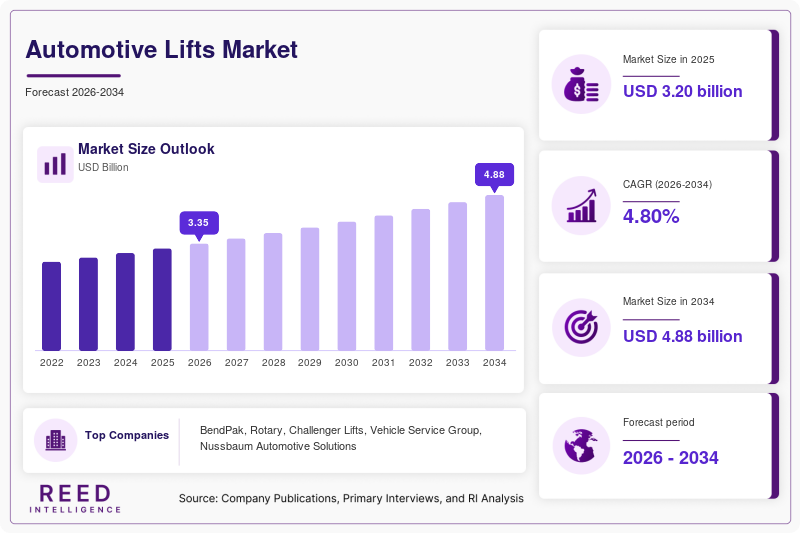
The Automotive Lifts Market was valued at USD 3.20 billion in 2025 and is estimated at USD 3.35 billion in 2026. Based on the supplied forecast, the market is projected to reach USD 4.88 billion by 2034, representing a CAGR of 4.80% during 2026–2034.
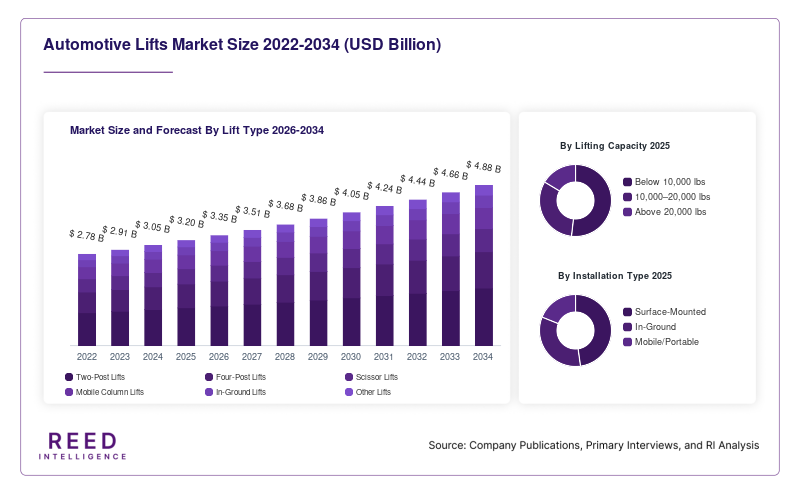
The 2026 market represents approximately 4.7% growth over 2025. Applying the supplied 4.80% CAGR backward gives an analytical market trajectory of approximately USD 3.05 billion in 2024, USD 2.91 billion in 2023 and USD 2.78 billion in 2022. These historical figures are back-calculated estimates, not independently reported historical market sizes.
Demand for automotive lifts is closely tied to the size and age of the vehicle parc, repair-bay utilization, dealership and independent-service investment, and the technical requirements of newer vehicles. S&P Global Mobility reported that the U.S. light-vehicle fleet reached 289 million vehicles in 2025, while the average vehicle age increased to 12.8 years. Vehicles between six and 14 years old represent an important aftermarket-service cohort because they require more frequent maintenance and repair.
Globally, S&P Global Mobility expects the number of light vehicles in operation to increase from approximately 1.6 billion in 2025 to 1.9 billion by 2034. This expanding installed vehicle base provides a structural demand foundation for workshop equipment, including vehicle lifting systems.
Automotive lifts are mechanical or hydraulic systems used to raise vehicles for inspection, maintenance, repair, alignment, component replacement, body work and, in some cases, vehicle storage. Major categories include two-post, four-post, scissor, mobile-column and in-ground systems.
Automotive Lifts Market Drivers
An aging vehicle fleet increases repair-bay utilization
The aging vehicle parc is one of the strongest demand mechanisms for automotive lifts.
S&P Global Mobility reported that the average age of vehicles in the U.S. reached 12.8 years in 2025, while the light-vehicle fleet reached 289 million units. More vehicles are consequently entering the age range in which maintenance, suspension, braking, exhaust, steering and other repairs become more frequent.
S&P Global estimates that more than 110 million U.S. vehicles were already in the six-to-14-year aftermarket "sweet spot," representing almost 38% of the fleet, with this share expected to rise toward 40% by 2028.
The commercial mechanism is direct: more repair orders require more service-bay capacity, and each additional bay capable of under-vehicle work generally requires appropriate lifting equipment.
The global vehicle parc continues to expand
S&P Global Mobility forecasts global vehicles in operation to reach approximately 1.9 billion light vehicles by 2034, compared with about 1.6 billion in 2025.
An expanding vehicle parc increases the installed base requiring periodic servicing, particularly in emerging markets where vehicle ownership and independent repair networks continue to develop.
This creates a long-term equipment replacement and capacity-expansion market rather than one dependent solely on new-vehicle production.
EV servicing requires specialized lifting equipment
Electric vehicles are changing the physical requirements of automotive service bays.
Battery packs can weigh thousands of pounds and need controlled removal, transportation and alignment during service. BendPak's EV-service equipment includes battery-powered mobile lift tables with capacities up to 4,500 lbs and dedicated systems for battery, powertrain and drivetrain work.
Challenger Lifts launched its BT3300 Lift Table in February 2026, a 3,300-lb-capacity scissor-style system designed for EV battery and chassis-component servicing.
The implication is that electrification expands the market beyond conventional vehicle lifts into specialized component-lifting systems.
Automotive Lifts Market Restraints
High equipment and installation costs
Automotive lifts require significant upfront expenditure, particularly for heavy-duty, in-ground, alignment or specialized EV systems.
In-ground installations can also require concrete work, excavation, drainage considerations and facility modifications. This makes replacement decisions more complex than purchasing portable workshop equipment.
Floor-space and facility constraints
The physical configuration of a service facility determines which lift type can be installed.
Two-post lifts provide relatively efficient access for under-vehicle repair, while four-post and alignment lifts require larger footprints. In-ground systems provide a clean floor when lowered but can be more difficult to install in existing facilities.
Older workshops may therefore favor surface-mounted or mobile systems even when an in-ground installation could provide operational advantages.
Safety and certification requirements
Automotive lifts operate with heavy vehicles suspended above workers, making structural integrity, locking mechanisms, load ratings, installation and inspection critical.
ALI's current standards address construction, testing, installation, operation and maintenance. ALI also operates a third-party certification program in which specific lift models are independently tested and certified.
This increases compliance requirements for manufacturers and can increase purchasing costs for end users.
Automotive Lifts Market Opportunities
EV-specific lifting systems
EV battery service represents one of the clearest product opportunities.
Dedicated battery lift tables can be sold as complementary equipment to existing two-post or four-post lifts rather than requiring workshops to replace their entire lift infrastructure.
BendPak and Challenger Lifts are already developing dedicated systems for battery removal, drivetrain work and large-component handling.
Multi-function lifts
Lifts capable of supporting different vehicle architectures can improve return on investment.
BendPak's OctaFlex system combines a 12,000-lb vehicle lift with auxiliary lifting capability for batteries, drivetrains, subframes and other components.
The broader opportunity is to design equipment around multiple service tasks rather than one lifting function.
Heavy-duty commercial vehicle service
Growing SUV, pickup and commercial-vehicle populations increase the requirement for higher-capacity lifts.
This creates opportunities for manufacturers to develop systems in the 12,000-lb-and-above category with longer arms, wider drive-through clearances and greater lifting height.
Segmental Analysis
By Lift Type
Two-Post Lifts represent approximately 38% of the 2025 market, equivalent to about USD 1.22 billion under the internal analytical allocation. The segment is modeled at approximately 4.5% CAGR through 2034, producing an indicative USD 1.81 billion by 2034. Two-post systems remain important because they provide strong underbody access while using relatively limited floor space, making them suitable for independent repair shops and dealerships.
Four-Post Lifts represent approximately 24% of the 2025 market, equivalent to about USD 0.77 billion. The segment is modeled at approximately 5.0% CAGR, reaching around USD 1.19 billion by 2034. Four-post designs benefit from applications requiring drive-on access, wheel alignment and vehicle storage, while their longer platforms support larger SUVs and light trucks.
Scissor Lifts represent approximately 18% of the 2025 market, or about USD 0.58 billion. The segment is modeled at approximately 5.5% CAGR, reaching approximately USD 0.93 billion by 2034. Their compact footprint and ability to provide unobstructed access around the vehicle make them attractive for alignment, tire, brake and general service applications.
Mobile Column Lifts represent approximately 10% of the 2025 market, equivalent to about USD 0.32 billion. The segment is modeled at approximately 6.0% CAGR, reaching around USD 0.54 billion by 2034. Mobile systems provide greater bay flexibility and are particularly relevant to fleet and heavy-vehicle facilities.
By Lifting Capacity
Below 10,000 lbs represents approximately 35% of the 2025 market, equivalent to about USD 1.12 billion under the internal allocation. The segment is modeled at approximately 4.3% CAGR, reaching approximately USD 1.64 billion by 2034. This capacity range is well suited to passenger cars, compact SUVs and many light-duty repair applications.
10,000–20,000 lbs represents approximately 45% of the 2025 market, or about USD 1.44 billion, making it the largest capacity category. It is modeled at approximately 5.2% CAGR, reaching approximately USD 2.27 billion by 2034. The range accommodates a broader mix of SUVs, pickups, vans and commercial vehicles and therefore provides greater flexibility for mixed-service workshops.
Above 20,000 lbs represents approximately 20% of the 2025 market, equivalent to about USD 0.64 billion. It is modeled at approximately 5.5% CAGR, reaching approximately USD 1.04 billion by 2034. Demand is concentrated in heavy-duty repair, fleet maintenance, commercial vehicles and specialized service facilities.
By Installation Type
Surface-Mounted lifts represent approximately 70% of the 2025 market, equivalent to about USD 2.24 billion. The segment is modeled at approximately 4.7% CAGR, reaching approximately USD 3.39 billion by 2034. Surface-mounted systems are easier to install in existing facilities than in-ground systems and can provide a practical replacement solution for workshops expanding capacity.
In-Ground systems represent approximately 15% of the 2025 market, or about USD 0.48 billion, and are modeled at approximately 5.0% CAGR, reaching around USD 0.75 billion by 2034. They are particularly suited to facilities prioritizing clear floor space and high service-bay utilization.
Mobile/Portable systems represent approximately 15% of the 2025 market, equivalent to about USD 0.48 billion. The segment is modeled at approximately 5.5% CAGR, reaching approximately USD 0.78 billion by 2034. Mobility provides a commercial advantage for fleets and workshops handling different vehicle classes or frequently reconfiguring their service areas.
By Application
Vehicle Service & Repair represents approximately 55% of the 2025 market, equivalent to about USD 1.76 billion under the internal analytical allocation. It is modeled at approximately 4.8% CAGR, reaching approximately USD 2.68 billion by 2034. This is the core application because brakes, suspension, steering, exhaust, drivetrain and underbody repairs require controlled vehicle elevation.
Vehicle Parking & Storage represents approximately 20% of the 2025 market, or about USD 0.64 billion. It is modeled at approximately 4.2% CAGR, reaching approximately USD 0.93 billion by 2034. Parking lifts create additional vehicle-storage capacity where land or building space is constrained.
Wheel Alignment & Inspection represents approximately 15% of the 2025 market, equivalent to about USD 0.48 billion. It is modeled at approximately 5.0% CAGR, reaching approximately USD 0.75 billion by 2034. Increasing vehicle complexity and the need for precise wheel and chassis service support demand for specialized alignment-compatible lifting systems.
Body & Collision Repair represents approximately 10% of the 2025 market, or about USD 0.32 billion. It is modeled at approximately 5.2% CAGR, reaching approximately USD 0.51 billion by 2034. Collision facilities require lifting equipment capable of safely positioning vehicles during structural, body and underbody repairs.
By End User
Independent Repair Shops represent approximately 45% of the 2025 market, equivalent to about USD 1.44 billion. The segment is modeled at approximately 5.0% CAGR, reaching around USD 2.23 billion by 2034. The aging vehicle fleet supports independent repair demand, while smaller shops often need versatile equipment that can serve several vehicle types.
Automotive Dealerships represent approximately 30% of the 2025 market, or about USD 0.96 billion. The segment is modeled at approximately 4.5% CAGR, reaching approximately USD 1.43 billion by 2034. Dealerships invest in lifts for scheduled maintenance, warranty work, recalls, inspections and used-vehicle preparation.
Fleet & Commercial Facilities represent approximately 15% of the 2025 market, equivalent to about USD 0.48 billion. It is modeled at approximately 5.5% CAGR, reaching around USD 0.78 billion by 2034. Fleets have a strong incentive to reduce vehicle downtime and can justify mobile, high-capacity and specialized lifting equipment.
Other End Users represent approximately 10% of the 2025 market, or about USD 0.32 billion, and are modeled at approximately 4.0% CAGR, reaching around USD 0.46 billion by 2034. This category includes specialist facilities, educational workshops, motorsport operations and other smaller professional applications.
Regional Analysis
North America Automotive Lifts Market
North America represents approximately 28% of the 2025 market, equivalent to about USD 0.90 billion under the internal analytical allocation. It is modeled at approximately 4.3% CAGR, reaching approximately USD 1.31 billion by 2034.
The region benefits from a large installed vehicle population and a mature aftermarket. S&P Global Mobility reported that the U.S. fleet reached 289 million light vehicles in 2025, while average vehicle age reached 12.8 years.
The region also has an established automotive-lift certification infrastructure. ALI operates a third-party lift certification program, and its 2025 ALCTV standard becomes effective in April 2027.
EV servicing is becoming another equipment category. Manufacturers such as BendPak and Challenger Lifts are introducing battery-support and EV-compatible lifting products for repair facilities.
Europe Automotive Lifts Market
Europe represents approximately 24% of the 2025 market, equivalent to about USD 0.77 billion. It is modeled at approximately 4.5% CAGR, reaching approximately USD 1.14 billion by 2034.
The European aftermarket has a large out-of-warranty vehicle population. S&P Global Mobility expects approximately 371 million out-of-warranty vehicles in Europe by the end of 2026, equivalent to roughly 84% of the regional vehicle population.
The combination of aging vehicles, increasing ADAS penetration and electrification is increasing technical requirements for service facilities. This favors lifting systems compatible with a wider range of vehicle architectures and workshop processes.
APAC Automotive Lifts Market
APAC represents approximately 27% of the 2025 market, equivalent to about USD 0.86 billion. It is modeled at approximately 6.0% CAGR, the fastest regional rate, reaching approximately USD 1.46 billion by 2034.
The region benefits from increasing vehicle ownership, expanding independent repair networks and growth in commercial transportation. India is particularly important because S&P Global Mobility identifies it as the fastest-growing major vehicle-in-operation market.
The transition toward EVs is also creating opportunities for dedicated battery and component lifting equipment, while workshops serving mixed vehicle fleets require flexible equipment capable of supporting both conventional and electric vehicles.
Middle East and Africa Automotive Lifts Market
The Middle East and Africa represent approximately 8% of the 2025 market, equivalent to about USD 0.26 billion. The region is modeled at approximately 4.5% CAGR, reaching around USD 0.38 billion by 2034.
Demand is supported by vehicle maintenance, commercial fleets, dealership development and the growth of independent service facilities. Heavy-duty vehicles and SUVs create demand for higher-capacity lifting systems in selected markets.
However, financing availability, import costs and workshop infrastructure differences can constrain equipment replacement cycles.
LATAM Automotive Lifts Market
LATAM represents approximately 13% of the 2025 market, equivalent to about USD 0.42 billion. It is modeled at approximately 5.0% CAGR, reaching approximately USD 0.65 billion by 2034.
Brazil, Mexico and other major markets support demand through large vehicle populations and expanding independent repair networks. Older vehicle fleets can also sustain aftermarket repair activity.
Economic volatility and exchange-rate movements can influence the timing of capital-equipment purchases, particularly for imported lifting systems.

Competitive Landscape
The Automotive Lifts Market is characterized by manufacturers competing on load capacity, safety certification, installation flexibility, lifting speed, vehicle coverage, EV compatibility and service support.
BendPak offers two-post, four-post, scissor, parking, alignment and mobile-column systems. Its current portfolio increasingly includes EV-service products, including battery and powertrain lift tables and the OctaFlex system designed for EV battery and drivetrain work.
Challenger Lifts provides two-post, four-post, scissor, in-ground and specialty lifts. Its 2026 BT3300 launch demonstrates the expansion into dedicated EV battery and chassis-component service equipment.
Rotary competes across vehicle lifting and service equipment, including systems for passenger vehicles, commercial vehicles and heavy-duty applications.
Key Market Players
- BendPak
- Rotary
- Challenger Lifts
- Vehicle Service Group
- Nussbaum Automotive Solutions
- MAHA
- Stertil-Koni
- Mohawk Lifts
- Hunter Engineering
- Ravaglioli
- Werther International
- Dannmar
Recent Market Developments
September 2026 – Challenger Lifts Opens Registration for Service School
In September 2026, Challenger Lifts announced registration for its November 2026 Service School in Louisville, Kentucky. The program is focused on technical training and service knowledge for automotive lifting equipment.
March 2026 – BendPak Introduces 12APF Open-Top Two-Post Lift
In March 2026, BendPak introduced the 12APF 12,000-lb open-top two-post lift, designed for commercial vans, work trucks, SUVs and cars in facilities with lower ceilings. The open-top configuration removes the overhead bar found on traditional two-post systems.
Automotive Lifts Market Segments
By Lift Type
- Two-Post Lifts
- Four-Post Lifts
- Scissor Lifts
- Mobile Column Lifts
- In-Ground Lifts
- Other Lifts
By Lifting Capacity
- Below 10,000 lbs
- 10,000–20,000 lbs
- Above 20,000 lbs
By Installation Type
- Surface-Mounted
- In-Ground
- Mobile/Portable
By Application
- Vehicle Service & Repair
- Vehicle Parking & Storage
- Wheel Alignment & Inspection
- Body & Collision Repair
By End User
- Independent Repair Shops
- Automotive Dealerships
- Fleet & Commercial Facilities
- Other End Users
By Region
- North America
- Europe
- APAC
- Middle East and Africa
- LATAM