Automotive Micro Switch Market Size, Share Demand Report By Type (Snap Action Micro Switches, Subminiature Micro Switches, Sealed Micro Switches), By Application (Power Windows, Door Lock Systems, Seat Adjustment Systems, Brake and Clutch Systems, Steering Controls, Lighting Systems), By Vehicle Type (Passenger Vehicles, Light Commercial Vehicles), By Sales Channel (OEM, Aftermarket) By Region & Segment Forecasts, 2026–2034
USD 3950
Market Overview
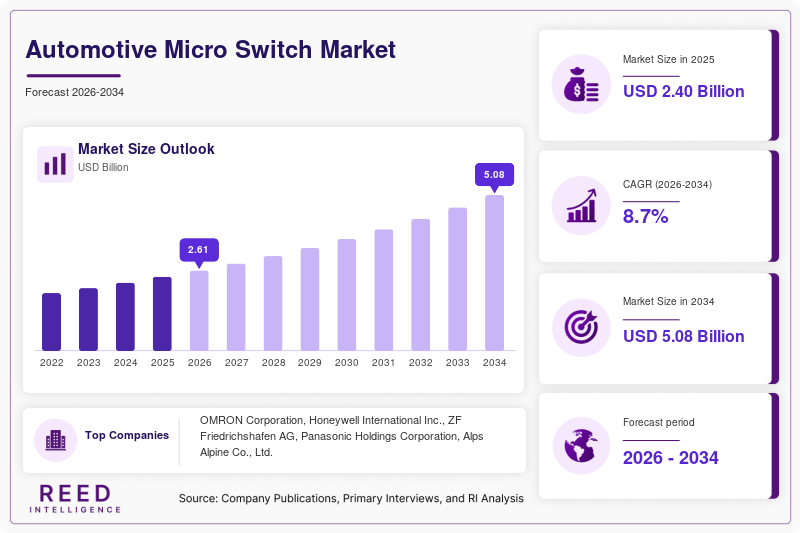
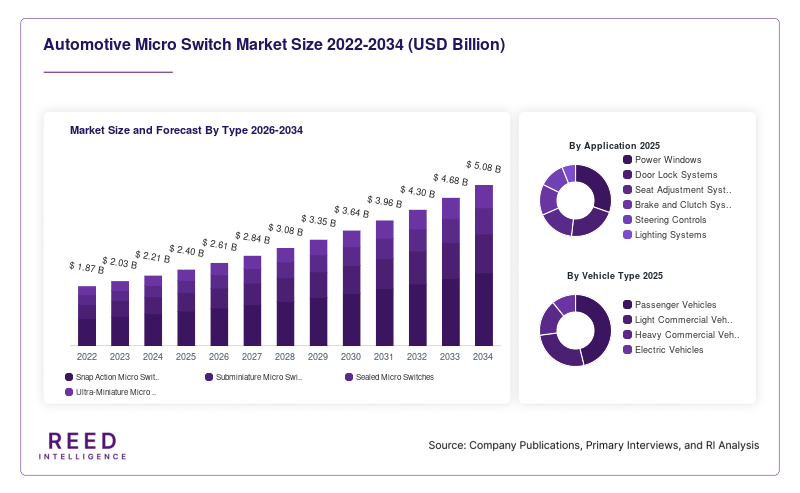
The global Automotive Micro Switch Market Size was valued at USD 2.4 billion in 2026 and is projected to reach USD 4.7 billion by 2034, expanding at a CAGR of 8.7% during the forecast period from 2026 to 2034. The market has experienced stable expansion due to the rapid growth of vehicle electrification, increasing adoption of advanced driver assistance systems, and rising integration of electronic components in modern automobiles. Automotive micro switches play a critical role in enabling precise electrical control functions across vehicle systems such as door locking, seat adjustment, braking systems, lighting modules, steering systems, and infotainment interfaces.
The growing transition toward electric and hybrid vehicles has significantly contributed to Automotive Micro Switch Market growth. Modern vehicles require a larger number of reliable switching components to support electronic architectures, safety systems, and user convenience features. Manufacturers are increasingly investing in compact, durable, and low-power switching technologies capable of operating efficiently under harsh automotive conditions. In addition, rising consumer demand for connected and premium vehicles has accelerated the integration of multifunctional control systems, further strengthening market demand.
Key Highlights:
- Asia Pacific dominated the Automotive Micro Switch Market with a 41.2% share in 2025, while North America is projected to register the fastest CAGR of 9.4% during 2026–2034.
- Snap-action micro switches represented the leading type segment with a 39.6% market share in 2025, whereas ultra-miniature micro switches are expected to grow at a CAGR of 10.8%.
- Passenger vehicles accounted for the largest end-use segment with a 64.5% share in 2025, while electric vehicles are projected to expand at a CAGR of 11.2%.
- Door and window control applications held the dominant market share of 28.4% in 2025 due to increasing electronic integration in vehicle interiors.
- China remained the dominant country market and was valued at USD 510 million in 2024 and approximately USD 560 million in 2025.
Market Trends
Increasing Integration of Smart Vehicle Electronics
The Automotive Micro Switch Market is witnessing strong growth due to the increasing integration of smart electronics within modern vehicles. Automakers are introducing electronic control systems for seating, windows, steering, infotainment, climate control, and safety mechanisms. This trend has increased demand for highly responsive and compact micro switches capable of handling multiple electronic functions with improved reliability. Advanced micro switches with tactile feedback and noise reduction features are becoming increasingly common in premium vehicles.
Miniaturization of Automotive Components
Miniaturization has become a major trend shaping the Automotive Micro Switch Market. Vehicle manufacturers are focusing on reducing component size and weight to improve fuel efficiency and optimize interior space. As a result, compact micro switches with higher operational accuracy are gaining popularity across automotive applications. The trend is particularly visible in electric vehicles where lightweight electronic systems contribute to improved battery performance and driving range.
Market Drivers
Rising Production of Electric Vehicles
The increasing global production of electric vehicles is a major growth driver for the Automotive Micro Switch Market. Electric vehicles require sophisticated electrical systems with precise switching mechanisms for battery management, charging ports, regenerative braking, and thermal management systems. Automotive micro switches are widely used in EV control systems due to their durability and operational efficiency. The growing shift toward sustainable transportation is expected to maintain strong market demand during the forecast period.
Expansion of Advanced Safety Features in Vehicles
Automotive manufacturers are increasingly integrating advanced safety features into vehicles, driving demand for reliable switching technologies. Systems such as automatic braking, airbag deployment, parking assistance, and electronic stability control require responsive micro switches to ensure operational accuracy. Regulatory emphasis on vehicle safety standards across global automotive markets has accelerated the deployment of electronic safety components, positively influencing market growth.
Market Restraint
Fluctuation in Raw Material Prices
One of the primary restraints affecting the Automotive Micro Switch Market is the fluctuation in raw material prices, particularly metals and specialized polymers used in switch manufacturing. Variability in supply chain costs may affect manufacturing margins and increase overall production expenses. Additionally, disruptions in semiconductor and electronic component supply chains can create delays in production cycles and inventory management.
Market Opportunities
Development of Autonomous Vehicle Technologies
The growing development of autonomous vehicle technologies presents a significant opportunity for the Automotive Micro Switch Market. Autonomous vehicles require complex sensor systems and electronic interfaces that depend on reliable switching mechanisms. The increasing adoption of semi-autonomous driving technologies is expected to accelerate demand for advanced automotive-grade micro switches with enhanced durability and precision.
Growth of Smart Interior Systems
Automotive manufacturers are increasingly focusing on intelligent cabin systems that provide improved comfort and user interaction. Features such as touch-sensitive controls, powered seating systems, smart dashboards, and gesture-controlled interfaces are expected to create new opportunities for advanced micro switch integration. The rising popularity of connected vehicles will continue supporting demand for innovative switching solutions.
Segmental Analysis
By Type
The Automotive Micro Switch Market is segmented into snap-action micro switches, ultra-miniature micro switches, waterproof micro switches, and high-temperature micro switches.
Snap-action micro switches dominated the market with a 39.6% share in 2025. These switches gained significant adoption due to their durability, fast response time, and reliability in automotive control applications. They are widely utilized in braking systems, door locks, and seat adjustment mechanisms.
Ultra-miniature micro switches are projected to witness the fastest CAGR of 10.8% during the forecast period. The increasing focus on compact vehicle electronics and lightweight component integration is expected to accelerate demand for miniature switching technologies. Their suitability for space-constrained electronic systems will continue driving segment growth.
By Application
Based on application, the Automotive Micro Switch Market is categorized into door & window control, seat adjustment systems, braking systems, steering systems, infotainment controls, and lighting systems.
Door and window control applications accounted for the leading market share of 28.4% in 2025. Rising integration of automated window systems and central locking mechanisms significantly contributed to segment growth. The growing demand for enhanced passenger convenience features supported widespread adoption.
Infotainment controls are expected to register the fastest CAGR of 10.3% during 2026–2034. Increasing deployment of touchscreen interfaces, multifunction steering controls, and smart cabin systems is anticipated to boost demand for advanced micro switches in infotainment applications.
By Vehicle Type
The Automotive Micro Switch Market is segmented into passenger vehicles, commercial vehicles, and electric vehicles.
Passenger vehicles dominated the market with a 64.5% share in 2025 due to increasing electronic integration across comfort, safety, and entertainment systems. Rising global passenger car production and growing consumer preference for connected features supported segment dominance.
Electric vehicles are projected to grow at the fastest CAGR of 11.2% during the forecast period. Increasing global EV adoption and expanding charging infrastructure investments are expected to strengthen demand for advanced automotive switching technologies.
By Sales Channel
Based on sales channel, the market is divided into OEM and aftermarket.
OEM sales accounted for the largest market share of 71.8% in 2025. Automotive manufacturers increasingly integrated advanced micro switches during vehicle assembly processes to support electronic architectures and safety systems.
The aftermarket segment is projected to expand at a CAGR of 8.6% during the forecast period. Rising replacement demand for aging automotive electrical components and increasing vehicle maintenance activities are expected to contribute to aftermarket growth.
Regional Analysis
Asia Pacific
Asia Pacific accounted for 41.2% of the Automotive Micro Switch Market share in 2025. The region maintained strong dominance due to large-scale automotive manufacturing activities, rapid electric vehicle adoption, and expanding industrial electronics production. China emerged as the leading country in the region due to its massive automotive production capacity and strong government support for electric mobility infrastructure. Japan and South Korea also contributed significantly through advanced automotive electronics manufacturing. Asia Pacific is projected to expand at a CAGR of 8.9% during the forecast period.
North America
North America represented 24.5% of the Automotive Micro Switch Market share in 2025 and is expected to witness the fastest CAGR of 9.4% during 2026–2034. The regional market has been driven by increasing adoption of electric vehicles, growing investments in autonomous driving technologies, and rising consumer demand for premium automotive electronics. The United States dominated the regional market due to the strong presence of EV manufacturers and expanding investments in automotive innovation.
Europe
Europe captured 22.3% of the Automotive Micro Switch Market share in 2025. The region experienced stable growth supported by stringent automotive safety regulations and increasing production of luxury vehicles equipped with advanced electronic systems. Germany dominated the regional market owing to its strong automotive manufacturing ecosystem and technological advancements in automotive engineering. Europe is expected to register a CAGR of 8.3% during the forecast period.
Middle East & Africa
The Middle East & Africa accounted for 5.4% of the Automotive Micro Switch Market share in 2025. Increasing investments in automotive assembly operations and rising vehicle demand supported market growth in the region. The United Arab Emirates emerged as the dominant country due to growing adoption of premium vehicles and expanding automotive aftermarket services. The regional market is projected to grow at a CAGR of 7.2% during 2026–2034.
Latin America
Latin America held 6.6% of the Automotive Micro Switch Market share in 2025. Expanding automotive production and increasing demand for passenger vehicles contributed to market growth. Brazil dominated the regional market due to its strong automotive manufacturing base and rising investments in vehicle electrification. Latin America is anticipated to grow at a CAGR of 7.8% during the forecast period.

Competitive Landscape
The Automotive Micro Switch Market remains highly competitive with the presence of multinational electronics manufacturers and specialized automotive component suppliers. Companies are focusing on miniaturization, waterproof technologies, durability enhancement, and EV-compatible product development to strengthen their competitive position. Strategic partnerships with automotive OEMs and investments in automotive electronics innovation remain important market strategies.
Omron Corporation maintained a strong leadership position in the Automotive Micro Switch Market due to its extensive product portfolio and strong automotive electronics expertise. The company recently introduced high-durability micro switches designed specifically for electric vehicle applications with improved thermal resistance and operational lifespan.
Honeywell International Inc. continued expanding its automotive switching technologies through investments in sensor-integrated systems. Panasonic Corporation focused on lightweight switch components for smart vehicle interiors. Alps Alpine Co., Ltd. strengthened its product lineup with advanced tactile feedback technologies, while ZF Friedrichshafen AG emphasized electronic control integration for autonomous mobility systems.
Competitive Landscape
The Automotive Micro Switch Market remains highly competitive with the presence of multinational electronics manufacturers and specialized automotive component suppliers. Companies are focusing on miniaturization, waterproof technologies, durability enhancement, and EV-compatible product development to strengthen their competitive position. Strategic partnerships with automotive OEMs and investments in automotive electronics innovation remain important market strategies.
Omron Corporation maintained a strong leadership position in the Automotive Micro Switch Market due to its extensive product portfolio and strong automotive electronics expertise. The company recently introduced high-durability micro switches designed specifically for electric vehicle applications with improved thermal resistance and operational lifespan.
Honeywell International Inc. continued expanding its automotive switching technologies through investments in sensor-integrated systems. Panasonic Corporation focused on lightweight switch components for smart vehicle interiors. Alps Alpine Co., Ltd. strengthened its product lineup with advanced tactile feedback technologies, while ZF Friedrichshafen AG emphasized electronic control integration for autonomous mobility systems.
Key Players List
- Omron Corporation
- Honeywell International Inc.
- Panasonic Corporation
- Alps Alpine Co., Ltd.
- ZF Friedrichshafen AG
- TE Connectivity Ltd.
- Johnson Electric Holdings Limited
- Marquardt GmbH
- Schneider Electric SE
- Nidec Corporation
- C&K Switches
- Bourns, Inc.
- Mitsumi Electric Co., Ltd.
- Lefoo Industrial Co., Ltd.
- E-Switch, Inc.
Automotive Micro Switch Market Segments
By Type
- Snap Action Micro Switches
- Subminiature Micro Switches
- Sealed Micro Switches
- Ultra-Miniature Micro Switches
By Application
- Power Windows
- Door Lock Systems
- Seat Adjustment Systems
- Brake and Clutch Systems
- Steering Controls
- Lighting Systems
By Vehicle Type
- Passenger Vehicles
- Light Commercial Vehicles
- Heavy Commercial Vehicles
- Electric Vehicles
By Sales Channel
- OEM
- Aftermarket
By Region
- North America
- Europe
- APAC
- Middle East and Africa
- LATAM