Automotive Mobile Gas Pumping System Market Size, Share, Demand Report By Equipment Type (Sensor-Integrated Mobile Pumping Systems, Software-Controlled Fuel Dispensing Systems, Hybrid Mobile Fueling Units), By End Use (Commercial Transportation & Logistics, Industrial Manufacturing, Mining & Energy Sector, Government & Defense Operations) By Region & Segment Forecasts, 2026–2034
USD 3950
Market Overview
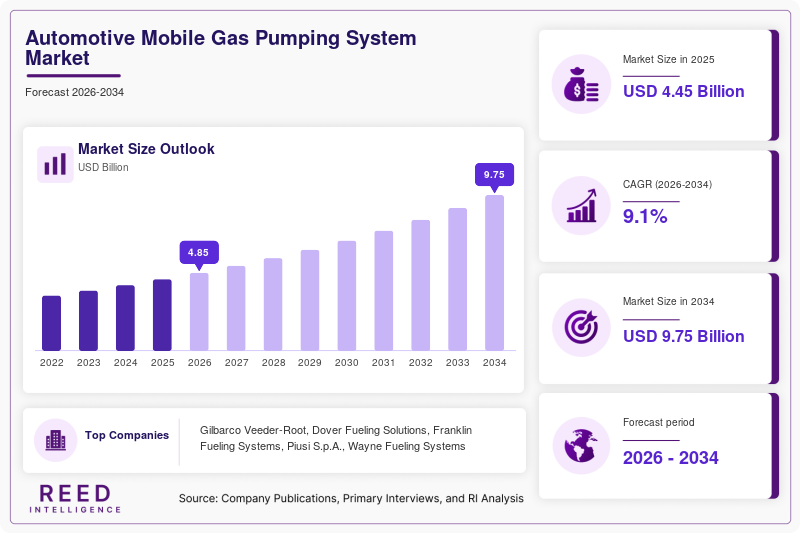
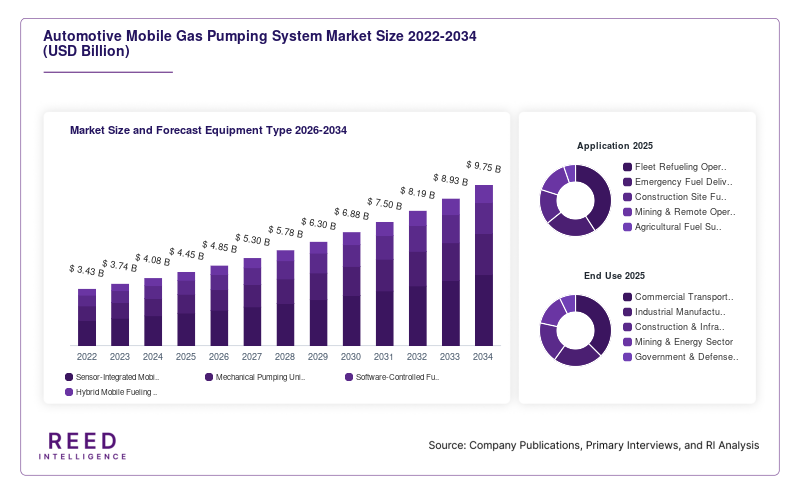
The Automotive Mobile Gas Pumping System Market size of approximately USD 4.85 billion in 2026 and is expected to reach around USD 9.72 billion by 2034, registering a CAGR of 9.1% (2026–2034). Growth is primarily supported by the increasing demand for flexible and on-demand fuel dispensing solutions across commercial fleets, logistics operations, and remote fueling applications. Rising urban mobility constraints and the expansion of decentralized fuel infrastructure have further strengthened adoption globally.
One of the key global factors driving market growth is the rapid expansion of last-mile delivery and construction activities in remote and semi-urban areas, which require mobile fueling solutions to reduce downtime and improve operational efficiency. Additionally, advancements in fuel metering systems and IoT-enabled pumping units have significantly enhanced safety, accuracy, and real-time monitoring capabilities.
Key Highlights
- North America dominated the market with a 34.2% share in 2025.
- Asia Pacific is expected to grow at the fastest CAGR of 11.2% during 2026–2034.
- By equipment type, sensor-integrated pumping systems accounted for the largest share of 38.5%.
- while automated software-controlled systems are projected to grow at a CAGR of 12.4%.
- By application, fleet refueling operations led with a 41.7% share, whereas emergency fuel delivery applications are expected to expand at a CAGR of 11.8%.
- The United States remained the dominant country, with market values of USD 510 million in 2024 and USD 560 million in 2025.
Market Trends
Integration of IoT and Smart Monitoring Systems
The Automotive Mobile Gas Pumping System Market is increasingly witnessing the integration of IoT-enabled monitoring systems that allow real-time tracking of fuel levels, flow accuracy, and equipment performance. These systems are being widely adopted by fleet operators and logistics companies to minimize fuel theft and operational inefficiencies. Advanced sensors connected to cloud-based dashboards provide predictive maintenance alerts, improving system uptime. The trend is further supported by the growing demand for data-driven fleet management solutions that enhance fuel optimization and cost control across large-scale transportation networks.
Shift Toward Electrically Driven Mobile Pumping Units
Another prominent trend shaping the market is the transition from traditional diesel-driven pumping systems to electrically powered mobile fuel dispensing units. This shift is driven by stricter emission regulations and the growing focus on sustainability within industrial fuel handling operations. Electrically driven systems offer reduced noise, lower operational costs, and improved energy efficiency. Manufacturers are increasingly investing in hybrid and battery-supported pumping systems that can operate in off-grid environments, particularly in construction and mining sectors where fuel accessibility remains limited.
Market Drivers
Expansion of Commercial Fleet and Logistics Operations
The rapid expansion of commercial transportation and logistics networks is a major driver for the Automotive Mobile Gas Pumping System Market. With the rise of e-commerce and on-demand delivery services, fleet operators are increasingly relying on mobile fueling systems to ensure uninterrupted vehicle operations. These systems help reduce downtime associated with traditional fueling station visits, thereby improving productivity. Additionally, the growing number of heavy-duty vehicles operating across urban and rural routes has significantly increased demand for flexible fueling infrastructure that can be deployed on-site or at depots.
Increasing Demand for Remote and Emergency Fueling Solutions
The need for emergency and remote fueling solutions is also fueling market growth. Industries such as construction, mining, agriculture, and disaster management often operate in areas with limited access to conventional fuel stations. Mobile gas pumping systems provide a reliable alternative by enabling on-demand fuel delivery directly to operational sites. This capability is particularly critical during natural disasters or infrastructure disruptions, where fuel continuity is essential for machinery, generators, and emergency response vehicles.
Market Restraint
High Initial Investment and Maintenance Complexity
One of the primary restraints in the Automotive Mobile Gas Pumping System Market is the high initial cost associated with advanced mobile pumping units equipped with digital monitoring, safety controls, and automated dispensing technologies. Small and medium-sized enterprises often face financial challenges in adopting these systems due to capital constraints. Additionally, maintenance of sophisticated electronic components and calibration systems requires specialized technical expertise, increasing overall operational expenditure. These factors collectively slow down adoption in cost-sensitive markets, particularly in developing economies where traditional fueling infrastructure remains dominant.
Market Opportunities
Expansion in Emerging Economies and Infrastructure Projects
Emerging economies present significant opportunities for the Automotive Mobile Gas Pumping System Market due to rapid infrastructure development and industrial expansion. Large-scale construction projects, highway development, and smart city initiatives require flexible fueling solutions that can support mobile equipment and machinery. Governments in Asia Pacific, Latin America, and parts of Africa are increasingly investing in infrastructure modernization, creating favorable conditions for mobile fuel system providers. This demand is further amplified by the lack of widespread fuel station networks in rural and semi-urban regions.
Adoption of Hybrid Fuel Dispensing Technologies
The integration of hybrid fuel dispensing technologies, capable of handling multiple fuel types such as diesel, gasoline, and biofuels, is emerging as a strong growth opportunity. As energy diversification gains momentum, fleet operators are seeking adaptable systems that can support alternative fuel transitions. Mobile gas pumping systems equipped with modular dispensing units and smart switching mechanisms are expected to gain traction. This flexibility allows operators to manage fuel logistics more efficiently while aligning with long-term sustainability goals.
Segmental Analysis
By Equipment Type
Sensor-integrated mobile pumping systems dominated the market with a 40.2% share in 2024, driven by their ability to provide real-time fuel tracking and enhanced safety control. These systems are widely used in fleet management applications where accuracy and monitoring are essential. Their adoption is further supported by integration with telematics platforms, enabling centralized fuel usage analytics across large vehicle networks.
Automated software-controlled pumping systems are expected to grow at a CAGR of 12.4%, driven by increasing demand for digitalized fueling infrastructure. These systems reduce manual intervention, enhance operational efficiency, and support predictive maintenance capabilities. Their ability to integrate with IoT ecosystems makes them highly suitable for modern logistics and industrial applications.
By Application
Fleet refueling operations accounted for a 42.1% share in 2024, making them the dominant application segment. The growth is supported by rising logistics activities and increasing dependency on mobile fueling to minimize downtime. Fleet operators are increasingly adopting centralized fueling strategies to improve fuel cost efficiency and operational control.
Emergency fuel delivery applications are projected to grow at a CAGR of 11.8%, driven by disaster response requirements and infrastructure limitations in remote regions. These systems ensure uninterrupted fuel supply during emergencies, supporting critical services such as healthcare, transportation, and utility operations.
By End Use
Commercial transportation dominated with a 39.5% share in 2024, driven by the expansion of logistics and delivery services. The segment benefits from high fuel consumption rates and the need for efficient on-site fueling solutions.
Industrial and construction end use is expected to grow at a CAGR of 10.9%, supported by large-scale infrastructure projects and mining operations requiring mobile fuel availability in remote locations.
Regional Analysis
North America
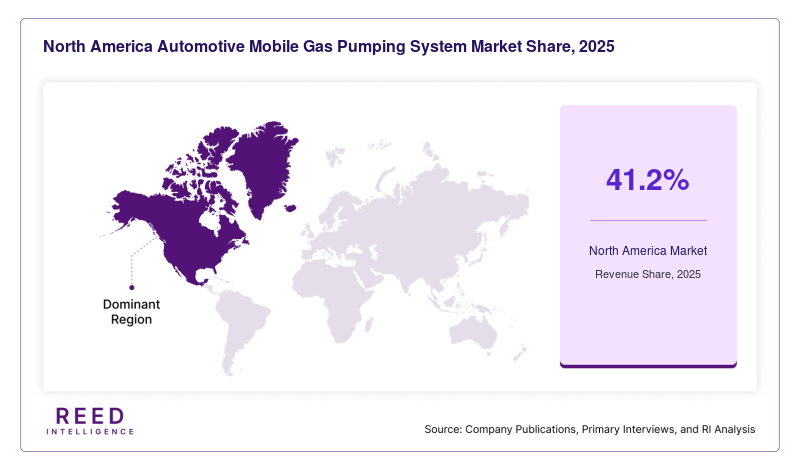
North America holds a significant position in the Automotive Mobile Gas Pumping System Market, accounting for approximately 41.2% of the global market share in 2025, supported by strong adoption across logistics, construction, and emergency fueling services. The region is expected to expand at a steady CAGR of around 8.7% during 2026–2034, driven by continued investments in smart fueling technologies and fleet optimization systems. The presence of well-established infrastructure and high penetration of mobile fueling solutions further strengthens regional dominance.
The United States dominates the North American market due to its extensive commercial fleet network and high demand for on-demand fuel delivery services. A key growth factor is the increasing integration of IoT-enabled fuel management platforms across logistics and transportation industries, allowing real-time monitoring, theft prevention, and operational efficiency. Additionally, government regulations supporting safe fuel handling and environmental compliance continue to drive innovation and adoption.
Europe
Europe represents a mature yet steadily growing market, contributing nearly 26% of the global share in 2025, with an anticipated CAGR of approximately 8.2% through 2034. Growth in the region is influenced by strict environmental regulations and the transition toward efficient fuel distribution systems. Countries are focusing on reducing emissions associated with fuel handling operations, which is accelerating the adoption of advanced mobile gas pumping systems.
Germany leads the European market due to its strong automotive manufacturing base and advanced industrial ecosystem. A major growth factor is the increasing demand for energy-efficient and low-emission fueling systems, particularly in industrial logistics and transportation sectors. Additionally, the adoption of hybrid and electric-powered mobile pumping units is gaining traction across the region.
Asia Pacific
Asia Pacific dominates as a high-growth region, holding approximately 32.6% market share in 2025 and projected to expand at the fastest CAGR of around 11.2% during the forecast period. The region’s growth is fueled by rapid industrialization, expanding logistics networks, and rising demand for efficient fuel distribution in densely populated urban centers. Increasing investments in digital infrastructure and automation technologies are further enhancing market expansion.
China emerges as the leading country in the region, supported by large-scale construction activities and extensive transportation networks. A key growth factor is the increasing adoption of mobile fueling systems in remote and infrastructure-limited areas, where traditional fuel stations are insufficient. Additionally, the rising number of commercial vehicles and the need for operational efficiency in fleet management significantly contribute to market growth.
Middle East & Africa
The Middle East & Africa region accounts for approximately 9–10% of the global market share in 2025, with an expected CAGR of around 9.5% through 2034. Growth in this region is driven by large-scale energy and infrastructure projects, particularly in oil-rich economies. The demand for mobile gas pumping systems is increasing due to the need for flexible fuel distribution in remote operational sites.
Saudi Arabia leads the regional market, supported by its strong oil and gas sector and ongoing infrastructure development initiatives. A unique growth factor is the increasing deployment of mobile fueling systems in desert and off-grid locations, where permanent fueling infrastructure is limited. These systems ensure continuous fuel supply for industrial machinery and construction equipment.
Latin America
Latin America holds approximately 7–8% market share in 2025, with a projected CAGR of around 8.9% during the forecast period. The region is witnessing steady growth due to expanding agricultural, mining, and transportation sectors. Mobile gas pumping systems are increasingly adopted to support fuel delivery in rural and remote locations where traditional infrastructure is underdeveloped.
Brazil dominates the Latin American market, driven by its large agricultural economy and mining operations. A key growth factor is the growing need for efficient fuel distribution in remote farmlands and extraction sites. Additionally, increasing investments in logistics infrastructure and the expansion of commercial fleets are supporting market growth across the region.
Competitive Landscape
The market is moderately consolidated with key players focusing on technological innovation and strategic partnerships. Leading companies include Gilbarco Veeder-Root, Dover Fueling Solutions, Franklin Fueling Systems, Piusi S.p.A., and Wayne Fueling Systems. Gilbarco Veeder-Root holds a leading position due to its advanced automation-based fueling solutions and global distribution network. Recent developments include the launch of IoT-enabled mobile dispensing units designed for real-time fuel analytics and remote fleet monitoring.
Key Players List
- Gilbarco Veeder-Root
- Dover Fueling Solutions
- Franklin Fueling Systems
- Piusi S.p.A.
- Wayne Fueling Systems
- Tatsuno Corporation
- Tuthill Corporation
- Elaflex Hiby
- Bennett Pump Company
- Tokheim Group
- Censtar Science & Technology
- Petrotec Group
- Sanki Engineering
- Neotec Energy Systems
- Morrison Bros. Co.
Recent Developments
- In 2025, leading manufacturers such as Gilbarco Veeder-Root and Wayne Fueling Systems focused on enhancing automated and IoT-enabled mobile fueling technologies, improving real-time monitoring, safety, and operational efficiency across fleet operations.
- Companies across the industry introduced advanced mobile refueling units with improved user interfaces and automated dispensing features, aimed at reducing human error and increasing fueling accuracy.
- Strategic investments in sustainable and alternative fuel integration, including biofuels and cleaner energy-compatible systems, have increased as companies align with environmental regulations and decarbonization goals.
Automotive Mobile Gas Pumping System Market Segments
Equipment Type
- Sensor-Integrated Mobile Pumping Systems
- Mechanical Pumping Units
- Software-Controlled Fuel Dispensing Systems
- Hybrid Mobile Fueling Units
Application
- Fleet Refueling Operations
- Emergency Fuel Delivery Services
- Construction Site Fueling
- Mining & Remote Operations Fueling
- Agricultural Fuel Supply Systems
End Use
- Commercial Transportation & Logistics
- Industrial Manufacturing
- Construction & Infrastructure
- Mining & Energy Sector
- Government & Defense Operations
By Region
- North America
- Europe
- APAC
- Middle East and Africa
- LATAM