Automotive NFC Market Size, Share & Demand Report By Component (NFC Chips, NFC Readers, NFC Antennas, NFC Controllers, Software & Platforms), By Application (Digital Key & Vehicle Access, Infotainment Pairing, Contactless Payments, Vehicle Authentication, Telematics & Connectivity), By Vehicle Type (Passenger Vehicles, Commercial Vehicles, Electric Vehicles), By Sales Channel (OEMs, Aftermarket) and By Region & Segment Forecasts, 2026–2034
USD 3950
Market Overview
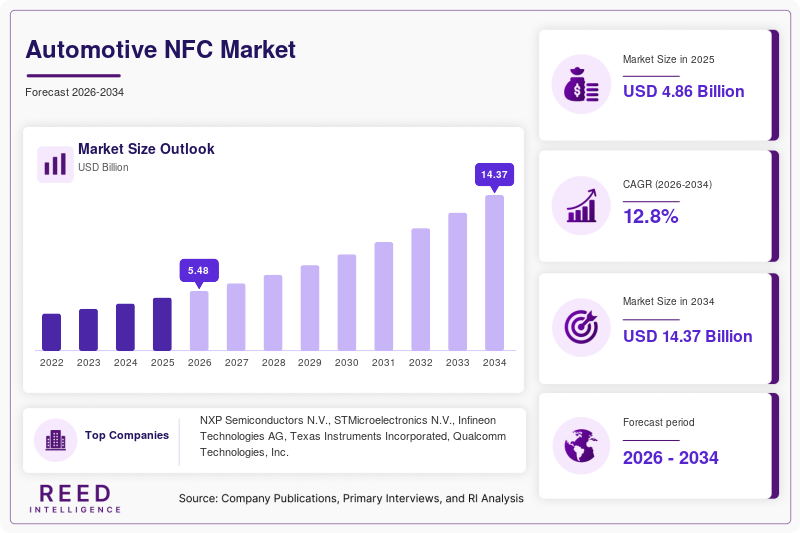
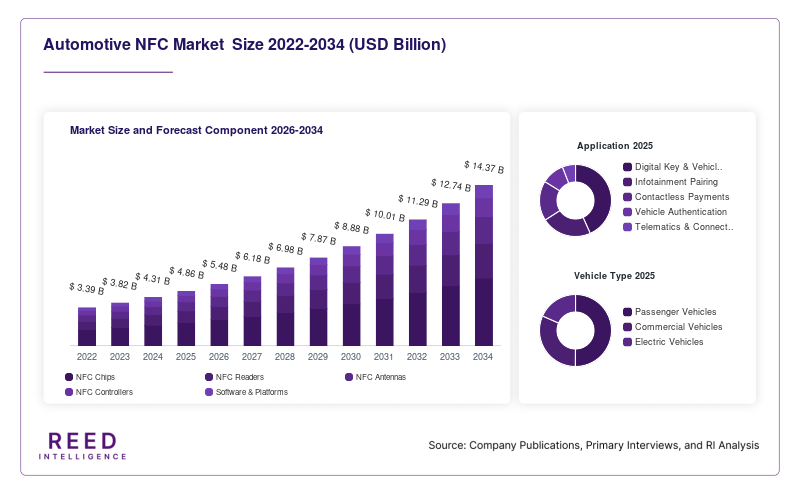
The Automotive NFC Market size was valued at USD 4.86 billion in 2026 and is projected to reach USD 12.74 billion by 2034, registering a CAGR of 12.8% during the forecast period (2026–2034). A major global factor supporting market expansion has been the rapid adoption of connected vehicle ecosystems. Automotive manufacturers are integrating Near Field Communication (NFC) technology to enhance vehicle access, authentication, personalization, payment functionality, and infotainment experiences. As consumers increasingly expect seamless smartphone-to-vehicle interaction, NFC-enabled automotive solutions have become an important component of next-generation mobility platforms.
Automotive NFC technology enables secure communication between vehicles and smart devices through short-range wireless connectivity. The technology is increasingly used for digital key systems, vehicle sharing platforms, driver identification, contactless payments, wireless pairing, maintenance authentication, and personalized vehicle settings. Growing investments in connected mobility, electric vehicles, and software-defined vehicle architectures continue to strengthen market demand worldwide.
Key Highlights
- Asia Pacific accounted for the largest Automotive NFC Market share of 41.2% in 2025, while North America is projected to register the fastest CAGR of 13.7% during 2026–2034.
- By Component, NFC Chips & Controllers held the dominant share of 45.6% in 2025, whereas NFC Software Platforms are expected to expand at a CAGR of 14.9% through 2034.
- By Application, Digital Vehicle Access Systems represented 38.4% market share in 2025, while In-Vehicle Payment Systems are forecast to grow at a CAGR of 15.2%.
- By Vehicle Type, Passenger Vehicles captured 72.8% of the market in 2025, whereas Electric Vehicles are anticipated to record a CAGR of 16.1%.
- By End User, OEMs remained the leading segment with 67.5% share in 2025, while Mobility Service Providers are forecast to grow at 15.8% CAGR.
- The United States remained the dominant country, with market values of USD 742 million in 2024 and USD 851 million in 2025.
Market Trends
Digital Vehicle Keys Replacing Traditional Access Systems
Automotive manufacturers are increasingly deploying NFC-enabled digital key solutions as alternatives to traditional mechanical and remote-control vehicle keys. Digital key technology allows users to unlock, start, and manage vehicles using smartphones, wearable devices, and authenticated credentials. Vehicle-sharing operators and fleet managers are also adopting NFC-based access systems to simplify user authorization and vehicle management processes. This trend is encouraging automakers to integrate NFC functionality as a standard feature within premium and mid-range vehicle models.
Integration of Contactless Vehicle Commerce Platforms
The automotive industry is witnessing growing integration of NFC technology within contactless payment ecosystems. Drivers can use NFC-enabled systems for fuel purchases, parking payments, toll transactions, charging station access, and retail services. As connected vehicles become digital commerce platforms, NFC functionality is supporting secure authentication and transaction processing. Increasing collaboration between automakers, payment providers, and mobility platforms is accelerating deployment of in-vehicle commerce capabilities.
Market Drivers
Expansion of Connected Vehicle Technologies
Connected vehicle adoption continues to increase as manufacturers prioritize software-based features and digital user experiences. NFC technology supports secure device pairing, driver authentication, and communication between vehicles and external systems. As connected mobility infrastructure expands globally, demand for automotive NFC solutions is increasing across passenger and commercial vehicle segments. Integration with cloud platforms and mobile applications further strengthens the role of NFC technology within modern vehicle ecosystems.
Rising Consumer Preference for Smartphone-Based Vehicle Functions
Consumers increasingly prefer smartphone-centric vehicle interaction models that eliminate the need for traditional keys and physical authentication methods. NFC technology enables convenient access to vehicle functions while maintaining security and usability. The growing popularity of mobile-first lifestyles is encouraging automakers to expand NFC-enabled services across multiple vehicle categories, supporting long-term market growth.
Market Restraint
Cybersecurity and Data Protection Concerns
Although NFC technology incorporates secure communication protocols, concerns regarding unauthorized access, credential theft, and data privacy remain significant challenges. Automotive manufacturers must continuously invest in encryption technologies, authentication mechanisms, and cybersecurity frameworks to maintain consumer confidence and regulatory compliance.
Market Opportunities
Growth of Shared Mobility Platforms
Car-sharing and subscription-based transportation services require secure and convenient vehicle access technologies. NFC-enabled digital key systems simplify vehicle authorization and user management processes. The expansion of shared mobility ecosystems is expected to create substantial opportunities for automotive NFC solution providers during the forecast period.
Expansion of Electric Vehicle Charging Authentication
The growing electric vehicle market is creating demand for simplified charging station authentication systems. NFC technology allows users to securely initiate charging sessions and complete transactions through smartphones or NFC-enabled devices. Increasing deployment of charging infrastructure worldwide is expected to strengthen future demand for automotive NFC solutions.
Segmental Analysis
By Component
The market is segmented into:
- NFC Chips & Controllers
- NFC Antennas
- NFC Readers
- NFC Software Platforms
NFC Chips & Controllers dominated the market with 45.6% share in 2025. These components serve as the core communication and authentication units within automotive NFC systems. Their widespread deployment across vehicle access and connectivity applications supported segment leadership.
NFC Software Platforms are projected to register the fastest CAGR of 14.9% during the forecast period. Increasing demand for cloud integration, remote credential management, and digital mobility services will support rapid adoption. Enhanced software functionality is expected to become a key differentiating factor among automotive NFC solutions.
By Application
The market includes:
- Digital Vehicle Access Systems
- Vehicle Pairing & Infotainment Connectivity
- In-Vehicle Payment Systems
- Driver Authentication & Personalization
- Fleet Management Solutions
Digital Vehicle Access Systems accounted for 38.4% market share in 2025 due to widespread implementation of smartphone-based unlocking and vehicle-start functions. Growing demand for convenient access solutions contributed significantly to segment revenue.
In-Vehicle Payment Systems are anticipated to grow at a CAGR of 15.2% through 2034. Increasing utilization of connected commerce applications for fueling, parking, toll collection, and EV charging transactions will strengthen future demand.
By Vehicle Type
The market is categorized into:
- Passenger Vehicles
- Commercial Vehicles
- Electric Vehicles
Passenger Vehicles held the largest market share of 72.8% in 2025 owing to widespread deployment of NFC-enabled convenience features across mainstream and premium vehicle models. Rising consumer demand for digital experiences supported segment dominance.
Electric Vehicles are forecast to register the fastest CAGR of 16.1% over the assessment period. Increasing integration of digital ecosystems, charging authentication systems, and connected services will drive accelerated adoption of NFC technology within EV platforms.
By End User
The market is segmented into:
- OEMs
- Aftermarket Providers
- Fleet Operators
- Mobility Service Providers
OEMs represented 67.5% market share in 2025 as automotive manufacturers increasingly integrated NFC technology directly into vehicle architectures during production. Strong adoption among major automakers supported segment leadership.
Mobility Service Providers are expected to record the highest CAGR of 15.8% during the forecast period. Expansion of shared mobility, subscription-based transportation services, and digital vehicle access solutions will contribute significantly to segment growth.
Regional Analysis
North America
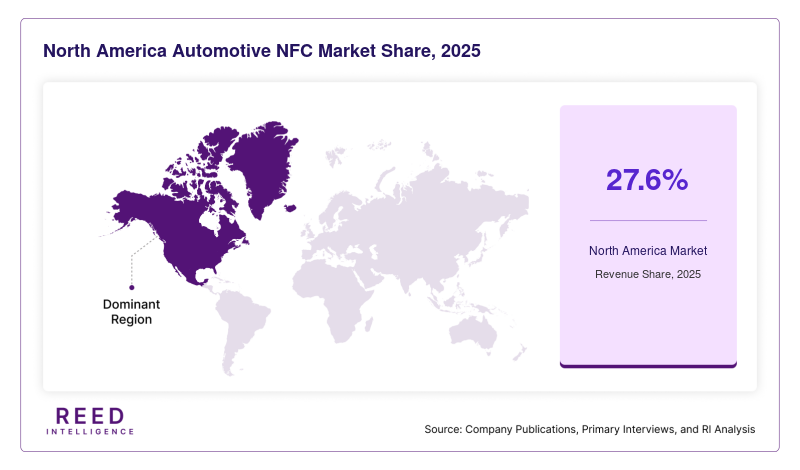
North America accounted for 27.6% of the Automotive NFC Market share in 2025 and is projected to grow at a CAGR of 13.7% between 2026 and 2034. The region benefits from strong adoption of connected vehicle technologies and advanced digital mobility services. Vehicle manufacturers are increasingly incorporating NFC-enabled access systems and smartphone integration features into new vehicle platforms.
The United States dominated the regional market due to strong penetration of connected vehicles and increasing deployment of software-driven automotive technologies. Growing investments in intelligent transportation solutions continue to support market expansion.
Europe
Europe represented 25.1% market share in 2025 and is anticipated to expand at a CAGR of 12.4% through 2034. Automotive digitization initiatives and widespread implementation of connected vehicle features continue to support regional demand. NFC technology is increasingly utilized across premium vehicle segments and fleet management platforms.
Germany maintained regional leadership owing to its advanced automotive manufacturing ecosystem and growing adoption of digital mobility technologies. Continuous innovation in vehicle connectivity solutions contributes to sustained market growth.
Asia Pacific
Asia Pacific held the largest 41.2% share of the Automotive NFC Market in 2025 and is forecast to register a CAGR of 13.1% during the assessment period. Rapid vehicle production, expanding smartphone penetration, and growing demand for connected transportation technologies continue to strengthen market development across the region.
China emerged as the dominant country due to large-scale production of connected and electric vehicles. Increasing integration of digital mobility platforms and smart transportation infrastructure is accelerating adoption of NFC-enabled automotive solutions.
Middle East & Africa
The Middle East & Africa accounted for 3.4% market share in 2025 and is expected to grow at a CAGR of 11.2% during 2026–2034. Increasing investments in smart city projects and connected transportation networks are supporting adoption of advanced vehicle technologies. Demand is gradually increasing among premium automotive segments and fleet operators.
United Arab Emirates led the regional market due to growing implementation of intelligent mobility initiatives and digital transportation infrastructure. Expansion of connected vehicle services is contributing to regional demand.
Latin America
Latin America represented 2.7% market share in 2025 and is forecast to expand at a CAGR of 10.8% through 2034. Increasing smartphone adoption and modernization of automotive technologies are encouraging deployment of NFC-enabled vehicle solutions across the region.
Brazil remained the dominant market due to its sizeable automotive industry and growing interest in connected vehicle technologies. Expanding digital ecosystems continue to create opportunities for NFC integration within automotive platforms.
Competitive Landscape
The Automotive NFC Market remains moderately competitive, with technology companies, semiconductor manufacturers, and automotive suppliers focusing on secure connectivity solutions, digital key platforms, and integrated mobility ecosystems. Strategic partnerships between automakers and technology providers continue to shape market dynamics.
NXP Semiconductors N.V. remained a leading participant due to its extensive portfolio of automotive NFC chipsets and digital vehicle access solutions. The company recently introduced an enhanced automotive NFC platform supporting secure digital key functionality, improved encryption standards, and interoperability with emerging connected vehicle ecosystems.
STMicroelectronics N.V. continues expanding its automotive NFC offerings through advanced controller technologies designed for connected vehicle applications.
Infineon Technologies AG focuses on secure authentication solutions and integrated automotive communication platforms supporting digital mobility initiatives.
Texas Instruments Incorporated develops NFC-enabled semiconductor solutions optimized for automotive connectivity and user authentication applications.
Continental AG remains active in vehicle access technologies, integrating NFC functionality into smart access and driver identification systems.
Key Players List
- NXP Semiconductors N.V.
- STMicroelectronics N.V.
- Infineon Technologies AG
- Texas Instruments Incorporated
- Continental AG
- Robert Bosch GmbH
- DENSO Corporation
- Valeo SA
- Aptiv PLC
- Harman International
- Alps Alpine Co., Ltd.
- HID Global Corporation
- Panasonic Holdings Corporation
- Identiv, Inc.
- Qualcomm Incorporated
- Samsung Electronics Co., Ltd.
- Sony Semiconductor Solutions Corporation
- Thales Group
Recent Developments
- In 2025, multiple automotive manufacturers expanded deployment of smartphone-based digital key solutions utilizing NFC authentication technologies.
- Several semiconductor companies introduced next-generation automotive NFC chipsets featuring enhanced encryption and low-power operation capabilities.
- Automotive OEMs increased collaboration with mobile ecosystem providers to improve compatibility between smartphones and connected vehicle platforms.
- New vehicle access management solutions were launched to support car-sharing services and subscription-based mobility programs.
- NFC-enabled payment platforms gained broader integration across electric vehicle charging networks and intelligent transportation ecosystems.
- Research initiatives focused on strengthening cybersecurity frameworks for connected vehicle authentication systems and digital identity management.
- Industry participants expanded investments in software-defined vehicle architectures incorporating NFC connectivity as part of broader digital mobility strategies.
Automotive NFC Market Segments
Component
- NFC Chips
- NFC Readers
- NFC Antennas
- NFC Controllers
- Software & Platforms
Application
- Digital Key & Vehicle Access
- Infotainment Pairing
- Contactless Payments
- Vehicle Authentication
- Telematics & Connectivity
Vehicle Type
- Passenger Vehicles
- Commercial Vehicles
- Electric Vehicles
Sales Channel
- OEMs
- Aftermarket
By Region
- North America
- Europe
- APAC
- Middle East and Africa
- LATAM