Automotive Non-contact Temperature Sensor Market Size, Share & Demand Report By Type (Infrared Sensors, Thermopile Sensors, Pyroelectric Sensors), By Application (Powertrain Systems, Battery Management Systems, HVAC Systems, Exhaust Systems), By Vehicle Type (Passenger Vehicles, Commercial Vehicles, Electric Vehicles), By Output Type (Analog Output, Digital Output), By Region & Segment Forecasts, 2025–2034
USD 3950
Market Overview
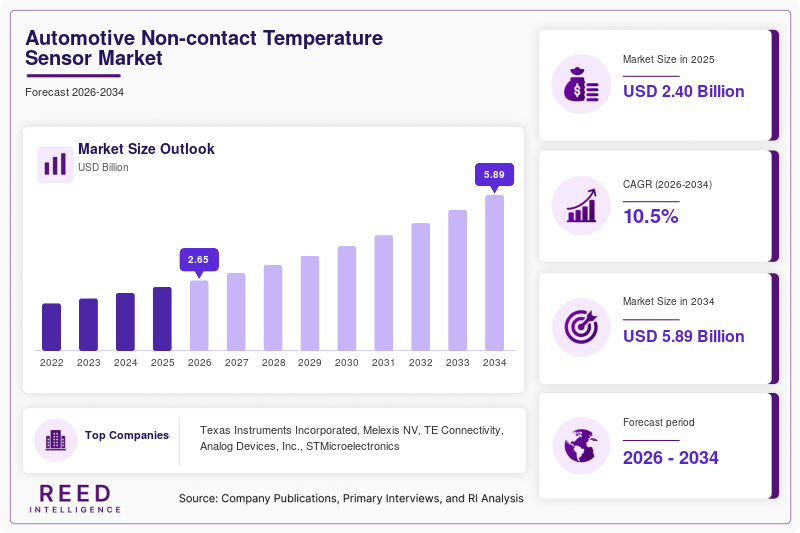
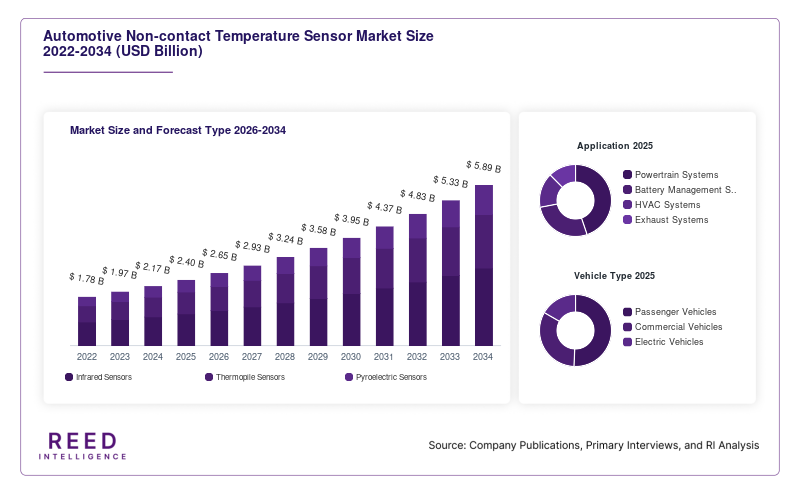
The Automotive Non-contact Temperature Sensor Market size was valued at approximately USD 2.4 billion in 2025 and is projected to reach USD 5.9 billion by 2034, expanding at a CAGR of 10.5% during 2025–2034. The market size is driven by the increasing integration of advanced sensing technologies in modern vehicles, particularly across electric vehicles (EVs), autonomous driving systems, and advanced driver assistance systems (ADAS). These sensors enable accurate temperature detection without physical contact, making them ideal for critical automotive applications such as battery monitoring, engine management, and cabin climate control.
A key global factor supporting market growth is the rapid electrification of the automotive sector. As EV adoption rises worldwide, the need for precise thermal management systems has intensified. Non-contact temperature sensors, including infrared (IR) and thermopile sensors, are essential for ensuring battery efficiency, safety, and longevity, thereby contributing to consistent market expansion.
Key Highlights
- Asia Pacific dominated the market with 38.6% share in 2025, while Europe is expected to be the fastest-growing region at a CAGR of 11.8%.
- Infrared sensors led the type segment with 54.2% share, while thermopile sensors are projected to grow fastest at a CAGR of 12.1%.
- Powertrain applications dominated with 41.7% share, while battery management systems are expected to grow fastest at a CAGR of 13.4%.
- China remained the dominant country, with market values of USD 620 million in 2025 and USD 685 million in 2026.
Market Trends
Integration of Non-contact Sensors in Electric Vehicle Architectures
The increasing adoption of electric vehicles is significantly shaping the Automotive Non-contact Temperature Sensor Market. EV systems rely heavily on thermal monitoring to maintain optimal battery performance and safety. Non-contact temperature sensors are being integrated into battery packs and charging systems to provide real-time temperature readings without direct contact. This reduces wear and improves sensor lifespan. Automakers are increasingly incorporating multi-point sensing systems to monitor temperature gradients across battery modules. This trend is strengthening the demand for compact, high-precision sensors that can operate in harsh automotive environments.
Miniaturization and Smart Sensor Integration
The market is witnessing a shift toward miniaturized and intelligent sensor solutions. Advances in semiconductor technology have enabled the development of compact sensors with integrated signal processing capabilities. These smart sensors can transmit real-time data to vehicle control units, enabling predictive maintenance and enhanced system efficiency. Integration with onboard diagnostics and vehicle communication networks is becoming common. Additionally, the growing use of Internet of Things (IoT) technologies in vehicles is further accelerating this trend. Manufacturers are focusing on developing sensors with improved accuracy, lower power consumption, and enhanced durability, aligning with evolving automotive design requirements.
Market Drivers
Rising Demand for Advanced Thermal Management Systems
The growing complexity of automotive systems has increased the need for efficient thermal management. Modern vehicles, especially electric and hybrid models, generate significant heat across batteries, power electronics, and engines. Non-contact temperature sensors play a critical role in monitoring and managing these thermal conditions without interfering with system components. Their ability to provide accurate readings in real time improves operational safety and system performance. As vehicle manufacturers continue to prioritize efficiency and reliability, the demand for these sensors is expected to rise steadily.
Increasing Adoption of Autonomous and Connected Vehicles
The advancement of autonomous driving technologies is another key driver of the Automotive Non-contact Temperature Sensor Market. Autonomous vehicles require multiple sensing systems to ensure safe operation under varying conditions. Temperature monitoring is essential for maintaining the functionality of electronic components, sensors, and processors. Non-contact temperature sensors offer a reliable solution for monitoring these systems without physical constraints. Furthermore, connected vehicles rely on data-driven insights, and temperature data plays a vital role in predictive diagnostics and system optimization. This growing reliance on advanced vehicle technologies is contributing to sustained market growth.
Market Restraint
High Cost of Advanced Sensor Technologies
One of the primary challenges in the Automotive Non-contact Temperature Sensor Market is the relatively high cost associated with advanced sensor technologies. Infrared and thermopile sensors, particularly those with integrated digital interfaces and high accuracy levels, involve complex manufacturing processes and specialized materials. This results in higher production costs compared to traditional contact-based sensors.
For cost-sensitive markets, especially in developing regions, the adoption of non-contact temperature sensors can be limited due to budget constraints. Automotive manufacturers operating in these markets often prioritize cost efficiency over advanced features, which can slow down the penetration of these sensors. Additionally, the integration of these sensors into vehicle systems requires compatible electronic architectures, further increasing overall costs.
Another aspect contributing to this restraint is the need for calibration and maintenance to ensure long-term accuracy. While non-contact sensors offer several advantages, their performance can be affected by environmental factors such as dust, humidity, and surface emissivity variations. Addressing these challenges requires additional design considerations, adding to the overall expense.
Market Opportunities
Expansion in Electric Commercial Vehicles
The growing adoption of electric commercial vehicles presents a strong opportunity for the Automotive Non-contact Temperature Sensor Market. These vehicles require advanced thermal monitoring systems to manage high-capacity battery packs and ensure operational efficiency. Non-contact sensors can play a vital role in enhancing safety and reducing maintenance requirements.
Development of AI-Enabled Sensor Systems
The integration of artificial intelligence with sensor technologies is creating new growth avenues. AI-enabled sensors can analyze temperature data in real time and predict potential system failures. This capability is particularly valuable in modern vehicles, where predictive maintenance is becoming a key focus. As automotive manufacturers invest in intelligent systems, the demand for advanced non-contact temperature sensors is expected to increase.
Segmental Analysis
By Type
Infrared sensors dominated the Automotive Non-contact Temperature Sensor Market with a 54.2% share in 2025, owing to their widespread use in automotive applications requiring accurate and rapid temperature measurement. Their ability to operate without direct contact makes them suitable for high-temperature environments.
Thermopile sensors are expected to be the fastest-growing subsegment, with a CAGR of 12.1% during the forecast period. Their enhanced sensitivity and compatibility with compact electronic systems will drive their adoption, particularly in advanced vehicle applications.
By Application
Powertrain applications held the largest share at 41.7% in 2025, as temperature monitoring is essential for engine performance and efficiency. Non-contact sensors are widely used to monitor engine components and exhaust systems.
Battery management systems are projected to grow at the fastest rate, with a CAGR of 13.4%. The increasing adoption of electric vehicles will drive the need for precise temperature monitoring in battery systems to ensure safety and performance.
By Vehicle Type
Passenger vehicles accounted for the largest share in 2025 due to high production volumes and increasing integration of advanced technologies. These vehicles require temperature sensors for multiple applications, including climate control and engine monitoring.
Electric vehicles are expected to witness the fastest growth, with a CAGR of 14.2%, driven by the rising demand for efficient thermal management systems and increasing EV adoption worldwide.
By Output Type
Analog output sensors dominated the market in 2025 due to their simplicity and cost-effectiveness. These sensors are widely used in traditional automotive systems.
Digital output sensors are expected to grow at a faster pace, with a CAGR of 11.7%, as they offer improved accuracy and integration with modern vehicle electronics.
Regional Analysis
North America
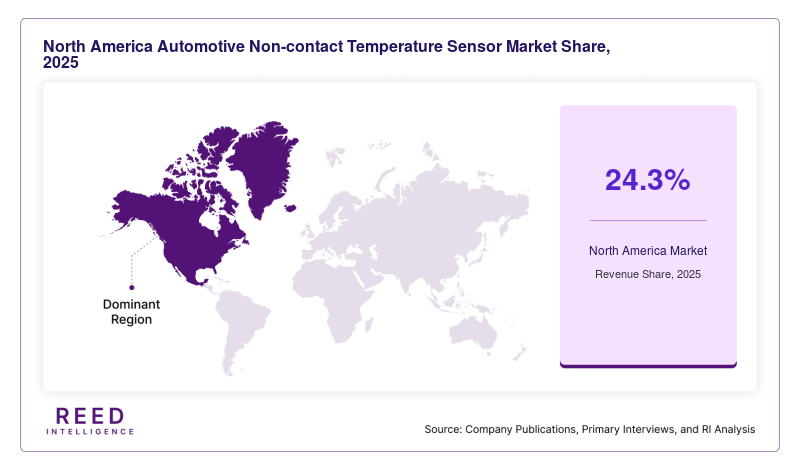
North America accounted for 24.3% of the Automotive Non-contact Temperature Sensor Market share in 2025 and is expected to grow at a CAGR of 9.6% during the forecast period. The region’s market was supported by strong adoption of advanced automotive technologies and the presence of established automotive manufacturers.
The United States dominated the regional market due to its focus on technological innovation. The increasing deployment of electric vehicles and investments in autonomous driving technologies have driven the demand for non-contact temperature sensors. The emphasis on vehicle safety standards has further contributed to the growth of this market.
Europe
Europe held a 22.7% share in 2025 and is projected to expand at a CAGR of 11.8%, making it the fastest-growing region. The region’s growth is influenced by stringent emission regulations and a strong push toward electrification.
Germany led the European market due to its well-established automotive industry and focus on engineering excellence. The country’s commitment to electric mobility and innovation in automotive technologies has increased the adoption of advanced temperature sensing solutions.
Asia Pacific
Asia Pacific dominated the market with a 38.6% share in 2025 and is expected to grow at a CAGR of 10.9%. The region’s growth is driven by high vehicle production volumes and increasing adoption of electric vehicles.
China emerged as the dominant country due to its large automotive manufacturing base and government support for electric mobility. The rapid expansion of EV infrastructure and production capacity has significantly boosted the demand for non-contact temperature sensors.
Middle East & Africa
The Middle East & Africa accounted for 6.8% of the market in 2025 and is projected to grow at a CAGR of 8.7%. The market in this region is gradually expanding due to increasing investments in automotive infrastructure.
The United Arab Emirates led the regional market, supported by rising adoption of advanced automotive technologies and a growing focus on vehicle safety and performance.
Latin America
Latin America held a 7.6% share in 2025 and is expected to grow at a CAGR of 9.1%. The region’s growth is supported by the recovery of the automotive sector and increasing demand for efficient vehicle systems.
Brazil dominated the market due to its large automotive industry and rising adoption of advanced vehicle components. The growing focus on improving vehicle performance and safety is contributing to the demand for non-contact temperature sensors.
Competitive Landscape
The Automotive Non-contact Temperature Sensor Market is moderately competitive, with several global players focusing on innovation and product development. Leading companies are investing in advanced sensor technologies and expanding their product portfolios to meet evolving automotive requirements.
A key market leader is Texas Instruments Incorporated, which has strengthened its position through continuous innovation in infrared sensing technologies. The company recently introduced a new series of compact, high-accuracy temperature sensors designed for automotive applications, enhancing its competitive edge.
Other prominent players include Melexis NV, TE Connectivity, Analog Devices, Inc., and STMicroelectronics. These companies are focusing on strategic collaborations, product launches, and technological advancements to expand their market presence.
Key Players
- Texas Instruments Incorporated
- Melexis NV
- TE Connectivity
- Analog Devices, Inc.
- STMicroelectronics
- NXP Semiconductors
- Honeywell International Inc.
- Panasonic Corporation
- Omron Corporation
- Amphenol Corporation
- Vishay Intertechnology, Inc.
- Excelitas Technologies Corp.
- Murata Manufacturing Co., Ltd.
- Sensirion AG
- Infineon Technologies AG
Recent Developments
- In 2025, Texas Instruments launched a new automotive-grade infrared temperature sensor series with improved accuracy and reduced power consumption.
- Melexis introduced advanced thermopile sensors designed specifically for electric vehicle battery monitoring systems.
- STMicroelectronics expanded its sensor portfolio with integrated digital temperature sensing solutions for automotive applications.
- Analog Devices announced a collaboration with automotive OEMs to develop next-generation thermal management systems.
- TE Connectivity invested in research and development to enhance sensor durability in extreme automotive environments.
Automotive Non-contact Temperature Sensor Market Segments
Type
- Infrared Sensors
- Thermopile Sensors
- Pyroelectric Sensors
Application
- Powertrain Systems
- Battery Management Systems
- HVAC Systems
- Exhaust Systems
Vehicle Type
- Passenger Vehicles
- Commercial Vehicles
- Electric Vehicles
Output Type
- Analog Output
- Digital Output
By Region
- North America
- Europe
- APAC
- Middle East and Africa
- LATAM