Automotive Platooning System Market Size, Share Demand Report By Component (Hardware, Software, Services), By Vehicle Type (Heavy Commercial Vehicles, Light Commercial Vehicles), By Communication Technology (Vehicle-to-Vehicle (V2V), Vehicle-to-Infrastructure (V2I), Vehicle-to-Network (V2N)), By Region & Segment Forecasts, 2026–2034
USD 3950
Market Overview
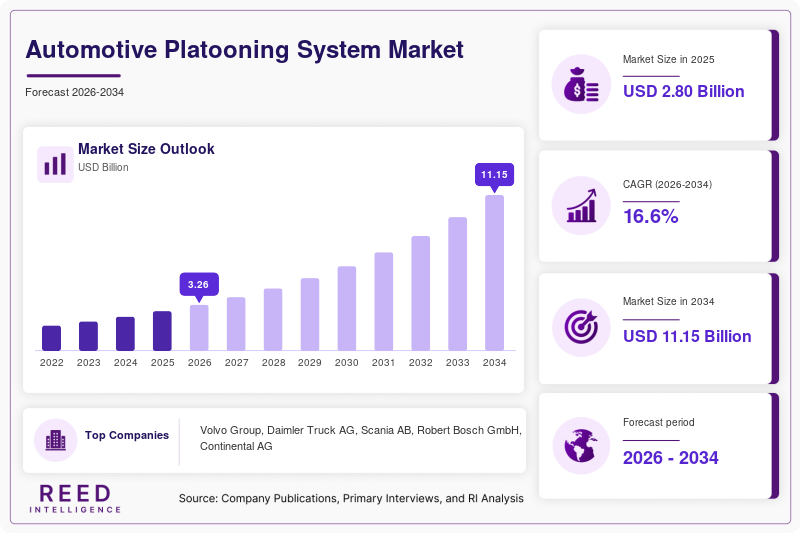
The Automotive Platooning System Market size was valued at approximately USD 2.8 billion in 2026 and is projected to reach USD 9.6 billion by 2034, expanding at a compound annual growth rate (CAGR) of 16.6% during the forecast period from 2026 to 2034. Automotive platooning systems enable multiple vehicles, particularly commercial trucks, to travel in closely coordinated convoys using advanced connectivity, sensors, and automation technologies. This synchronized movement enhances fuel efficiency, reduces emissions, and improves road safety, making it increasingly relevant in modern logistics and transportation ecosystems.
A key global factor driving the market growth is the increasing demand for fuel-efficient transportation solutions across freight and logistics industries. Rising fuel costs and stringent emission regulations are encouraging fleet operators to adopt technologies that optimize fuel consumption. Platooning systems, by reducing aerodynamic drag and enabling coordinated acceleration and braking, significantly improve fuel efficiency, thereby supporting sustainability goals and operational cost reduction.
Key Highlights
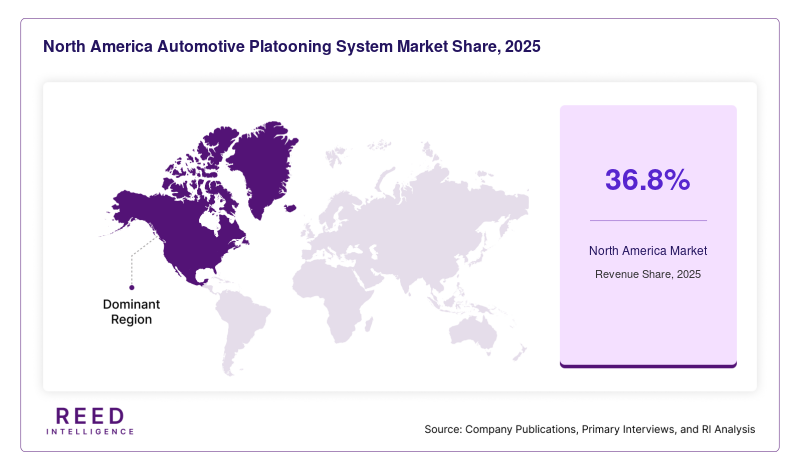
- North America dominated the market with a 36.8% share in 2025.
- Asia Pacific is expected to grow at the fastest CAGR of 17.9% during 2026–2034.
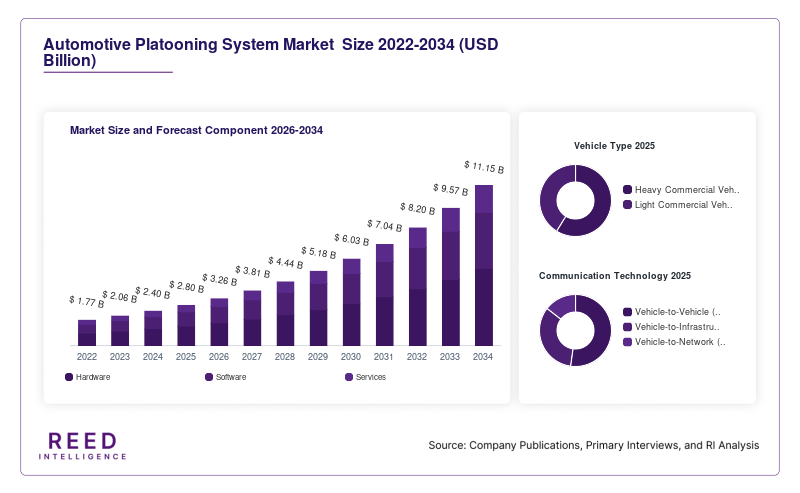
- By component, hardware accounted for the largest share of 42.6%, while software platforms are projected to grow at a CAGR of 18.5%.
- By vehicle type, heavy commercial vehicles led with a 58.3% share, whereas light commercial vehicles are expected to expand at a CAGR of 17.2%.
- The United States remained the dominant country, with market values of USD 1.1 billion in 2024 and USD 1.3 billion in 2025.
Market Trends
Integration of Advanced Connectivity Technologies in Platooning Systems
The increasing integration of advanced connectivity technologies such as 5G and vehicle-to-everything (V2X) communication is shaping the Automotive Platooning System Market. These technologies enable real-time data exchange between vehicles, infrastructure, and cloud platforms, allowing precise coordination within platoons. Enhanced connectivity improves safety by enabling instant communication regarding braking, speed adjustments, and road conditions. Moreover, the deployment of edge computing solutions is reducing latency issues, ensuring reliable operation even in high-speed environments. Fleet operators are increasingly investing in connected vehicle ecosystems to improve operational efficiency and compliance with regulatory requirements. This trend is also supported by government initiatives promoting smart transportation infrastructure, which further accelerates the adoption of platooning systems globally.
Growing Adoption of Semi-Autonomous and Autonomous Driving Technologies
The rising adoption of semi-autonomous and autonomous driving technologies is another significant trend influencing the market. Automotive platooning relies heavily on automation features such as adaptive cruise control, lane-keeping assistance, and collision avoidance systems. As these technologies become more advanced and cost-effective, their integration into platooning systems is becoming more feasible. Automotive manufacturers are focusing on developing scalable solutions that can support varying levels of automation, enabling gradual adoption across different fleet sizes. Additionally, partnerships between technology providers and automotive OEMs are fostering innovation in autonomous platooning capabilities. This trend is expected to drive market growth by enhancing system reliability, reducing driver fatigue, and improving overall transportation efficiency.
Market Drivers
Increasing Demand for Fuel Efficiency and Cost Optimization
The rising demand for fuel efficiency and cost optimization in the logistics and transportation sector is a major driver for the Automotive Platooning System Market. Fleet operators are under constant pressure to reduce operational costs while maintaining service efficiency. Platooning systems help achieve this by reducing aerodynamic drag, which significantly lowers fuel consumption for trailing vehicles. This results in substantial cost savings over time, especially for long-haul transportation. Additionally, the reduction in fuel consumption aligns with environmental sustainability goals, making platooning an attractive solution for companies aiming to reduce their carbon footprint. As fuel prices continue to fluctuate, the adoption of platooning systems is expected to increase further, driving market growth.
Stringent Emission Regulations and Environmental Policies
Governments worldwide are implementing stringent emission regulations to address environmental concerns, which is driving the adoption of automotive platooning systems. Regulatory frameworks aimed at reducing greenhouse gas emissions are encouraging the use of technologies that improve fuel efficiency and reduce pollution. Platooning systems contribute to lower emissions by optimizing vehicle movement and minimizing unnecessary acceleration and braking. Furthermore, incentives and subsidies for adopting green technologies are encouraging fleet operators to invest in platooning solutions. The growing emphasis on sustainable transportation is expected to create a favorable environment for market expansion during the forecast period.
Market Restraint
High Initial Investment and Infrastructure Requirements
One of the primary restraints in the Automotive Platooning System Market is the high initial investment required for deployment. Implementing platooning systems involves significant costs related to advanced hardware components, software integration, and communication technologies. Fleet operators must invest in sensors, radar systems, communication modules, and onboard computing units, which can be expensive, particularly for small and medium-sized enterprises. Additionally, the need for robust infrastructure, including reliable network connectivity and smart road systems, further increases the overall cost of implementation.
The lack of standardized regulations across different regions also poses a challenge, as it creates uncertainty for stakeholders planning to invest in platooning technologies. Moreover, the integration of platooning systems with existing fleet operations requires technical expertise and training, adding to operational complexities. These factors collectively hinder the widespread adoption of platooning systems, particularly in developing regions where infrastructure and financial resources may be limited. Despite the long-term benefits, the high upfront costs remain a significant barrier to market growth.
Market Opportunities
Expansion in Emerging Economies
Emerging economies present significant growth opportunities for the Automotive Platooning System Market. Rapid urbanization and industrialization in countries across Asia Pacific, Latin America, and parts of Africa are driving the demand for efficient transportation systems. Governments in these regions are investing in smart infrastructure and digital connectivity, which supports the deployment of advanced vehicle technologies, including platooning systems. Additionally, the increasing demand for logistics and freight services due to the growth of e-commerce is creating a favorable environment for the adoption of platooning solutions. As these economies continue to develop, the demand for cost-effective and efficient transportation systems is expected to rise, providing lucrative opportunities for market players.
Integration with Electric and Autonomous Vehicles
The integration of automotive platooning systems with electric and autonomous vehicles offers a promising growth opportunity. As the adoption of electric vehicles (EVs) increases, platooning systems can enhance their efficiency by optimizing energy consumption through coordinated driving. This is particularly beneficial for commercial fleets, where operational efficiency is crucial. Furthermore, the advancement of autonomous driving technologies is expected to enable fully automated platooning systems, reducing the need for human intervention. This integration can significantly improve safety, reduce labor costs, and enhance overall fleet performance. The convergence of these technologies is likely to drive innovation and create new growth avenues in the market.
Segmental Analysis
By Component
The hardware segment dominated the Automotive Platooning System Market, accounting for approximately 42.6% of the market share in 2024. This dominance is attributed to the critical role of physical components such as sensors, radar systems, cameras, and communication devices in enabling platooning functionality. These components are essential for real-time data collection and communication between vehicles, ensuring safe and efficient operation. The increasing adoption of advanced sensor technologies and the growing demand for reliable hardware solutions are driving the growth of this segment. Additionally, continuous advancements in hardware design and manufacturing are improving performance and reducing costs, further supporting market expansion.
The software segment is expected to be the fastest-growing subsegment, with a CAGR of 18.5% during the forecast period. The growth of this segment is driven by the increasing need for advanced algorithms and data analytics to manage platooning operations. Software solutions enable real-time decision-making, route optimization, and system integration, which are critical for efficient platooning. The rise of artificial intelligence and machine learning technologies is further enhancing the capabilities of platooning software, enabling predictive maintenance and improved safety. As the demand for intelligent transportation systems increases, the software segment is expected to experience significant growth.
By Vehicle Type
Heavy commercial vehicles dominated the market, accounting for approximately 58.3% of the market share in 2024. This dominance is primarily due to the extensive use of platooning systems in long-haul trucking operations. Heavy commercial vehicles benefit significantly from platooning, as it improves fuel efficiency and reduces operational costs. The increasing demand for efficient freight transportation and the growing focus on reducing emissions are driving the adoption of platooning systems in this segment. Additionally, the availability of advanced technologies and supportive regulatory frameworks are further supporting the growth of heavy commercial vehicles in the market.
Light commercial vehicles are expected to be the fastest-growing subsegment, with a CAGR of 17.2% during the forecast period. The growth of this segment is driven by the increasing demand for last-mile delivery services, particularly in urban areas. The rise of e-commerce and the need for efficient delivery solutions are encouraging the adoption of platooning systems in light commercial vehicles. Additionally, advancements in technology are making platooning more accessible for smaller vehicles, further supporting the growth of this segment.
By Communication Technology
The vehicle-to-vehicle (V2V) communication segment dominated the market, accounting for approximately 46.1% of the market share in 2024. This dominance is attributed to the critical role of V2V communication in enabling real-time coordination between vehicles in a platoon. V2V technology allows vehicles to share information about speed, position, and road conditions, ensuring synchronized movement. The increasing adoption of connected vehicle technologies and the growing emphasis on road safety are driving the growth of this segment.
The vehicle-to-infrastructure (V2I) communication segment is expected to be the fastest-growing, with a CAGR of 18.1% during the forecast period. The growth of this segment is driven by the increasing development of smart infrastructure and the integration of transportation systems with digital technologies. V2I communication enables vehicles to interact with traffic signals, road sensors, and other infrastructure components, improving efficiency and safety. As governments invest in smart city initiatives, the demand for V2I communication is expected to increase significantly.
Regional Analysis
North America
North America accounted for approximately 36.8% of the Automotive Platooning System Market share in 2025 and is expected to maintain steady growth with a CAGR of 15.8% during the forecast period. The region’s dominance is attributed to the early adoption of advanced automotive technologies and strong investment in research and development. The presence of major automotive manufacturers and technology providers further supports market growth. Additionally, government initiatives promoting connected and autonomous vehicles are contributing to the adoption of platooning systems across the region.
The United States remains the dominant country in North America, driven by its well-established logistics industry and focus on innovation. A unique growth factor in the country is the increasing collaboration between private companies and government agencies to test and deploy platooning technologies on highways. These pilot programs are providing valuable insights and accelerating commercialization, making the U.S. a key contributor to regional market growth.
Europe
Europe held a market share of around 28.5% in 2025 and is projected to grow at a CAGR of 15.2% during the forecast period. The region’s strong regulatory framework supporting emission reduction and sustainable transportation is a key driver of market growth. European countries are actively promoting the adoption of advanced vehicle technologies to meet environmental targets. Additionally, the presence of leading automotive manufacturers and a well-developed transportation infrastructure further supports the adoption of platooning systems.
Germany is the dominant country in the European market, owing to its strong automotive industry and technological advancements. A unique growth factor in Germany is the extensive testing of platooning systems on highways under real-world conditions. These initiatives are supported by government funding and industry partnerships, which are accelerating the development and deployment of platooning technologies across the region.
Asia Pacific
Asia Pacific is expected to grow at the fastest CAGR of 17.9% during the forecast period, with a market share of approximately 22.4% in 2025. The region’s rapid economic growth and increasing demand for efficient transportation solutions are driving the adoption of automotive platooning systems. Countries in this region are investing heavily in smart infrastructure and digital connectivity, which supports the implementation of advanced vehicle technologies.
China dominates the Asia Pacific market, driven by its large automotive industry and strong government support for innovation. A unique growth factor in China is the integration of platooning systems with smart city initiatives. The government’s focus on developing intelligent transportation systems is creating a favorable environment for the adoption of platooning technologies, contributing to the region’s rapid growth.
Middle East & Africa
The Middle East & Africa region accounted for a smaller market share of around 6.3% in 2025 but is expected to grow at a CAGR of 14.1% during the forecast period. The region’s growth is driven by increasing investments in infrastructure development and the adoption of advanced technologies in the transportation sector. Governments in the region are focusing on improving logistics efficiency to support economic diversification.
The United Arab Emirates is the dominant country in this region, driven by its focus on innovation and smart city development. A unique growth factor in the UAE is the implementation of advanced transportation projects that incorporate autonomous and connected vehicle technologies. These initiatives are supporting the adoption of platooning systems and contributing to regional market growth.
Latin America
Latin America held a market share of approximately 6.0% in 2025 and is projected to grow at a CAGR of 13.8% during the forecast period. The region’s growth is supported by the increasing demand for efficient logistics and transportation solutions. Economic development and the expansion of trade activities are driving the need for advanced vehicle technologies.
Brazil is the dominant country in the Latin American market, driven by its large transportation sector and growing industrial base. A unique growth factor in Brazil is the increasing adoption of digital technologies in logistics operations. This trend is supporting the implementation of platooning systems, which are helping to improve efficiency and reduce operational costs in the region.
Competitive Landscape
The Automotive Platooning System Market is characterized by the presence of several key players focusing on innovation and strategic partnerships to strengthen their market position. The competitive landscape is moderately consolidated, with leading companies investing in research and development to enhance their technological capabilities. Companies are also forming collaborations with automotive manufacturers and technology providers to accelerate the development and deployment of platooning systems.
One of the leading players in the market is Volvo Group, which has been actively involved in developing advanced platooning technologies. The company recently conducted successful pilot tests of autonomous platooning systems on highways, demonstrating the feasibility and efficiency of its solutions. Other major players are focusing on expanding their product portfolios and entering new markets to gain a competitive edge. The increasing focus on sustainability and efficiency is driving innovation in the market, leading to the development of advanced and cost-effective platooning solutions.
Key Players
- Volvo Group
- Daimler Truck AG
- Scania AB
- Robert Bosch GmbH
- Continental AG
- ZF Friedrichshafen AG
- Denso Corporation
- Qualcomm Incorporated
- NVIDIA Corporation
- Intel Corporation
- Peloton Technology
- Aptiv PLC
- Valeo SA
- Toyota Motor Corporation
- AB Volvo Autonomous Solutions
Recent Developments
- In 2025, Volvo Group conducted large-scale highway trials of autonomous platooning systems in North America to improve logistics efficiency.
- In 2024, Daimler Truck AG partnered with technology firms to develop next-generation connected platooning solutions.
- In 2025, Scania AB introduced an advanced platooning platform integrating AI-based predictive analytics for fleet optimization.
Automotive Platooning System Market Segments
Component
- Hardware
- Software
- Services
Vehicle Type
- Heavy Commercial Vehicles
- Light Commercial Vehicles
Communication Technology
- Vehicle-to-Vehicle (V2V)
- Vehicle-to-Infrastructure (V2I)
- Vehicle-to-Network (V2N)
By Region
- North America
- Europe
- APAC
- Middle East and Africa
- LATAM