Automotive Positive Crankcase Ventilation PCV Valve Market Size, Share Demand Report By Type (Spring-Loaded PCV Valves, Fixed Orifice PCV Valves, Electronically Controlled PCV Valves), By Vehicle Type (Passenger Cars, Light Commercial Vehicles, Heavy Commercial Vehicles), By Sales Channel (OEM, Aftermarket), By Region & Segment Forecasts, 2026–2034
USD 3950
Market Overview
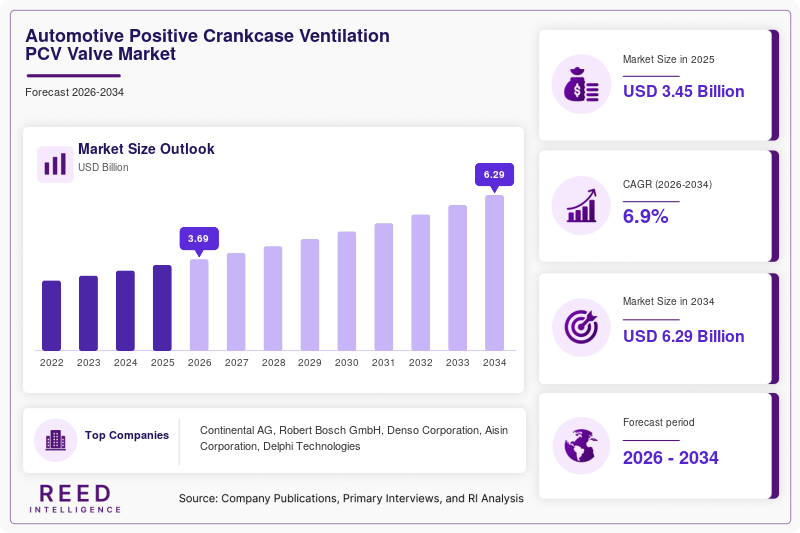
The Automotive Positive Crankcase Ventilation Pcv Valve Market was valued at approximately USD 3.45 billion in 2026 and is projected to reach USD 5.92 billion by 2034, expanding at a compound annual growth rate (CAGR) of 6.9% during 2026–2034. The market continues to grow steadily due to the increasing adoption of emission control technologies across global automotive manufacturing. PCV valves play a critical role in reducing harmful emissions by recirculating blow-by gases back into the combustion chamber, thereby improving engine efficiency and compliance with environmental regulations.
A major global factor supporting market growth is the tightening of emission norms across developed and developing economies. Regulatory frameworks aimed at reducing carbon emissions have compelled automakers to incorporate efficient crankcase ventilation systems in both gasoline and diesel engines. Additionally, rising vehicle production, especially in emerging economies, has further strengthened the demand for PCV valves. Technological advancements in valve design and materials are also contributing to enhanced durability and efficiency, which supports long-term market expansion.
Key Highlights
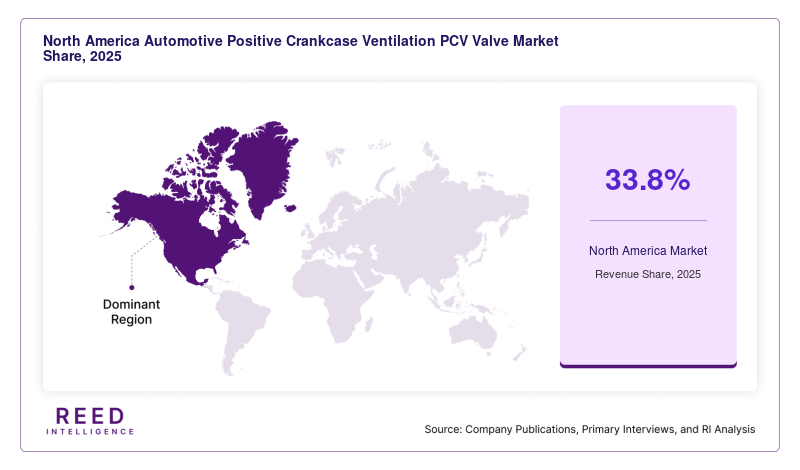
- North America dominated the market with a 33.8% share in 2025.
- Asia Pacific is expected to grow at the fastest CAGR of 7.8% during 2026–2034.
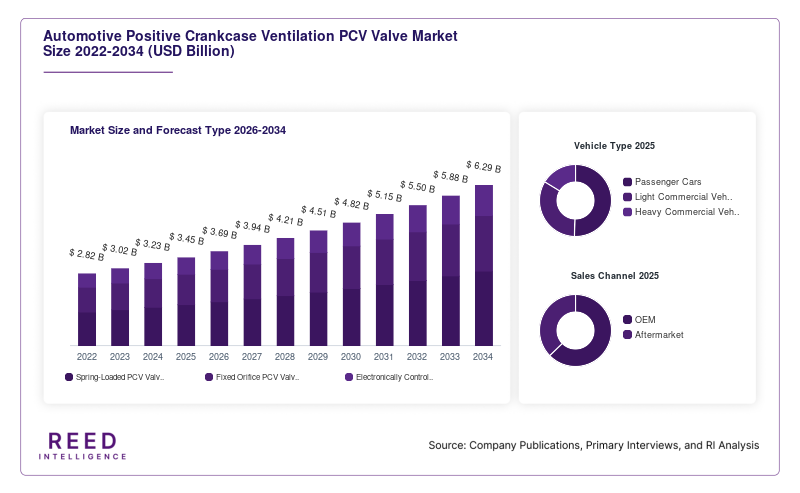
- By type, spring-loaded PCV valves accounted for the largest share of 46.5%, while electronically controlled PCV valves are projected to grow at a CAGR of 8.3%.
- By vehicle type, passenger cars led with a 58.2% share, whereas light commercial vehicles are expected to expand at a CAGR of 7.5%.
- The United States remained the dominant country, with market values of USD 780 million in 2024 and USD 835 million in 2025.
Market Trends
Integration of Electronic Control Systems in PCV Valves
A notable trend in the Automotive Positive Crankcase Ventilation PCV Valve Market is the increasing integration of electronic control systems within PCV valves. Traditionally, PCV valves were mechanical components, but the growing complexity of modern engines has created demand for electronically controlled solutions. These valves enable precise regulation of airflow based on engine load, temperature, and speed, which improves fuel efficiency and emission performance. Automakers are adopting such advanced systems to meet stringent regulatory standards and enhance engine optimization. The integration also supports onboard diagnostics, allowing early detection of faults and reducing maintenance costs. This trend is expected to gain traction as vehicle electrification and hybridization increase the need for more intelligent emission management systems.
Growing Demand for Lightweight and Durable Materials
Another key trend is the increasing use of lightweight and high-performance materials in PCV valve manufacturing. Manufacturers are shifting toward engineered plastics and advanced composites to reduce overall vehicle weight while maintaining durability. Lightweight materials contribute to improved fuel efficiency and lower emissions, aligning with global sustainability goals. Additionally, these materials offer resistance to high temperatures and chemical corrosion, extending the lifespan of PCV valves. The automotive industry’s broader focus on lightweighting strategies has influenced component design across systems, including ventilation mechanisms. This trend is particularly prominent in regions with strict emission norms, where manufacturers prioritize efficiency without compromising performance or reliability.
Market Drivers
Stringent Emission Regulations Across Global Markets
The implementation of stringent emission regulations is a primary driver for the Automotive Positive Crankcase Ventilation PCV Valve Market. Governments worldwide are enforcing strict norms to reduce vehicular emissions, which has made PCV systems a mandatory component in internal combustion engines. These valves help minimize the release of unburned hydrocarbons into the atmosphere, thereby supporting compliance with environmental standards. Regulatory bodies in North America and Europe have introduced advanced emission limits, while emerging economies are gradually adopting similar frameworks. This regulatory push has increased the demand for efficient and reliable PCV valves. Automakers are investing in improved designs and technologies to meet these standards, which is further driving market growth.
Rising Global Vehicle Production and Ownership
Another major driver is the steady increase in global vehicle production and ownership. Emerging economies, particularly in Asia Pacific, have witnessed rapid urbanization and rising disposable incomes, leading to higher demand for passenger and commercial vehicles. Each vehicle requires a PCV system as part of its engine configuration, directly contributing to market expansion. Additionally, the growth of the aftermarket segment, driven by maintenance and replacement needs, supports sustained demand. As vehicles age, PCV valves require periodic replacement to maintain engine performance and emission efficiency. This recurring demand creates a stable revenue stream for manufacturers and distributors operating in the market.
Market Restraint
Increasing Adoption of Electric Vehicles (EVs)
The growing adoption of electric vehicles poses a significant restraint to the Automotive Positive Crankcase Ventilation PCV Valve Market. EVs do not rely on internal combustion engines, which eliminates the need for PCV systems altogether. As governments and consumers shift toward electric mobility to reduce carbon emissions, the demand for traditional engine components, including PCV valves, is expected to decline over time. This transition is particularly evident in developed regions where EV adoption rates are increasing rapidly due to supportive policies, incentives, and infrastructure development.
The impact of this restraint is further amplified by investments from automakers in electric vehicle production. Many leading automotive manufacturers are reallocating resources from internal combustion engine technologies to electric powertrains. This shift reduces innovation and development focus on PCV systems, potentially slowing market growth. For example, countries with aggressive EV targets may experience a decline in demand for PCV valves in the long term. However, the internal combustion engine segment is expected to remain relevant in hybrid vehicles and emerging markets, which may partially offset the restraint.
Market Opportunities
Expansion of Hybrid Vehicle Segment
The expansion of hybrid vehicles presents a significant opportunity for the Automotive Positive Crankcase Ventilation PCV Valve Market. Hybrid vehicles combine internal combustion engines with electric propulsion systems, requiring efficient emission control components such as PCV valves. As governments promote hybrid vehicles as a transitional solution toward full electrification, demand for PCV systems is expected to remain stable. Hybrid engines often operate under variable conditions, which increases the importance of advanced PCV valve technologies. Manufacturers can leverage this opportunity by developing solutions tailored to hybrid applications, ensuring optimal performance and compliance with emission standards.
Growth of Automotive Aftermarket Services
The growing automotive aftermarket sector offers another key opportunity for market expansion. PCV valves require regular maintenance and replacement to ensure proper engine function and emission control. As the global vehicle fleet ages, the demand for replacement components increases. Aftermarket service providers play a crucial role in meeting this demand, particularly in regions with large numbers of older vehicles. Additionally, consumers are becoming more aware of vehicle maintenance and its impact on performance and efficiency. This awareness drives the adoption of high-quality replacement parts, including PCV valves. Companies can capitalize on this opportunity by expanding distribution networks and offering cost-effective, durable products.
Segmental Analysis
By Type
The spring-loaded PCV valve segment dominated the Automotive Positive Crankcase Ventilation PCV Valve Market, accounting for approximately 46.5% of the market share in 2024. These valves are widely used due to their simple design, cost-effectiveness, and reliability. They operate mechanically, adjusting airflow based on engine vacuum levels, which makes them suitable for a wide range of vehicles. The dominance of this segment is supported by its extensive use in traditional internal combustion engines. Additionally, the availability of these valves in the aftermarket further strengthens their market presence.
Electronically controlled PCV valves are the fastest-growing subsegment, with a projected CAGR of 8.3% during the forecast period. These valves offer enhanced precision and adaptability, making them suitable for modern engine systems. The growth of this segment is driven by the increasing adoption of advanced engine technologies and the need for improved emission control. Automakers are integrating electronic PCV systems to optimize engine performance and comply with stringent regulations. This trend is expected to continue as vehicles become more technologically advanced.
By Vehicle Type
Passenger cars held the largest share in the Automotive Positive Crankcase Ventilation PCV Valve Market, accounting for approximately 58.2% in 2024. The dominance of this segment is attributed to the high volume of passenger vehicle production and ownership globally. PCV valves are essential components in these vehicles, ensuring efficient engine operation and emission control. The growing demand for personal mobility and urban transportation further supports the expansion of this segment. Additionally, the replacement demand for PCV valves in aging passenger vehicles contributes to sustained market growth.
Light commercial vehicles (LCVs) are the fastest-growing subsegment, with a CAGR of 7.5% during the forecast period. The growth of this segment is driven by increasing demand for logistics and transportation services, particularly in emerging economies. LCVs operate under varying conditions, which requires durable and efficient PCV systems. The expansion of e-commerce and last-mile delivery services has further increased the demand for these vehicles, supporting the growth of the PCV valve market.
By Sales Channel
The OEM segment dominated the market, accounting for approximately 62.7% of the market share in 2024. Original equipment manufacturers integrate PCV valves during vehicle production, ensuring compliance with emission standards. The dominance of this segment is supported by the continuous growth in vehicle production and the need for high-quality components. OEMs prioritize reliability and performance, which drives demand for advanced PCV valve technologies.
The aftermarket segment is the fastest-growing, with a projected CAGR of 7.9%. The growth of this segment is driven by the increasing need for replacement and maintenance of PCV valves. As vehicles age, the performance of these components declines, necessitating periodic replacement. The expanding network of service centers and the availability of cost-effective replacement parts contribute to the growth of the aftermarket segment. Additionally, consumer awareness regarding vehicle maintenance supports market expansion.
Regional Analysis
North America
North America accounted for a significant share of the Automotive Positive Crankcase Ventilation PCV Valve Market, holding approximately 33.8% in 2025. The region is expected to grow at a CAGR of 6.5% during the forecast period, driven by stringent emission regulations and a well-established automotive industry. The presence of major automakers and advanced manufacturing capabilities further supports market growth. Additionally, increasing consumer awareness regarding vehicle maintenance contributes to the demand for high-quality PCV valves in both OEM and aftermarket segments.
The United States dominates the North American market due to its large vehicle fleet and strong regulatory framework. A unique growth factor in the country is the emphasis on reducing emissions through technological innovation. Automakers are investing in advanced engine components to meet federal standards, which drives demand for efficient PCV systems. The presence of a robust aftermarket ecosystem also supports sustained growth in the region.
Europe
Europe held a market share of approximately 27.4% in 2025 and is projected to grow at a CAGR of 6.2% over the forecast period. The region’s growth is primarily driven by strict environmental regulations and a strong focus on sustainability. European countries have implemented advanced emission standards, which require efficient crankcase ventilation systems in vehicles. The presence of leading automotive manufacturers also contributes to market expansion.
Germany is the dominant country in the European market, supported by its strong automotive manufacturing base. A unique growth factor in Germany is the focus on engineering excellence and innovation in vehicle components. Manufacturers in the country prioritize high-performance and durable PCV valves, which enhances overall market development. Additionally, the adoption of advanced technologies in engine systems supports demand for improved PCV solutions.
Asia Pacific
Asia Pacific is the fastest-growing region, with a projected CAGR of 7.8% during 2026–2034, and held a share of 24.6% in 2025. The region’s growth is driven by rapid industrialization, increasing vehicle production, and rising consumer demand. Countries such as China and India are witnessing significant growth in the automotive sector, which directly impacts the demand for PCV valves.
China leads the Asia Pacific market due to its large-scale vehicle production and expanding automotive industry. A unique growth factor in the country is the government’s push toward reducing emissions while maintaining high production levels. This balance has led to increased adoption of efficient PCV systems. Additionally, the growth of the aftermarket segment in China supports sustained demand for replacement components.
Middle East & Africa
The Middle East & Africa region accounted for approximately 7.2% of the market share in 2025 and is expected to grow at a CAGR of 5.9%. The region’s growth is influenced by increasing vehicle ownership and gradual implementation of emission regulations. While the market is smaller compared to other regions, it presents opportunities for expansion due to rising demand for automotive components.
Saudi Arabia is the dominant country in the region, driven by its growing automotive sector. A unique growth factor is the increasing focus on vehicle maintenance and aftermarket services. Consumers are becoming more aware of the importance of maintaining engine performance, which drives demand for PCV valves. Additionally, the expansion of distribution networks supports market growth.
Latin America
Latin America held a market share of approximately 7.0% in 2025 and is projected to grow at a CAGR of 6.1%. The region’s growth is supported by increasing vehicle production and improving economic conditions. Countries in the region are gradually adopting emission standards, which drives demand for PCV systems.
Brazil dominates the Latin American market due to its large automotive industry. A unique growth factor in Brazil is the increasing adoption of flex-fuel vehicles, which require efficient emission control components. This trend supports demand for advanced PCV valves. Additionally, the growth of the aftermarket sector contributes to market expansion in the region.
Competitive Landscape
The Automotive Positive Crankcase Ventilation PCV Valve Market is moderately fragmented, with several global and regional players competing based on product quality, pricing, and technological innovation. Leading companies focus on enhancing product performance and durability to meet evolving regulatory requirements. The market is characterized by strategic partnerships, product launches, and investments in research and development.
One of the leading players in the market is Continental AG, which has established a strong presence through its advanced automotive component portfolio. The company focuses on integrating innovative technologies into its PCV valve solutions to improve efficiency and emission control. A recent development includes the introduction of electronically controlled PCV systems designed for modern hybrid engines. Other key players are also investing in lightweight materials and advanced designs to strengthen their market position. The competitive environment encourages continuous innovation, which benefits the overall market.
Key Players
- Continental AG
- Robert Bosch GmbH
- Denso Corporation
- Aisin Corporation
- Delphi Technologies
- Standard Motor Products
- Mahle GmbH
- Hitachi Astemo Ltd.
- MANN+HUMMEL Group
- Valeo SA
- BorgWarner Inc.
- Tenneco Inc.
- Mitsubishi Electric Corporation
- Hyundai Mobis
- NGK Spark Plug Co., Ltd.
Recent Developments
- In 2025, a major automotive supplier introduced an advanced electronically controlled PCV valve designed for hybrid vehicles, enhancing emission efficiency.
- In 2024, a leading manufacturer expanded its production capacity in Asia Pacific to meet growing regional demand.
- In 2025, a global automotive component company launched a new line of lightweight PCV valves using advanced composite materials to improve durability and reduce weight.
Automotive Positive Crankcase Ventilation PCV Valve Market Segments
Type
- Spring-Loaded PCV Valves
- Fixed Orifice PCV Valves
- Electronically Controlled PCV Valves
Vehicle Type
- Passenger Cars
- Light Commercial Vehicles
- Heavy Commercial Vehicles
Sales Channel
- OEM
- Aftermarket
By Region
- North America
- Europe
- APAC
- Middle East and Africa
- LATAM