Automotive Retrofit Electric Vehicle Powertrain Market Size, Share & Demand Report By Component (Battery Systems, Electric Motors, Electric Controllers, Thermal Management Systems, Power Electronics), By Vehicle Type (Passenger Vehicles, Commercial Vehicles, Buses, Utility Vehicles), By Propulsion Type (Battery Electric Retrofit Systems, Hybrid Retrofit Systems, Plug-in Hybrid Retrofit Systems), By End Use (Public Transportation, Logistics & Fleet Operators, Municipal Services, Private Vehicle O
USD 3950
Market Overview
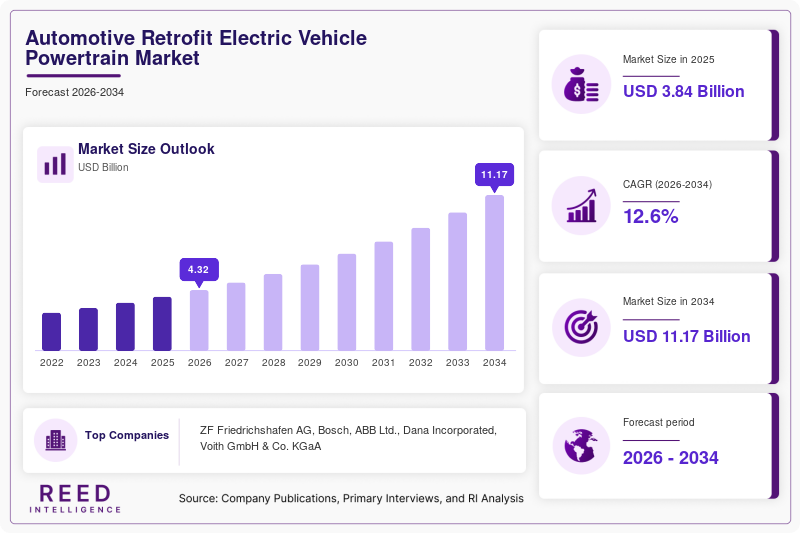
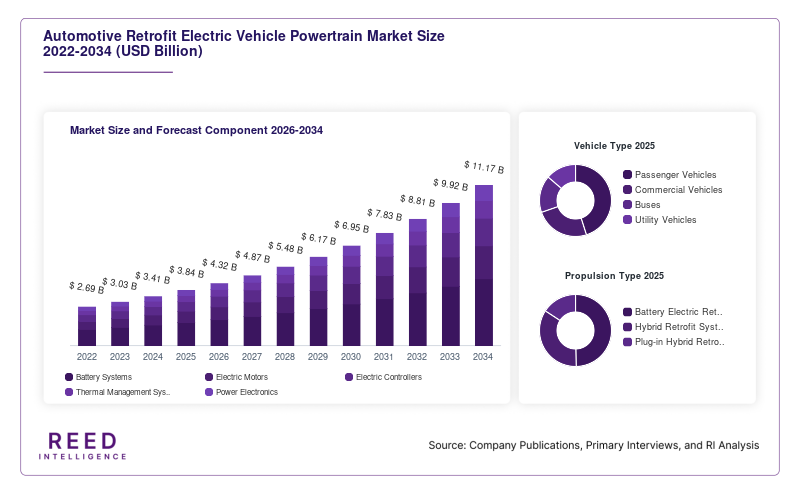
The global Automotive Retrofit Electric Vehicle Powertrain Market size was valued at USD 3.84 billion in 2026 and is projected to reach USD 9.92 billion by 2034, expanding at a CAGR of 12.6% during the forecast period from 2026 to 2034. The market is gaining momentum as governments, fleet operators, and consumers seek cost-efficient alternatives to purchasing new electric vehicles. Retrofit electric vehicle powertrains enable conventional internal combustion engine vehicles to be converted into electric vehicles through the installation of electric motors, battery systems, controllers, and related electronic components. The approach reduces carbon emissions while extending vehicle life cycles and lowering capital expenditure for fleet modernization.
Growing pressure to reduce greenhouse gas emissions across transportation networks has significantly supported market growth. Several urban administrations have implemented low-emission zones and stricter vehicle emission regulations, encouraging commercial fleet owners and logistics companies to adopt retrofit electrification solutions. The market is also benefiting from rising fuel costs, improved lithium-ion battery efficiency, and increasing awareness regarding sustainable mobility solutions. Automotive retrofit solutions are becoming particularly attractive in public transport fleets, light commercial vehicles, school buses, and classic passenger vehicles where complete fleet replacement is financially challenging.
Key Highlights
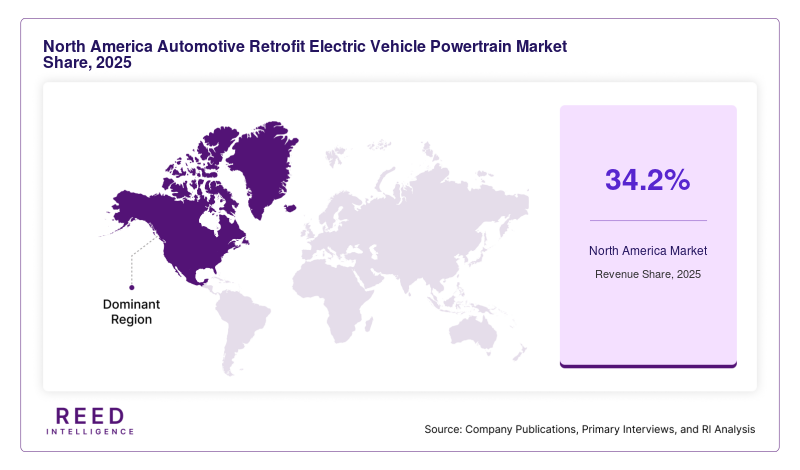
- North America dominated the market with a 34.2% share in 2025.
- Asia Pacific is expected to grow at the fastest CAGR of 13.1% during 2026–2034.
- By component, battery systems accounted for the largest share of 39.4%, while electric controllers are projected to grow at a CAGR of 14.2%.
- By vehicle type, commercial vehicles led with a 44.7% share, whereas passenger vehicles are expected to expand at a CAGR of 13.8%.
- By propulsion type, battery electric retrofit systems dominated with a 61.5% share, while hybrid retrofit systems are projected to grow at a CAGR of 11.9%.
- The United States remained the dominant country, with market values of USD 910 million in 2024 and USD 1.04 billion in 2025.
Market Trends
Expansion of Fleet Electrification Retrofit Programs
Commercial fleet operators are increasingly investing in retrofit electric powertrain systems to reduce operational fuel expenses and comply with environmental regulations. Public transportation authorities, municipal agencies, and logistics operators are retrofitting buses, delivery vans, and utility vehicles instead of replacing entire fleets with newly manufactured electric vehicles. Retrofit programs are gaining traction because they reduce upfront investment while enabling organizations to achieve sustainability targets. Fleet electrification initiatives are particularly visible in urban delivery networks where vehicle utilization rates are high and emission compliance standards continue to tighten.
Manufacturers are responding by offering modular retrofit platforms compatible with multiple vehicle models and operating conditions. The integration of telematics, predictive maintenance software, and energy management systems is improving fleet efficiency after conversion. Demand is also increasing for retrofit kits that support medium-duty and heavy-duty commercial vehicles. As battery prices decline and charging infrastructure expands, retrofit electrification programs are expected to become more commercially viable across developing and developed economies.
Increasing Adoption of Circular Economy Mobility Solutions
The automotive industry is witnessing a broader shift toward circular economy principles, supporting demand for retrofit electric vehicle powertrains. Instead of scrapping aging vehicles, retrofit conversion allows owners to extend vehicle usability while reducing waste generation and raw material consumption. Sustainability-focused consumers and businesses are increasingly viewing retrofitting as an environmentally responsible alternative to purchasing new vehicles. This trend is particularly strong among operators of vintage cars, public transportation fleets, and specialized industrial vehicles where chassis durability remains high.
Automotive engineering firms are also developing refurbishment and remanufacturing programs alongside retrofit operations. The combination of reused vehicle structures and modern electric propulsion systems reduces lifecycle emissions associated with new vehicle manufacturing. Government agencies in several regions are supporting pilot programs aimed at reducing automotive waste through retrofit electrification. The growing emphasis on resource optimization and carbon neutrality is expected to strengthen long-term market demand for retrofit powertrain technologies.
Market Drivers
Rising Government Incentives for Vehicle Electrification
Government support for transportation electrification continues to drive growth in the Automotive Retrofit Electric Vehicle Powertrain Market. Several countries are introducing subsidy programs, tax exemptions, and low-interest financing schemes for retrofit electric conversion projects. Policymakers are increasingly recognizing retrofitting as an effective strategy to accelerate emission reduction without requiring full vehicle replacement. Public transportation agencies are receiving financial support to electrify diesel bus fleets through retrofit programs, particularly in urban areas facing air quality concerns.
Emission regulations targeting commercial fleets are also encouraging fleet owners to explore retrofit alternatives. Cities implementing low-emission transport zones are placing restrictions on conventional diesel vehicles, increasing demand for electric conversions. In emerging economies, retrofit electrification is viewed as a cost-effective pathway toward sustainable mobility due to lower purchasing power and slower electric vehicle replacement cycles. These policy developments are expected to sustain long-term market expansion and encourage investment in retrofit infrastructure and component manufacturing.
Advancements in Battery and Electric Powertrain Technologies
Continuous innovation in battery systems and electric drivetrain technologies is improving the performance and reliability of retrofit electric powertrains. Lithium-ion batteries now offer higher energy density, improved thermal management, and longer operational life compared to earlier battery generations. These improvements enable retrofitted vehicles to achieve greater driving range and operational efficiency. Declining battery costs are also making retrofit projects more financially attractive for consumers and fleet operators.
Power electronics and electric motor technologies are evolving rapidly, enabling smoother integration with existing vehicle platforms. Manufacturers are developing compact and lightweight retrofit kits that reduce installation complexity and improve compatibility across vehicle categories. Smart battery management systems and regenerative braking technologies are further enhancing energy efficiency in retrofitted vehicles. As technological advancements continue to improve safety, performance, and charging capability, adoption rates for retrofit electric vehicle powertrains are expected to increase significantly across global markets.
Market Restraint
High Initial Conversion Costs and Technical Standardization Challenges
Despite growing demand, the Automotive Retrofit Electric Vehicle Powertrain Market faces limitations associated with high conversion costs and the lack of standardization across vehicle platforms. Retrofitting a conventional vehicle with an electric powertrain often requires substantial investment in batteries, motors, controllers, thermal management systems, and integration engineering. For small fleet operators and individual consumers, these expenses can reduce the economic attractiveness of retrofit solutions compared to retaining conventional vehicles. The cost burden is particularly significant for heavy-duty commercial vehicles where larger battery systems are required to maintain operational range.
Technical integration complexity also remains a challenge for market participants. Different vehicle models require customized retrofit engineering, creating variations in installation procedures, safety certification, and maintenance requirements. Limited availability of trained retrofit technicians and inconsistent regulatory standards across regions can slow adoption rates. In some countries, vehicle homologation procedures for retrofitted electric vehicles remain unclear, increasing project timelines and compliance costs. These challenges may restrain widespread market penetration, especially in cost-sensitive regions where retrofit infrastructure and technical expertise are still developing.
Market Opportunities
Growth Potential in Emerging Urban Public Transportation Systems
Rapid urbanization and increasing investment in sustainable public transportation systems present strong opportunities for retrofit electric vehicle powertrain providers. Many developing economies operate aging diesel bus fleets that contribute significantly to urban air pollution. Retrofitting these buses with electric propulsion systems offers a practical and affordable pathway toward cleaner transportation. Municipal authorities are increasingly partnering with retrofit solution providers to modernize public transport infrastructure without incurring the higher costs associated with purchasing entirely new electric buses.
The opportunity is particularly significant in densely populated cities where governments are introducing stricter emission standards for public transportation vehicles. Retrofit projects can also reduce maintenance costs and improve operational efficiency for transit agencies. As financing mechanisms for green transportation initiatives expand, retrofit companies are expected to secure additional contracts from public sector organizations. The growing focus on sustainable urban mobility is likely to create long-term opportunities for component manufacturers, engineering firms, and battery suppliers operating in the retrofit market.
Expansion of Retrofit Solutions for Specialty and Vintage Vehicles
The increasing popularity of electric conversions for specialty vehicles and classic automobiles is creating additional growth opportunities in the Automotive Retrofit Electric Vehicle Powertrain Market. Owners of vintage cars, recreational vehicles, utility trucks, and off-road vehicles are seeking retrofit solutions that preserve vehicle aesthetics while improving environmental performance. Electric conversion allows operators to comply with evolving emission standards without retiring historically valuable or operationally specialized vehicles.
Engineering firms are introducing customizable retrofit packages tailored for luxury vintage cars and niche commercial applications. The demand for silent operation, lower maintenance requirements, and improved drivability is encouraging adoption among specialty vehicle owners. Tourism operators, airport shuttle services, and industrial vehicle fleets are also exploring retrofit electrification to reduce operating costs and align with sustainability goals. As consumer acceptance of electric mobility expands, specialty retrofit applications are expected to emerge as an important revenue stream for market participants globally.
Segmental Analysis
By Component
Battery systems dominated the Automotive Retrofit Electric Vehicle Powertrain Market in 2024, accounting for 39.4% of the total market share. The dominance of this subsegment is primarily attributed to the central role batteries play in vehicle range, efficiency, and overall performance. Retrofit operators prioritize high-capacity lithium-ion battery systems capable of supporting longer operational cycles and improved energy management. Growing investment in battery technology innovation has also enhanced energy density and charging efficiency, making retrofit projects more commercially attractive. Commercial vehicle fleet conversions particularly depend on reliable battery systems to ensure operational continuity and lower maintenance costs. Demand for modular battery packs that simplify installation and maintenance procedures is increasing across retrofit applications globally.
By Vehicle Type
Commercial vehicles accounted for the largest share of the Automotive Retrofit Electric Vehicle Powertrain Market in 2024, representing 44.7% of total revenue. Fleet operators are increasingly retrofitting delivery vans, buses, and municipal service vehicles to reduce fuel costs and comply with emission regulations. The high daily utilization rates of commercial vehicles make electric conversion financially beneficial over long operating periods. Public transportation agencies are also investing heavily in retrofit electrification to modernize aging diesel fleets without incurring the substantial capital costs associated with purchasing entirely new electric vehicles.
By Propulsion Type
Battery electric retrofit systems held the dominant share of the Automotive Retrofit Electric Vehicle Powertrain Market in 2024, accounting for 61.5% of total revenue. Fully electric retrofit systems are increasingly preferred due to their zero tailpipe emissions, lower maintenance requirements, and compatibility with evolving environmental regulations. Fleet operators and municipal transportation agencies are prioritizing battery electric conversions to achieve sustainability targets and reduce long-term operational costs. Improvements in charging infrastructure and battery performance are further strengthening the commercial viability of fully electric retrofit systems.
Regional Analysis
North America
North America accounted for 34.2% of the global Automotive Retrofit Electric Vehicle Powertrain Market share in 2025 and is projected to maintain stable growth at a CAGR of 11.4% through 2034. The regional market benefits from strong government incentives supporting vehicle electrification and emission reduction programs. Fleet modernization initiatives across public transportation and logistics sectors are accelerating retrofit adoption. Rising fuel prices and increasing environmental awareness among businesses are also supporting market expansion. The presence of advanced automotive engineering companies and battery manufacturers strengthens the regional retrofit ecosystem.
Europe
Europe represented a significant share of the Automotive Retrofit Electric Vehicle Powertrain Market in 2025 and is forecast to grow at a CAGR of 12.1% during the assessment period. Strict carbon emission regulations and aggressive climate policies are driving market adoption across the region. Several European countries are implementing low-emission zones that restrict diesel vehicle operations in urban centers. These regulatory developments are encouraging public transport operators and commercial fleet owners to invest in retrofit electrification solutions as a cost-efficient compliance strategy.
Asia Pacific
Asia Pacific is expected to register the fastest CAGR of 13.1% from 2026 to 2034 in the Automotive Retrofit Electric Vehicle Powertrain Market. Rapid urbanization, increasing pollution concerns, and supportive government policies are contributing to regional growth. Several countries are encouraging electric mobility adoption through subsidies and pilot electrification programs. Retrofit solutions are gaining popularity in developing economies where replacing existing vehicle fleets with new electric vehicles remains financially challenging. The region also benefits from expanding battery manufacturing capacity and improving charging infrastructure.
Middle East & Africa
The Middle East & Africa region is gradually emerging in the Automotive Retrofit Electric Vehicle Powertrain Market and is projected to grow at a CAGR of 10.3% through 2034. Increasing focus on economic diversification and sustainable transportation initiatives is supporting market development. Governments across the Gulf region are investing in clean mobility projects to reduce dependence on fossil fuel-intensive transportation systems. Retrofit electric solutions are becoming attractive for commercial vehicle operators seeking lower maintenance costs and improved energy efficiency in high-usage transportation fleets.
Latin America
Latin America is witnessing steady growth in the Automotive Retrofit Electric Vehicle Powertrain Market, supported by increasing interest in affordable electrification solutions. The regional market is expected to expand at a CAGR of 10.8% during the forecast period. Economic constraints in several countries make retrofit conversion more practical than purchasing new electric vehicles. Public transportation modernization programs and growing awareness regarding fuel cost reduction are supporting demand for retrofit electric powertrain systems across commercial vehicle fleets.
Competitive Landscape
The Automotive Retrofit Electric Vehicle Powertrain Market is characterized by growing competition among automotive engineering firms, electric drivetrain manufacturers, battery suppliers, and mobility technology companies. Market participants are focusing on product innovation, strategic partnerships, and regional expansion to strengthen their competitive positioning. Companies are increasingly investing in modular retrofit platforms capable of supporting multiple vehicle categories, including buses, commercial fleets, and passenger vehicles.
Among leading participants, ZF Friedrichshafen AG maintains a strong market presence due to its extensive expertise in electric driveline technologies and commercial vehicle electrification systems. The company has expanded its retrofit product portfolio for public transportation fleets and urban logistics applications. Meanwhile, ABB Ltd. continues to strengthen its charging and electrification infrastructure capabilities through strategic collaborations with retrofit engineering firms.
Key Players
- ZF Friedrichshafen AG
- Bosch
- ABB Ltd.
- Dana Incorporated
- Voith GmbH & Co. KGaA
- Cummins Inc.
- Hitachi Astemo
- Equipmake
- SEA Electric
- Blue Bird Corporation
- Tata Motors
- Fenix Power
- Transition-One
- Lightning eMotors
- XL Fleet
Recent Developments
- In February 2026, Equipmake introduced an upgraded electric bus retrofit platform featuring enhanced battery efficiency and fast-charging capability for municipal transit fleets.
- In September 2025, SEA Electric expanded its commercial fleet electrification operations in North America through partnerships with regional logistics companies.
- In June 2025, Voith GmbH & Co. KGaA launched a next-generation electric retrofit drive system designed for heavy-duty urban transportation applications.
- In November 2025, Bosch announced investment in advanced electric controller technologies aimed at improving retrofit integration efficiency for commercial vehicles.
- In January 2026, Dana Incorporated expanded its electric drivetrain manufacturing capacity to support increasing demand for retrofit commercial vehicle powertrain systems.
Automotive Retrofit Electric Vehicle Powertrain Market Segments
Component
- Battery Systems
- Electric Motors
- Electric Controllers
- Thermal Management Systems
- Power Electronics
Vehicle Type
- Passenger Vehicles
- Commercial Vehicles
- Buses
- Utility Vehicles
Propulsion Type
- Battery Electric Retrofit Systems
- Hybrid Retrofit Systems
- Plug-in Hybrid Retrofit Systems
End Use
- Public Transportation
- Logistics & Fleet Operators
- Municipal Services
- Private Vehicle Owners
- Industrial Transportation
By Region
- North America
- Europe
- APAC
- Middle East and Africa
- LATAM