Automotive Seat Massage System Market Size, Share & Demand Report By Technology Type (Air-Based Massage Systems, Vibration-Based Massage Systems, Roller-Based Massage Systems), By Vehicle Type (Passenger Cars, Commercial Vehicles, Electric Vehicles), By Component (Air Pumps, Motors, Control Units, Sensors), By Sales Channel (OEM, Aftermarket), By Region & Segment Forecasts, 2025–2034
USD 3950
Market Overview
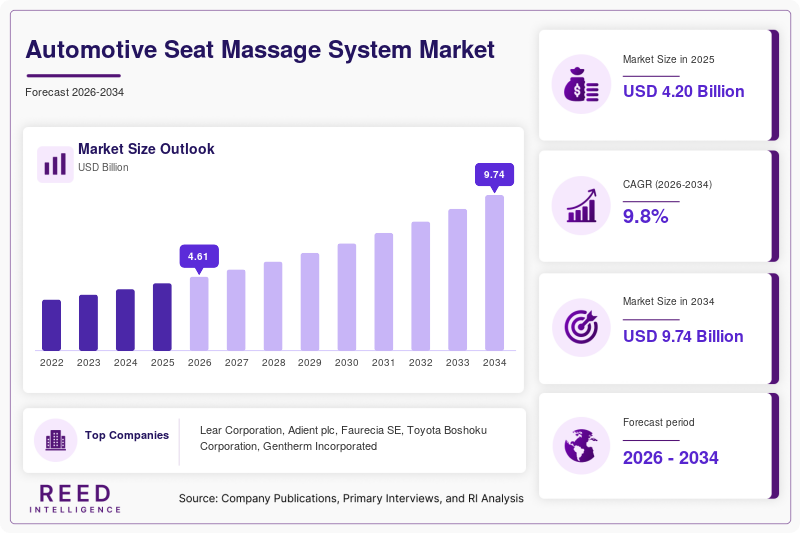
The Automotive Seat Massage System Market size was valued at approximately USD 4.2 billion in 2025 and is projected to reach USD 9.8 billion by 2034, expanding at a CAGR of 9.8% from 2025 to 2034. The market has experienced consistent growth due to increasing consumer preference for enhanced in-vehicle comfort, especially in mid-range and premium vehicles. The integration of wellness-oriented features in automobiles has emerged as a major global factor supporting the expansion of automotive seat massage systems.
Rising urbanization and longer commuting durations have encouraged automakers to incorporate ergonomic seating technologies that reduce fatigue and improve driving experience. Additionally, technological advancements such as programmable massage modes, lumbar support systems, and integration with vehicle infotainment systems have strengthened the market outlook. OEMs are also collaborating with seating system manufacturers to offer customizable comfort solutions.
Key Highlights
- North America held the dominant regional share of 34.5% in 2025, while Asia Pacific is projected to grow at a CAGR of 11.2%.
- By component, air-based massage systems dominated with 46.8% share, while vibration-based systems are expected to grow fastest at a CAGR of 10.9%.
- By vehicle type, passenger cars led with 71.3% share, while electric vehicles are projected to expand at 12.4% CAGR.
- The United States market was valued at USD 1.2 billion in 2025 and is expected to reach USD 1.3 billion in 2026.
Market Trends
Integration of Smart and Connected Seating Systems
The integration of smart technologies into automotive seating systems is shaping the Automotive Seat Massage System Market. Modern systems now include AI-based posture detection, personalized massage settings, and connectivity with mobile applications. These features allow users to customize massage intensity, duration, and zones in real time. Automakers are also integrating seat massage controls with central infotainment systems, enhancing user convenience and interaction. This trend aligns with the broader movement toward connected vehicles and digital cockpit experiences.
Expansion into Mid-Range Vehicle Segments
Previously limited to luxury vehicles, seat massage systems are increasingly being introduced in mid-range and upper-mid-range vehicles. Cost optimization in components such as actuators and air pumps has enabled manufacturers to offer these features at competitive prices. As consumer awareness grows regarding comfort and health benefits, automakers are using massage seats as a differentiating feature in mass-market vehicles. This democratization of comfort technology is expected to significantly increase market penetration over the forecast period.
Market Drivers
Increasing Demand for In-Vehicle Comfort and Wellness
Consumer expectations in the automotive sector are evolving beyond basic functionality toward comfort and wellness. Seat massage systems help reduce fatigue, improve blood circulation, and enhance overall driving experience, making them highly desirable for long-distance commuters and professional drivers. This growing emphasis on passenger well-being is a key factor driving adoption across vehicle segments.
Growth of Premium and Electric Vehicle Segments
The rapid expansion of premium and electric vehicle segments has significantly contributed to the Automotive Seat Massage System Market growth. Premium vehicles often come equipped with advanced comfort features, including massage seats, as standard or optional offerings. Electric vehicles, on the other hand, emphasize passenger comfort and quiet cabins, making massage systems more noticeable and appealing. As EV adoption accelerates globally, the demand for integrated comfort solutions is expected to rise steadily.
Market Restraint
High System Cost and Integration Complexity
Despite strong demand, the Automotive Seat Massage System Market faces challenges related to high system costs and integration complexity. Massage systems require multiple components such as actuators, control units, air compressors, and sensors, which increase overall seat manufacturing costs. These costs can limit adoption, particularly in entry-level and budget vehicles.
Additionally, integrating massage systems into existing seat architectures requires careful design to ensure durability, safety, and comfort. The added weight and power consumption of these systems also pose challenges, especially in electric vehicles where efficiency is critical. Maintenance and repair costs further add to the total cost of ownership, which may discourage some consumers.
While technological advancements are gradually reducing costs, affordability remains a key barrier to widespread adoption across all vehicle segments.
Market Opportunities
Rising Adoption in Autonomous Vehicles
The emergence of autonomous vehicles presents a significant opportunity for the Automotive Seat Massage System Market. As vehicles transition toward self-driving capabilities, passengers will have more time to relax and engage in non-driving activities. This shift is expected to increase demand for comfort-enhancing features such as massage seats. Manufacturers are exploring advanced seating configurations that incorporate wellness functionalities, creating new growth avenues.
Increasing Demand in Emerging Economies
Emerging economies in Asia Pacific and Latin America offer substantial growth potential for the Automotive Seat Massage System Market. Rising disposable incomes, expanding middle-class populations, and growing automotive sales are driving demand for feature-rich vehicles. Automakers are introducing affordable variants with advanced comfort features to cater to these markets. Localization of manufacturing and supply chains is also helping reduce costs, making massage systems more accessible to a broader consumer base.
Segmental Analysis
By Technology Type
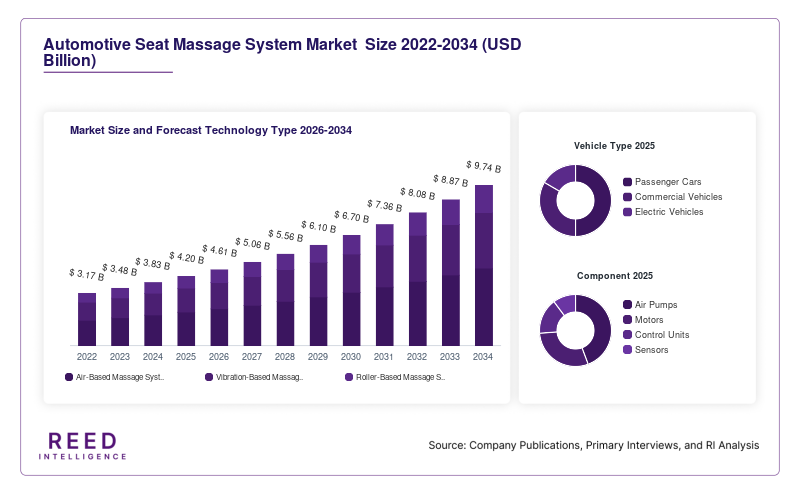
Air-based massage systems dominated the Automotive Seat Massage System Market with a 46.8% share in 2025. These systems use air bladders to create a massaging effect, offering better comfort and adjustability compared to other technologies.
Vibration-based systems are expected to grow at the fastest CAGR of 10.9% during the forecast period. Their lower cost and simpler design make them suitable for mid-range vehicles. Increasing demand for affordable comfort features will drive their adoption.
By Vehicle Type
Passenger cars held the largest share of 71.3% in 2025, driven by high demand for comfort features in personal vehicles. Luxury and mid-range passenger cars increasingly include massage seats as standard or optional features.
Electric vehicles are projected to grow at a CAGR of 12.4%. The focus on passenger experience in EVs and the quiet cabin environment enhance the appeal of massage systems, making them a key growth segment.
By Component
Air pumps accounted for the largest share of 32.5% in 2025, as they are essential for air-based massage systems. Their reliability and efficiency make them a critical component in seat massage systems.
Control units are expected to grow at a CAGR of 11.6%, driven by advancements in smart seating technologies. These units enable customization and integration with vehicle systems, enhancing user experience.
By Sales Channel
OEMs dominated the market with a 78.9% share in 2025, as most seat massage systems are integrated during vehicle manufacturing.
The aftermarket segment is expected to grow at a CAGR of 10.2%, supported by increasing demand for retrofitting existing vehicles with comfort features.
Regional Analysis
North America
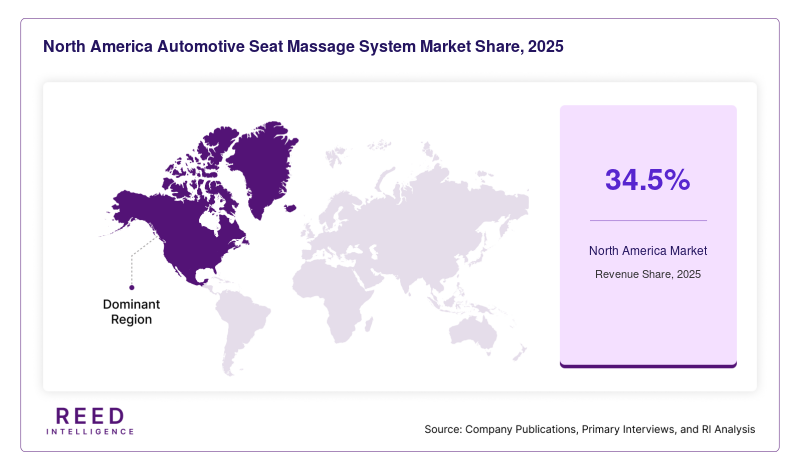
North America accounted for 34.5% of the Automotive Seat Massage System Market share in 2025 and is expected to grow at a CAGR of 8.9% during the forecast period. The region’s strong automotive industry and high consumer preference for comfort features supported its dominant position.
The United States led the regional market due to high demand for premium SUVs and luxury vehicles. A key growth factor was the increasing adoption of advanced seating technologies in domestic vehicle production. Automakers in the country are focusing on integrating innovative comfort features to enhance customer satisfaction and brand value.
Europe
Europe held a 26.8% market share in 2025 and will grow at a CAGR of 9.2% from 2025 to 2034. The region’s strong emphasis on automotive innovation and passenger safety contributed to market expansion.
Germany emerged as the dominant country due to its leadership in luxury vehicle manufacturing. The presence of established automotive brands and advanced engineering capabilities has driven the adoption of seat massage systems. Additionally, consumer demand for high-end comfort features continues to support growth.
Asia Pacific
Asia Pacific represented 22.4% of the market in 2025 and is projected to grow at the fastest CAGR of 11.2%. Rapid urbanization and increasing vehicle production have contributed to market expansion in the region.
China dominated the regional market due to its large automotive manufacturing base and growing demand for premium vehicles. A key growth factor was the increasing adoption of electric vehicles, which often include advanced comfort features such as massage seats.
Middle East & Africa
The Middle East & Africa held a 9.1% market share in 2025 and is expected to grow at a CAGR of 8.3%. The region’s demand for luxury vehicles supported the adoption of seat massage systems.
The United Arab Emirates led the market due to high disposable incomes and strong demand for premium cars. Consumers in the region prefer vehicles with advanced comfort features, driving the adoption of massage seating systems.
Latin America
Latin America accounted for 7.2% of the Automotive Seat Massage System Market share in 2025 and is projected to grow at a CAGR of 8.7%. The region’s growing automotive sector contributed to steady market growth.
Brazil emerged as the dominant country due to its expanding automotive manufacturing industry. Increasing consumer awareness of comfort features and rising vehicle sales have supported the adoption of seat massage systems.
Competitive Landscape
The Automotive Seat Massage System Market is moderately consolidated, with key players focusing on innovation and partnerships. Leading companies include global automotive seating and component manufacturers.
The market leader, Lear Corporation, has strengthened its position through continuous innovation in smart seating technologies. The company recently introduced advanced massage systems integrated with AI-based posture detection, enhancing user comfort.
Other major players such as Adient plc, Faurecia, Toyota Boshoku Corporation, and Gentherm Incorporated are investing in research and development to improve system efficiency and reduce costs. Strategic collaborations with automakers and expansion into emerging markets are common growth strategies among key players.
Key Players
- Lear Corporation
- Adient plc
- Faurecia SE
- Toyota Boshoku Corporation
- Gentherm Incorporated
- Magna International Inc.
- TS Tech Co., Ltd.
- NHK Spring Co., Ltd.
- Hyundai Transys
- Tachi-S Co., Ltd.
- Grammer AG
- Brose Fahrzeugteile GmbH & Co. KG
- Aisin Corporation
- DURA Automotive Systems
- Continental AG
Recent Developments
- 2024: Lear Corporation launched a next-generation intelligent seating system with integrated massage and climate control features.
- 2024: Adient plc expanded its manufacturing capacity in Asia Pacific to meet rising demand.
- 2023: Faurecia introduced modular seat massage solutions for electric vehicles.
- 2023: Gentherm Incorporated developed energy-efficient massage systems optimized for EVs.
- 2023: Toyota Boshoku Corporation partnered with automakers to integrate advanced seating technologies.
Automotive Seat Massage System Market Segments
Technology Type
- Air-Based Massage Systems
- Vibration-Based Massage Systems
- Roller-Based Massage Systems
Vehicle Type
- Passenger Cars
- Commercial Vehicles
- Electric Vehicles
Component
- Air Pumps
- Motors
- Control Units
- Sensors
Sales Channel
- OEM
- Aftermarket
By Region
- North America
- Europe
- APAC
- Middle East and Africa
- LATAM