Automotive Sensor Cleaning System Market Size, Share Demand Report By Sensor Type (Camera Cleaning Systems, LiDAR Cleaning Systems, Radar Cleaning Systems, Ultrasonic Sensor Cleaning Systems), By Vehicle Type (Passenger Cars, Commercial Vehicles, Autonomous Vehicles), Regional Insights & Segment Forecasts, 2026–2034
USD 3950
Automotive Sensor Cleaning System Market Size
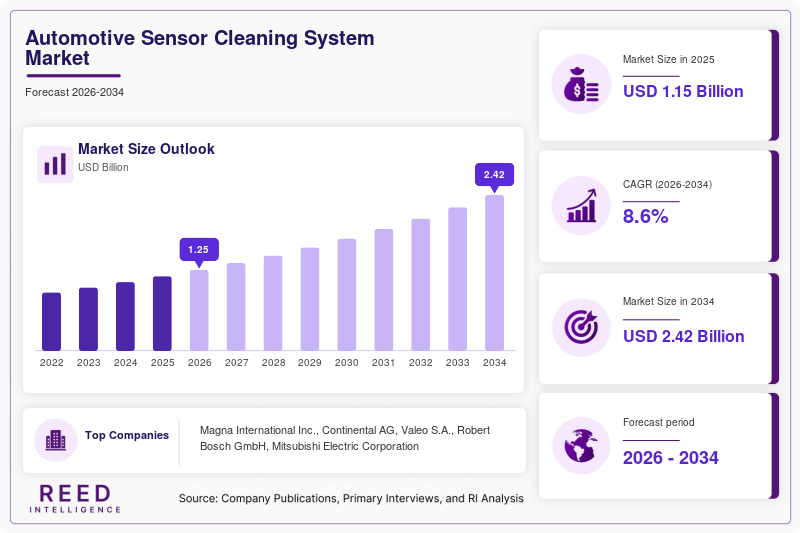
The Automotive Sensor Cleaning System market size is projected at USD 485.6 million in 2026 and is expected to hit USD 1,085.3 million by 2034 with a CAGR of 10.6% during the forecast period. The increasing integration of advanced driver-assistance systems (ADAS) and autonomous driving technologies, coupled with the growing demand for reliable sensor performance in all weather conditions, underpins market expansion. This report delivers a comprehensive analysis of the Automotive Sensor Cleaning System market, including segmentation by sensor type and vehicle type, competitive dynamics, and regional growth patterns, equipping stakeholders with critical intelligence. The Automotive Sensor Cleaning System market continues to demonstrate strong growth potential, fueled by the rising adoption of autonomous vehicles, the increasing emphasis on road safety, and continuous innovation in cleaning technologies.
Automotive sensor cleaning systems are integrated technologies designed to maintain the operational clarity and performance of vehicle sensors by removing dirt, debris, water, and other contaminants. These systems are critical for ensuring the reliability of sensors used in ADAS, autonomous driving, parking assistance, and other safety-critical functions. The global Automotive Sensor Cleaning System market is growing rapidly, with over 5.5 million systems installed globally in 2025, reflecting a 15% increase from 2023, driven by the increasing demand for vehicle safety and autonomy. Adoption patterns reveal that the Camera Cleaning Systems type dominates the market, accounting for 45% of total revenue, followed by LiDAR Cleaning Systems at 25%, Radar Cleaning Systems at 18%, and Ultrasonic Sensor Cleaning Systems at 12%. The Automotive Sensor Cleaning System market's trajectory is closely linked to the growth of the global ADAS market, which is projected to reach USD 75 billion by 2028, and the increasing production of autonomous vehicles.
Automotive Sensor Cleaning System Market Trends
Growing Integration of Cleaning Systems in Autonomous Vehicles
The Automotive Sensor Cleaning System market is witnessing a significant trend toward the integration of advanced cleaning systems in autonomous vehicles, driven by the need to ensure uninterrupted sensor operation for safe autonomous driving. The production of sensor cleaning systems for autonomous vehicles increased by 20% in 2025, reaching 1.5 million units, as 40% of new autonomous vehicle designs in 2025 specified integrated cleaning solutions. Adoption rates of sensor cleaning systems in autonomous shuttles and robotaxis reached 25%, with this figure projected to exceed 55% by 2030. The Automotive Sensor Cleaning System market's trend toward autonomy is reinforced by the need for reliability in harsh weather conditions, the increasing focus on Level 3+ autonomy, and the continuous innovation in cleaning and drying technologies.
Increasing Focus on Smart and Automated Cleaning Technologies
The increasing focus on smart and automated cleaning technologies is a major trend shaping the Automotive Sensor Cleaning System market, with the development of systems that can detect sensor contamination and activate cleaning cycles automatically. The market has seen a 15% increase in demand for smart cleaning systems since 2023, with 30% of new product launches in 2025 featuring intelligent cleaning capabilities. The use of automated cleaning for LiDAR and camera sensors in adverse weather has also gained significant traction. The Automotive Sensor Cleaning System market's trend toward automation is reinforced by the need for hands-free operation, the increasing complexity of sensor systems, and the continuous innovation in sensor contamination detection and cleaning algorithms.
Automotive Sensor Cleaning System Market Drivers
The Automotive Sensor Cleaning System market's expansion is primarily driven by the rapid growth of the ADAS and autonomous driving markets, with the global autonomous vehicle market valued at over USD 50 billion in 2025. The need to ensure reliable sensor performance in all driving conditions, especially in rain, snow, and mud, has been a major driver, with sensor contamination being a significant cause of false alarms and system failures. The increasing regulatory requirements for vehicle safety have also fueled market demand. Additionally, the rising consumer expectations for advanced safety features have spurred growth. The Automotive Sensor Cleaning System market's growth is further reinforced by the continuous innovation in sensor and cleaning technologies, leading to more efficient and reliable systems.
Automotive Sensor Cleaning System Market Restraints
Despite favorable growth prospects, the Automotive Sensor Cleaning System market faces significant constraints, primarily related to the high cost of advanced cleaning systems, which can increase the overall vehicle price and limit adoption in lower-cost segments. The complexity of integrating cleaning systems with existing vehicle architectures and the need for additional maintenance can also be a limitation. The Automotive Sensor Cleaning System market's growth is also tempered by the competition from alternative solutions, such as hydrophobic sensor coatings and self-cleaning materials.
Automotive Sensor Cleaning System Market Opportunities
The Automotive Sensor Cleaning System market presents significant opportunities in the rapidly expanding market for autonomous ride-hailing and delivery vehicles, where reliable sensor operation is critical for operational efficiency. The development of lightweight and cost-effective cleaning systems for mass-market passenger cars is expected to grow at a CAGR of 12% through 2034. Emerging opportunities also exist in the integration of sensor cleaning systems with predictive maintenance and fleet management platforms. The Automotive Sensor Cleaning System market's opportunity profile is further enhanced by the growing trend of software-defined vehicles and the increasing focus on data-driven maintenance.
Challenges in Automotive Sensor Cleaning System Market
The Automotive Sensor Cleaning System market faces persistent challenges related to the need for continuous innovation to reduce system size, weight, and cost while maintaining high cleaning efficiency and reliability. The complexity of ensuring that cleaning systems do not interfere with sensor operation or vehicle aerodynamics can also be a challenge. The market is also contending with the challenge of varying sensor configurations and mounting positions across different vehicle models, which requires a high degree of customization. Additionally, the Automotive Sensor Cleaning System market is challenged by the need to demonstrate the long-term value and ROI of these systems to vehicle manufacturers and consumers.
Automotive Sensor Cleaning System Market Segmentation
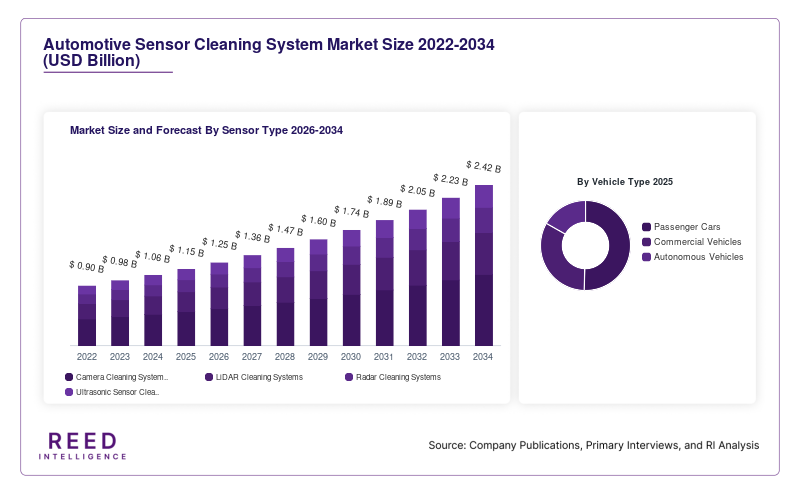
The Automotive Sensor Cleaning System market is segmented by Sensor Type and Vehicle Type to provide a comprehensive market perspective. By Sensor Type, Camera Cleaning Systems dominate with a 45% market share, driven by the widespread use of cameras in ADAS and autonomous vehicles. The Vehicle Type segment is led by Passenger Cars, which accounts for 50% of the market, followed by Commercial Vehicles at 30%, and Autonomous Vehicles at 20%.
By Sensor Type
Camera Cleaning Systems represent the largest segment in the Automotive Sensor Cleaning System market, commanding a 45% share, with revenue exceeding USD 218 million in 2025. These are characterized by their use of fluid spray, wipers, or air jets to clean camera lenses, ensuring clear image capture. Technical specifications include spray nozzle design, fluid pressure, and wiper blade durability. The Automotive Sensor Cleaning System market's Camera segment is driven by its use in surround-view and forward-facing cameras.
LiDAR Cleaning Systems capture a 25% share of the Automotive Sensor Cleaning System market, with revenue of USD 121 million in 2025. These are characterized by their use of air or fluid systems to clean LiDAR sensor housings, maintaining unobstructed laser beams. Technical specifications include air flow pressure, fluid distribution, and cleaning cycle timing. The Automotive Sensor Cleaning System market's LiDAR segment is driven by its use in autonomous and semi-autonomous vehicles.
Radar Cleaning Systems represent 18% of the market, with revenue of USD 87 million in 2025, characterized by their use of dedicated cleaning mechanisms to remove contaminants from radar sensor surfaces. Technical specifications include cleaning agent compatibility and durability. The Automotive Sensor Cleaning System market's Radar segment is driven by its use in adaptive cruise control and collision avoidance systems.
Ultrasonic Sensor Cleaning Systems account for the remaining 12% of the market, with revenue of USD 58 million in 2025, characterized by their use of methods to clean ultrasonic sensors used in parking assistance. Technical specifications include cleaning agent compatibility and durability. The Automotive Sensor Cleaning System market's Ultrasonic segment is driven by its use in parking assist and blind-spot detection.
By Vehicle Type
Passenger Cars dominates the Automotive Sensor Cleaning System market, accounting for 50% of sales, representing USD 243 million in 2025. This segment includes use in a wide range of passenger vehicles, from compact cars to luxury sedans and SUVs. Usage penetration exceeds 15% in luxury vehicles. The Automotive Sensor Cleaning System market's Passenger Cars segment is characterized by its focus on driver assistance and comfort.
Commercial Vehicles accounts for 30% of the Automotive Sensor Cleaning System market, with revenue of USD 146 million in 2025. This segment encompasses use in trucks, buses, and fleet vehicles for safety and operational efficiency. The segment is growing at a strong CAGR, driven by fleet safety regulations. The Automotive Sensor Cleaning System market's Commercial Vehicles segment is characterized by its focus on durability and reliability.
Autonomous Vehicles represents 20% of the market, with revenue of USD 97 million in 2025, involving use in robotaxis, autonomous shuttles, and delivery vehicles where sensor reliability is paramount. The segment is growing at the fastest CAGR, driven by the increasing deployment of autonomous services. The Automotive Sensor Cleaning System market's Autonomous Vehicles segment is characterized by its focus on system redundancy and reliability.
Automotive Sensor Cleaning System Market Regional Outlook
North America Automotive Sensor Cleaning System Market
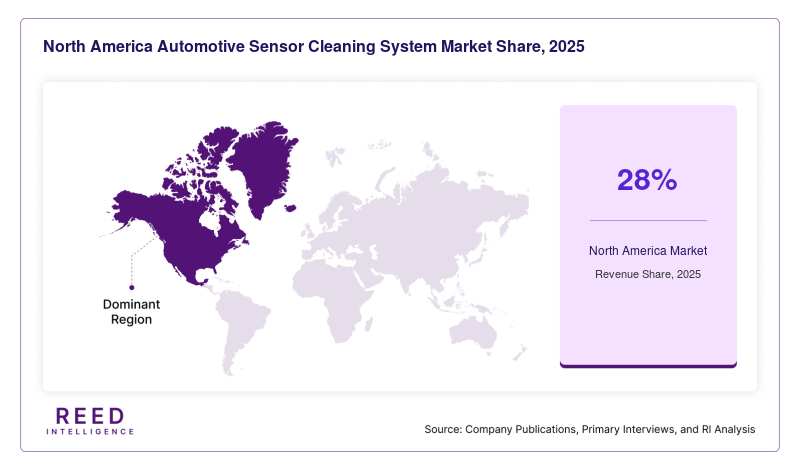
Leads the Automotive Sensor Cleaning System market, commanding a 35% share, with a revenue of USD 170 million in 2025. The United States is the primary driver, accounting for 85% of regional demand, driven by the high adoption of ADAS, the presence of major autonomous vehicle developers, and strong regulatory support for vehicle safety. The North American Automotive Sensor Cleaning System market is characterized by its focus on innovation and early adoption.
Europe Automotive Sensor Cleaning System Market
Represents the second-largest market, capturing a 30% share with a revenue of USD 146 million in 2025. Germany, the UK, and France are the primary drivers, collectively accounting for 55% of regional demand, driven by stringent safety regulations, a strong automotive industry, and a focus on autonomous driving. The Automotive Sensor Cleaning System market in Europe is characterized by its focus on quality and safety.
Asia-Pacific Automotive Sensor Cleaning System Market
Accounts for 25% of the global Automotive Sensor Cleaning System market, with a revenue of USD 121 million in 2025. China, Japan, and South Korea are the primary drivers, together accounting for 65% of regional demand, driven by the large automotive production base, growing ADAS adoption, and increasing investment in autonomous driving. The Asia-Pacific Automotive Sensor Cleaning System market is projected to grow at the fastest CAGR of 12% through 2034.
Middle East & Africa and Latin America Automotive Sensor Cleaning System Market
Together account for the remaining 10% of the Automotive Sensor Cleaning System market, with the UAE and Brazil leading their respective regions. Both regions are projected to grow at CAGRs exceeding 9%, driven by increasing vehicle sales and safety awareness.
Top players in Automotive Sensor Cleaning System Market
- Magna International Inc.
- Continental AG
- Valeo S.A.
- Robert Bosch GmbH
- Mitsubishi Electric Corporation
- Denso Corporation
- Hella GmbH & Co. KGaA
- Trinseo S.A.
- Wiper Systems, Inc.
- Ficosa International S.A.
- Kautex Textron GmbH & Co. KG
- Actron
- Eaton Corporation
- Mergon Group
- Illinois Tool Works Inc.
Magna International Inc.
Magna International Inc. holds a dominant position in the Automotive Sensor Cleaning System market, with an estimated 15% global market share, particularly strong in the North American and European passenger car and commercial vehicle segments. The company's portfolio of sensor cleaning systems, including advanced integrated solutions, is widely recognized for its quality, reliability, and integration expertise. Magna's market leadership is reinforced by its significant investment in R&D, its strong relationships with major OEMs, and its extensive global manufacturing footprint. Magna commands over 18% of the North American market and 14% of the European market for sensor cleaning systems, positioning it as a key player in the global market.
Continental AG
Continental AG is a leading player in the Automotive Sensor Cleaning System market, commanding approximately 12% of the global market share through its comprehensive portfolio of automotive technologies and sensors. The company's expertise in ADAS, sensor fusion, and integrated vehicle systems have solidified its position. Continental's sensor cleaning systems are known for their advanced technology, reliability, and seamless integration with vehicle electronics. The company's commitment to innovation and its strong presence in the European, North American, and Asian markets have enhanced its competitive advantage.
Valeo S.A. holds a significant 10% market share, with particular strength in the European and Asian camera cleaning segments. Robert Bosch GmbH is a major player in the automotive technology market, holding a 10% share, known for its comprehensive systems approach.
Recent Developments in Automotive Sensor Cleaning System Market
- 2025: Magna International launched a new integrated, multi-sensor cleaning system that uses a single fluid reservoir and pump to clean cameras, LiDAR, and radar sensors, reducing system complexity and cost.
- 2025: Continental AG announced a new smart cleaning system that uses AI to detect sensor contamination and optimize cleaning cycles, improving efficiency and reducing fluid usage.
Automotive Sensor Cleaning System Market Segments
By Sensor Type
- Camera Cleaning Systems
- LiDAR Cleaning Systems
- Radar Cleaning Systems
- Ultrasonic Sensor Cleaning Systems
By Vehicle Type
- Passenger Cars
- Commercial Vehicles
- Autonomous Vehicles
By Region
- North America
- Europe
- APAC
- Middle East and Africa
- LATAM