Automotive Smart Helmet Market Size, Share Demand Report By Product Type (Full-Face Smart Helmets, Open-Face Smart Helmets, Modular Smart Helmets), By Technology (Bluetooth-Enabled, AR-Based, GPS-Integrated), By Application (Motorcycle Riders, Fleet & Delivery Services), By End-Use (Individual Consumers, Commercial Users), By Distribution Channel (Offline Retail, Online Retail), By Region & Segment Forecasts, 2025–2034
USD 3950
Market Overview
The Automotive Smart Helmet Market size was valued at approximately USD 785 million in 2025 and is projected to reach USD 2.15 billion by 2034, expanding at a CAGR of 11.9% during 2025–2034. The market growth reflects increasing adoption of connected safety technologies in two-wheeler transportation and the growing emphasis on rider protection and real-time communication systems.
A key global factor supporting the growth of the Automotive Smart Helmet Market is the rising integration of Internet of Things (IoT) and advanced sensor technologies in mobility solutions. Smart helmets equipped with features such as heads-up displays (HUD), GPS navigation, Bluetooth connectivity, and crash detection systems are gaining traction among consumers and fleet operators. These innovations are enhancing rider safety, convenience, and situational awareness.
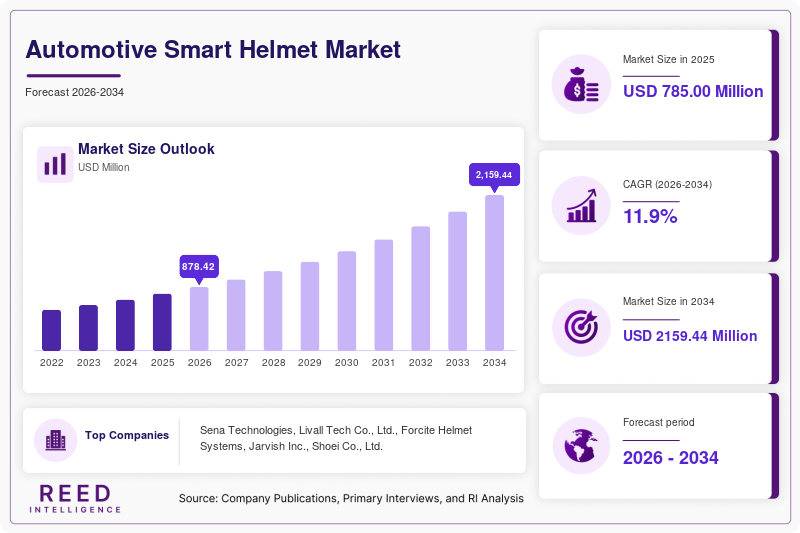
Key Highlights:
- Asia Pacific dominated the Automotive Smart Helmet Market with a 44% share in 2025, while North America is projected to grow at the fastest CAGR of 12.6%.
- By product type, full-face smart helmets led with a 49% share, while modular smart helmets are expected to grow at a CAGR of 12.3%.
- By application, motorcycle riders accounted for the largest share, whereas fleet and delivery services are projected to grow at a CAGR of 12.8%.
- India remained the dominant country, with market values of USD 145 million in 2025 and USD 162 million in 2026.
Market Trends
Integration of Augmented Reality and Heads-Up Displays
The Automotive Smart Helmet Market is witnessing increased adoption of augmented reality (AR) and heads-up display technologies. These features enable riders to access navigation, speed, and traffic information without diverting attention from the road. This trend is improving safety and enhancing the overall riding experience.
Expansion of Connected Ecosystems
Another notable trend is the integration of smart helmets with connected ecosystems, including smartphones and vehicle systems. These helmets offer features such as voice control, real-time alerts, and communication capabilities. The growing adoption of connected devices is driving innovation and expanding the functionality of smart helmets.
Market Drivers
Increasing Focus on Rider Safety
The rising number of road accidents involving two-wheelers is driving demand for advanced safety solutions. Smart helmets provide features such as collision alerts, emergency notifications, and improved visibility, which enhance rider safety. This growing focus on safety is a key driver for the Automotive Smart Helmet Market.
Growth in Two-Wheeler Usage
The increasing use of motorcycles and scooters, particularly in urban areas, is supporting market growth. Two-wheelers are widely used for personal transportation and delivery services. The need for enhanced safety and connectivity in these vehicles is driving the adoption of smart helmets.
Market Restraint
High Product Cost and Limited Affordability
A major restraint in the Automotive Smart Helmet Market is the high cost of smart helmets compared to traditional helmets. Advanced features such as AR displays, sensors, and connectivity modules increase manufacturing costs. This pricing factor can limit adoption among price-sensitive consumers, particularly in developing regions. Additionally, concerns related to battery life and maintenance can further impact consumer acceptance. These challenges may slow down market penetration despite the growing demand for advanced safety solutions.
Market Opportunities
Expansion in E-Commerce and Delivery Services
The rapid growth of e-commerce and last-mile delivery services presents a significant opportunity for the Automotive Smart Helmet Market. Delivery riders require efficient communication and navigation tools, which smart helmets can provide. Companies can target this segment with specialized products designed for fleet operations.
Technological Advancements in Wearable Devices
Advancements in wearable technology are creating new opportunities for smart helmet development. Innovations in battery efficiency, lightweight materials, and sensor integration are improving product performance. These advancements are expected to drive adoption and open new avenues for market growth.
Segmental Analysis
By Product Type
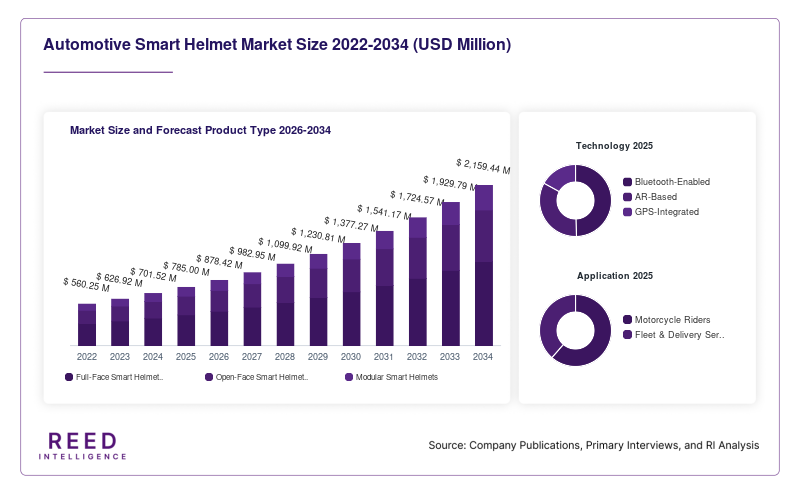
Full-face smart helmets dominated the Automotive Smart Helmet Market with a 49% share in 2025, due to their superior safety features and comprehensive coverage. These helmets are widely preferred for long-distance and high-speed riding.
Modular smart helmets are expected to grow at the fastest CAGR of 12.3%, driven by their versatility and convenience. These helmets offer both full-face and open-face configurations, making them suitable for various riding conditions.
By Technology
Bluetooth-enabled helmets held the largest share at 41% in 2025, as they provide communication and connectivity features at a relatively lower cost.
AR-based helmets will grow at a CAGR of 12.9%, supported by advancements in augmented reality technology. These helmets will offer enhanced navigation and situational awareness features.
By Application
Motorcycle riders accounted for the largest share of 52% in 2025, driven by widespread use of two-wheelers for personal transportation.
Fleet and delivery services will grow at a CAGR of 12.8%, fueled by the expansion of e-commerce and logistics industries.
By End-Use
Individual consumers dominated with a 55% share in 2025, as smart helmets are increasingly adopted for personal safety and convenience.
Commercial users will grow at a CAGR of 12.5%, driven by the need for efficient fleet management and communication tools.
By Distribution Channel
Offline channels held the largest share at 58% in 2025, as customers prefer to physically evaluate helmets before purchase.
Online channels are expected to grow at a CAGR of 12.7%, supported by the expansion of e-commerce platforms and digital marketing strategies.
Regional Analysis
North America
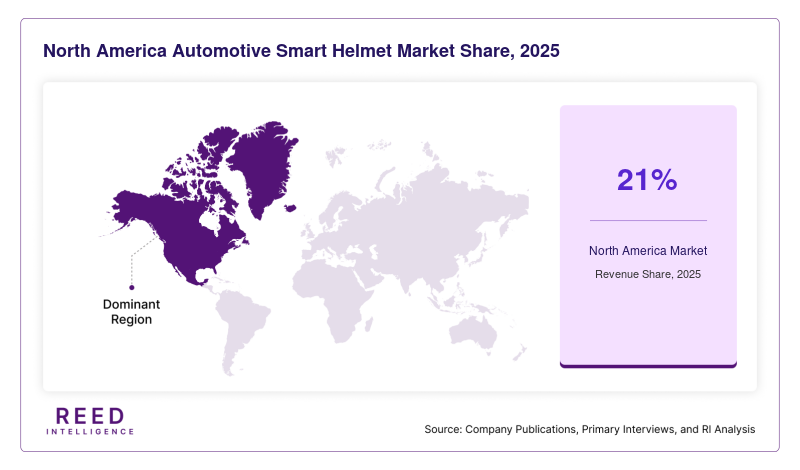
North America accounted for 21% of the Automotive Smart Helmet Market share in 2025 and will grow at a CAGR of 12.6% through 2034. The region showed increasing adoption of advanced safety technologies and connected devices.
The United States dominated the region due to high consumer awareness and technological adoption. A key growth factor is the increasing demand for premium smart helmets with advanced features among motorcycle enthusiasts.
Europe
Europe held approximately 23% market share in 2025 and is expected to grow at a CAGR of 11.5%. The region benefited from strict road safety regulations and increasing adoption of advanced mobility solutions.
Germany emerged as the dominant country, driven by strong automotive and technology sectors. A key growth factor is the integration of smart helmets with advanced mobility systems.
Asia Pacific
Asia Pacific captured around 44% of the market share in 2025 and will continue to grow at a CAGR of 11.8%. Rapid urbanization and high two-wheeler usage contributed to market expansion.
India dominated the region, supported by a large population of two-wheeler users. A major growth factor is the increasing adoption of safety gear among riders and the expansion of delivery services.
Middle East & Africa
The Middle East & Africa region held about 7% share in 2025 and is projected to grow at a CAGR of 11.2%. Market growth was driven by increasing urbanization and rising awareness of road safety.
United Arab Emirates led the region due to its advanced infrastructure. A key growth factor is the adoption of smart mobility solutions in urban areas.
Latin America
Latin America accounted for nearly 5% of the Automotive Smart Helmet Market in 2025 and will grow at a CAGR of 11.0%. The region showed steady growth due to increasing motorcycle usage.
Brazil dominated the market, supported by expanding urban transportation systems. A significant growth factor is the rising demand for safety equipment among riders.
Competitive Landscape
The Automotive Smart Helmet Market is characterized by a mix of established helmet manufacturers and emerging technology companies. Market participants are focusing on innovation and product differentiation to gain a competitive edge.
Sena Technologies is a leading player, known for its advanced communication systems integrated into helmets. The company recently introduced a new range of smart helmets with enhanced connectivity features, strengthening its market position.
Other players are investing in research and development to integrate advanced technologies such as AR and AI into their products. Strategic partnerships and collaborations are also common, enabling companies to expand their market presence and improve product offerings.
Key Players List
- Sena Technologies
- Livall Tech Co., Ltd.
- Forcite Helmet Systems
- Jarvish Inc.
- Shoei Co., Ltd.
- AGV (Dainese Group)
- Bell Helmets
- Nolan Helmets
- Schuberth GmbH
- HJC Helmets
- Shark Helmets
- Steelbird Hi-Tech India Ltd.
- Studds Accessories Ltd.
- Reevu Helmets
- Skully Technologies
Recent Developments
- 2024: Sena Technologies launched new smart helmets with improved communication features.
- 2024: Livall Tech expanded its product portfolio with advanced safety features.
- 2025: Forcite Helmet Systems introduced AR-enabled helmets for enhanced navigation.
- 2025: Jarvish Inc. developed AI-integrated smart helmets for improved rider safety.
- 2025: Steelbird Hi-Tech India Ltd. expanded its smart helmet offerings in emerging markets.
Automotive Smart Helmet Market Segments
Product Type
- Full-Face Smart Helmets
- Open-Face Smart Helmets
- Modular Smart Helmets
Technology
- Bluetooth-Enabled
- AR-Based
- GPS-Integrated
Application
- Motorcycle Riders
- Fleet & Delivery Services
End-Use
- Individual Consumers
- Commercial Users
Distribution Channel
- Offline Retail
- Online Retail
By Region
- North America
- Europe
- APAC
- Middle East and Africa
- LATAM