Automotive Spray Guns Market Size, Share & Demand Report By Technology Type (HVLP Spray Guns, Conventional Spray Guns), By Operation Mode (Manual Spray Guns, Automatic Spray Guns), By Application (Automotive Refinishing, OEM Vehicle Manufacturing), By End User (Automotive Body Shops and Repair Centers, Automotive Manufacturing Facilities, Independent Garages), By Distribution Channel (Direct Sales, Industrial Distributors), By Region & Segment Forecasts, 2026–2034
USD 3950
Market Overview
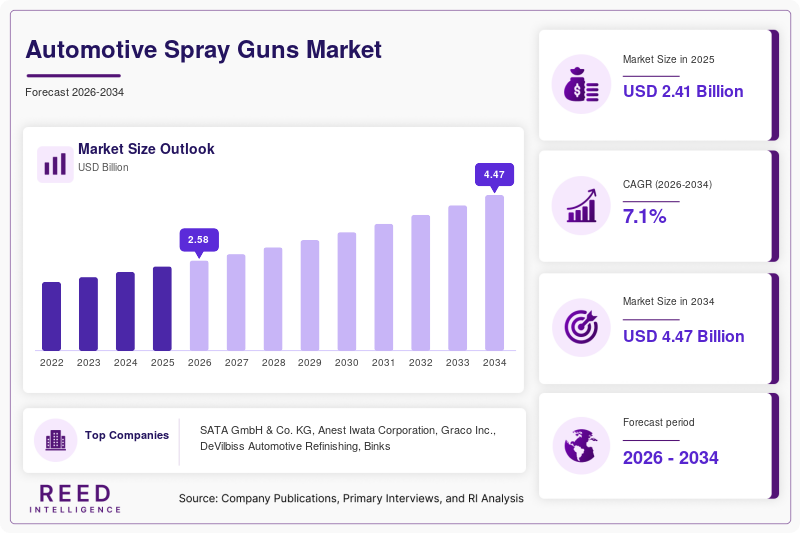
The Automotive Spray Guns Market was valued at USD 2.41 billion in 2026 and is projected to reach USD 4.18 billion by 2034, expanding at a CAGR of 7.1% during 2026–2034. The market continues to gain momentum as automotive manufacturers, repair facilities, and refinishing service providers increasingly invest in advanced paint application technologies that improve coating quality, reduce material waste, and enhance production efficiency.
A significant global factor supporting market growth has been the continued expansion of vehicle production and refinishing activities worldwide. Rising passenger vehicle ownership, increasing demand for vehicle customization, and growing maintenance requirements have encouraged investments in modern spray painting equipment. Automotive manufacturers are also focusing on precision coating processes to improve vehicle aesthetics and corrosion resistance while complying with environmental regulations related to paint emissions and material utilization.
Key Highlights
- North America accounted for the largest market share of 34.8% in 2025, while Asia Pacific is anticipated to register the fastest CAGR of 8.4% during 2026–2034.
- By technology type, HVLP spray guns held the dominant share of 42.6% in 2025, while electrostatic spray guns are projected to expand at a CAGR of 8.9% through 2034.
- By operation mode, manual spray guns represented 61.2% of market revenue in 2025, whereas automatic spray guns are forecast to grow at 8.5% CAGR.
- By application, automotive refinishing captured 48.3% market share in 2025, while OEM vehicle coating applications are expected to grow at 8.2% CAGR.
- By end user, automotive body shops and repair centers accounted for 45.7% share in 2025, while automotive manufacturing facilities are anticipated to expand at 8.0% CAGR.
- The United States, the dominant country market, was valued at USD 632 million in 2024 and increased to USD 676 million in 2025.
Market Trends
Integration of Smart Spray Technologies
Digital monitoring capabilities are becoming increasingly common across automotive coating operations. Modern spray guns feature electronic pressure controls, spray pattern monitoring, fluid management systems, and data connectivity functions. These technologies help operators maintain coating consistency, optimize paint consumption, and reduce rework rates. As manufacturing facilities embrace Industry 4.0 initiatives, demand for intelligent spray equipment continues to increase.
Growing Adoption of Eco-Friendly Coating Systems
The transition toward waterborne paints and environmentally compliant coating materials is influencing spray gun innovation. Manufacturers are developing equipment capable of handling specialized coating formulations while maintaining transfer efficiency and finish quality. Improved atomization performance and reduced overspray characteristics support sustainability objectives and lower operational costs across automotive painting environments.
Market Drivers
Rising Vehicle Refinishing and Collision Repair Activities
Growing vehicle ownership levels and increasing road traffic volumes have contributed to higher collision repair requirements worldwide. Automotive repair centers rely on advanced spray guns to deliver professional-quality finishes while reducing labor time and paint consumption. The continuous expansion of vehicle repair networks is supporting steady demand for painting equipment.
Expansion of Automotive Manufacturing Capacity
Automotive production investments across emerging and established markets are driving equipment procurement activities. Manufacturers require high-performance coating systems to achieve uniform finishes, improve productivity, and support large-scale production operations. Increased vehicle manufacturing capacity directly stimulates demand for advanced spray application technologies.
Market Restraint
High Initial Equipment and Maintenance Costs
Advanced automotive spray guns equipped with digital controls, electrostatic systems, and automation compatibility often require significant capital investment. Small repair facilities and independent workshops may face budget limitations that delay equipment upgrades. Ongoing maintenance and operator training requirements can further influence purchasing decisions.
Market Opportunities
Expansion of Robotic Painting Systems
Automotive manufacturers are increasingly deploying robotic painting solutions to improve consistency and production efficiency. This trend creates opportunities for specialized spray guns designed for integration with automated coating platforms. Equipment providers capable of supporting robotic applications are expected to benefit from growing industrial demand.
Growth of Premium Vehicle Customization Services
Consumer interest in personalized vehicle aesthetics is increasing demand for custom painting services. Specialized coatings, unique finishes, and restoration projects require advanced spray equipment capable of precise paint application. Service providers investing in premium customization capabilities are creating additional growth opportunities for spray gun manufacturers.
Segmental Analysis
By Technology Type
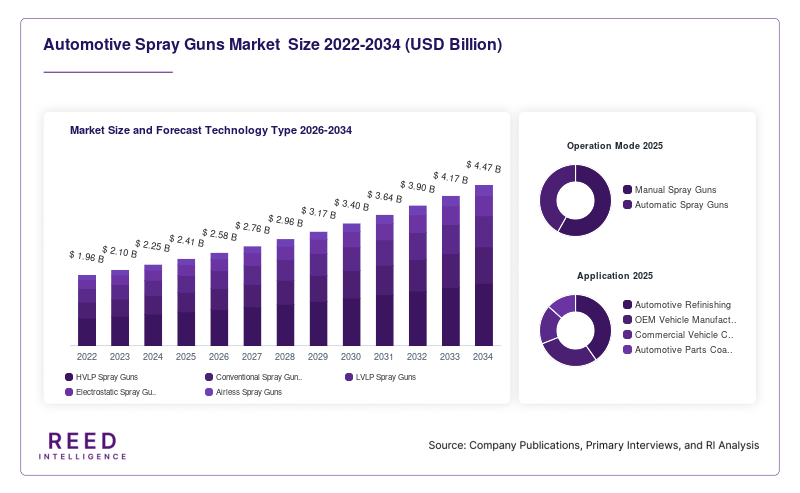
The market is segmented into HVLP Spray Guns, Conventional Spray Guns, LVLP Spray Guns, Electrostatic Spray Guns, and Airless Spray Guns.
HVLP spray guns dominated the segment with 42.6% share in 2025. Their ability to provide higher transfer efficiency, lower paint waste, and improved finish quality contributed to widespread adoption across automotive repair and manufacturing environments.
Electrostatic spray guns are expected to be the fastest-growing subsegment, advancing at a CAGR of 8.9% through 2034. Growth will be driven by superior coating adhesion capabilities and reduced material consumption during high-volume production operations.
By Operation Mode
The market is categorized into Manual Spray Guns and Automatic Spray Guns.
Manual spray guns accounted for 61.2% of market revenue in 2025. Their flexibility, affordability, and suitability for refinishing applications supported broad adoption among repair centers and customization workshops.
Automatic spray guns are projected to grow at 8.5% CAGR over the forecast period. Growth will result from increasing integration with robotic painting systems designed to improve production consistency and throughput.
By Application
The application segment includes Automotive Refinishing, OEM Vehicle Manufacturing, Commercial Vehicle Coating, and Automotive Parts Coating.
Automotive refinishing held the largest share at 48.3% in 2025. Consistent demand from collision repair centers, restoration specialists, and aftermarket service providers contributed to segment leadership.
OEM vehicle manufacturing is forecast to expand at a CAGR of 8.2% through 2034. Growth will be supported by investments in advanced production lines requiring precise and efficient coating technologies.
By End User
The market is segmented into Automotive Body Shops and Repair Centers, Automotive Manufacturing Facilities, Independent Garages, and Vehicle Restoration Specialists.
Automotive body shops and repair centers accounted for 45.7% share in 2025 due to strong demand for repainting and collision repair services.
Automotive manufacturing facilities are expected to register a CAGR of 8.0%. Increased automation and modernization of vehicle assembly operations will stimulate adoption of advanced spray application equipment.
By Distribution Channel
The market includes Direct Sales, Industrial Distributors, Online Sales Channels, and Specialty Equipment Retailers.
Industrial distributors represented 39.8% share in 2025, benefiting from established relationships with repair centers and manufacturing customers.
Online sales channels are anticipated to expand at a CAGR of 8.1% through 2034. Digital procurement platforms will gain popularity as buyers seek broader product availability and simplified purchasing processes.
Regional Analysis
North America
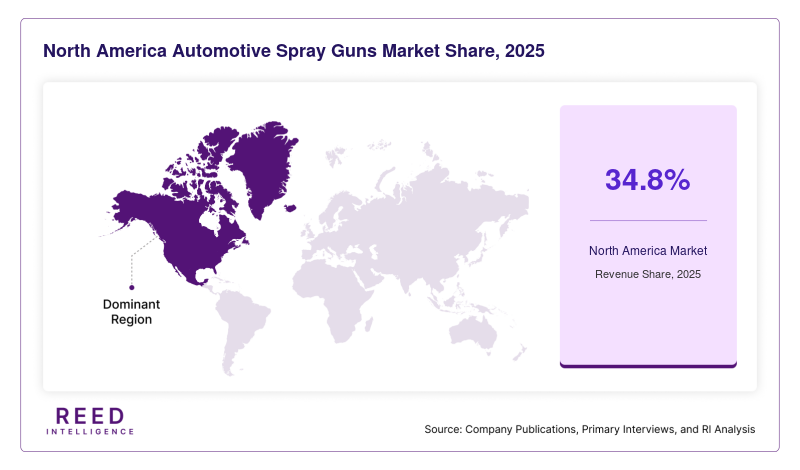
North America held 34.8% of the Automotive Spray Guns Market in 2025. The region benefits from a mature automotive aftermarket, extensive collision repair infrastructure, and widespread adoption of advanced painting technologies. Market participants continue to invest in equipment modernization to improve coating quality and operational efficiency.
The United States remained the dominant country in the region. Growth was supported by strong demand for vehicle restoration projects and expanding investments in advanced automotive refinishing facilities. The regional market is expected to grow at a 6.6% CAGR through 2034.
Europe
Europe represented 27.6% market share in 2025. The region maintained steady demand due to established automotive manufacturing operations and strict coating quality requirements. Investments in environmentally compliant painting technologies contributed to market expansion.
Germany led the European market. Growth was supported by extensive automotive engineering expertise and continuous modernization of vehicle production facilities. The European market is forecast to expand at a 6.8% CAGR during 2026–2034.
Asia Pacific
Asia Pacific accounted for 24.5% of global revenue in 2025. Rapid industrialization, increasing vehicle production, and expanding automotive service networks supported regional demand. Growing adoption of advanced coating technologies further strengthened market performance.
China dominated the region due to its substantial automotive manufacturing base and growing refinishing industry. Expansion of vehicle production facilities and increasing demand for high-quality coating applications will support a projected 8.4% CAGR through 2034.
Middle East & Africa
The Middle East & Africa captured 7.2% market share in 2025. Demand was supported by infrastructure development, growing vehicle ownership, and expanding automotive maintenance services. Market participants increasingly adopted modern refinishing technologies to improve service quality.
Saudi Arabia remained the dominant country market. Growth was driven by investments in automotive service infrastructure and increasing demand for vehicle maintenance solutions. The region is anticipated to register a 7.0% CAGR between 2026 and 2034.
Latin America
Latin America represented 5.9% of the Automotive Spray Guns Market in 2025. Expansion of automotive repair networks and increasing vehicle usage contributed to market growth. Local workshops continued upgrading painting equipment to improve productivity and finish quality.
Brazil led the regional market due to its sizable automotive fleet and established repair industry. Rising demand for refinishing services will support a forecast CAGR of 7.3% through 2034.
Competitive Landscape
The Automotive Spray Guns Market remains moderately consolidated with established equipment manufacturers competing through product innovation, distribution expansion, and technology development. Companies focus on improving transfer efficiency, operator ergonomics, automation compatibility, and environmental compliance.
SATA GmbH & Co. KG remains a market leader due to its extensive portfolio of professional automotive spray equipment and strong presence across OEM and refinishing applications. The company recently introduced an advanced digital spray gun platform featuring enhanced airflow management and improved coating consistency capabilities.
Anest Iwata Corporation continues expanding its precision coating solutions portfolio while strengthening distribution networks across Asia and Europe.
Graco Inc. focuses on industrial coating technologies and automated spray systems that support automotive manufacturing environments.
DeVilbiss Automotive Refinishing maintains strong market recognition through professional-grade refinishing equipment designed for body shops and repair facilities.
Binks continues investing in high-efficiency spray technologies that improve coating quality while reducing material consumption.
Key Players List
- SATA GmbH & Co. KG
- Anest Iwata Corporation
- Graco Inc.
- DeVilbiss Automotive Refinishing
- Binks
- Walther Pilot GmbH
- Krautzberger GmbH
- Nordson Corporation
- Fuji Spray
- 3M Company
- Apollo Sprayers International Inc.
- Carlisle Fluid Technologies
- EXEL Industries
- Wagner Group GmbH
- Tritech Industries Inc.
Automotive Spray Guns Market Segments
Technology Type
- HVLP Spray Guns
- Conventional Spray Guns
- LVLP Spray Guns
- Electrostatic Spray Guns
- Airless Spray Guns
Operation Mode
- Manual Spray Guns
- Automatic Spray Guns
Application
- Automotive Refinishing
- OEM Vehicle Manufacturing
- Commercial Vehicle Coating
- Automotive Parts Coating
End User
- Automotive Body Shops and Repair Centers
- Automotive Manufacturing Facilities
- Independent Garages
- Vehicle Restoration Specialists
Distribution Channel
- Direct Sales
- Industrial Distributors
- Online Sales Channels
- Specialty Equipment Retailers
By Region
- North America
- Europe
- APAC
- Middle East and Africa
- LATAM