Automotive Stabilizer Link Market Size, Share & Demand Report By Vehicle Type (Passenger Cars, Light Commercial Vehicles, Heavy Commercial Vehicles), By Material (Steel, Aluminum, Composite), By Sales Channel (OEM, Aftermarket), By Link Type (Fixed, Adjustable), By Region & Segment Forecasts, 2026–2034
USD 3950
Market Overview
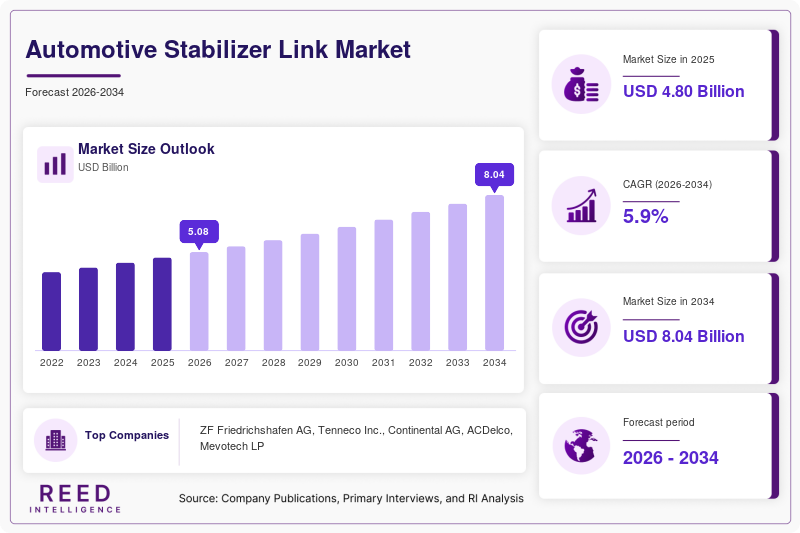
The global Automotive Stabilizer Link Market size was valued at approximately USD 4.8 billion in 2026 and is projected to reach USD 7.6 billion by 2034, expanding at a compound annual growth rate (CAGR) of 5.9% from 2026 to 2034. Stabilizer links, also known as sway bar links, are essential suspension components that enhance vehicle stability, handling, and ride comfort. The growing emphasis on vehicle safety standards and driving performance has significantly contributed to the expansion of the Automotive Stabilizer Link Market across passenger and commercial vehicle segments.
A key global factor supporting market growth is the increasing production and sales of vehicles worldwide, particularly in emerging economies. The rising demand for durable suspension systems capable of withstanding diverse road conditions has led to higher adoption of advanced stabilizer link designs. Additionally, the aftermarket segment has witnessed steady demand due to frequent replacement cycles driven by wear and tear.
Key Highlights:
- Asia Pacific dominated the Automotive Stabilizer Link Market with a 41% share, while it is expected to grow at the fastest CAGR of 6.8% during the forecast period.
- By vehicle type, passenger cars led with 62% share, whereas light commercial vehicles are projected to grow at a CAGR of 6.5%.
- By material, steel-based stabilizer links held 68% share, while composite materials are expected to grow at 7.2% CAGR.
- The U.S. market was valued at USD 0.95 billion in 2024 and USD 1.01 billion in 2025, maintaining its position as the dominant country.
Market Trends
Integration of Lightweight Materials in Suspension Components
The Automotive Stabilizer Link Market is experiencing a transition toward lightweight materials such as aluminum alloys and advanced composites. Automakers are focusing on reducing vehicle weight to improve fuel efficiency and meet emission norms. Lightweight stabilizer links contribute to lower unsprung mass, enhancing ride quality and handling. This trend is particularly visible in electric and hybrid vehicles, where efficiency optimization is critical. Manufacturers are investing in material innovation to achieve durability without compromising strength, thereby shaping the future of the Automotive Stabilizer Link Market.
Growth of Electric Vehicles and Suspension Redesign
The increasing adoption of electric vehicles (EVs) is influencing suspension system architecture, including stabilizer links. EVs have unique weight distribution due to battery placement, which requires redesigned stabilizer systems for improved balance and stability. As EV production expands globally, the demand for customized stabilizer links is rising. This trend is driving innovation in link geometry, joint design, and materials. Consequently, the Automotive Stabilizer Link Market is evolving to cater to next-generation vehicle platforms with enhanced performance requirements.
Market Drivers
Rising Vehicle Production and Ownership
The steady increase in global vehicle production and ownership is a primary driver of the Automotive Stabilizer Link Market. Emerging economies, particularly in Asia Pacific and Latin America, are witnessing rising disposable incomes and urbanization, leading to higher vehicle demand. Stabilizer links are critical components in all vehicle categories, ensuring consistent demand across OEM and aftermarket channels. The expansion of automotive manufacturing facilities and supply chains further supports market growth.
Increasing Focus on Vehicle Safety and Comfort
Automotive manufacturers are placing greater emphasis on safety and driving comfort, which directly influences the demand for high-quality suspension components. Stabilizer links play a vital role in minimizing body roll and improving vehicle stability during turns. Regulatory bodies are also enforcing stricter safety standards, prompting automakers to adopt advanced suspension technologies. This focus on safety and comfort continues to drive innovation and demand within the Automotive Stabilizer Link Market.
Market Restraint
High Cost of Advanced Materials and Design Complexity
One of the key challenges in the Automotive Stabilizer Link Market is the increasing cost associated with advanced materials and complex designs. While lightweight and composite materials offer performance advantages, they also lead to higher manufacturing costs. Small and mid-sized manufacturers often face difficulties in adopting these technologies due to limited capital investment capabilities. Additionally, the design complexity of modern stabilizer links, especially for electric and high-performance vehicles, increases production costs and technical challenges. These factors may limit widespread adoption in price-sensitive markets, thereby restraining overall market growth.
Market Opportunities
Expansion of Automotive Aftermarket Services
The growing automotive aftermarket sector presents a significant opportunity for the Automotive Stabilizer Link Market. Stabilizer links are subject to wear and require periodic replacement, creating consistent demand in the aftermarket. The rise of e-commerce platforms and organized service networks is improving accessibility and distribution of replacement parts. Manufacturers can leverage this trend by offering durable and cost-effective products tailored for aftermarket consumers.
Technological Advancements in Suspension Systems
Advancements in suspension technologies, including adaptive and semi-active systems, are opening new avenues for stabilizer link innovation. As vehicles become more technologically advanced, the demand for precision-engineered components increases. Manufacturers can capitalize on this opportunity by developing high-performance stabilizer links compatible with modern suspension architectures. This trend is expected to create new growth prospects within the Automotive Stabilizer Link Market over the forecast period.
Segmental Analysis
By Vehicle Type
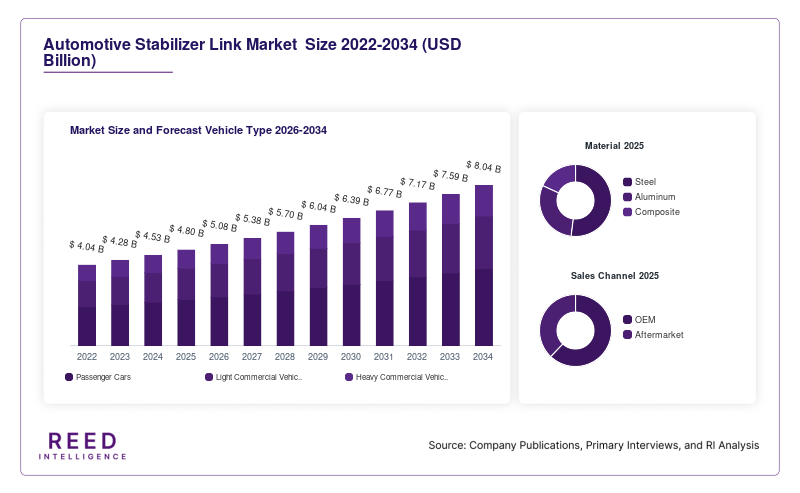
Passenger cars dominated the Automotive Stabilizer Link Market with a 62% share in 2025. The high production volume and widespread adoption of passenger vehicles contributed to this dominance.
Light commercial vehicles are expected to be the fastest-growing segment, with a projected CAGR of 6.5%. The growth is driven by increasing logistics and e-commerce activities, which require efficient transportation solutions.
By Material
Steel-based stabilizer links accounted for 68% of the market share in 2025, owing to their durability and cost-effectiveness. Steel remains the preferred material for most OEM applications.
Composite materials are projected to grow at a CAGR of 7.2%, driven by the demand for lightweight components. These materials offer improved performance and fuel efficiency benefits.
By Sales Channel
OEM sales dominated the market with a 64% share in 2025, supported by strong vehicle production rates globally.
The aftermarket segment is expected to grow at a CAGR of 6.7%, driven by increasing vehicle lifespan and replacement needs.
By Link Type
Fixed stabilizer links held a 70% share in 2025, due to their widespread use in standard suspension systems.
Adjustable stabilizer links are expected to grow at a CAGR of 6.9%, supported by demand for performance and customization in vehicles.
Regional Analysis
North America
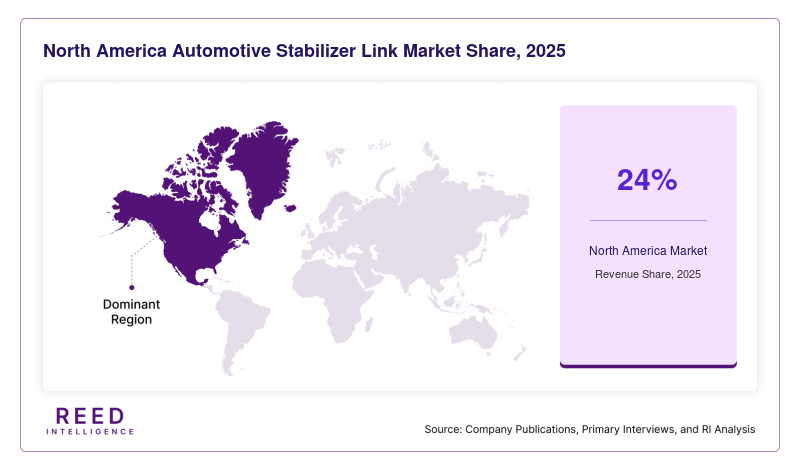
North America accounted for approximately 24% of the Automotive Stabilizer Link Market share in 2025 and is expected to grow at a CAGR of 5.2% during the forecast period. The region’s mature automotive industry and strong presence of OEM manufacturers have contributed to steady demand for stabilizer links.
The United States dominated the regional market due to its large vehicle fleet and strong aftermarket demand. A key growth factor is the increasing average vehicle age, which drives replacement demand for suspension components, including stabilizer links.
Europe
Europe held around 22% market share in 2025 and is projected to grow at a CAGR of 5.5% from 2026 to 2034. The region’s focus on vehicle safety and stringent regulatory standards has supported the adoption of advanced suspension systems.
Germany led the European Automotive Stabilizer Link Market, driven by its strong automotive manufacturing base. The emphasis on engineering precision and high-performance vehicles has increased demand for premium stabilizer link components.
Asia Pacific
Asia Pacific dominated the Automotive Stabilizer Link Market with a 41% share in 2025 and is anticipated to grow at a CAGR of 6.8% during the forecast period. Rapid industrialization and expanding automotive production have fueled market growth in this region.
China emerged as the dominant country due to its large-scale vehicle production and growing domestic demand. The expansion of electric vehicle manufacturing has further contributed to increased demand for advanced stabilizer links.
Middle East & Africa
The Middle East & Africa region accounted for approximately 7% market share in 2025 and is expected to grow at a CAGR of 5.7%. The region’s growth is supported by infrastructure development and increasing vehicle imports.
The United Arab Emirates dominated the regional market, driven by high demand for premium vehicles and a growing aftermarket sector. Harsh road conditions also contribute to frequent replacement of stabilizer links.
Latin America
Latin America held nearly 6% share of the Automotive Stabilizer Link Market in 2025 and is projected to grow at a CAGR of 5.9%. Economic recovery and increasing vehicle sales are supporting market expansion.
Brazil led the region due to its strong automotive manufacturing industry. Government initiatives to boost domestic production have positively influenced demand for automotive components, including stabilizer links.
Competitive Landscape
The Automotive Stabilizer Link Market is moderately fragmented, with several global and regional players competing on product quality, pricing, and innovation. Leading companies focus on expanding their product portfolios and strengthening distribution networks.
A key market leader is ZF Friedrichshafen AG, which has consistently invested in advanced suspension technologies. The company recently introduced enhanced stabilizer link designs aimed at improving durability and performance in electric vehicles.
Other prominent players are focusing on strategic collaborations, product development, and regional expansion to strengthen their market presence.
Key Players List
- ZF Friedrichshafen AG
- Tenneco Inc.
- Continental AG
- ACDelco
- Mevotech LP
- MOOG Inc.
- Dorman Products
- TRW Automotive
- Delphi Technologies
- NSK Ltd.
- Mando Corporation
- Sogefi SpA
- Yorozu Corporation
- NHK Spring Co., Ltd.
- Federal-Mogul LLC
Recent Developments
- 2025: ZF Friedrichshafen AG launched a new lightweight stabilizer link for electric vehicles.
- 2024: Tenneco expanded its aftermarket product portfolio in Asia Pacific.
- 2025: Continental AG invested in advanced material research for suspension components.
- 2024: Sogefi introduced high-durability stabilizer links for commercial vehicles.
- 2025: Mando Corporation expanded production capacity in South Korea.
Automotive Stabilizer Link Market Segments
Vehicle Type
- Passenger Cars
- Light Commercial Vehicles
- Heavy Commercial Vehicles
Material
- Steel
- Aluminum
- Composite
Sales Channel
- OEM
- Aftermarket
Link Type
- Fixed Stabilizer Links
- Adjustable Stabilizer Links
By Region
- North America
- Europe
- APAC
- Middle East and Africa
- LATAM