Automotive Steering Torque Sensor Market Size, Share Demand Report By Product Type (Contact-Type Torque Sensors, Non-Contact Torque Sensors), By Application (Passenger Vehicles, Commercial Vehicles, Electric Vehicles), By Technology (Magnetic Sensing, Optical Sensing, Strain Gauge Technology), By Distribution Channel (OEM, Aftermarket) By Region & Segment Forecasts, 2026–2034
USD 3950
Market Overview
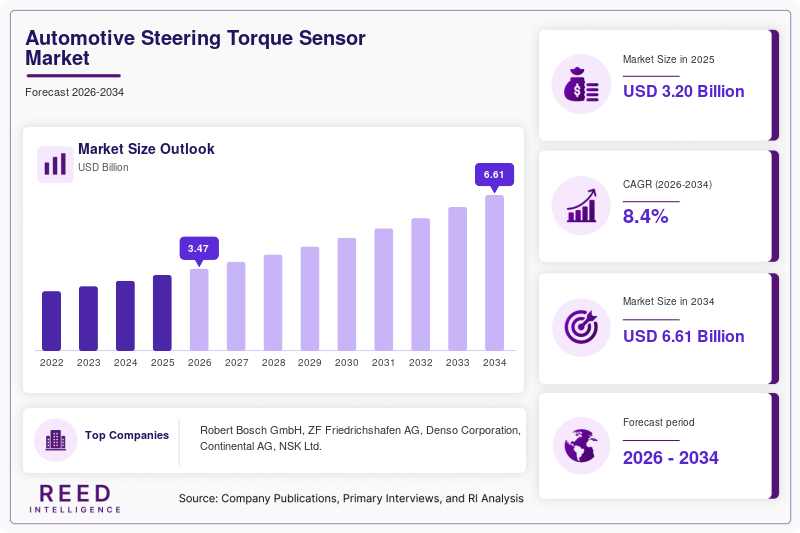
The Automotive Steering Torque Sensor Market size was valued at USD 3.2 billion in 2026 and is projected to reach USD 6.1 billion by 2034, expanding at a CAGR of 8.4% during the forecast period (2026–2034). The market is experiencing steady expansion due to the increasing integration of electronic power steering (EPS) systems in modern vehicles. Steering torque sensors play a critical role in measuring driver input and enabling precise steering assistance, which is essential for safety, comfort, and vehicle control.
A key global factor supporting the Automotive Steering Torque Sensor Market growth is the rapid adoption of advanced driver assistance systems (ADAS). As automotive manufacturers focus on improving vehicle safety and automation, the demand for accurate sensing technologies such as torque sensors has increased significantly.
Key Highlights
- Asia Pacific dominated the market with 41.5% share in 2025, while North America is projected to grow at the fastest CAGR of 8.9%
- Contact-type torque sensors led with 57.8% share, while non-contact sensors are expected to grow at a CAGR of 9.2%
- Passenger vehicles segment held 68.3% share, while electric vehicles are forecasted to grow at a CAGR of 10.1%
- China market was valued at USD 610 million in 2024 and reached USD 655 million in 2025
Market Trends
Rising Integration of Electric Power Steering Systems
The shift from hydraulic steering systems to electric power steering is a key trend in the Automotive Steering Torque Sensor Market. EPS systems rely heavily on torque sensors to deliver accurate steering assistance, improving fuel efficiency and reducing emissions.
Growing Adoption of Autonomous and Semi-Autonomous Vehicles
The increasing development of autonomous and semi-autonomous vehicles is influencing Automotive Steering Torque Sensor Market trends. These vehicles require precise sensing technologies to ensure accurate steering response and enhanced safety performance.
Market Drivers
Increasing Demand for Vehicle Safety Features
The growing emphasis on vehicle safety regulations and consumer awareness is driving the adoption of advanced safety systems. Torque sensors are integral to these systems, supporting improved steering control and stability.
Growth in Electric Vehicle Production
The rapid expansion of the electric vehicle segment is contributing to the Automotive Steering Torque Sensor Market growth. EVs commonly use electric power steering systems, which depend on torque sensors for efficient operation.
Market Restraint
High Cost of Advanced Sensor Technologies
The cost associated with advanced torque sensor technologies can limit adoption, particularly in cost-sensitive markets. This may impact the overall growth potential of the Automotive Steering Torque Sensor Market.
Market Opportunities
Expansion of Smart Mobility Solutions
The development of smart mobility and connected vehicle technologies presents opportunities for the Automotive Steering Torque Sensor Market. Integration with digital platforms enhances system efficiency and performance.
Technological Advancements in Sensor Design
Innovations in sensor miniaturization and accuracy are creating new growth opportunities. Advanced torque sensors with improved durability and precision are expected to drive market expansion.
Segmental Analysis
By Type
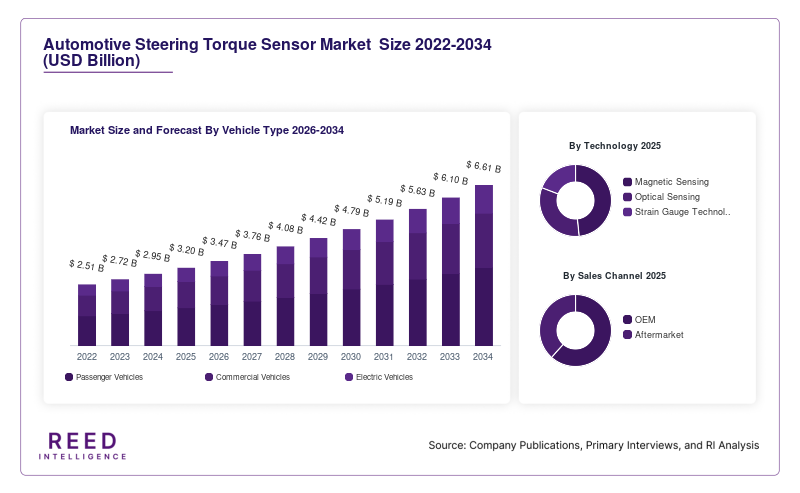
The contact-type torque sensor segment dominated the Automotive Steering Torque Sensor Market with 57.8% share in 2025 due to its cost-effectiveness and widespread usage. The non-contact torque sensor segment is expected to grow at the fastest CAGR of 9.2%, driven by higher accuracy and durability.
By Vehicle Type
The passenger vehicles segment held the largest share of 68.3% in 2025, supported by high global vehicle production. The electric vehicles segment is projected to grow at a CAGR of 10.1%, driven by increasing adoption of EVs.
By Technology
The magnetic sensing technology segment accounted for 49.6% share in 2025 due to its reliability and performance. The optical sensing technology segment is expected to grow at a CAGR of 8.7%, supported by advancements in precision sensing.
By Sales Channel
The OEM segment dominated with 72.5% share in 2025 as sensors are integrated during vehicle manufacturing. The aftermarket segment is expected to grow at a CAGR of 7.9%, driven by replacement demand.
Regional Analysis
North America
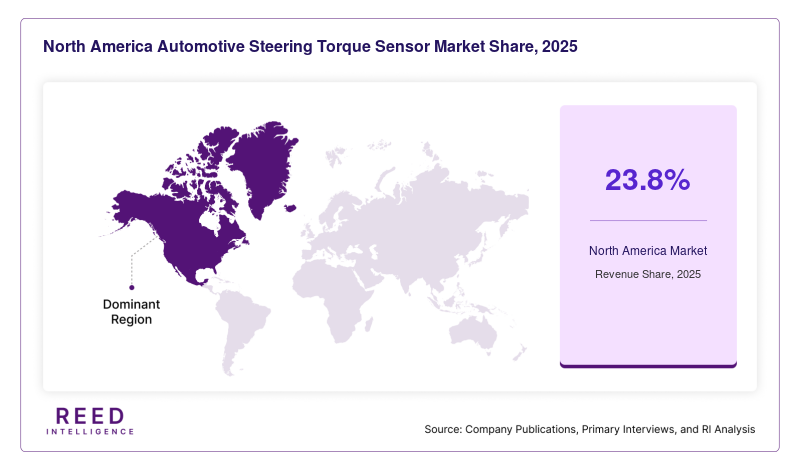
North America accounted for 23.8% of the Automotive Steering Torque Sensor Market share in 2025 and is expected to grow at a CAGR of 8.9% through 2034. The United States dominated the region due to strong adoption of advanced automotive technologies.
Europe
Europe held 25.4% share in 2025 and is projected to expand at a CAGR of 8.1%. Germany led the regional market, supported by the presence of major automotive manufacturers.
Asia Pacific
Asia Pacific captured 41.5% share in 2025 and is expected to grow at a CAGR of 8.6%. China dominated the region due to high vehicle production and increasing demand for electric vehicles.
Middle East & Africa
The Middle East & Africa region held 5.1% share in 2025 and is projected to grow at a CAGR of 7.8%. UAE led the market due to increasing adoption of advanced automotive technologies.
Latin America
Latin America accounted for 4.2% share in 2025 and is expected to grow at a CAGR of 8.0%. Brazil dominated the region, supported by growth in automotive manufacturing.
Competitive Landscape
The Automotive Steering Torque Sensor Market is characterized by moderate competition, with key players focusing on innovation and strategic collaborations. Leading companies are investing in advanced sensor technologies to enhance product accuracy and durability. One prominent market leader has recently introduced a next-generation non-contact torque sensor designed for electric vehicles, improving performance and efficiency.
Companies are also expanding their production capacities and strengthening partnerships with automotive manufacturers to gain a competitive edge. The increasing demand for electric and autonomous vehicles is influencing competitive dynamics. Market participants are focusing on research and development and cost optimization strategies to maintain their position in the evolving Automotive Steering Torque Sensor Market.
Key Players List
- Robert Bosch GmbH
- ZF Friedrichshafen AG
- Denso Corporation
- Continental AG
- NSK Ltd.
- JTEKT Corporation
- Infineon Technologies AG
- Nidec Corporation
- TE Connectivity Ltd.
- Alps Alpine Co., Ltd.
- Honeywell International Inc.
- Amphenol Corporation
- Melexis NV
- CTS Corporation
- Analog Devices, Inc.
Recent Developments
- In 2025, a major company launched a non-contact torque sensor for electric vehicles with enhanced precision
- In 2024, manufacturers increased investments in sensor miniaturization technologies
- In 2025, strategic collaborations were formed between sensor manufacturers and automotive OEMs
- In 2024, advancements in magnetic sensing improved product performance and durability
- In 2025, companies expanded production facilities to meet growing demand
Automotive Steering Torque Sensor Market Segments
By Vehicle Type
- Passenger Vehicles
- Commercial Vehicles
- Electric Vehicles
By Technology
- Magnetic Sensing
- Optical Sensing
- Strain Gauge Technology
By Sales Channel
- OEM
- Aftermarket
By Region
- North America
- Europe
- APAC
- Middle East and Africa
- LATAM