Automotive Tire Mold Market Size, Share & Demand Report By Mold Type (Segmental Tire Molds, Integrated Tire Molds, 3D Printed Tire Molds), By Application (Passenger Vehicles, Commercial Vehicles, Electric Vehicles, Off-Road Vehicles), By End-Use (OEM Tire Manufacturing, Replacement Tire Market, Specialty Tire Manufacturing) By Region & Segment Forecasts, 2026–2034
USD 3950
Market Overview
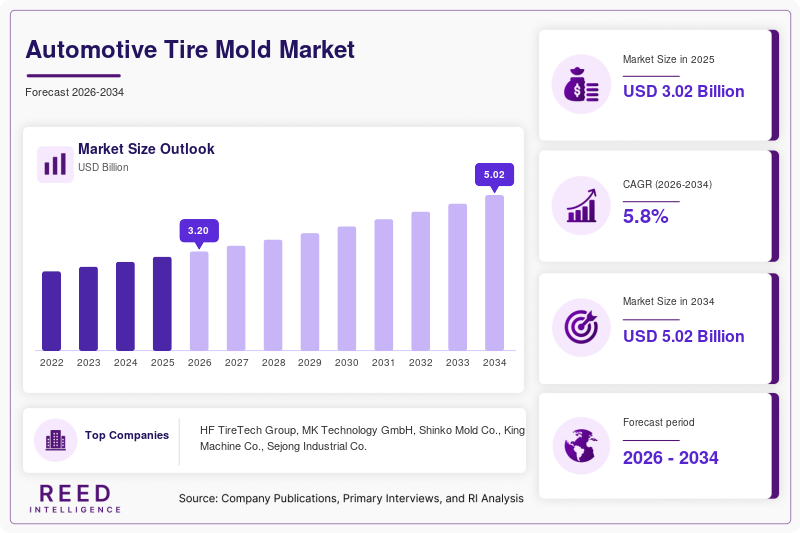
The Automotive Tire Mold Market size is projected to reach USD 3.2 billion in 2026 and is expected to attain USD 5.1 billion by 2034, registering a CAGR of 5.8% during 2026–2034. The market expansion is primarily driven by the steady rise in global vehicle production, increasing demand for high-performance tires, and the shift toward precision-engineered tire manufacturing technologies. Tire molds play a critical role in shaping tread patterns, improving fuel efficiency, and enhancing vehicle safety, making them an essential component in the automotive manufacturing value chain.
One of the key global factors supporting market growth is the rapid expansion of electric vehicle (EV) production, which requires specialized tire designs with optimized rolling resistance and durability. This has led to increased adoption of advanced CNC-machined molds and laser-engraved mold technologies. Additionally, tire manufacturers are investing in automation and digital mold design systems to reduce production cycles and improve consistency in tire performance across different driving conditions.
Key Highlights:
- Asia Pacific dominated the market with a 45.3% share in 2025.
- The Middle East & Africa is expected to grow at the fastest CAGR of 11.5% during 2026–2034.
- By mold type, segmental tire molds accounted for the largest share of 42.6%, while 3D-printed molds are projected to grow at a CAGR of 13.1%.
- By application, passenger vehicle tires led with a 48.9% share, whereas electric vehicle tire molds are expected to expand at a CAGR of 12.3%.
- The United States remained the dominant country, with market values of USD 680 million in 2024 and USD 720 million in 2025.
Market Trends
Adoption of Digital Mold Design and Simulation Technologies
The Automotive Tire Mold Market is experiencing a strong shift toward digital design platforms and simulation-based mold engineering. Manufacturers are increasingly adopting CAD/CAM systems integrated with AI-driven simulation tools to optimize tread pattern accuracy and reduce prototyping cycles. These technologies allow engineers to test mold performance virtually, minimizing material waste and production downtime. Digital twins are also being used to replicate mold behavior under different pressure and temperature conditions. This trend is improving design precision, reducing lead time, and enabling manufacturers to respond quickly to evolving tire performance requirements across passenger, commercial, and EV segments.
Growth of 3D Printing in Mold Manufacturing
Another significant trend shaping the Automotive Tire Mold Market is the increasing integration of additive manufacturing technologies. 3D printing enables rapid prototyping of complex mold geometries that were previously difficult to achieve using conventional machining methods. This approach reduces tooling costs and enhances customization capabilities for specialized tire designs. Tire manufacturers are leveraging 3D printing for producing lightweight and high-precision mold inserts, especially for performance and EV tires. The flexibility of additive manufacturing also supports faster design iterations, which is particularly important in competitive automotive markets where product development cycles are continuously shortening.
Market Drivers
Expansion of Global Automotive Production
The steady rise in global automotive production is a major driver for the Automotive Tire Mold Market. Increasing vehicle ownership across emerging economies has resulted in higher demand for both OEM and replacement tires, directly influencing mold production volumes. Automotive OEMs are expanding manufacturing capacities, particularly in Asia Pacific, to meet growing demand. This expansion necessitates large-scale production of high-precision tire molds capable of supporting diverse tire categories, including all-season, off-road, and high-performance variants. Additionally, stricter safety and fuel efficiency standards are pushing manufacturers to adopt advanced mold technologies, further boosting market demand.
Rising Demand for High-Performance and EV Tires
The growing demand for high-performance and electric vehicle tires is significantly influencing the Automotive Tire Mold Market. EV tires require specialized tread designs that minimize rolling resistance while enhancing grip and durability. This has led to increased use of precision-engineered molds with advanced patterning capabilities. High-performance sports and luxury vehicles also require customized tire designs that demand complex mold structures. Tire manufacturers are investing in innovative mold technologies to meet these evolving requirements, resulting in increased adoption of laser-engraved and digitally controlled mold systems across global production facilities.
Market Restraint
High Cost of Precision Mold Manufacturing
One of the primary restraints affecting the Automotive Tire Mold Market is the high cost associated with precision mold manufacturing. Advanced mold production requires specialized CNC machinery, high-grade materials, and skilled labor, all of which significantly increase production expenses. Additionally, the integration of digital design systems and additive manufacturing technologies adds further capital investment requirements. Small and medium-sized tire manufacturers often face challenges in adopting these technologies due to budget constraints. This cost barrier limits widespread adoption of advanced mold solutions, particularly in price-sensitive markets, thereby restricting overall market penetration in certain regions.
Market Opportunities
Increasing Adoption of Smart Manufacturing Systems
The integration of Industry 4.0 technologies presents a major opportunity for the Automotive Tire Mold Market. Smart manufacturing systems equipped with IoT sensors, predictive maintenance tools, and AI-driven analytics are transforming mold production processes. These systems enable real-time monitoring of mold performance, reducing downtime and improving operational efficiency. Tire manufacturers are increasingly adopting automated mold production lines to enhance productivity and reduce human error. The growing focus on smart factories is expected to create significant demand for digitally integrated mold systems over the forecast period.
Growth in Replacement Tire Demand
The rising demand for replacement tires presents another strong growth opportunity for the Automotive Tire Mold Market. As global vehicle fleets expand and average vehicle age increases, the replacement tire segment is witnessing steady growth. This directly drives demand for tire molds used in aftermarket tire production. Additionally, increasing road infrastructure development and higher vehicle usage rates are contributing to faster tire wear, further boosting replacement cycles. Manufacturers are focusing on developing versatile molds capable of producing multiple tire variants to cater to diverse aftermarket requirements.
Segmental Analysis
By Type
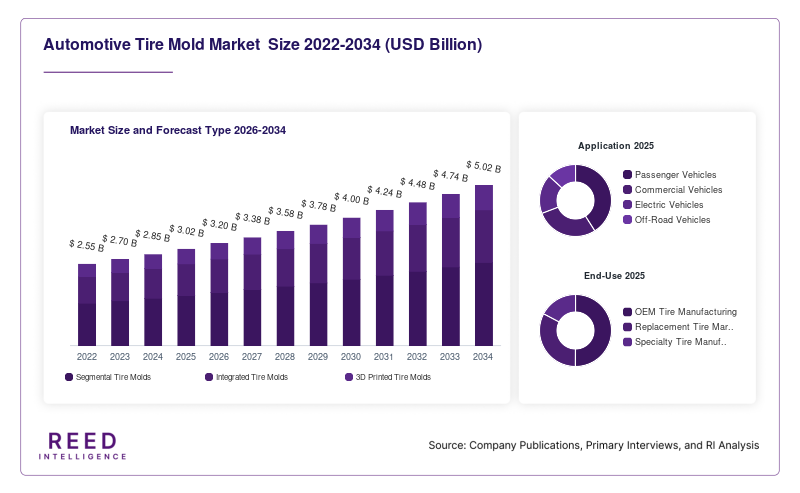
The segmental tire mold category dominated the Automotive Tire Mold Market with approximately 42.6% share in 2024, driven by its widespread use in producing multi-pattern tire designs for passenger and commercial vehicles. Segmental molds offer flexibility in tread customization, making them highly suitable for OEM applications. Manufacturers prefer these molds due to their durability and ability to support complex tread geometries required in modern tire designs.
The fastest-growing subsegment is 3D-printed tire molds, projected to register a CAGR of 13.1% during 2026–2034. Growth is driven by increasing adoption of additive manufacturing technologies that reduce production time and enable rapid prototyping. Tire manufacturers are leveraging 3D printing to develop customized mold inserts for EV and high-performance tires, improving design efficiency and reducing tooling costs.
By Application
Passenger vehicle tire molds accounted for the dominant 48.9% share in 2024, supported by high global passenger car production and replacement demand. This segment benefits from consistent demand for standard and performance tire categories across urban and highway driving conditions. OEM partnerships with tire manufacturers further strengthen demand for high-volume mold production.
Electric vehicle tire molds represent the fastest-growing subsegment, expected to expand at a CAGR of 12.3% during 2026–2034. Growth is driven by the increasing global shift toward electric mobility. EV-specific tires require specialized tread designs for low rolling resistance and enhanced battery efficiency, increasing demand for advanced mold engineering solutions.
By End-Use
OEM tire manufacturing dominated the end-use segment with a 51.4% share in 2024, supported by large-scale automotive production and integrated supply chains. OEMs require high-volume, precision molds to maintain consistency in tire performance and meet regulatory standards. Strong collaboration between automakers and tire manufacturers further supports this dominance.
The replacement tire segment is the fastest-growing, projected to expand at a CAGR of 6.8% during 2026–2034. Growth is driven by increasing global vehicle parc and rising vehicle usage rates. This segment requires flexible mold solutions capable of producing multiple tire variants, supporting aftermarket demand across diverse vehicle categories.
Regional Analysis
North America
North America accounted for approximately 28.4% share in 2025, with a projected CAGR of 5.2% from 2026 to 2034. The region benefits from advanced automotive manufacturing infrastructure and strong presence of leading tire manufacturers.
The United States dominates the regional market due to its established automotive OEM ecosystem and high demand for performance and EV tires. A key growth factor is the rapid adoption of automation in tire mold production facilities, improving efficiency and reducing production lead times.
Europe
Europe held around 22.6% market share in 2025, with a projected CAGR of 5.0% during the forecast period. The region is characterized by strict automotive safety regulations and strong emphasis on sustainability in manufacturing processes.
Germany leads the European market due to its strong automotive engineering base. A key growth factor is the increasing demand for eco-friendly tire designs that require precision-engineered molds with optimized tread structures.
Asia Pacific
Asia Pacific dominated with a 45.3% share in 2025 and is expected to grow at a CAGR of 6.4% during 2026–2034. The region remains the global manufacturing hub for automotive and tire production.
China is the leading country due to massive tire manufacturing capacity and export-oriented production. A key growth factor is the rapid expansion of domestic EV production, driving demand for specialized tire mold technologies.
Middle East & Africa
Middle East & Africa accounted for 3.8% share in 2025, with a strong CAGR of 11.5% during the forecast period. The region is gradually expanding its automotive manufacturing base.
South Africa leads the regional market due to its growing automotive assembly industry. A key growth factor is increasing investment in industrial diversification and tire manufacturing localization initiatives.
Latin America
Latin America held around 5.9% market share in 2025, with a projected CAGR of 5.7% during 2026–2034. The region is witnessing gradual expansion in automotive production and aftermarket tire demand.
Brazil dominates the regional market due to its large automotive fleet and manufacturing capabilities. A key growth factor is rising demand for commercial vehicle tires driven by logistics and transportation sector expansion.

Competitive Landscape
The Automotive Tire Mold Market is moderately consolidated, with key players focusing on technological advancements, precision engineering, and capacity expansion. Leading companies include HF TireTech Group, MK Technology GmbH, Shinko Mold Co., King Machine Co., and Sejong Industrial Co.. HF TireTech Group remains a prominent leader due to its strong global distribution network and advanced mold automation solutions. Recent developments include investments in digital mold manufacturing systems and expansion of production facilities in Asia Pacific to meet rising demand from EV tire manufacturers.
Key Players
- HF TireTech Group
- MK Technology GmbH
- Shinko Mold Co.
- King Machine Co.
- Sejong Industrial Co.
- Anhui Jichi Tire Mold Co.
- Greatoo Intelligent Equipment Inc.
- Guilin Rubber Machinery Co.
- Mesnac Co.
- Harburg-Freudenberger Maschinenbau
- Actuador Industrial
- LD Carbon
- Jiangsu Fengyuan Tire Mold Co.
- Saehan Mold Co.
- Wuxi Anmai Tire Mold Co.
Recent Developments
- HF TireTech Group expanded its automated tire mold production facility in Asia Pacific to enhance EV tire mold output capacity.
- Mesnac Co. introduced AI-integrated mold monitoring systems aimed at improving production efficiency and reducing defect rates.
- Shinko Mold Co. launched a new line of laser-engraved molds designed for high-performance and low rolling resistance tire applications.
Automotive Tire Mold Market Segments
Type
- Segmental Tire Molds
- Integrated Tire Molds
- 3D Printed Tire Molds
Application
- Passenger Vehicles
- Commercial Vehicles
- Electric Vehicles
- Off-Road Vehicles
End-Use
- OEM Tire Manufacturing
- Replacement Tire Market
- Specialty Tire Manufacturing
By Region
- North America
- Europe
- APAC
- Middle East and Africa
- LATAM