Automotive Tooling (Molds) Market Size, Share & Demand Report By Tooling Type (Injection Molds, Die Casting Molds, Blow Molds, Stamping Tools, Compression Molds), By Vehicle Type (Passenger Vehicles, Commercial Vehicles, Electric Vehicles), By Application (Interior Components, Exterior Components, Powertrain Components, Battery Housing, Lighting Systems, Structural Components) By Region & Segment Forecasts, 2026–2034
USD 3950
Market Overview
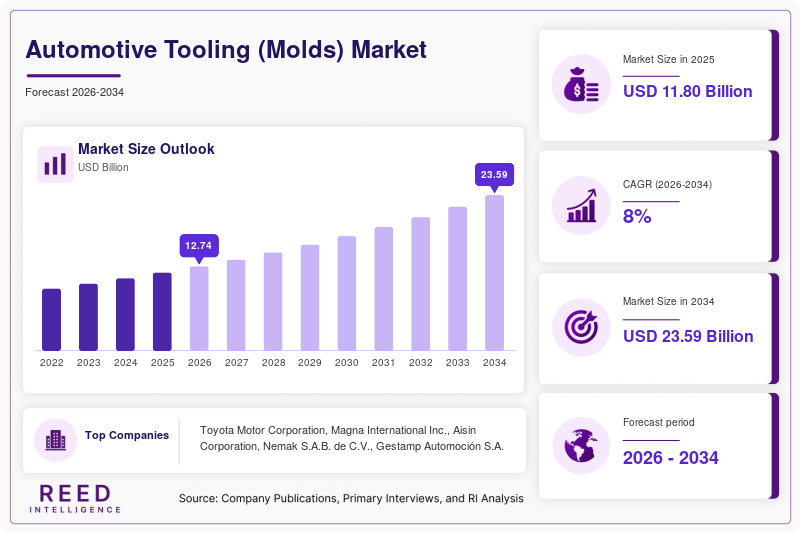
The global Automotive Tooling (Molds) Market size was valued at USD 11.8 billion in 2026 and is projected to reach USD 21.9 billion by 2034, expanding at a CAGR of 8.0% during the forecast period from 2026 to 2034. Automotive tooling molds are widely used for the production of body panels, dashboards, bumpers, interior trims, lighting systems, and structural components across passenger cars, electric vehicles, and commercial vehicles. The market continues to evolve as automotive manufacturers increase investments in lightweight materials, precision manufacturing, and automated production lines to improve operational efficiency and vehicle performance.
The growing production of electric vehicles has remained a major factor supporting market expansion across developed and emerging economies. Electric vehicle manufacturers require highly accurate molds and tooling systems to produce lightweight aluminum and composite parts with improved dimensional stability. In addition, increasing demand for customized vehicle interiors and aerodynamic vehicle structures has encouraged automakers to adopt advanced tooling technologies such as high-pressure die casting molds, injection molds, and rapid prototyping systems. The integration of digital simulation software and smart manufacturing platforms has also reduced tooling development time, enabling automotive companies to shorten product launch cycles and improve production flexibility.
Key Highlights
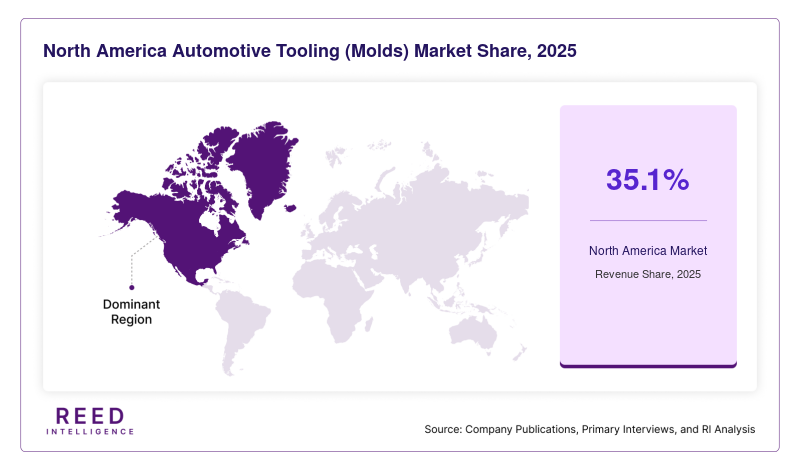
- North America dominated the market with a 35.1% share in 2025.
- Asia Pacific is expected to grow at the fastest CAGR of 9.8% during 2026–2034.
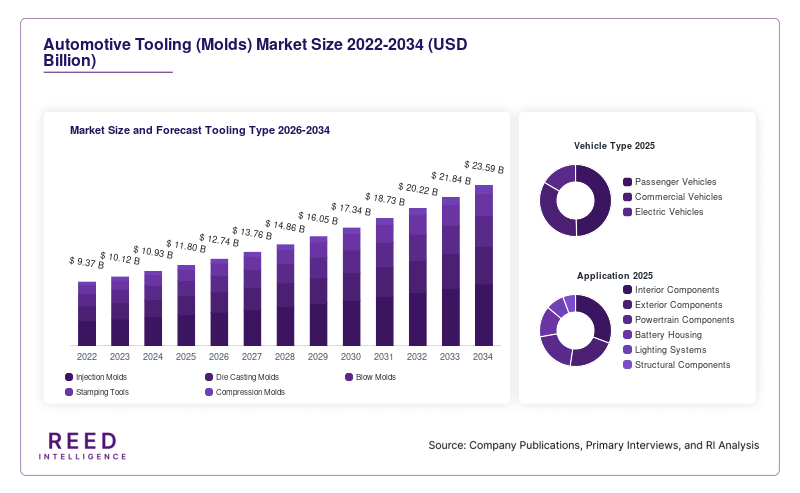
- By tooling type, injection molds accounted for the largest share of 39.4%, while die casting molds are projected to grow at a CAGR of 10.3%.
- By vehicle type, passenger vehicles led with a 58.7% share, whereas electric vehicles are expected to expand at a CAGR of 11.4%.
- By application, interior components held a 33.8% share, while battery housing applications are projected to grow at a CAGR of 12.1%.
- China remained the dominant country, with market values of USD 2.42 billion in 2024 and USD 2.68 billion in 2025.
Market Trends
Rising Adoption of Smart Manufacturing and Digital Tooling Systems
Automotive manufacturers are increasingly integrating smart manufacturing systems with tooling and mold production processes to improve accuracy and operational efficiency. Advanced technologies such as digital twins, AI-enabled predictive maintenance, and automated inspection systems are being adopted to reduce production downtime and tooling defects. Mold manufacturers are using real-time monitoring systems to track tool wear and temperature variations during high-volume production cycles. These technologies help automotive companies improve part consistency and reduce scrap generation across production lines. The adoption of cloud-connected manufacturing systems also supports faster communication between design teams and production facilities, enabling rapid modifications in tooling configurations.
The growing implementation of Industry 4.0 practices has accelerated the use of digitally controlled machining equipment and simulation software in mold development. Automotive suppliers are increasingly investing in computer-aided engineering platforms to optimize mold flow analysis and shorten product development cycles. The use of additive manufacturing for prototype tooling has also expanded due to its ability to lower production lead times and improve design flexibility. These developments are expected to improve manufacturing precision and support long-term growth within the Automotive Tooling (Molds) Market.
Increasing Demand for Lightweight Vehicle Components
The automotive industry is witnessing a strong transition toward lightweight vehicle structures to improve fuel efficiency and battery performance. This trend has significantly increased the demand for specialized molds capable of processing aluminum alloys, engineered plastics, and composite materials. Automotive companies are redesigning vehicle platforms with lightweight structural components that require advanced tooling solutions with high durability and precision. Manufacturers are focusing on multi-cavity molds and complex geometries to support the production of aerodynamic body parts and lightweight interiors.
Electric vehicle production has further strengthened this trend because lightweight designs improve driving range and energy efficiency. Mold producers are developing advanced die casting systems and injection molds to manufacture battery enclosures, thermal management components, and lightweight chassis structures. Automotive OEMs are also collaborating with tooling providers to reduce part complexity and assembly time. The expansion of lightweight automotive applications across passenger and commercial vehicles is expected to generate consistent demand for technologically advanced molds throughout the forecast period.
Market Drivers
Growth in Electric Vehicle Manufacturing Activities
The rapid expansion of electric vehicle production across China, Europe, and North America has become a major driver for the Automotive Tooling (Molds) Market. Electric vehicles require specialized molds for battery systems, lightweight structural frames, charging connectors, and thermal management components. Automotive manufacturers are investing in new production plants and expanding existing facilities to meet rising consumer demand for zero-emission mobility solutions. This expansion has created significant demand for high-performance tooling systems capable of supporting large-scale precision manufacturing.
Automakers are also focusing on reducing vehicle weight and improving structural integrity, which increases the need for advanced die casting and injection molding technologies. Tooling manufacturers are benefiting from growing investments in giga-casting processes used in electric vehicle body production. The increasing number of EV platform launches and battery manufacturing projects is expected to sustain long-term demand for molds and precision tooling equipment. Government incentives supporting electric mobility adoption are further encouraging automotive companies to increase production capacity, positively influencing market growth.
Expansion of Automotive Production Facilities in Emerging Economies
Automotive production is expanding rapidly across emerging economies due to favorable manufacturing costs, infrastructure development, and rising vehicle demand. Countries such as India, Thailand, Mexico, and Vietnam are attracting investments from global automotive manufacturers seeking to strengthen regional production capabilities. The establishment of new assembly plants and component manufacturing facilities has increased demand for tooling systems used in stamping, injection molding, and die casting operations.
Local governments are introducing industrial policies that support domestic automotive manufacturing and encourage technology transfer initiatives. Tooling suppliers are responding by establishing regional production centers and engineering facilities to improve supply chain efficiency and customer support. Rising demand for affordable passenger vehicles and commercial transportation solutions has further strengthened the need for efficient mold production systems. The expansion of contract manufacturing and automotive supplier networks across developing regions is expected to create sustained opportunities for tooling companies during the forecast period.
Market Restraint
High Initial Investment and Maintenance Costs Associated with Advanced Tooling Systems
The high cost of advanced tooling systems remains a significant restraint for the Automotive Tooling (Molds) Market, particularly for small and medium-sized manufacturers. Precision molds used for high-volume automotive production require advanced machining equipment, specialized materials, and skilled engineering expertise, leading to substantial capital expenditure. Automotive suppliers must also invest in simulation software, automation technologies, and quality inspection systems to meet evolving manufacturing standards. These expenses often increase operational pressure for companies operating with limited financial resources.
Maintenance and repair requirements further add to the total ownership cost of automotive molds. High-pressure die casting molds and multi-cavity injection molds experience wear due to continuous production cycles and exposure to extreme temperatures. Frequent maintenance shutdowns can reduce production efficiency and increase operating costs for manufacturers. In addition, fluctuations in raw material prices for tool steel, aluminum, and specialty alloys can influence tooling production expenses. Smaller suppliers may face difficulties in upgrading production capabilities due to limited access to financing and rising competition from established global tooling providers.
Market Opportunities
Development of Battery Housing and Structural EV Components
The increasing production of electric vehicles has created major opportunities for tooling manufacturers involved in battery housing and structural component applications. Battery packs require highly accurate molds capable of producing lightweight and heat-resistant enclosures that support vehicle safety and thermal efficiency. Automotive companies are investing in advanced aluminum die casting technologies to manufacture integrated vehicle structures and large battery casings. This trend is increasing demand for large-scale molds with improved durability and dimensional accuracy.
Tooling providers are also developing customized mold solutions for battery cooling systems, charging connectors, and lightweight underbody components. Growing investments in battery manufacturing plants across Asia Pacific, Europe, and North America are expected to strengthen demand for precision tooling systems. Automotive OEMs are seeking long-term partnerships with tooling suppliers capable of delivering rapid design modifications and scalable production solutions. The expansion of EV battery production capacity is likely to generate new revenue streams for mold manufacturers throughout the forecast period.
Increasing Adoption of Additive Manufacturing for Prototype Tooling
Additive manufacturing technologies are creating new opportunities for automotive tooling companies by improving flexibility and reducing product development timelines. Automotive manufacturers are increasingly using 3D printing systems to produce prototype molds and tooling inserts for testing and low-volume production applications. This approach enables engineers to validate component designs more quickly and reduce the time required for conventional machining processes. The ability to create complex mold geometries with minimal material waste is further supporting the adoption of additive manufacturing technologies.
Tooling suppliers are integrating hybrid manufacturing techniques that combine traditional machining with additive production systems to improve operational efficiency. Rapid prototyping technologies also support customized automotive production and shorter product launch cycles. Automotive companies are focusing on reducing tooling modification costs and improving design adaptability, particularly for electric and autonomous vehicle platforms. The increasing use of digital manufacturing technologies and advanced materials in additive manufacturing is expected to create long-term growth opportunities within the Automotive Tooling (Molds) Market.
Segmental Analysis
By Tooling Type
Injection molds accounted for the largest share of the Automotive Tooling (Molds) Market in 2024, representing 39.4% of total revenue. These molds are widely used in the production of dashboards, bumpers, interior trims, lighting components, and electronic housings due to their ability to support high-volume manufacturing with consistent precision. Automotive manufacturers prefer injection molding systems because they reduce material waste and improve component uniformity across production cycles. Increasing demand for plastic-based lightweight components has further strengthened the use of injection molds in modern vehicle manufacturing. Tooling companies are also introducing multi-cavity designs and automated cooling systems to improve production efficiency and reduce cycle times. The growing adoption of advanced polymers and reinforced plastics in electric vehicles is expected to sustain demand for injection molding technologies across automotive production facilities.
Die casting molds are projected to witness the fastest CAGR of 10.3% during the forecast period due to increasing demand for lightweight aluminum structural components and battery enclosures. Automotive manufacturers are adopting high-pressure die casting technologies to produce large integrated vehicle structures with improved dimensional stability and reduced assembly complexity. The rising popularity of giga-casting systems in electric vehicle manufacturing has significantly increased demand for durable die casting molds capable of handling large-scale production operations. Tooling suppliers are investing in heat-resistant alloys and advanced cooling channels to improve mold longevity and production accuracy. The growing use of aluminum in vehicle chassis systems and structural frames is expected to create substantial opportunities for die casting mold manufacturers over the coming years.
By Vehicle Type
Passenger vehicles held the dominant share of 58.7% in the Automotive Tooling (Molds) Market in 2024 due to high global production volumes and rising consumer demand for technologically advanced automobiles. Automotive manufacturers continue to invest in precision tooling systems for the production of lightweight body panels, interior components, infotainment systems, and safety structures. Increasing consumer preference for improved vehicle aesthetics and comfort features has further strengthened demand for customized tooling solutions. The expansion of compact SUV and crossover vehicle production has also increased the need for advanced molds capable of supporting complex component geometries. Tooling suppliers are focusing on reducing production lead times and improving mold durability to meet evolving automotive manufacturing requirements. Growing demand for fuel-efficient passenger vehicles is expected to support long-term growth within this segment.
Electric vehicles are anticipated to register the fastest CAGR of 11.4% during the forecast period due to accelerating global investments in sustainable transportation solutions. EV manufacturers require specialized tooling systems for battery housings, lightweight chassis structures, thermal management components, and integrated electronic assemblies. Governments across major economies are supporting electric vehicle adoption through subsidies and emission regulations, encouraging automakers to expand EV production capacity. Automotive tooling companies are developing high-performance molds capable of supporting advanced materials such as aluminum alloys and engineered composites. The increasing adoption of giga-casting processes and modular EV platforms is also driving demand for large-scale precision molds. Rising consumer interest in electric mobility and charging infrastructure expansion are expected to further strengthen market opportunities for tooling providers.
By Application
Interior components represented the largest application segment in the Automotive Tooling (Molds) Market in 2024, accounting for 33.8% of total revenue. Automotive manufacturers are increasingly emphasizing vehicle comfort, digital connectivity, and aesthetic appeal, resulting in higher demand for advanced molded interior systems. Tooling solutions are extensively used in the production of dashboards, center consoles, door trims, seat structures, and infotainment housings. The growing integration of smart displays and electronic control systems into vehicle interiors has increased the need for highly precise molds with improved surface finishing capabilities. Automotive suppliers are investing in automated injection molding technologies to improve production efficiency and maintain product consistency. Rising consumer demand for premium interior features and customized cabin designs is expected to continue supporting growth within this segment.
Battery housing applications are projected to grow at the fastest CAGR of 12.1% during the forecast period due to the rapid expansion of electric vehicle manufacturing worldwide. Battery enclosures require durable and lightweight structures capable of protecting battery systems from thermal and mechanical stress. Automotive manufacturers are increasingly using aluminum die casting and advanced molding technologies to produce large battery housings with integrated cooling channels and structural reinforcements. Tooling suppliers are focusing on developing heat-resistant molds and precision machining systems to meet strict safety and performance requirements. The expansion of battery gigafactories and increasing investments in electric mobility infrastructure are expected to create significant demand for advanced tooling systems. The rising need for scalable battery production capabilities will continue to strengthen growth opportunities across this application segment.
Regional Analysis
North America
North America accounted for 35.1% of the global Automotive Tooling (Molds) Market share in 2025 and is expected to expand at a CAGR of 7.4% during the forecast period. The region maintains a strong manufacturing ecosystem supported by advanced automotive production facilities, high automation adoption, and significant investments in electric vehicle manufacturing. Automotive manufacturers in the United States and Canada are increasingly adopting precision tooling systems to improve production quality and reduce operational downtime. Growing investments in lightweight vehicle structures and advanced stamping technologies continue to support market demand.
The United States remained the dominant country in North America due to its extensive automotive manufacturing base and strong investments in electric mobility infrastructure. Automotive companies are increasingly implementing giga-casting technologies for large structural vehicle components, which has increased the demand for durable die casting molds. The presence of advanced robotics and digital manufacturing systems has further improved tooling efficiency across the region. Growing research activities focused on lightweight materials and next-generation vehicle platforms continue to strengthen regional market expansion.
Europe
Europe represented 27.3% of the global Automotive Tooling (Molds) Market in 2025 and is projected to register a CAGR of 7.7% from 2026 to 2034. The region benefits from strong automotive engineering expertise and high demand for premium vehicles across Germany, France, Italy, and the United Kingdom. Automotive manufacturers are investing heavily in precision tooling systems to support complex vehicle designs and lightweight body structures. Strict environmental regulations are also encouraging the use of energy-efficient production processes and advanced mold technologies.
Germany dominated the European market due to its established automotive manufacturing sector and strong export capabilities. The country is witnessing increased investments in electric vehicle assembly plants and battery production facilities, creating higher demand for precision molds and automated tooling systems. Automotive suppliers are focusing on advanced simulation software and modular tooling solutions to improve manufacturing flexibility. Collaborative research projects involving automotive OEMs and tooling companies are also supporting innovation in mold design and production technologies.
Asia Pacific
Asia Pacific held 24.8% of the global Automotive Tooling (Molds) Market in 2025 and is expected to grow at the fastest CAGR of 9.8% during the forecast period. The region has become a global manufacturing hub for automotive production due to favorable labor costs, strong industrial infrastructure, and increasing vehicle demand. Countries such as China, India, Japan, and South Korea are expanding production capacity for passenger vehicles and electric vehicles. Rising investments in automated manufacturing systems and smart factories are contributing to increased demand for advanced tooling solutions.
China remained the dominant country within Asia Pacific due to its large automotive production capacity and extensive electric vehicle manufacturing ecosystem. The country continues to invest in high-pressure die casting systems and lightweight vehicle structures to support domestic and export-oriented production. Government incentives for electric mobility and industrial automation have encouraged automotive suppliers to modernize tooling operations. Increasing collaborations between local mold manufacturers and international automotive companies are further strengthening the competitive landscape in the regional market.
Middle East & Africa
The Middle East & Africa accounted for 6.1% of the global Automotive Tooling (Molds) Market in 2025 and is expected to witness a CAGR of 6.8% through 2034. Automotive production activities in the region are gradually expanding due to infrastructure development, industrial diversification programs, and rising demand for commercial vehicles. Countries across the Gulf region are investing in local manufacturing capabilities to reduce dependence on imports and strengthen industrial output. Tooling demand is increasing as automotive suppliers establish assembly operations and component manufacturing facilities.
Saudi Arabia emerged as the dominant country in the Middle East & Africa market due to government initiatives supporting industrial manufacturing and economic diversification. Investments in automotive industrial zones and localized vehicle production have increased demand for precision molds and tooling systems. The country is also attracting foreign automotive companies seeking regional production opportunities. Rising demand for commercial transportation solutions and industrial vehicles is expected to support tooling market growth across the region during the forecast period.
Latin America
Latin America captured 6.7% of the global Automotive Tooling (Molds) Market share in 2025 and is projected to expand at a CAGR of 6.9% from 2026 to 2034. The market is supported by growing automotive assembly operations and increasing investments in local component manufacturing. Automotive suppliers are focusing on improving production efficiency and reducing import dependency through domestic tooling capabilities. Rising demand for passenger vehicles and light commercial vehicles is also encouraging investments in modern manufacturing technologies across the region.
Brazil remained the leading country in Latin America due to its established automotive production sector and strong domestic vehicle demand. Automotive manufacturers are expanding local operations to improve supply chain resilience and meet changing consumer preferences. Government support for industrial modernization and export-oriented manufacturing has encouraged investments in advanced tooling technologies. The increasing adoption of automation and digital production systems is expected to improve manufacturing competitiveness and strengthen long-term regional market growth.
Competitive Landscape
The Automotive Tooling (Molds) Market remains moderately consolidated, with global and regional manufacturers competing on the basis of precision engineering capabilities, production efficiency, customization services, and technological innovation. Leading companies are investing in automation systems, digital manufacturing technologies, and advanced material processing solutions to improve tooling durability and reduce production costs. Market participants are also expanding regional production facilities to strengthen customer support and improve supply chain responsiveness.
Toyota Motor Corporation remains one of the leading companies in the market due to its extensive automotive manufacturing network and strong investments in advanced tooling technologies for electric vehicle production. The company has focused on expanding lightweight component manufacturing capabilities through automated die casting systems. Other major players are increasingly forming partnerships with automotive OEMs to develop customized mold solutions for next-generation mobility platforms.
Key Players
- Toyota Motor Corporation
- Nemak S.A.B. de C.V.
- Gestamp Automoción S.A.
- Magna International Inc.
- Aisin Corporation
- Ryobi Limited
- Yizumi Holdings Co., Ltd.
- GF Casting Solutions
- Dynacast International
- Martinrea International Inc.
- Sundaram Clayton Limited
- Endurance Technologies Limited
- Rheinmetall AG
- Guangdong Hongtu Technology Holdings Co., Ltd.
- Dongguan Eontec Co., Ltd.
Recent Developments
- In February 2026, GF Casting Solutions expanded its aluminum die casting production capacity in Europe to support increasing electric vehicle demand and lightweight structural component manufacturing.
- In July 2025, Magna International Inc. introduced AI-enabled mold monitoring systems designed to improve predictive maintenance and reduce production downtime across automotive assembly operations.
- In November 2025, Ryobi Limited announced investments in large-scale giga-casting mold technologies for next-generation electric vehicle platforms in Asia Pacific.
- In March 2026, Gestamp Automoción S.A. partnered with regional automotive suppliers to develop lightweight tooling solutions for modular battery housing systems.
- In September 2025, Yizumi Holdings Co., Ltd. launched advanced high-pressure die casting systems aimed at improving precision and operational efficiency in automotive manufacturing facilities.
Automotive Tooling (Molds) Market Segments
Tooling Type
- Injection Molds
- Die Casting Molds
- Blow Molds
- Stamping Tools
- Compression Molds
Vehicle Type
- Passenger Vehicles
- Commercial Vehicles
- Electric Vehicles
Application
- Interior Components
- Exterior Components
- Powertrain Components
- Battery Housing
- Lighting Systems
- Structural Components
By Region
- North America
- Europe
- APAC
- Middle East and Africa
- LATAM