Automotive Transmission Dynamometer Market Size, Share & Demand Report By Equipment Type (AC Dynamometer, DC Dynamometer, Hydraulic Dynamometer, Hybrid Dynamometer), By Application (Performance Testing, Durability Testing, Electric Powertrain Validation, Emission Testing), By End-Use (Automotive OEMs, Component Manufacturers, Independent Testing Laboratories, Research Institutions), By Region & Segment Forecasts, 2026–2034
USD 3950
Market Overview
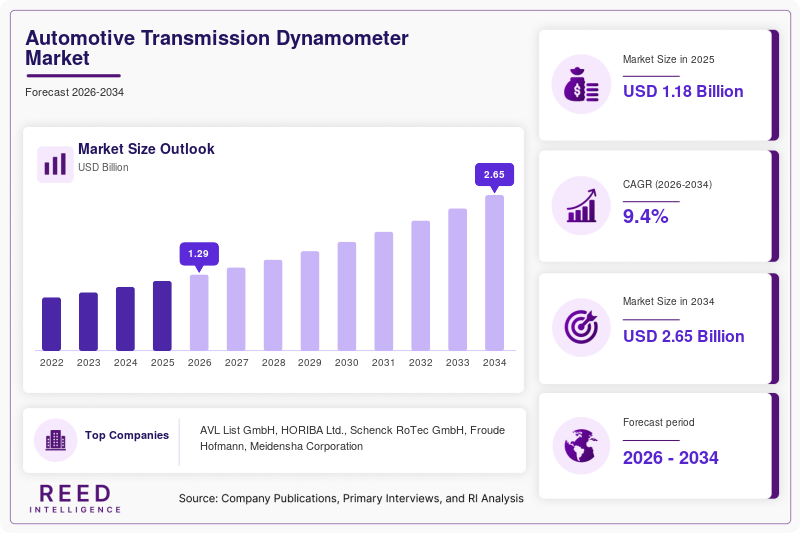
The global Automotive Transmission Dynamometer Market size was valued at approximately USD 1.18 billion in 2026 and is projected to reach around USD 2.41 billion by 2034, expanding at a CAGR of 9.4% during the forecast period (2026–2034). The market size is supported by growing investments in automotive testing infrastructure and the rising complexity of transmission systems across passenger and commercial vehicles. Transmission dynamometers are increasingly used to measure torque, efficiency, and durability under real-world conditions, which is essential for meeting evolving performance and regulatory standards.
A key global factor supporting market growth is the rapid shift toward electrification and hybridization of vehicles. As automakers integrate advanced transmission systems, including dual-clutch, continuously variable transmissions (CVT), and electric drive units, the need for precise and reliable testing equipment has intensified. This has driven demand for high-performance dynamometers capable of simulating varied operating conditions, thereby enhancing product development cycles and reducing time-to-market.
Key Highlights
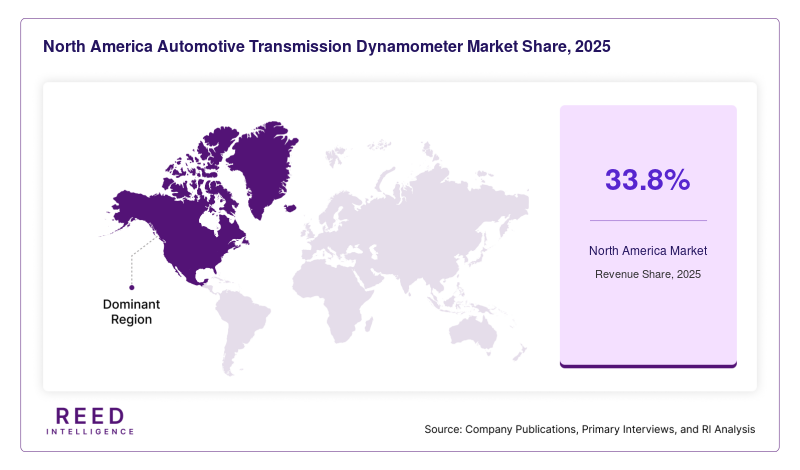
- North America dominated the market with a 33.8% share in 2025.
- Asia Pacific is expected to grow at the fastest CAGR of 10.8% during 2026–2034.
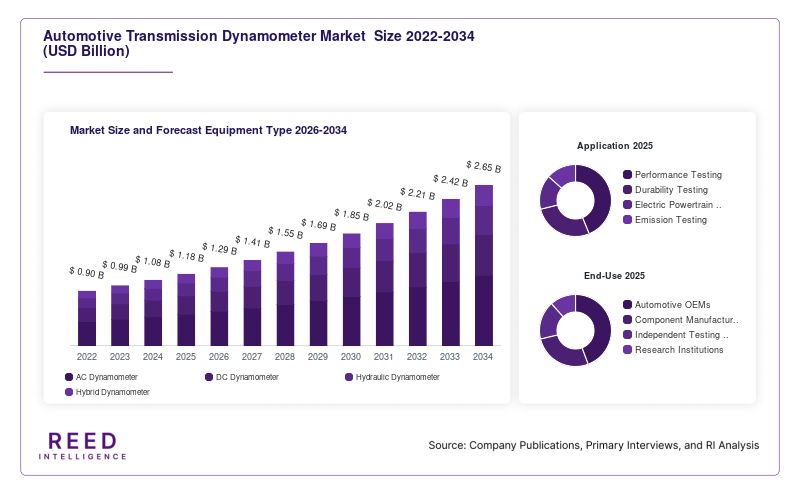
- By equipment type, AC dynamometers accounted for the largest share of 41.2%, while hybrid dynamometer systems are projected to grow at a CAGR of 11.6%.
- By application, performance testing led with a 39.5% share, whereas electric powertrain validation is expected to expand at a CAGR of 12.1%.
- The United States remained the dominant country, with market values of USD 420 million in 2024 and USD 455 million in 2025.
Market Trends
Increasing adoption of electrified powertrain testing systems
The Automotive Transmission Dynamometer Market is witnessing a notable shift toward electrified powertrain testing systems. As electric vehicles (EVs) and hybrid electric vehicles (HEVs) gain traction, traditional dynamometer systems are being upgraded or replaced with advanced setups capable of testing electric drivetrains. These systems are designed to simulate torque delivery, regenerative braking, and variable load conditions associated with electric motors. Manufacturers are increasingly integrating software-driven control systems that provide real-time analytics and predictive insights, improving testing accuracy and operational efficiency.
This trend is also supported by regulatory frameworks promoting zero-emission vehicles, which require extensive validation of electric transmission components. Testing facilities are investing in modular dynamometer solutions that can handle both internal combustion engine (ICE) and electric powertrain configurations. The convergence of mechanical and electrical testing capabilities is creating new opportunities for innovation, making electrified testing systems a central trend shaping the market’s growth trajectory.
Integration of digital twin and simulation technologies
Another prominent trend in the Automotive Transmission Dynamometer Market is the integration of digital twin and advanced simulation technologies. Automotive manufacturers are leveraging virtual testing environments alongside physical dynamometers to reduce development costs and accelerate product validation. Digital twin models replicate real-world transmission behavior, allowing engineers to conduct extensive simulations before actual testing.
This integration enables predictive maintenance and enhanced performance optimization by identifying potential issues early in the development cycle. The use of cloud-based platforms and artificial intelligence further enhances data analysis capabilities, enabling more informed decision-making. As automotive systems become more complex, the reliance on simulation-driven testing is increasing, driving demand for dynamometers that can seamlessly integrate with digital tools. This trend is expected to significantly influence market dynamics over the forecast period.
Market Drivers
Rising demand for advanced transmission systems
The increasing complexity of automotive transmission systems is a major driver for the Automotive Transmission Dynamometer Market. Modern vehicles are equipped with sophisticated transmission technologies such as dual-clutch systems, automated manual transmissions, and CVTs, which require precise testing for performance validation. Automakers are focusing on enhancing fuel efficiency and driving performance, which necessitates rigorous testing under diverse operating conditions.
Transmission dynamometers play a critical role in evaluating torque output, efficiency, and durability, enabling manufacturers to meet stringent performance standards. The growing demand for high-performance vehicles and the need to comply with regulatory norms related to emissions and fuel economy further amplify the importance of advanced testing equipment. This driver is particularly significant in developed markets where technological innovation is a key competitive factor.
Expansion of automotive R&D and testing facilities
The expansion of automotive research and development (R&D) infrastructure globally is another key driver of market growth. Automotive manufacturers and suppliers are investing heavily in testing facilities to support innovation and product development. This includes the establishment of dedicated transmission testing laboratories equipped with advanced dynamometer systems.
The trend is especially prominent in emerging economies, where governments are encouraging domestic manufacturing and technological advancement. Increased collaboration between automotive companies and research institutions is also contributing to the demand for high-precision testing equipment. As the automotive industry continues to evolve, the need for comprehensive testing solutions is expected to drive sustained growth in the Automotive Transmission Dynamometer Market.
Market Restraint
High initial investment and maintenance costs
One of the primary challenges facing the Automotive Transmission Dynamometer Market is the high initial investment required for installing advanced dynamometer systems. These systems involve sophisticated hardware and software components, including sensors, control units, and data acquisition systems, which significantly increase capital expenditure. Small and medium-sized enterprises often find it difficult to allocate resources for such investments, limiting market penetration.
In addition to installation costs, ongoing maintenance and calibration requirements add to operational expenses. Regular updates and system upgrades are necessary to keep pace with evolving automotive technologies, further increasing costs. This restraint impacts the adoption of dynamometer systems, particularly in price-sensitive markets. For example, smaller automotive component manufacturers may rely on third-party testing services instead of investing in in-house facilities, which slows overall market growth.
Market Opportunities
Growth in electric vehicle testing infrastructure
The rapid expansion of electric vehicle testing infrastructure presents a significant opportunity for the Automotive Transmission Dynamometer Market. Governments and private organizations are investing in EV testing facilities to support the transition toward sustainable mobility. This includes the development of specialized dynamometers capable of testing electric drivetrains and battery systems.
As EV adoption increases, the demand for accurate and reliable testing solutions is expected to rise. Transmission dynamometers designed for electric applications offer enhanced capabilities, such as high-speed operation and precise torque measurement. This creates opportunities for manufacturers to develop innovative products tailored to the needs of the EV segment, driving market growth.
Increasing outsourcing of testing services
Another emerging opportunity is the growing trend of outsourcing automotive testing services. Many manufacturers are opting to collaborate with third-party testing providers to reduce costs and improve efficiency. This trend is driving demand for advanced dynamometer systems in independent testing facilities.
Outsourcing allows companies to access specialized expertise and state-of-the-art equipment without significant capital investment. Testing service providers are expanding their capabilities to include advanced transmission testing, creating new revenue streams. This opportunity is particularly relevant in regions with a strong automotive manufacturing base, where demand for testing services is high.
Segmental Analysis
By Equipment Type
The AC dynamometer segment dominated the Automotive Transmission Dynamometer Market, accounting for approximately 41.2% of the market share in 2024. These systems are widely used due to their high efficiency, precise control, and ability to simulate various load conditions. AC dynamometers are preferred in automotive testing facilities for their reliability and compatibility with modern transmission systems. Their ability to handle high-speed operations and provide accurate torque measurements makes them suitable for both passenger and commercial vehicle applications.
The dominance of this segment is also attributed to advancements in power electronics and control systems, which have enhanced the performance of AC dynamometers. Manufacturers are continuously improving these systems to meet the evolving requirements of the automotive industry. The integration of digital monitoring and data analytics capabilities further strengthens their position in the market.
Hybrid dynamometer systems are expected to be the fastest-growing subsegment, with a CAGR of 11.6% during the forecast period. These systems combine the capabilities of different dynamometer technologies to provide versatile testing solutions. The growing demand for testing both ICE and electric powertrains is driving the adoption of hybrid systems.
A key growth factor for this subsegment is the increasing complexity of automotive systems, which requires flexible testing solutions. Hybrid dynamometers offer the ability to simulate diverse operating conditions, making them ideal for modern automotive applications. This flexibility is expected to drive significant growth in this segment.
By Application
Performance testing emerged as the dominant application segment, accounting for 39.5% of the market share in 2024. This segment involves evaluating the efficiency, durability, and reliability of transmission systems under various conditions. Performance testing is critical for ensuring that vehicles meet regulatory standards and customer expectations.
The dominance of this segment is driven by the increasing demand for high-performance vehicles and the need for continuous improvement in transmission technologies. Automotive manufacturers are investing heavily in performance testing to enhance product quality and competitiveness. The use of advanced dynamometer systems enables precise measurement and analysis, supporting innovation in transmission design.
Electric powertrain validation is expected to be the fastest-growing application segment, with a CAGR of 12.1%. The rapid adoption of electric vehicles is driving the need for specialized testing solutions. This segment focuses on validating the performance of electric drivetrains, including motors and battery systems.
A key growth factor is the increasing investment in EV development and infrastructure. As automakers transition to electric mobility, the demand for accurate and reliable testing solutions is expected to rise. This will drive growth in the electric powertrain validation segment.
By End-Use
Automotive OEMs dominated the end-use segment, accounting for a significant share of 52.7% in 2024. OEMs rely on transmission dynamometers for in-house testing and validation of new vehicle models. These systems enable manufacturers to ensure compliance with regulatory standards and optimize performance.
The dominance of this segment is driven by the increasing focus on innovation and product development. OEMs are investing in advanced testing facilities to support the development of new transmission technologies. The integration of digital tools and automation further enhances the efficiency of testing processes.
Independent testing laboratories are expected to be the fastest-growing subsegment, with a CAGR of 10.9%. The growing trend of outsourcing testing services is driving demand in this segment. Independent labs provide specialized testing services to automotive manufacturers and suppliers.
A key growth factor is the cost advantage offered by outsourcing. Companies can access advanced testing capabilities without significant capital investment. This trend is expected to drive growth in independent testing laboratories.
Regional Analysis
North America
North America accounted for a significant share of the Automotive Transmission Dynamometer Market, holding approximately 33.8% in 2025. The region is expected to maintain steady growth with a CAGR of 8.9% during the forecast period. This growth is driven by the presence of established automotive manufacturers and advanced testing infrastructure. The United States and Canada are key contributors, with strong investments in R&D and innovation.
The United States dominates the regional market due to its robust automotive industry and focus on technological advancement. A unique growth factor in this region is the increasing adoption of autonomous vehicle testing, which requires advanced transmission validation systems. This has led to higher demand for sophisticated dynamometers capable of simulating complex driving conditions.
Europe
Europe held a substantial market share of 27.5% in 2025 and is projected to grow at a CAGR of 9.1%. The region’s growth is supported by stringent emission regulations and a strong focus on sustainability. Countries such as Germany, France, and the UK are leading contributors, with well-established automotive industries.
Germany remains the dominant country in Europe, driven by its leadership in automotive engineering. A unique growth factor is the region’s emphasis on reducing carbon emissions, which has accelerated the adoption of electric and hybrid vehicles. This, in turn, has increased demand for advanced transmission testing solutions.
Asia Pacific
Asia Pacific is the fastest-growing region in the Automotive Transmission Dynamometer Market, with a CAGR of 10.8% during the forecast period. The region accounted for 24.3% of the market share in 2025. Rapid industrialization and the expansion of automotive manufacturing hubs are key growth drivers.
China leads the regional market, supported by large-scale vehicle production and government initiatives promoting EV adoption. A unique growth factor is the increasing localization of automotive component manufacturing, which has driven demand for in-house testing facilities and dynamometer systems.
Middle East & Africa
The Middle East & Africa region held a smaller market share of 7.2% in 2025 but is expected to grow at a CAGR of 8.3%. The market is gradually expanding due to investments in automotive infrastructure and industrial development.
The United Arab Emirates is a key contributor, with growing interest in automotive innovation. A unique growth factor is the development of automotive testing centers to support regional manufacturing and export activities, which is boosting demand for dynamometer systems.
Latin America
Latin America accounted for 7.2% of the market share in 2025 and is projected to grow at a CAGR of 8.6%. The region’s growth is supported by increasing automotive production and economic development.
Brazil dominates the regional market due to its large automotive industry. A unique growth factor is the rising demand for fuel-efficient vehicles, which has increased the need for transmission testing and validation, driving market growth.
Competitive Landscape
The Automotive Transmission Dynamometer Market is moderately consolidated, with several key players focusing on innovation and strategic partnerships. Leading companies are investing in research and development to enhance product capabilities and expand their market presence. The competitive landscape is characterized by technological advancements and the introduction of integrated testing solutions.
AVL List GmbH is a leading player in the market, known for its advanced dynamometer systems and comprehensive testing solutions. The company recently introduced a new modular dynamometer platform designed for electric powertrain testing, enhancing its product portfolio. Other major players are focusing on expanding their global footprint and strengthening their distribution networks to gain a competitive edge.
Collaborations and partnerships with automotive manufacturers and research institutions are common strategies adopted by market participants. These initiatives enable companies to develop customized solutions and address specific customer requirements. The competitive environment is expected to intensify as new entrants introduce innovative technologies.
Key Players
- AVL List GmbH
- HORIBA Ltd.
- Schenck RoTec GmbH
- Froude Hofmann
- Meidensha Corporation
- Magtrol Inc.
- SAJ Test Plant Pvt. Ltd.
- Taylor Dynamometer Inc.
- Mustang Dynamometer
- Power Test Inc.
- Dynomerk Controls
- KAHN Industries
- SuperFlow Dynamometers
- Rototest International AB
- MTS Systems Corporation
Recent Developments
- AVL List GmbH launched a modular dynamometer platform for electric vehicle testing in 2025, enhancing flexibility and efficiency.
- HORIBA Ltd. expanded its testing facility in Asia Pacific to support growing demand for advanced automotive testing solutions.
- Schenck RoTec GmbH introduced a new high-speed dynamometer system designed for next-generation transmission testing applications.
Automotive Transmission Dynamometer Market Segments
Equipment Type
- AC Dynamometer
- DC Dynamometer
- Hydraulic Dynamometer
- Hybrid Dynamometer
Application
- Performance Testing
- Durability Testing
- Electric Powertrain Validation
- Emission Testing
End-Use
- Automotive OEMs
- Component Manufacturers
- Independent Testing Laboratories
- Research Institutions
By Region
- North America
- Europe
- APAC
- Middle East and Africa
- LATAM