Automotive Weigh In Motion Market Size, Share Demand Report By Component (Hardware Systems, Software and Analytics Solutions, Services), By Application (Highway Tolling and Enforcement, Logistics and Fleet Management, Traffic Monitoring, Others), By Technology Type (Bending Plate, Piezoelectric, Load Cell, Others), By Region & Segment Forecasts, 2026–2034
USD 3950
Market Overview
The Automotive Weigh In Motion Market size was valued at approximately USD 1.48 billion in 2026 and is projected to reach USD 2.67 billion by 2034, expanding at a compound annual growth rate (CAGR) of 7.7% during the forecast period. The market reflects steady adoption across transportation infrastructure, logistics optimization, and regulatory compliance applications. Weigh-in-motion (WIM) systems allow real-time vehicle weight measurement without requiring vehicles to stop, which improves traffic flow and reduces operational delays. The rising need for efficient freight monitoring and road safety enforcement continues to support market expansion globally.
One key global factor driving the market is the increasing focus on infrastructure modernization and intelligent transportation systems (ITS). Governments across developed and emerging economies are investing in smart highways and digital tolling networks to enhance traffic management and reduce congestion. Automotive WIM systems are becoming a core component of these initiatives, enabling authorities to monitor axle loads, prevent road damage, and ensure compliance with transportation regulations. Additionally, the integration of advanced sensors, cloud-based analytics, and automated enforcement systems has enhanced the accuracy and scalability of WIM technologies, further boosting adoption across public and private sectors.
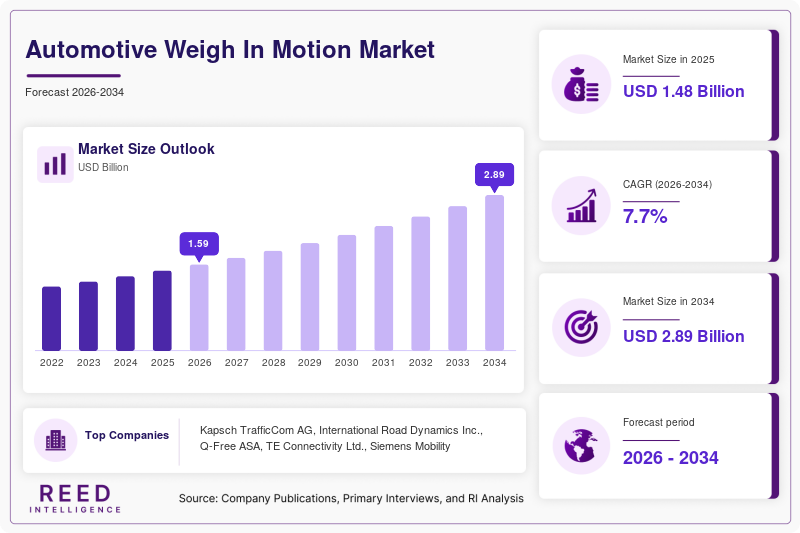
Key Highlights
- North America dominated the market with a 35.1% share in 2025.
- Asia Pacific is expected to grow at the fastest CAGR of 9.3% during 2026–2034.
- By component, hardware systems accounted for the largest share of 46.8%.
- while software and analytics solutions are projected to grow at a CAGR of 10.1%.
- By application, highway tolling and enforcement led with a 43.6% share, whereas logistics and fleet management is expected to expand at a CAGR of 9.8%.
- The United States remained the dominant country, with market values of USD 480 million in 2024 and USD 525 million in 2025.
Market Trends
The increasing integration of artificial intelligence and data analytics in WIM systems is shaping the evolution of the market. Modern solutions are no longer limited to weight measurement; they now offer predictive insights into traffic patterns, vehicle overloading trends, and infrastructure stress levels. Advanced analytics platforms process data collected from sensors in real time, enabling authorities to make informed decisions regarding road maintenance and traffic planning. This shift toward data-driven transportation systems has enhanced operational efficiency and reduced manual intervention. As cities adopt smart mobility frameworks, the demand for intelligent WIM systems with cloud connectivity and automated reporting capabilities continues to grow steadily.
Another significant trend is the deployment of high-speed WIM systems across highways and urban corridors. Traditional static weighing systems often create bottlenecks and inefficiencies, while high-speed WIM solutions allow vehicles to be weighed at normal driving speeds without disruption. This advancement has encouraged adoption in regions with heavy freight traffic and growing e-commerce logistics networks. Furthermore, technological improvements in piezoelectric sensors, bending plates, and load cell systems have increased measurement accuracy, making high-speed WIM suitable for legal enforcement. As governments emphasize seamless transportation infrastructure, the demand for non-intrusive and high-performance WIM systems is expected to expand further.
Market Drivers
The growing demand for efficient freight transportation and logistics management is a major factor driving the Automotive Weigh In Motion Market. With global trade volumes increasing and supply chains becoming more complex, there is a need for real-time monitoring of vehicle loads to optimize operations and reduce inefficiencies. WIM systems help logistics companies ensure compliance with weight regulations, avoid penalties, and improve vehicle utilization. Additionally, these systems enable route optimization and fuel efficiency by preventing overloading and underloading. The expansion of e-commerce and last-mile delivery networks has further intensified the need for automated weighing solutions, making WIM technology an integral component of modern logistics infrastructure.
Another important driver is the rising emphasis on road safety and infrastructure preservation. Overloaded vehicles contribute significantly to road damage, increased maintenance costs, and safety hazards. Governments worldwide are implementing strict regulations to control axle loads and prevent excessive wear on highways and bridges. WIM systems provide a reliable and efficient way to enforce these regulations without disrupting traffic flow. The ability to identify non-compliant vehicles in real time enhances enforcement capabilities and reduces manual inspections. As infrastructure investments increase globally, the adoption of WIM systems is expected to rise in parallel, driven by the need to maintain road quality and ensure public safety.
Market Restraint
The high initial installation and maintenance costs associated with WIM systems pose a notable challenge to market growth. Implementing these systems requires significant investment in hardware components such as sensors, controllers, and communication infrastructure, along with software integration and calibration processes. Additionally, maintaining system accuracy over time requires periodic calibration and technical expertise, which can increase operational costs. These factors can limit adoption, particularly in developing regions with constrained budgets for transportation infrastructure.
The impact of this restraint is more pronounced in smaller municipalities and emerging economies, where cost sensitivity remains high. For example, local authorities may prioritize basic road development over advanced monitoring systems, delaying WIM deployment. Furthermore, variations in road conditions, climate, and traffic patterns can affect system performance, necessitating additional customization and maintenance. Despite these challenges, technological advancements and economies of scale are gradually reducing costs, but the financial barrier remains a consideration for widespread adoption in certain regions.
Market Opportunities
The expansion of smart city initiatives presents a significant opportunity for the Automotive Weigh In Motion Market. Governments and urban planners are increasingly focusing on integrating digital technologies into transportation infrastructure to improve efficiency and sustainability. WIM systems play a crucial role in this ecosystem by providing real-time data on vehicle loads, traffic flow, and infrastructure usage. This data can be integrated with other smart city systems such as traffic management platforms and tolling networks, enabling seamless operations. As urban populations continue to grow, the demand for intelligent transportation solutions is expected to create new growth avenues for WIM providers.
Another promising opportunity lies in the adoption of WIM systems in emerging economies. Rapid industrialization, urbanization, and infrastructure development in regions such as Asia Pacific, Latin America, and parts of Africa are driving the need for efficient transportation management solutions. Governments in these regions are investing in highway networks and logistics corridors to support economic growth. The deployment of WIM systems in these projects can enhance operational efficiency and ensure regulatory compliance. Additionally, the increasing availability of cost-effective solutions and public-private partnerships is making WIM technology more accessible, further expanding its market potential.
Segmental Analysis
By Component
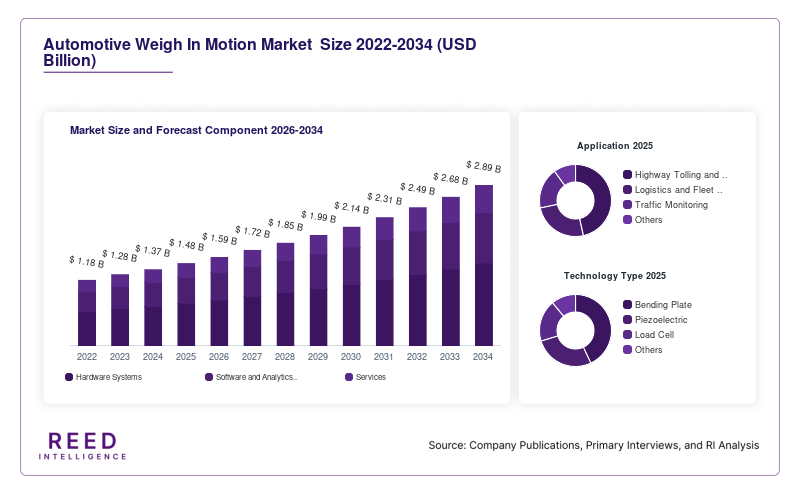
Hardware systems represented the dominant subsegment in 2024, accounting for approximately 46.8% of the market share. This segment includes sensors, load cells, and data acquisition systems that form the core of WIM solutions. The widespread deployment of hardware components across highways and tolling stations has contributed to their significant market presence. Additionally, advancements in sensor technologies have improved measurement accuracy and durability, making hardware systems a critical component of WIM infrastructure. The increasing adoption of high-speed WIM systems has further driven demand for robust hardware solutions capable of operating under varying traffic conditions.
Software and analytics solutions are expected to be the fastest-growing subsegment, with a CAGR of 10.1% during the forecast period. The growth is driven by the rising need for data analysis, real-time monitoring, and integration with intelligent transportation systems. Software platforms enable authorities and logistics companies to derive actionable insights from WIM data, improving decision-making and operational efficiency. The increasing adoption of cloud-based solutions and artificial intelligence further enhances the capabilities of WIM systems, driving demand for advanced software applications.
By Application
Highway tolling and enforcement emerged as the dominant subsegment in 2024, holding a market share of 43.6%. The widespread use of WIM systems in tolling operations and regulatory enforcement has driven this segment’s growth. These systems enable seamless toll collection and identification of overloaded vehicles without disrupting traffic flow. Governments and transportation authorities are increasingly adopting WIM technology to improve compliance and reduce road damage. The integration of WIM systems with electronic toll collection networks has further enhanced operational efficiency and user experience.
Logistics and fleet management is projected to be the fastest-growing subsegment, with a CAGR of 9.8% over the forecast period. The growth is driven by the increasing need for efficient supply chain management and real-time monitoring of vehicle loads. WIM systems help logistics companies optimize operations, reduce fuel consumption, and ensure compliance with weight regulations. The expansion of e-commerce and global trade has further increased the demand for advanced logistics solutions, supporting the growth of this segment.
By Technology Type
Bending plate technology dominated the market in 2024, accounting for a significant share due to its reliability and cost-effectiveness. This technology is widely used in highway applications where durability and accuracy are critical. Bending plate systems provide consistent performance under varying traffic conditions, making them a preferred choice for large-scale deployments. The ease of installation and maintenance further contributes to their widespread adoption across different regions.
Piezoelectric technology is expected to be the fastest-growing subsegment, with a CAGR of 9.5% during the forecast period. The growth is attributed to its ability to provide high-speed and accurate measurements in dynamic conditions. Piezoelectric sensors are increasingly being used in modern WIM systems due to their compact design and efficiency. The rising demand for high-speed weighing solutions and advancements in sensor technology are driving the adoption of this segment.
Regional Analysis
North America
North America accounted for approximately 35.1% of the Automotive Weigh In Motion Market share in 2025 and is projected to maintain steady growth at a CAGR of 6.8% during the forecast period. The region benefits from advanced transportation infrastructure, strong regulatory frameworks, and widespread adoption of intelligent transportation systems. Government initiatives aimed at improving highway safety and reducing infrastructure damage have driven the deployment of WIM systems across major freight corridors. The presence of established market players and continuous technological advancements further support regional growth.
The United States remains the dominant country in this region, driven by extensive highway networks and high freight transportation volumes. A key growth factor is the implementation of automated enforcement programs that utilize WIM systems to identify overweight vehicles without manual inspections. This approach enhances efficiency and reduces operational costs for regulatory authorities, contributing to sustained market expansion.
Europe
Europe held a market share of around 27.4% in 2025 and is expected to grow at a CAGR of 6.5% through 2034. The region’s focus on sustainability and infrastructure preservation has encouraged the adoption of WIM systems to monitor and control vehicle loads. Stringent regulations regarding axle weights and emissions have further accelerated the deployment of these systems across highways and urban areas. Additionally, the integration of WIM technology with electronic toll collection systems has improved operational efficiency.
Germany leads the European market, supported by its strong automotive and logistics industries. A unique growth factor in the country is the emphasis on maintaining high-quality road infrastructure, which requires effective monitoring of heavy vehicle traffic. The adoption of advanced WIM solutions enables authorities to ensure compliance and extend the lifespan of transportation assets.
Asia Pacific
Asia Pacific is expected to be the fastest-growing region, with a CAGR of 9.3% during the forecast period, while accounting for 22.8% of the market share in 2025. Rapid urbanization, increasing freight transportation, and large-scale infrastructure projects are driving demand for WIM systems. Governments in the region are investing heavily in smart transportation networks to address congestion and improve efficiency. The growing logistics and e-commerce sectors further contribute to market expansion.
China dominates the regional market due to its extensive highway network and high freight volumes. A key growth factor is the government’s focus on reducing road damage caused by overloaded vehicles. The implementation of nationwide enforcement programs using WIM technology has significantly improved compliance and created opportunities for market players.
Middle East & Africa
The Middle East & Africa region accounted for approximately 7.2% of the market share in 2025 and is projected to grow at a CAGR of 7.1% over the forecast period. The region is witnessing increased investments in transportation infrastructure, particularly in Gulf Cooperation Council (GCC) countries. The adoption of WIM systems is driven by the need to support economic diversification and improve logistics efficiency.
Saudi Arabia leads the market in this region, supported by large-scale infrastructure projects and logistics development initiatives. A unique growth factor is the integration of WIM systems into smart highway projects, which aim to enhance traffic management and ensure compliance with weight regulations. This trend is expected to drive further adoption in the coming years.
Latin America
Latin America held a market share of around 7.5% in 2025 and is anticipated to grow at a CAGR of 7.4% during the forecast period. The region’s growth is driven by increasing investments in road infrastructure and the need to improve freight transportation efficiency. Governments are focusing on modernizing transportation networks to support economic development, creating opportunities for WIM system deployment.
Brazil is the dominant country in the region, driven by its extensive road network and growing logistics sector. A key growth factor is the implementation of regulatory measures to control vehicle overloading, which has led to increased adoption of WIM systems. These initiatives are expected to support market growth across the region.

Competitive Landscape
The Automotive Weigh In Motion Market is characterized by moderate competition, with several global and regional players focusing on technological innovation and strategic partnerships. Companies are investing in research and development to enhance system accuracy, durability, and integration capabilities. The market also witnesses collaborations between technology providers and government agencies to deploy advanced WIM solutions across transportation networks.
Kapsch TrafficCom AG is recognized as a leading player in the market, leveraging its expertise in intelligent transportation systems and tolling solutions. The company has recently expanded its portfolio by integrating advanced analytics and cloud-based platforms into its WIM offerings, enhancing real-time monitoring and data management capabilities. Other key players are also focusing on expanding their geographic presence and developing cost-effective solutions to cater to emerging markets. The competitive landscape is expected to evolve further as new entrants introduce innovative technologies and existing players strengthen their market positions.
Key Players List
- Kapsch TrafficCom AG
- International Road Dynamics Inc.
- Q-Free ASA
- TE Connectivity Ltd.
- Siemens Mobility
- SWARCO AG
- EFKON GmbH
- TransCore
- Intercomp Company
- Weighing Systems International
- Axis Communications
- Traffic Data Systems
- Clearview Intelligence
- FLIR Systems
- CAMEA Technology
Recent Developments
- Several companies have introduced advanced WIM solutions integrating artificial intelligence and cloud analytics to enhance data processing capabilities and improve system accuracy.
- A leading market player has partnered with a government transportation authority to deploy high-speed WIM systems across major highways, improving traffic flow and regulatory enforcement.
- Another development includes the launch of compact and cost-effective WIM systems designed for emerging markets, enabling wider adoption in regions with budget constraints.
Automotive Weigh In Motion Market Segments
Component
- Hardware Systems
- Software and Analytics Solutions
- Services
Application
- Highway Tolling and Enforcement
- Logistics and Fleet Management
- Traffic Monitoring
- Others
Technology Type
- Bending Plate
- Piezoelectric
- Load Cell
- Others
By Region
- North America
- Europe
- APAC
- Middle East and Africa
- LATAM