Autonomous Underwater Gliders Market Size, Share & Demand Report By Component (Sensors, Navigation Systems, Communication Systems, Software), By Application (Oceanographic Research, Defense Surveillance, Environmental Monitoring, Offshore Energy), By End-Use (Research Institutions, Defense, Commercial Enterprises) By Region & Segment Forecasts, 2026–2034
USD 3950
Market Overview
The Autonomous Underwater Gliders Market size was valued at approximately USD 680 million in 2026 and is projected to reach USD 1620 million by 2034, expanding at a compound annual growth rate (CAGR) of 11.5% during 2026–2034. This growth trajectory reflects the rising demand for long-duration ocean monitoring systems, particularly in defense, environmental research, and offshore energy exploration. Autonomous underwater gliders are increasingly preferred over traditional underwater vehicles due to their energy efficiency, extended deployment capabilities, and ability to collect high-resolution oceanographic data.
A major global factor supporting market growth is the increased focus on climate monitoring and oceanographic research. Governments and research institutions are investing in advanced ocean sensing technologies to better understand climate change, marine biodiversity, and underwater ecosystems. These gliders enable continuous data collection over long durations, making them highly valuable for scientific and commercial applications.
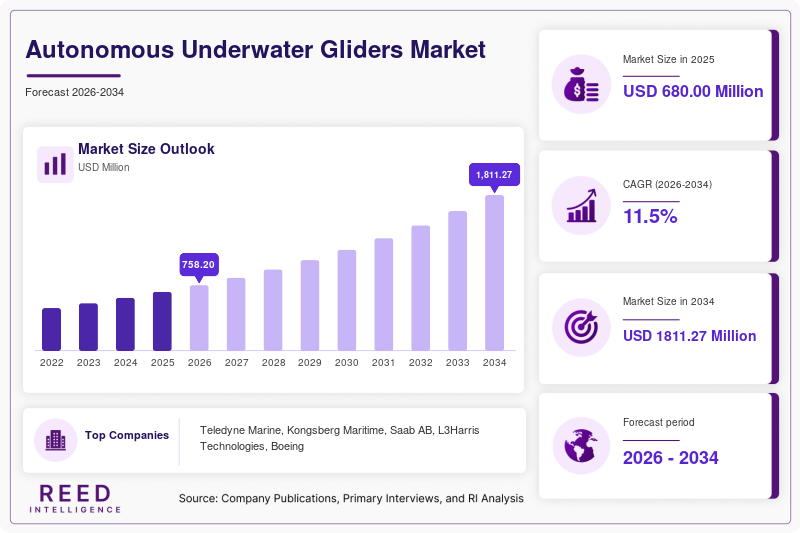
Key Highlights
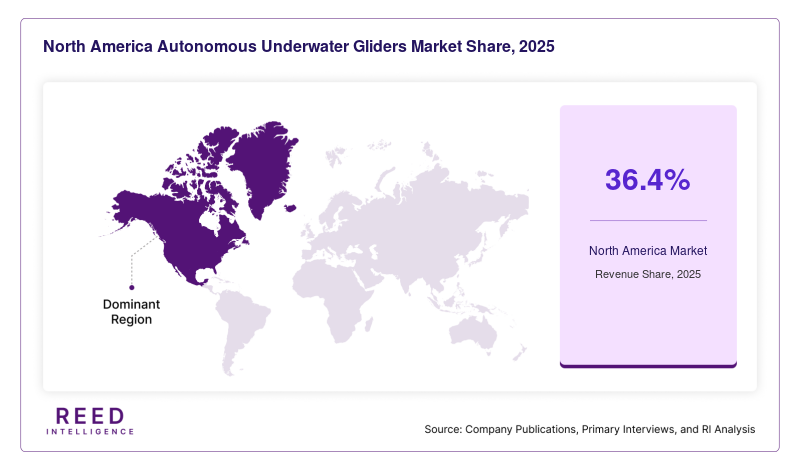
- North America dominated the market with a 36.4% share in 2025.
- Asia Pacific is expected to grow at the fastest CAGR of 12.1% during 2026–2034.
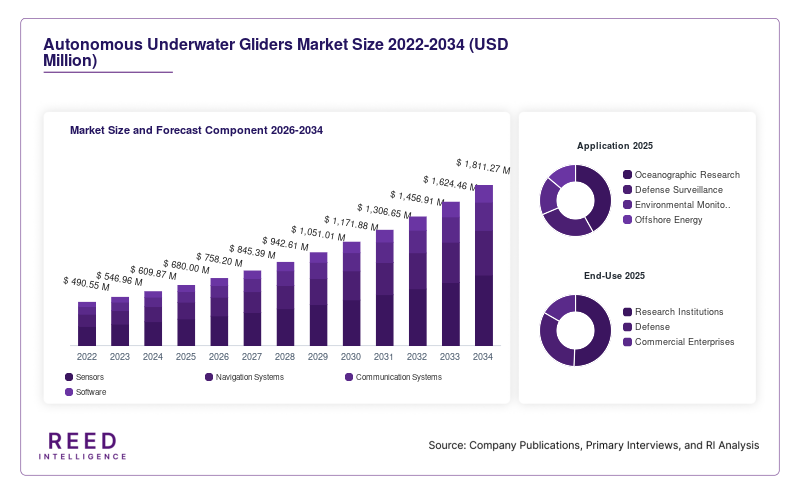
- By component, sensors accounted for the largest share of 39.2%.
- while software systems are projected to grow at a CAGR of 13.3%.
- By application, oceanographic research led with a 44.6% share, whereas defense surveillance is expected to expand at a CAGR of 12.7%.
- The United States remained the dominant country, with market values of USD 520 million in 2024 and USD 575 million in 2025.
Market Trends
Integration of AI and Advanced Data Analytics
The integration of artificial intelligence and advanced analytics into autonomous underwater gliders is shaping the future of the market. These technologies allow gliders to process data in real time, adapt their navigation routes, and improve mission efficiency without human intervention. AI-enabled gliders can identify anomalies in ocean conditions, detect underwater objects, and optimize data collection strategies. This reduces operational costs and enhances the reliability of collected data. Furthermore, the use of machine learning algorithms helps in predictive modeling of ocean currents and environmental changes, which is beneficial for both scientific research and defense operations. As digital transformation accelerates across industries, the adoption of intelligent underwater systems is expected to increase significantly.
Growing Adoption in Offshore Energy Exploration
The increasing demand for energy resources is driving the use of autonomous underwater gliders in offshore oil, gas, and renewable energy sectors. These gliders are used to map seabed structures, monitor underwater infrastructure, and assess environmental conditions before drilling or installation activities. Compared to traditional survey vessels, gliders offer cost-effective and continuous monitoring capabilities. The expansion of offshore wind farms and deep-sea exploration projects is further boosting demand. Companies are leveraging these gliders to ensure regulatory compliance and minimize environmental impact. As offshore energy investments rise globally, the deployment of autonomous underwater systems is expected to become a standard practice in exploration and monitoring operations.
Market Drivers
Rising Demand for Oceanographic Research and Climate Monitoring
The growing emphasis on understanding ocean ecosystems and climate change is a key driver of the autonomous underwater gliders market. Governments, research institutions, and environmental organizations are investing heavily in ocean monitoring programs. Autonomous gliders provide long-duration data collection capabilities, allowing researchers to gather detailed insights into ocean temperature, salinity, currents, and marine life patterns. This data is critical for predicting climate trends and assessing environmental risks. Additionally, international collaborations on marine research are increasing, further boosting demand for advanced underwater technologies. The ability of gliders to operate in remote and harsh environments makes them indispensable tools for scientific exploration.
Increasing Defense and Maritime Surveillance Applications
Defense agencies across the globe are adopting autonomous underwater gliders for surveillance, reconnaissance, and security operations. These systems offer stealth capabilities, long endurance, and the ability to operate without human presence, making them ideal for monitoring maritime boundaries and detecting underwater threats. Naval forces are integrating gliders into their surveillance networks to enhance situational awareness and reduce operational risks. The growing geopolitical tensions and the need for advanced defense technologies are accelerating investments in autonomous underwater systems. Furthermore, the integration of advanced sensors and communication technologies is improving the effectiveness of these gliders in defense applications.
Market Restraint
High Initial Costs and Technical Complexity
The high cost associated with the development and deployment of autonomous underwater gliders remains a significant restraint for market growth. These systems require advanced materials, precision engineering, and sophisticated software, which contribute to their high manufacturing costs. Additionally, the need for specialized training and technical expertise to operate and maintain these systems adds to the overall expenditure. Small research institutions and developing economies often face budget constraints, limiting their adoption of such technologies. The complexity of integrating multiple sensors, communication systems, and navigation tools also poses challenges. For instance, maintaining consistent performance in deep-sea conditions requires continuous technological upgrades and testing, which further increases operational costs. These factors collectively slow down market penetration, especially in cost-sensitive regions.
Market Opportunities
Expansion of Marine Data Services and Commercial Applications
The growing demand for marine data services presents a significant opportunity for the autonomous underwater gliders market. Industries such as fisheries, shipping, and environmental monitoring are increasingly relying on real-time ocean data to optimize operations and ensure sustainability. Autonomous gliders can provide continuous data streams, enabling businesses to make informed decisions. The commercialization of marine data is creating new revenue streams for technology providers and service companies. Additionally, the integration of cloud-based platforms allows for efficient data storage and analysis, further enhancing the value proposition of these systems. As industries recognize the importance of ocean data, the adoption of autonomous gliders is expected to rise.
Technological Advancements in Energy Efficiency and Communication
Advancements in energy-efficient propulsion systems and underwater communication technologies are creating new growth opportunities in the market. Modern gliders are being designed with improved battery life and energy-harvesting capabilities, allowing them to operate for extended periods without recharging. Innovations in acoustic and satellite communication are enabling real-time data transmission, which enhances the usability of these systems. These technological improvements are reducing operational limitations and expanding the range of applications. Furthermore, the development of modular designs allows for easy customization and integration of new components, making gliders more versatile. As technology continues to evolve, the market is expected to witness increased adoption across various sectors.
Segmental Analysis
By Component
Sensors emerged as the dominant subsegment in 2024, accounting for approximately 39.2% of the market share. These components play a critical role in data collection, enabling gliders to measure various ocean parameters such as temperature, salinity, pressure, and biological activity. The increasing demand for high-precision data in oceanographic research and defense applications is driving the adoption of advanced sensors. Technological advancements in miniaturization and accuracy are further enhancing their performance. Additionally, the integration of multiple sensors into a single platform allows for comprehensive data collection, making them indispensable in autonomous underwater systems.
Software systems are projected to be the fastest-growing subsegment, with a CAGR of 13.3% during the forecast period. The growth is driven by the increasing need for data processing, analytics, and real-time decision-making capabilities. Advanced software solutions enable efficient mission planning, navigation, and data interpretation. The integration of artificial intelligence and machine learning algorithms is further enhancing the functionality of these systems. As the volume of collected data increases, the demand for sophisticated software solutions is expected to rise significantly.
By Application
Oceanographic research held the largest share of 44.6% in 2024, driven by the growing need for environmental monitoring and climate studies. Autonomous underwater gliders are widely used in research programs to collect long-term data on ocean conditions. Their ability to operate in remote and harsh environments makes them ideal for scientific exploration. Governments and research institutions are increasingly investing in these technologies to support marine studies and environmental conservation efforts.
Defense surveillance is expected to be the fastest-growing application, with a CAGR of 12.7% during the forecast period. The increasing focus on maritime security and the need for advanced surveillance systems are driving this growth. Autonomous gliders offer stealth capabilities and long endurance, making them suitable for monitoring underwater activities. The integration of advanced sensors and communication technologies is enhancing their effectiveness in defense operations.
By End-Use
Research institutions dominated the market in 2024, accounting for a significant share due to their extensive use of autonomous underwater gliders for scientific studies. These institutions rely on gliders to collect high-quality data for research purposes, including climate change analysis and marine biodiversity studies. The increasing number of research programs and collaborations is driving the demand for these systems.
Commercial enterprises are expected to be the fastest-growing end-use segment, with a CAGR of 11.9% during the forecast period. The growth is driven by the increasing adoption of autonomous gliders in offshore energy, shipping, and environmental monitoring industries. These organizations are leveraging advanced technologies to improve operational efficiency and reduce costs. The commercialization of marine data services is further contributing to the growth of this segment.
Regional Analysis
North America
North America held the largest share of the autonomous underwater gliders market in 2025, accounting for approximately 36.4%, and is expected to grow at a CAGR of 10.8% during the forecast period. The region’s dominance is attributed to strong investments in defense, oceanographic research, and technological innovation. The presence of advanced research institutions and government funding programs supports the development and deployment of autonomous underwater systems. Additionally, the region benefits from a well-established infrastructure for marine research and offshore exploration.
The United States is the dominant country in this region, driven by extensive defense spending and a strong focus on maritime security. A unique growth factor is the integration of autonomous gliders into national ocean monitoring programs, which enhances data collection and environmental analysis capabilities.
Europe
Europe accounted for a significant share of the market in 2025 and is projected to grow at a CAGR of 10.5% through 2034. The region’s growth is supported by increasing investments in marine research and environmental monitoring initiatives. European countries are focusing on sustainable ocean management and are adopting advanced technologies to monitor marine ecosystems. The presence of collaborative research programs also contributes to market expansion.
Norway leads the market in Europe, driven by its strong offshore energy sector and focus on marine exploration. A unique growth factor is the country’s investment in offshore wind energy projects, which require continuous underwater monitoring and data collection.
Asia Pacific
Asia Pacific is expected to be the fastest-growing region, with a CAGR of 12.1% during the forecast period. The region accounted for a growing share in 2025 due to increasing investments in marine research, defense, and offshore energy exploration. Rapid industrialization and the need for sustainable resource management are driving the adoption of autonomous underwater gliders.
China dominates the regional market, supported by government initiatives to strengthen maritime capabilities. A unique growth factor is the expansion of deep-sea exploration programs, which require advanced underwater technologies for data collection and analysis.
Middle East & Africa
The Middle East & Africa region is witnessing steady growth, with a CAGR of 9.7% during the forecast period. The market is driven by the increasing demand for underwater monitoring in the oil and gas sector. Countries in this region are investing in technologies to improve offshore exploration and ensure environmental compliance.
Saudi Arabia is the leading country in this region, benefiting from its extensive offshore oil reserves. A unique growth factor is the adoption of autonomous gliders for monitoring underwater pipelines and infrastructure, ensuring operational efficiency and safety.
Latin America
Latin America is expected to grow at a CAGR of 9.9% during the forecast period, supported by increasing investments in marine research and offshore energy projects. The region accounted for a moderate share in 2025, with growing awareness of the importance of ocean monitoring technologies.
Brazil dominates the market in Latin America, driven by its offshore oil exploration activities. A unique growth factor is the use of autonomous gliders for environmental monitoring in sensitive marine ecosystems, supporting sustainable development initiatives.
Competitive Landscape
The autonomous underwater gliders market is characterized by the presence of several established players focusing on technological innovation and strategic partnerships. The competitive landscape is moderately consolidated, with companies investing in research and development to enhance product capabilities. Key players are focusing on expanding their product portfolios and improving operational efficiency.
Teledyne Marine is recognized as a leading player in the market, driven by its strong product portfolio and global presence. The company has recently introduced advanced glider systems with enhanced data collection capabilities and improved energy efficiency. Other companies are also focusing on collaborations with research institutions and government agencies to expand their market reach. The increasing demand for autonomous underwater systems is encouraging companies to invest in new technologies and explore emerging markets.
Key Players List
- Teledyne Marine
- Kongsberg Maritime
- Saab AB
- L3Harris Technologies
- Boeing
- General Dynamics
- Bluefin Robotics
- Liquid Robotics
- Ocean Infinity
- ECA Group
- Fugro
- ASV Global
- Deep Ocean Engineering
- Alseamar
- Exail Technologies
Recent Developments
- Teledyne Marine launched a next-generation autonomous glider with improved battery life and AI-based navigation capabilities in 2025.
- Kongsberg Maritime partnered with a European research institute to develop advanced underwater monitoring systems for climate studies in 2024.
- Saab AB introduced a modular glider platform designed for defense and surveillance applications, enhancing operational flexibility in 2025.
Autonomous Underwater Gliders Market Segments
Component
- Sensors
- Navigation Systems
- Communication Systems
- Software
Application
- Oceanographic Research
- Defense Surveillance
- Environmental Monitoring
- Offshore Energy
End-Use
- Research Institutions
- Defense
- Commercial Enterprises
By Region
- North America
- Europe
- APAC
- Middle East and Africa
- LATAM