Avalanche Radar Market Size, Share & Demand Report By System Type (Ground-Based Radar, Satellite-Integrated Radar), By Application (Transportation Infrastructure Monitoring, Ski Resort Safety Management), By End-Use (Government Agencies, Private Sector Enterprises, Research Institutions), By Technology (Doppler Radar, FMCW Radar, Synthetic Aperture Radar, AI-Integrated Radar Systems), By Region & Segment Forecasts, 2026–2034
USD 3950
Market Overview
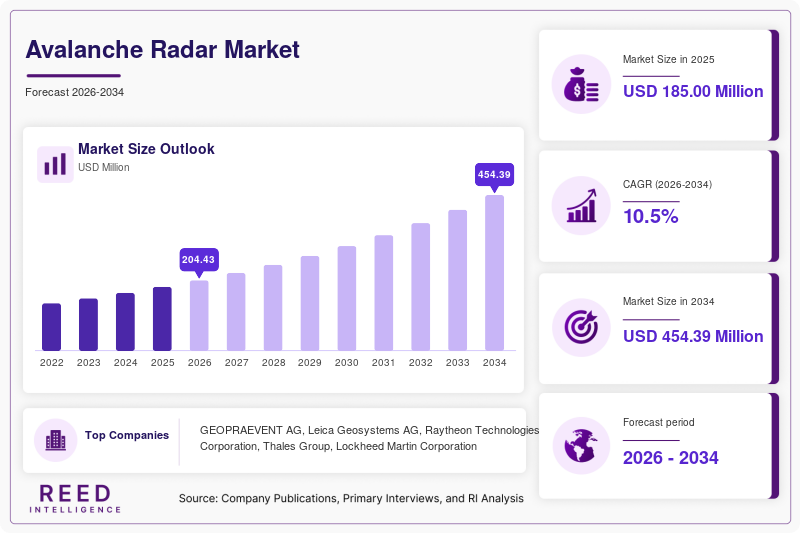
The Avalanche Radar Market size was valued at approximately USD 185 million in 2026 and is projected to reach around USD 410 million by 2034, expanding at a CAGR of 10.5% during the forecast period (2026–2034). The market growth is being driven by increasing investments in safety infrastructure across mountainous regions and the rising need for real-time avalanche monitoring systems to protect transportation corridors, ski resorts, and critical infrastructure.
One of the key global factors supporting market growth is the rising impact of climate variability, which has led to unpredictable snow accumulation and increased avalanche risks. Governments and private stakeholders are increasingly deploying advanced radar-based monitoring solutions to mitigate risks and ensure public safety. These systems offer continuous surveillance, accurate detection, and automated alerts, making them essential for avalanche-prone areas.
Key Highlights:
- North America dominated the market with a share of 38% in 2025, while Asia Pacific is projected to grow at the fastest CAGR of 12.8%.
- By system type, ground-based radar accounted for the largest share (62%), while satellite-integrated systems are expected to grow at a CAGR of 13.5%.
- By application, transportation infrastructure led with a 45% share, whereas ski resort monitoring is expected to grow at a CAGR of 11.9%.
- The United States remained the dominant country, with market values of USD 68 million in 2024 and USD 74 million in 2025.
Market Trends
Integration of AI and Predictive Analytics
A major trend shaping the Avalanche Radar Market is the integration of artificial intelligence and predictive analytics into radar systems. These technologies enable advanced data processing, allowing systems to predict avalanche occurrences based on snowpack conditions, weather patterns, and terrain data. AI-powered systems improve accuracy and reduce false alarms, enhancing operational efficiency for authorities. The ability to provide early warnings has made these systems increasingly valuable for critical infrastructure protection. As a result, manufacturers are focusing on developing intelligent radar systems with enhanced analytical capabilities.
Deployment of Remote and Autonomous Monitoring Systems
Another significant trend is the growing deployment of remote and autonomous avalanche monitoring systems. These systems operate in harsh and inaccessible terrains with minimal human intervention. Equipped with solar power, wireless connectivity, and automated alert mechanisms, they ensure continuous monitoring even in extreme weather conditions. This trend is particularly relevant in regions with limited accessibility, where manual monitoring is not feasible. The shift toward automation is reducing operational costs while improving safety outcomes, thereby driving adoption across both public and private sectors.
Market Drivers
Rising Demand for Infrastructure Safety in Mountainous Regions
The increasing development of infrastructure in mountainous areas is a primary driver of the Avalanche Radar Market. Roads, railways, tunnels, and energy installations in avalanche-prone zones require continuous monitoring to prevent disruptions and ensure safety. Governments are allocating higher budgets for protective technologies, including radar systems, to minimize economic losses caused by avalanches. The need for reliable and real-time monitoring solutions has made avalanche radar systems a critical component of infrastructure planning.
Growth in Winter Tourism and Recreational Activities
The expansion of winter tourism and recreational activities such as skiing and snowboarding is another key driver. Ski resorts are increasingly adopting avalanche radar systems to enhance safety for visitors and staff. These systems help in early detection and controlled avalanche triggering, reducing risks and improving visitor confidence. As global tourism continues to grow, particularly in alpine regions, the demand for advanced safety systems is expected to rise significantly.
Market Restraint
High Installation and Maintenance Costs
One of the major restraints in the Avalanche Radar Market is the high cost associated with installation and maintenance of radar systems. These systems require specialized equipment, skilled personnel, and significant infrastructure investments. Additionally, maintaining systems in extreme weather conditions can be challenging and costly. The need for regular calibration, software updates, and repairs further adds to operational expenses.
This cost factor can limit adoption, particularly in developing regions with budget constraints. Smaller ski resorts and local authorities may find it difficult to justify the investment, especially when alternative monitoring methods are available. Although technological advancements are gradually reducing costs, affordability remains a key challenge for widespread market penetration.
Market Opportunities
Expansion in Emerging Economies
Emerging economies present significant growth opportunities for the Avalanche Radar Market. Countries in Asia Pacific and Latin America are investing in infrastructure development in mountainous regions. As awareness of avalanche risks increases, governments are expected to adopt advanced monitoring solutions. The growing focus on disaster management and public safety is likely to drive demand for radar systems in these regions.
Integration with Smart Infrastructure Systems
The integration of avalanche radar systems with smart infrastructure platforms offers another promising opportunity. Smart cities and intelligent transportation systems are increasingly incorporating real-time monitoring technologies. Avalanche radar systems can be integrated with traffic management systems, weather stations, and emergency response networks to provide comprehensive safety solutions. This integration enhances decision-making and improves response times, creating new avenues for market growth.
Segmental Analysis
By System Type
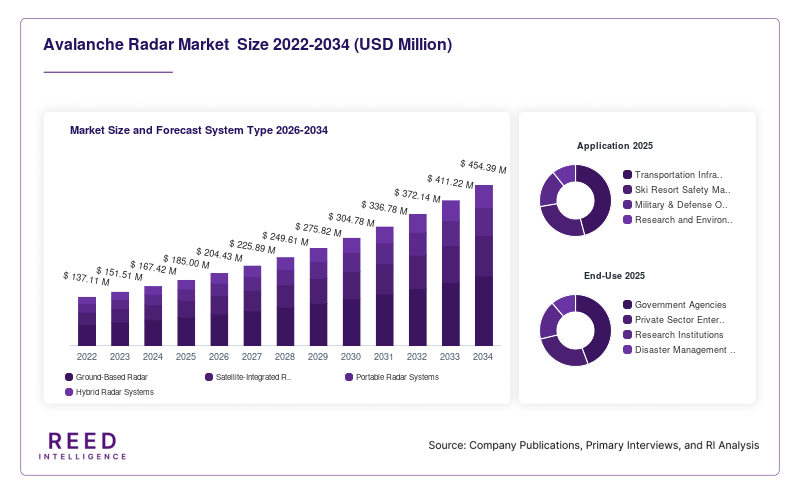
Ground-based radar systems dominated the Avalanche Radar Market in 2025, accounting for approximately 62% of the total share. These systems were widely adopted due to their reliability, continuous monitoring capabilities, and cost-effectiveness compared to satellite-based solutions.
Satellite-integrated radar systems are expected to grow at the fastest CAGR of 13.5% during the forecast period. Their ability to provide large-area coverage and real-time data will drive adoption, particularly in remote regions.
By Application
Transportation infrastructure was the leading application segment, holding a 45% share in 2025. The need to ensure safety on highways, railways, and tunnels in avalanche-prone areas drove demand.
Ski resort monitoring is anticipated to grow at a CAGR of 11.9%, driven by increasing tourism and the need for enhanced safety measures. Resorts will increasingly adopt radar systems to improve risk management.
By End-Use
Government agencies accounted for the largest share of 55% in 2025, driven by their responsibility for public safety and infrastructure protection.
Private sector adoption is expected to grow at a CAGR of 11.3%, supported by investments from ski resorts, mining companies, and energy firms seeking to mitigate risks.
By Technology
Doppler radar technology dominated the market with a 48% share in 2025 due to its accuracy in detecting moving snow masses.
Hybrid radar systems are projected to grow at a CAGR of 12.6%, offering enhanced capabilities through the integration of multiple technologies.
Regional Analysis
North America
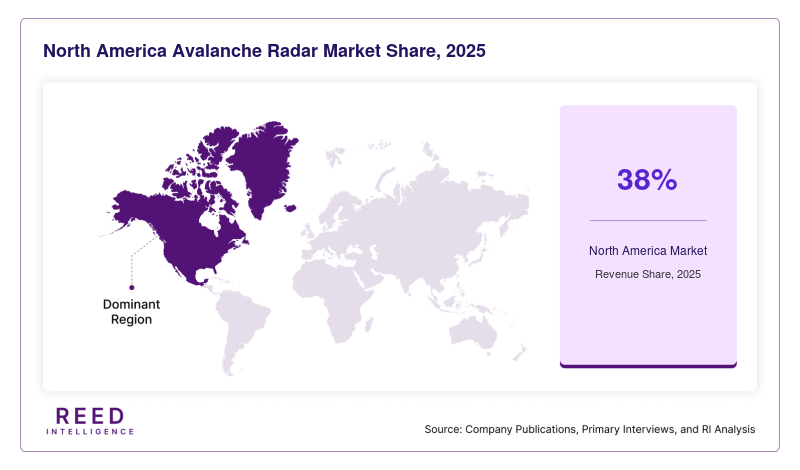
North America accounted for 38% of the Avalanche Radar Market share in 2025 and is expected to grow at a CAGR of 9.8% during the forecast period. The region’s dominance was attributed to well-established infrastructure and high adoption of advanced safety technologies.
The United States led the regional market due to extensive mountainous terrain and significant investments in transportation safety. The presence of advanced research institutions and strong government support for disaster mitigation contributed to market growth.
Europe
Europe held a 27% market share in 2025 and is projected to grow at a CAGR of 10.2% from 2026 to 2034. The region’s growth was driven by the presence of major alpine regions and a strong focus on tourism safety.
Switzerland emerged as the dominant country, supported by its advanced avalanche monitoring infrastructure and emphasis on technological innovation. The country’s proactive approach to risk management played a key role in market expansion.
Asia Pacific
Asia Pacific captured 18% of the market share in 2025 and is anticipated to register the fastest CAGR of 12.8% during the forecast period. Rapid infrastructure development and increasing awareness of avalanche risks contributed to growth.
China led the region due to large-scale infrastructure projects in mountainous areas and growing investments in disaster management systems. The country’s focus on modernization supported market expansion.
Middle East & Africa
The Middle East & Africa region accounted for 9% of the market share in 2025 and is expected to grow at a CAGR of 8.7%. Growth was primarily driven by infrastructure development in select mountainous areas.
Turkey dominated the regional market due to its geographical exposure to avalanche risks and increasing investments in safety technologies. Government initiatives played a crucial role in adoption.
Latin America
Latin America held an 8% market share in 2025 and is projected to grow at a CAGR of 9.1% during the forecast period. The region’s growth was supported by expanding infrastructure and tourism activities.
Chile emerged as the leading country, driven by its mountainous terrain and focus on mining and transportation safety. Investments in monitoring systems contributed to market growth.
Segmental Analysis
By System Type
Ground-based radar systems dominated the Avalanche Radar Market in 2025, accounting for approximately 62% of the total share. These systems were widely adopted due to their reliability, continuous monitoring capabilities, and cost-effectiveness compared to satellite-based solutions.
Satellite-integrated radar systems are expected to grow at the fastest CAGR of 13.5% during the forecast period. Their ability to provide large-area coverage and real-time data will drive adoption, particularly in remote regions.
By Application
Transportation infrastructure was the leading application segment, holding a 45% share in 2025. The need to ensure safety on highways, railways, and tunnels in avalanche-prone areas drove demand.
Ski resort monitoring is anticipated to grow at a CAGR of 11.9%, driven by increasing tourism and the need for enhanced safety measures. Resorts will increasingly adopt radar systems to improve risk management.
By End-Use
Government agencies accounted for the largest share of 55% in 2025, driven by their responsibility for public safety and infrastructure protection.
Private sector adoption is expected to grow at a CAGR of 11.3%, supported by investments from ski resorts, mining companies, and energy firms seeking to mitigate risks.
By Technology
Doppler radar technology dominated the market with a 48% share in 2025 due to its accuracy in detecting moving snow masses.
Hybrid radar systems are projected to grow at a CAGR of 12.6%, offering enhanced capabilities through the integration of multiple technologies.
Competitive Landscape
The Avalanche Radar Market is moderately consolidated, with key players focusing on technological innovation and strategic collaborations. Companies are investing in advanced radar systems with enhanced detection capabilities and integration features.
The market leader, GEOPRAEVENT AG, has strengthened its position through continuous product development and global expansion. The company recently introduced an upgraded radar system with improved AI-based analytics for real-time avalanche prediction.
Other major players are focusing on partnerships with government agencies and infrastructure developers to expand their market presence. Competitive strategies include product differentiation, regional expansion, and investment in research and development.
Key Players List
- GEOPRAEVENT AG
- Leica Geosystems AG
- Raytheon Technologies Corporation
- Thales Group
- Lockheed Martin Corporation
- Northrop Grumman Corporation
- IDS GeoRadar
- Campbell Scientific Inc.
- Vaisala Oyj
- OTT HydroMet
- Meteomatics AG
- Snowbound Solutions
- EWR Radar Systems
- Geosense Ltd.
- Alpine Radar Technologies
Recent Developments
- 2025: GEOPRAEVENT AG launched an advanced AI-enabled avalanche radar system.
- 2024: Leica Geosystems expanded its monitoring solutions portfolio with integrated radar systems.
- 2025: Vaisala Oyj introduced a new weather-integrated avalanche detection platform.
- 2024: IDS GeoRadar partnered with infrastructure agencies for large-scale deployments.
- 2025: Thales Group enhanced its radar systems for extreme weather monitoring applications.
Avalanche Radar Market Segments
System Type
- Ground-Based Radar
- Satellite-Integrated Radar
- Portable Radar Systems
- Hybrid Radar Systems
Application
- Transportation Infrastructure Monitoring
- Ski Resort Safety Management
- Military & Defense Operations
- Research and Environmental Monitoring
End-Use
- Government Agencies
- Private Sector Enterprises
- Research Institutions
- Disaster Management Organizations
Technology
- Doppler Radar
- FMCW Radar
- Synthetic Aperture Radar (SAR)
- AI-Integrated Radar Systems
By Region
- North America
- Europe
- APAC
- Middle East and Africa
- LATAM