Avian Influenza Drug Market Size, Share Demand Report By Drug Class (Neuraminidase Inhibitors, Polymerase Inhibitors, Other Antiviral Drugs), By Route of Administration (Oral, Parenteral, Inhalation), By Distribution Channel (Hospital Pharmacies, Retail Pharmacies, Online Pharmacies), By End-Use (Hospitals, Clinics, Homecare Settings) By Region & Segment Forecasts, 2025–2034
USD 3950
Market Overview
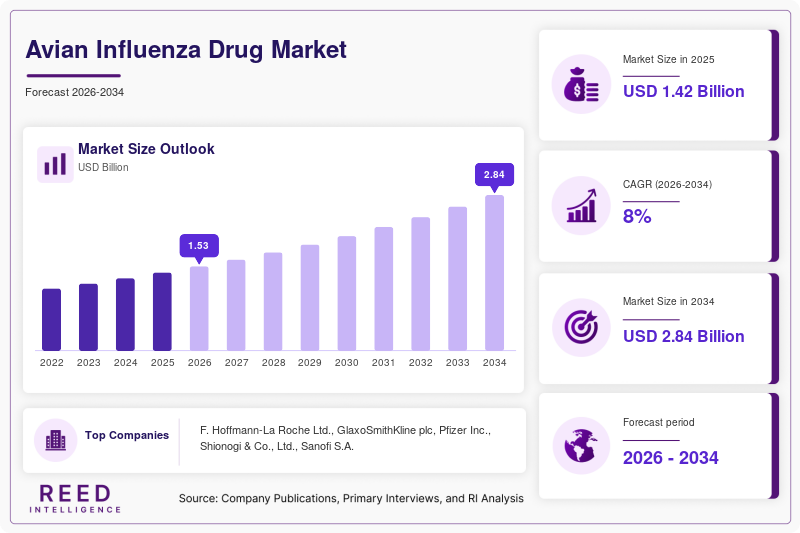
The global Avian Influenza Drug Market size was valued at USD 1.42 billion in 2025 and is projected to reach USD 2.85 billion by 2034, expanding at a CAGR of 8.0% during the forecast period (2025–2034). The market growth is driven by the increasing incidence of avian influenza outbreaks across poultry and human populations, along with the growing emphasis on pandemic preparedness and infectious disease control.
A major global factor supporting the expansion of the Avian Influenza Drug Market is the heightened investment in public health infrastructure and antiviral drug stockpiling by governments and healthcare organizations. Countries worldwide are strengthening their response capabilities against zoonotic diseases, which has led to increased procurement of antiviral medications and development of advanced therapeutics. Additionally, international collaborations and surveillance programs are enhancing early detection and treatment strategies, thereby boosting demand.
Key Highlights:
- North America dominated the Avian Influenza Drug Market with a share of 38% in 2025, while Asia Pacific is expected to register the fastest CAGR of 9.2% during the forecast period.
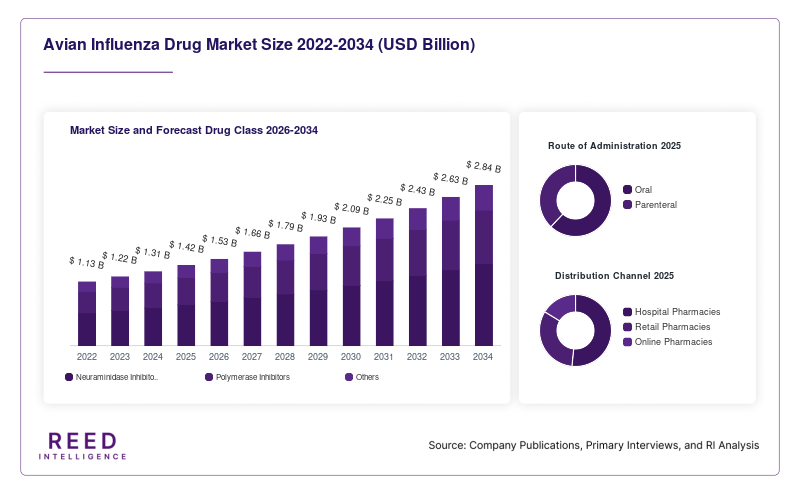
- By drug class, neuraminidase inhibitors accounted for the largest share, while polymerase inhibitors are projected to grow at the fastest CAGR of 9.5%.
- By distribution channel, hospital pharmacies led the segment, whereas online pharmacies are expected to grow at a CAGR of 8.8%.
- The United States remained the dominant country, with market values of USD 520 million in 2025 and USD 548 million in 2026.
Market Trends
Increasing Development of Broad-Spectrum Antivirals
The Avian Influenza Drug Market is witnessing a growing focus on the development of broad-spectrum antiviral drugs capable of targeting multiple influenza strains. Pharmaceutical companies are investing in innovative drug platforms that can provide effective treatment against evolving viral mutations. This trend is gaining importance due to the unpredictable nature of avian influenza viruses, which often undergo genetic changes. Broad-spectrum antivirals reduce dependency on strain-specific drugs and enhance preparedness for future outbreaks, making them a critical component of modern infectious disease management strategies.
Integration of Digital Surveillance and Rapid Response Systems
Another key trend shaping the Avian Influenza Drug Market is the integration of digital health technologies for real-time disease surveillance and response. Governments and healthcare organizations are adopting data-driven monitoring systems to track outbreaks and ensure timely distribution of antiviral drugs. These systems improve supply chain efficiency and enable faster deployment of treatments in affected regions. As digital healthcare infrastructure continues to expand globally, it is expected to support more efficient management of avian influenza cases and drive market growth.
Market Drivers
Rising Incidence of Zoonotic Disease Outbreaks
The increasing frequency of zoonotic disease outbreaks is a major driver of the Avian Influenza Drug Market. Avian influenza viruses have shown the ability to infect both birds and humans, raising concerns about potential pandemics. Governments and health organizations are investing heavily in antiviral stockpiles and treatment strategies to mitigate risks. This growing need for preparedness is significantly boosting demand for effective antiviral drugs.
Expansion of Government Stockpiling Programs
Government initiatives to stockpile antiviral medications for emergency use are another key factor driving the Avian Influenza Drug Market. Many countries maintain strategic reserves of influenza drugs to ensure rapid response during outbreaks. These programs create consistent demand for pharmaceutical manufacturers and support market stability. Additionally, international health agencies are encouraging coordinated efforts to strengthen global preparedness, further contributing to market growth.
Market Restraint
Viral Mutation and Drug Resistance
A significant restraint in the Avian Influenza Drug Market is the continuous mutation of influenza viruses, which can lead to drug resistance. Over time, certain strains of the virus may become less responsive to existing antiviral treatments, reducing their effectiveness. This challenge complicates treatment protocols and increases the need for ongoing research and development.
Drug resistance also impacts the reliability of stockpiled medications, as previously effective drugs may not work against new variants. This creates uncertainty among healthcare providers and policymakers, potentially limiting the widespread adoption of certain treatments. Furthermore, the high cost and time required for developing new antiviral drugs add to the complexity of addressing resistance issues. Despite these challenges, ongoing research efforts aim to develop more resilient and adaptable treatment options.
Market Opportunities
Advancements in Combination Therapy Development
The development of combination therapies presents a significant opportunity in the Avian Influenza Drug Market. Combining multiple antiviral agents can enhance treatment efficacy and reduce the risk of drug resistance. Pharmaceutical companies are exploring innovative combinations that target different stages of the viral lifecycle. This approach not only improves patient outcomes but also strengthens the overall treatment framework for avian influenza.
Expansion in Emerging Markets
Emerging economies offer substantial growth opportunities for the Avian Influenza Drug Market. Regions with high poultry populations and increasing healthcare investments are particularly vulnerable to avian influenza outbreaks. Governments in these regions are focusing on improving healthcare infrastructure and disease management capabilities. As awareness and access to healthcare services improve, demand for antiviral drugs is expected to rise significantly.
Segmental Analysis
By Drug Class
Neuraminidase inhibitors dominated the Avian Influenza Drug Market in 2025, accounting for 61% of the total share. These drugs are widely used due to their effectiveness in inhibiting viral replication and reducing disease severity.
Polymerase inhibitors are expected to grow at the fastest CAGR of 9.5% during the forecast period. Their ability to target viral RNA synthesis and provide broader antiviral coverage will drive adoption in advanced treatment protocols.
By Route of Administration
Oral administration held the largest share of 54% in 2025, as it offers convenience and ease of use for patients. Oral drugs are widely prescribed for both preventive and therapeutic purposes.
Parenteral administration is projected to grow at a CAGR of 8.6%, driven by its effectiveness in severe cases requiring immediate medical intervention. Hospitals increasingly prefer injectable formulations for critical care settings.
By Distribution Channel
Hospital pharmacies accounted for 57% of the market share in 2025, as they are the primary distribution points during outbreaks and emergencies.
Online pharmacies are expected to grow at a CAGR of 8.8%, supported by increasing digitalization and consumer preference for convenient purchasing options.
By End-Use
Hospitals dominated the Avian Influenza Drug Market with a 48% share in 2025 due to the high volume of patients treated in clinical settings.
Homecare settings are anticipated to grow at a CAGR of 8.4%, driven by the availability of oral medications and increasing preference for outpatient care.
Regional Analysis
North America
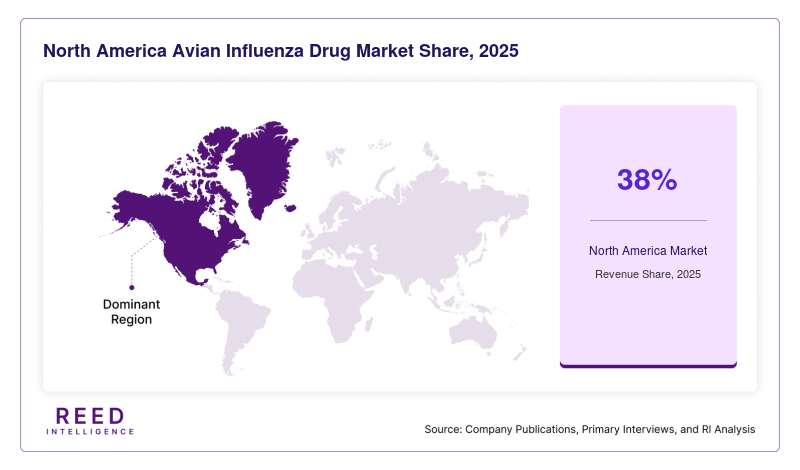
North America accounted for 38% of the Avian Influenza Drug Market share in 2025 and will grow at a CAGR of 7.5% during the forecast period. The region benefits from advanced healthcare infrastructure, strong pharmaceutical R&D capabilities, and well-established disease surveillance systems.
The United States dominates the regional market due to its comprehensive pandemic preparedness programs and significant investments in antiviral drug stockpiling. The presence of major pharmaceutical companies and ongoing clinical research activities further support market growth.
Europe
Europe held a 24% share of the Avian Influenza Drug Market in 2025 and is expected to grow at a CAGR of 7.2% through 2034. The region’s growth is supported by strong regulatory frameworks and coordinated public health initiatives.
Germany leads the European market due to its robust healthcare system and focus on infectious disease management. Government support for research and development, along with collaboration between healthcare institutions, drives demand for antiviral treatments.
Asia Pacific
Asia Pacific represented 26% of the market in 2025 and is projected to grow at the fastest CAGR of 9.2%. The region’s growth is driven by high poultry production, increasing incidence of avian influenza outbreaks, and expanding healthcare infrastructure.
China dominates the regional market due to its large population and significant poultry industry. The government’s focus on disease control and investment in healthcare systems contributes to rising demand for antiviral drugs.
Middle East & Africa
The Middle East & Africa accounted for 6% of the Avian Influenza Drug Market in 2025 and will grow at a CAGR of 7.0%. Increasing awareness of infectious diseases and improving healthcare infrastructure support market growth.
Saudi Arabia is a key contributor, driven by government initiatives to enhance healthcare services and disease surveillance. Investments in public health programs are expected to boost demand for antiviral drugs.
Latin America
Latin America held a 6% share of the market in 2025 and is expected to grow at a CAGR of 7.3%. The region’s growth is supported by increasing healthcare investments and rising awareness of disease prevention.
Brazil dominates the regional market due to its large poultry industry and growing focus on disease management. Government efforts to strengthen healthcare infrastructure further drive market expansion.
Competitive Landscape
The Avian Influenza Drug Market is characterized by moderate competition, with key players focusing on innovation, strategic collaborations, and product development. Companies are investing in research to develop advanced antiviral drugs and improve treatment efficacy.
F. Hoffmann-La Roche Ltd. is a leading player in the market, known for its strong portfolio of antiviral drugs. The company recently expanded its production capacity to meet rising global demand during influenza outbreaks. Other major players include GlaxoSmithKline plc, Pfizer Inc., and Shionogi & Co., Ltd., which are actively involved in developing next-generation antiviral therapies. Strategic partnerships, mergers, and acquisitions are common strategies adopted by these companies to strengthen their market presence and expand their product offerings.
Key Players List
- F. Hoffmann-La Roche Ltd.
- GlaxoSmithKline plc
- Pfizer Inc.
- Shionogi & Co., Ltd.
- Cipla Ltd.
- Dr. Reddy’s Laboratories Ltd.
- Sun Pharmaceutical Industries Ltd.
- Mylan N.V.
- Sanofi S.A.
- AstraZeneca plc
- Novartis AG
- Gilead Sciences, Inc.
- Teva Pharmaceutical Industries Ltd.
- Zydus Lifesciences Ltd.
- Aurobindo Pharma Ltd.
Recent Developments
- F. Hoffmann-La Roche Ltd. expanded antiviral drug manufacturing capacity to address rising global demand.
- GlaxoSmithKline plc advanced research on next-generation influenza treatments.
- Shionogi & Co., Ltd. introduced new antiviral formulations targeting resistant strains.
- Pfizer Inc. strengthened its infectious disease portfolio through strategic collaborations.
- Cipla Ltd. increased production of generic antiviral drugs for emerging markets.
Avian Influenza Drug Market Segments
Drug Class
- Neuraminidase Inhibitors
- Polymerase Inhibitors
- Others
Route of Administration
- Oral
- Parenteral
Distribution Channel
- Hospital Pharmacies
- Retail Pharmacies
- Online Pharmacies
End-Use
- Hospitals
- Clinics
- Homecare Settings
By Region
- North America
- Europe
- APAC
- Middle East and Africa
- LATAM