Aviation Borescope Market Size, Share Demand Report By Type (Video Borescopes, Fiber Optic Borescopes, Robotic Borescopes), By Application (Engine Inspection, Turbine Inspection, Airframe Inspection), By End-Use (Commercial Aviation, Military Aviation, MRO Service Providers), By Distribution Channel (Direct Sales, Distributors) By Region & Segment Forecasts, 2026–2034
USD 3950
Market Overview
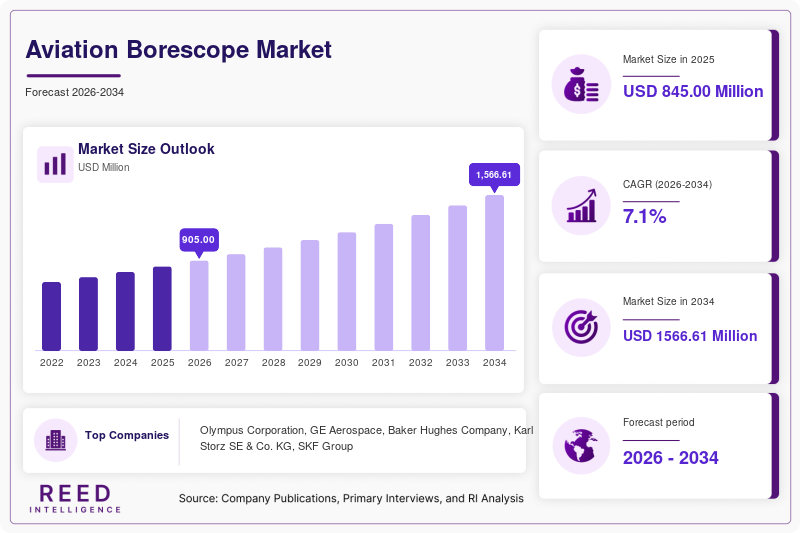
The global Aviation Borescope Market size was valued at approximately USD 845 million in 2026 and is projected to reach USD 1.46 billion by 2034, expanding at a CAGR of 7.1% during the forecast period (2026–2034). The market is experiencing steady growth due to the increasing need for efficient aircraft maintenance, inspection, and safety compliance. Aviation borescopes are widely used for non-destructive inspection of aircraft engines, turbines, and internal components, enabling operators to detect faults without disassembly.
A key global factor supporting the Aviation Borescope Market growth is the rising global air traffic and expansion of commercial aviation fleets. Airlines are focusing on preventive maintenance and operational efficiency, which has increased the demand for advanced inspection tools such as borescopes.
Key Highlights
- North America dominated the market with 37.8% share in 2025, while Asia Pacific is projected to grow at the fastest CAGR of 8.4%
- Video borescopes segment led with 61.2% share, while robotic borescopes are expected to grow at a CAGR of 8.9%
- Engine inspection application held 44.5% share, while turbine inspection is forecasted to grow at a CAGR of 8.2%
- The United States market was valued at USD 305 million in 2024 and reached USD 325 million in 2025
Aviation Borescope Market Trends
Integration of Advanced Imaging Technologies
The incorporation of high-definition cameras, 3D imaging, and AI-assisted diagnostics is transforming borescope capabilities. These advancements improve inspection accuracy and efficiency, shaping key Aviation Borescope Market trends.
Adoption of Portable and Wireless Devices
The demand for lightweight and portable inspection tools is increasing. Wireless borescopes enable easier handling and faster inspections, making them suitable for field operations and maintenance tasks.
Market Drivers
Increasing Focus on Aircraft Safety and Compliance
Regulatory authorities are enforcing strict maintenance and inspection standards to ensure aircraft safety. This has increased the adoption of borescopes for routine inspections, supporting market growth.
Growth of Global Aviation Industry
The expansion of commercial and military aviation fleets has led to higher demand for maintenance and inspection equipment. Borescopes play a critical role in ensuring operational efficiency and reducing downtime.
Market Restraint
High Cost of Advanced Borescope Systems
Advanced aviation borescopes equipped with high-end imaging technologies can be expensive. This may limit adoption among smaller operators and maintenance service providers.
Market Opportunities
Expansion in MRO Services
The growth of maintenance, repair, and overhaul (MRO) services presents significant opportunities for the Aviation Borescope Market. Increasing aircraft maintenance activities are driving demand for inspection tools.
Technological Advancements in Inspection Tools
Continuous innovation in imaging and robotic technologies is creating new opportunities for market expansion. Enhanced capabilities are improving inspection outcomes and operational efficiency.
Segmental Analysis
By Type
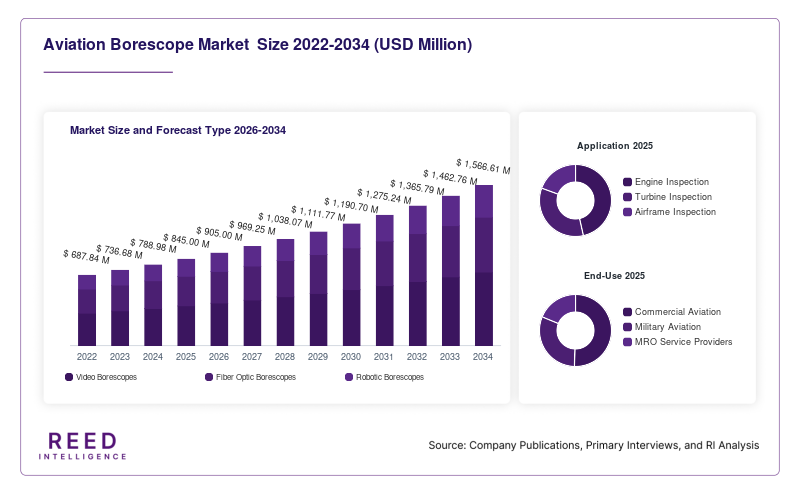
The video borescopes segment dominated the Aviation Borescope Market with 61.2% share in 2025 due to superior imaging capabilities. The robotic borescopes segment is expected to grow at the fastest CAGR of 8.9%, driven by automation and precision inspection.
By Application
The engine inspection segment held the largest share of 44.5% in 2025, supported by frequent maintenance requirements. The turbine inspection segment is projected to grow at a CAGR of 8.2%, driven by increasing focus on efficiency and safety.
By End-Use
The commercial aviation segment dominated with 49.3% share in 2025 due to high aircraft utilization rates. The MRO service providers segment is expected to grow at a CAGR of 8.6%, supported by expanding maintenance activities.
By Distribution Channel
The direct sales segment accounted for 63.7% share in 2025, as manufacturers directly supply to airlines and MRO providers. The distributor segment is projected to grow at a CAGR of 7.8%, driven by expanding global reach.
Regional Analysis
North America
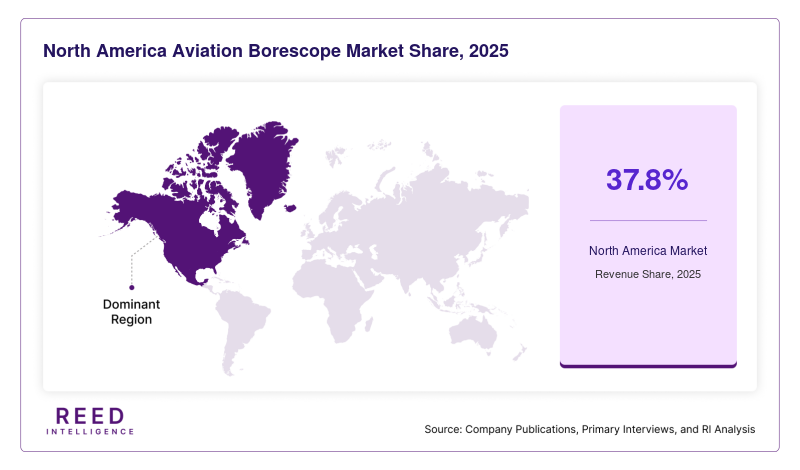
North America accounted for 37.8% of the Aviation Borescope Market share in 2025 and is expected to grow at a CAGR of 6.8% through 2034. The United States dominated the region due to a strong aviation industry and advanced maintenance infrastructure.
Europe
Europe held 26.9% share in 2025 and is projected to expand at a CAGR of 6.9%. Germany led the regional market, supported by a well-established aerospace sector.
Asia Pacific
Asia Pacific captured 22.6% share in 2025 and is expected to grow at the fastest CAGR of 8.4%. China dominated the region due to rapid growth in aviation and increasing investments in infrastructure.
Middle East & Africa
The Middle East & Africa region held 6.4% share in 2025 and is projected to grow at a CAGR of 7.5%. The UAE led the market due to expanding airline operations and MRO facilities.
Latin America
Latin America accounted for 6.3% share in 2025 and is expected to grow at a CAGR of 7.3%. Brazil dominated the region, supported by increasing air travel demand.
Competitive Landscape
The Aviation Borescope Market is moderately consolidated, with key players focusing on technological advancements and product innovation. Leading companies are investing in high-resolution imaging and AI-enabled inspection solutions to enhance performance. One major market participant has recently launched an advanced video borescope with real-time analytics capabilities, strengthening its competitive position.
Other companies are adopting strategies such as partnerships, mergers, and geographic expansion to increase their market presence. The integration of digital technologies and automation is shaping competitive dynamics. As demand for efficient inspection tools increases, manufacturers are focusing on innovation and cost optimization to maintain their market position.
Key Players List
- Olympus Corporation
- GE Aerospace
- Baker Hughes Company
- Karl Storz SE & Co. KG
- SKF Group
- FLIR Systems, Inc.
- IT Concepts GmbH
- Gradient Lens Corporation
- JME Technologies Ltd.
- USA Borescopes
- Hawkeye Borescopes
- Mitcorp (Medical Intubation Technology Corporation)
- Coantec Co., Ltd.
- Yateks Co., Ltd.
- Fiberscope.net by Medit Inc.
Recent Developments
- In 2025, a leading company introduced an AI-enabled video borescope with enhanced inspection capabilities
- In 2024, manufacturers launched portable wireless borescopes for field applications
- In 2025, partnerships were formed to expand MRO service integration
- In 2024, advancements in imaging technology improved inspection accuracy
- In 2025, companies increased investment in R&D for next-generation inspection tools
Aviation Borescope Market Segments
Type
- Video Borescopes
- Fiber Optic Borescopes
- Robotic Borescopes
Application
- Engine Inspection
- Turbine Inspection
- Airframe Inspection
End-Use
- Commercial Aviation
- Military Aviation
- MRO Service Providers
Distribution Channel
- Direct Sales
- Distributors
By Region
- North America
- Europe
- APAC
- Middle East and Africa
- LATAM