Aviation Gasoline Avga Market Size, Share & Demand Report By Fuel Grade (100LL, UL91, Unleaded Aviation Gasoline, Others), By Application (Flight Training Aircraft, Recreational Aviation, Agricultural Aviation, Emergency Medical Aviation, Charter Aviation), By End Use (Civil Aviation Operators, Government and Defense Support Operations, Aviation Training Institutions, Private Aircraft Owners) By Region & Segment Forecasts, 2026–2034
USD 3950
Market Overview
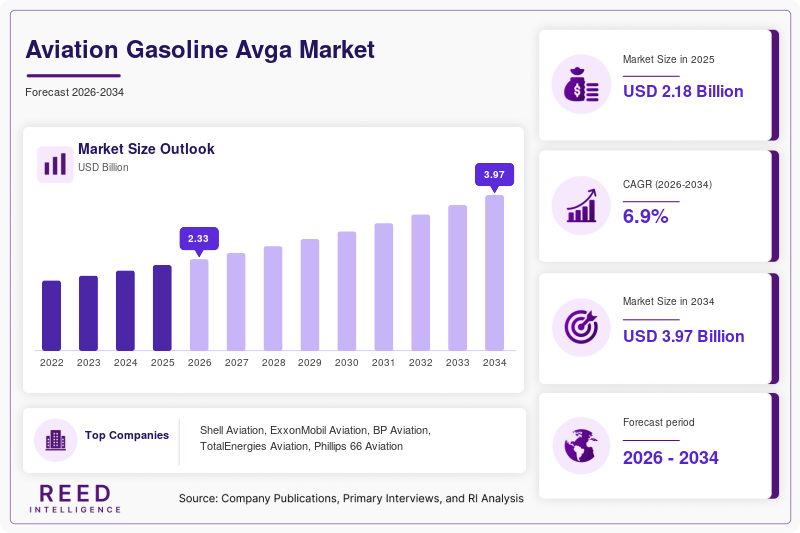
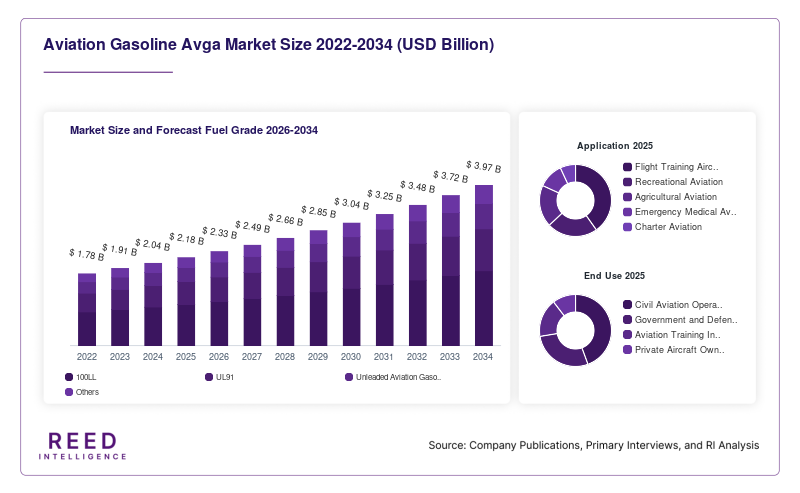
The global Aviation Gasoline Avga Market size was valued at approximately USD 2.18 billion in 2026 and is projected to reach nearly USD 3.74 billion by 2034, expanding at a CAGR of 6.9% during the forecast period from 2026 to 2034. Aviation gasoline, commonly known as Avgas, remains a critical fuel source for piston-engine aircraft used in private aviation, pilot training, agricultural aviation, emergency medical transport, and military support operations. Stable growth in general aviation activities, along with increasing investments in regional air connectivity and flight training infrastructure, continues to support long-term market expansion across developed and emerging economies.
A major global factor contributing to market growth is the sustained increase in pilot training programs and private aviation activity. Several countries are experiencing a shortage of certified pilots, leading to expansion in aviation academies and training fleets that heavily depend on Avgas-powered aircraft. In addition, governments in emerging economies are investing in regional airport modernization and rural connectivity programs, increasing the operational use of light aircraft. Growth in recreational flying and aerial tourism has also contributed to consistent fuel demand in both mature and developing aviation markets.
Key Highlights
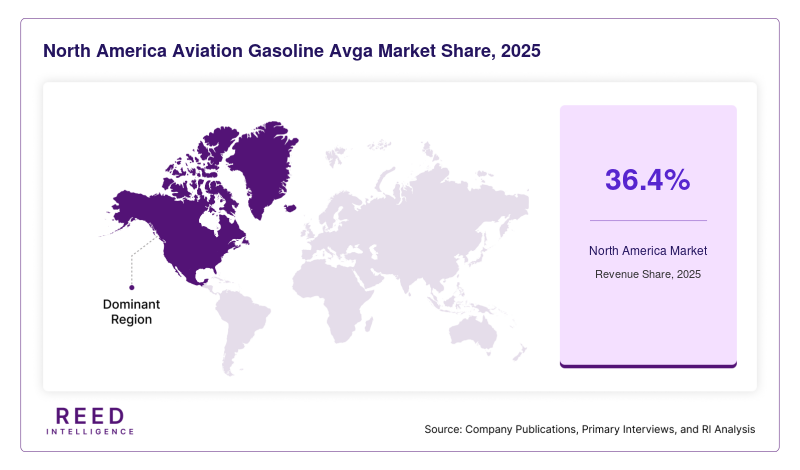
- North America dominated the market with a 36.4% share in 2025, while Asia Pacific is expected to grow at the fastest CAGR of 8.7% during 2026–2034.
- By fuel grade, 100LL accounted for the largest share of 61.8%, while unleaded aviation gasoline is projected to grow at a CAGR of 9.4%.
- By application, flight training aircraft led with a 39.6% share, whereas recreational aviation is expected to expand at a CAGR of 8.9%.
- By end use, civil aviation operators accounted for the largest market share of 67.3%, while government and defense support operations are projected to grow at a CAGR of 7.8%.
- The United States remained the dominant country, with market values of USD 620 million in 2024 and USD 665 million in 2025.
Market Trends
Rising Transition Toward Unleaded Aviation Gasoline
The aviation industry is increasingly shifting toward unleaded aviation gasoline formulations due to tightening environmental standards and concerns regarding lead emissions from piston-engine aircraft. Regulatory agencies in North America and Europe are encouraging fuel manufacturers and aircraft operators to adopt cleaner fuel alternatives that reduce environmental impact without compromising engine performance. This trend is encouraging refiners to invest in research programs focused on high-octane unleaded aviation gasoline products suitable for legacy aircraft fleets. Several airport fuel distributors are also preparing infrastructure upgrades to accommodate new fuel variants.
Aircraft operators and aviation schools are gradually adopting compatible engines and fuel systems to support this transition. The trend is especially visible among flight training academies that seek long-term operational sustainability and regulatory compliance. In addition, growing public awareness regarding aviation emissions is influencing aviation stakeholders to support cleaner fuel solutions. As a result, the market is witnessing a gradual but steady expansion of unleaded aviation gasoline production and distribution networks across key aviation hubs.
Expansion of General Aviation and Pilot Training Infrastructure
The increasing demand for trained pilots and regional aviation services is contributing to the expansion of general aviation infrastructure globally. Countries across Asia Pacific, the Middle East, and Latin America are investing in new aviation academies, regional airports, and small aircraft fleets to strengthen domestic aviation capabilities. This trend is directly supporting aviation gasoline consumption because a significant portion of trainer aircraft continues to rely on piston-engine systems powered by Avgas.
Private aviation activity has also increased due to rising disposable income and growing interest in recreational flying experiences. Flying clubs, charter operators, and aerial tourism companies are expanding their fleets, resulting in higher fuel demand across local airports. Governments are additionally supporting aviation skill development initiatives to address long-term pilot shortages, leading to higher utilization of training aircraft. These developments are expected to sustain consistent growth in aviation gasoline demand throughout the forecast period.
Market Drivers
Growth in Flight Training and Aviation Academies
The rising establishment of aviation academies and pilot training centers is a major factor driving the Aviation Gasoline Avga Market. Commercial aviation expansion has created a substantial need for trained pilots, prompting airlines and governments to increase investments in pilot development programs. Most primary flight training aircraft operate using piston engines that depend on aviation gasoline, making training activity directly linked to fuel consumption growth.
Several countries in Asia Pacific and the Middle East are rapidly expanding aviation education infrastructure to support regional airline growth. Flight schools are increasing fleet sizes and aircraft utilization rates, leading to continuous demand for aviation gasoline. Additionally, many aviation training institutions prefer piston-engine aircraft because of lower acquisition and operational costs compared to turbine aircraft. The consistent increase in student pilot enrollments, combined with fleet modernization initiatives in training centers, continues to strengthen long-term market demand.
Increasing Demand for Recreational and Private Aviation
Growing interest in recreational flying and private aviation services is significantly contributing to market expansion. High-net-worth individuals and aviation enthusiasts are increasingly investing in small aircraft ownership and flying memberships. This trend is especially visible in North America and Europe, where general aviation networks are well established and supported by extensive airport infrastructure.
Aerial tourism services, adventure flying experiences, and flying clubs are also expanding operations in developing economies. Recreational aircraft typically rely on aviation gasoline-powered piston engines due to their cost efficiency and operational simplicity. In addition, the flexibility offered by small aircraft for regional travel and emergency access is supporting higher flight activity. Governments are also encouraging general aviation development through airport modernization and simplified licensing regulations, further contributing to increased aviation gasoline consumption worldwide.
Market Restraint
Environmental Regulations and Transition Toward Alternative Aviation Fuels
Stringent environmental regulations associated with lead emissions from aviation gasoline remain a major restraint for market growth. Traditional aviation gasoline formulations, particularly leaded fuel grades, have faced increasing scrutiny from environmental agencies due to their impact on air quality and public health. Regulatory pressure is encouraging aviation stakeholders to transition toward cleaner alternatives, creating uncertainty for conventional aviation gasoline suppliers and distributors.
The aviation industry is also witnessing increasing investment in electric aircraft, sustainable aviation fuel technologies, and hybrid propulsion systems that may gradually reduce dependence on conventional piston-engine aircraft. Aircraft manufacturers are exploring alternative propulsion technologies for training and recreational aviation applications, potentially affecting long-term Avgas demand. In addition, airport operators may face rising compliance costs associated with fuel storage, environmental monitoring, and emissions management.
Smaller fuel distributors and regional airports may experience operational challenges while adapting to evolving fuel standards and infrastructure requirements. Some aircraft operators are delaying fleet expansion decisions due to uncertainty regarding future fuel regulations and engine compatibility. These factors collectively create pressure on traditional aviation gasoline demand and could limit market growth in regions with aggressive environmental policies.
Market Opportunities
Development of Sustainable and Low-Emission Avgas Solutions
The development of sustainable and low-emission aviation gasoline products presents a strong growth opportunity for market participants. Fuel manufacturers are increasingly investing in advanced refining technologies and additive formulations designed to reduce emissions while maintaining engine safety and performance standards. The transition toward cleaner aviation gasoline products offers suppliers an opportunity to differentiate themselves in a competitive market environment.
Governments and aviation authorities are supporting collaborative research programs focused on sustainable aviation fuel alternatives for piston-engine aircraft. Companies capable of delivering certified low-emission fuel solutions may gain long-term partnerships with flight schools, private operators, and airport fuel distributors. The introduction of environmentally compatible aviation gasoline can also help extend the operational life of existing piston-engine aircraft fleets while supporting regulatory compliance. This opportunity is expected to create new revenue streams for fuel producers and technology developers over the coming years.
Expansion of Regional Air Connectivity Programs
Increasing investment in regional air connectivity programs across developing economies creates substantial opportunities for the Aviation Gasoline Avga Market. Governments are focusing on improving transportation access to remote and underserved regions using small aircraft and regional aviation networks. Many of these aircraft continue to operate using piston engines that rely on aviation gasoline.
Countries in Asia Pacific, Latin America, and Africa are modernizing regional airports and establishing aviation support infrastructure to stimulate tourism, emergency medical services, and economic development. Agricultural aviation and aerial surveying services are also expanding in rural areas, further supporting fuel demand. In addition, humanitarian and disaster-response aviation operations often depend on lightweight aircraft capable of operating from smaller runways. These developments are expected to strengthen aviation gasoline consumption across emerging aviation markets during the forecast period.
Segmental Analysis
By Fuel Grade
The 100LL fuel grade segment accounted for the largest share of the Aviation Gasoline Avga Market in 2024, representing approximately 61.8% of total revenue. This dominance is primarily linked to the extensive installed base of piston-engine aircraft certified to operate on 100LL aviation gasoline. Flight training schools, private aircraft operators, and agricultural aviation services continue to rely heavily on this fuel type due to its widespread availability and compatibility with legacy aircraft engines. North America and Europe remain key consumption centers for 100LL fuel because of their mature general aviation infrastructure and large active aircraft fleets. Fuel distributors and airport operators continue to prioritize storage and supply systems for 100LL aviation gasoline to maintain operational continuity across general aviation networks.
Unleaded aviation gasoline is projected to register the fastest CAGR of 9.4% during the forecast period due to increasing environmental regulations and industry efforts to reduce lead emissions. Aircraft manufacturers and fuel suppliers are collaborating to develop high-performance unleaded formulations compatible with a broader range of piston-engine aircraft. Flight schools and private aviation operators are increasingly adopting cleaner fuel alternatives to support sustainability objectives and regulatory compliance initiatives. Governments in Europe and North America are also encouraging the transition through certification programs and fuel research funding. As infrastructure upgrades continue across regional airports, the availability of unleaded aviation gasoline is expected to improve significantly, supporting long-term segment expansion globally.
By Application
Flight training aircraft represented the dominant application segment in 2024, accounting for nearly 39.6% of the global Aviation Gasoline Avga Market share. Increasing pilot shortages across commercial aviation have encouraged airlines, governments, and private institutions to expand aviation training capacity. Most entry-level and intermediate pilot training programs rely on piston-engine aircraft because of their lower operating costs and training efficiency. This has resulted in substantial aviation gasoline consumption across aviation academies and flying schools worldwide. North America and Asia Pacific remain major centers for pilot training operations due to rising airline expansion activities and strong demand for certified aviation professionals. Increasing student pilot enrollment and aircraft fleet expansion among training institutions continue to support consistent fuel demand.
Recreational aviation is anticipated to expand at the fastest CAGR of 8.9% during the forecast period due to rising interest in private flying experiences and aerial tourism activities. Flying clubs, charter tourism companies, and private aircraft owners are increasingly contributing to aviation gasoline consumption, particularly in developed economies. Countries with strong tourism industries are promoting aerial sightseeing and adventure aviation services, supporting higher utilization of light aircraft fleets. Additionally, growing disposable income among affluent consumers has increased participation in leisure aviation activities. Airport modernization initiatives and simplified pilot licensing procedures in several countries are further encouraging market growth within the recreational aviation segment.
By End Use
Civil aviation operators held the largest share of the Aviation Gasoline Avga Market in 2024, contributing approximately 67.3% of total industry revenue. This segment includes flight schools, private aircraft operators, charter services, agricultural aviation companies, and flying clubs. The widespread use of piston-engine aircraft across civil aviation activities continues to drive strong demand for aviation gasoline. General aviation infrastructure in North America and Europe remains highly developed, enabling stable fuel distribution and operational support for civil aviation operators. In addition, increasing regional air connectivity initiatives in developing economies are expanding the role of small aircraft in passenger transportation and emergency response operations. These factors continue to strengthen the position of the civil aviation segment in the global market.
Government and defense support operations are projected to witness the fastest CAGR of 7.8% during the forecast period. Several governments use piston-engine aircraft for border surveillance, pilot training, emergency medical transport, and disaster response missions. Defense organizations are also increasing investments in lightweight support aircraft capable of operating in remote environments where larger aircraft may face operational limitations. Emerging economies are expanding aviation infrastructure for security and humanitarian applications, supporting higher demand for aviation gasoline-powered aircraft. Furthermore, governments are increasingly partnering with private aviation operators for emergency response and regional transportation projects, contributing to continued growth within this segment.
Regional Analysis
North America
North America accounted for the largest share of the Aviation Gasoline Avga Market in 2025, representing approximately 36.4% of global revenue. The region is expected to maintain stable growth at a CAGR of 5.8% during the forecast period due to its established general aviation ecosystem and extensive network of regional airports. The presence of large flight training institutions, recreational aviation clubs, and private aircraft operators continues to support consistent aviation gasoline demand across the United States and Canada.
The United States remained the dominant country in the regional market due to its large fleet of piston-engine aircraft and advanced aviation infrastructure. Increasing pilot shortages have encouraged airlines and aviation institutions to expand training activities, creating sustained demand for aviation gasoline. The country also benefits from strong participation in recreational aviation and aerial agricultural operations, particularly across rural states with significant farming activity.
Europe
Europe represented a considerable share of the global Aviation Gasoline Avga Market in 2025 and is projected to expand at a CAGR of 5.9% through 2034. The region benefits from strong aviation regulatory frameworks, active flying clubs, and growing interest in sustainable aviation practices. Western European countries continue to invest in airport modernization and cleaner aviation fuel technologies, supporting market stability despite regulatory challenges related to emissions.
Germany remained the leading country within the European market due to its established aviation manufacturing sector and active pilot training ecosystem. The country’s network of regional airports and aviation academies contributes significantly to aviation gasoline consumption. In addition, increasing investment in lower-emission fuel technologies and research partnerships between fuel producers and aviation organizations is strengthening market development across the region.
Asia Pacific
Asia Pacific is anticipated to register the fastest growth rate in the Aviation Gasoline Avga Market, with a projected CAGR of 8.7% from 2026 to 2034. Rising investments in aviation infrastructure, increasing airline fleet expansion, and growing demand for pilot training programs are major factors driving regional growth. Countries across Southeast Asia and South Asia are focusing on regional connectivity initiatives that rely heavily on small aircraft operations.
China emerged as the dominant country in the Asia Pacific market due to rapid growth in domestic aviation infrastructure and increasing investments in aviation education. The country is expanding regional airport networks and encouraging development in general aviation services. Rising disposable income and interest in recreational flying activities are also contributing to higher demand for aviation gasoline across private aviation segments.
Middle East & Africa
The Middle East & Africa region is witnessing moderate growth in the Aviation Gasoline Avga Market and is expected to achieve a CAGR of 6.3% during the forecast period. Expansion of aviation training programs, rising tourism activities, and increasing investments in regional air transport infrastructure are supporting market development. Several countries are modernizing small airport facilities to strengthen connectivity between remote communities and major urban centers.
The United Arab Emirates remained the dominant country within the regional market due to its strong aviation sector and expanding pilot training industry. Aviation academies and tourism-focused aviation services continue to increase aircraft utilization rates across the country. In addition, rising investments in aerial surveying, emergency medical aviation, and charter aviation services are contributing to sustained aviation gasoline demand in the region.
Latin America
Latin America accounted for a developing share of the Aviation Gasoline Avga Market in 2025 and is expected to grow at a CAGR of 6.5% through 2034. Agricultural aviation, regional transportation services, and pilot training activities remain key contributors to fuel demand. Governments in the region are increasingly supporting aviation infrastructure modernization to improve economic connectivity and tourism development.
Brazil dominated the Latin American market due to its extensive agricultural aviation industry and large regional aircraft network. The country relies heavily on small aircraft for crop monitoring, pesticide spraying, and transportation across remote areas. Growth in aviation training institutions and rising private aviation demand among business travelers are also supporting market expansion throughout the forecast period.
Competitive Landscape
The Aviation Gasoline Avga Market remains moderately consolidated, with major fuel manufacturers and aviation energy suppliers competing through fuel quality improvements, distribution expansion, and sustainability initiatives. Companies are focusing on strategic partnerships with airports, aviation academies, and aircraft operators to strengthen regional supply networks and maintain long-term customer relationships.
Shell Aviation emerged as one of the leading market participants due to its extensive global airport fuel distribution network and strong presence in general aviation markets. The company has increased investments in lower-emission aviation fuel research and regional infrastructure partnerships to strengthen its competitive position. ExxonMobil Aviation, TotalEnergies Aviation, Phillips 66 Aviation, and BP Aviation also maintain strong market shares through diversified fuel portfolios and broad airport supply operations.
Key Players
- Shell Aviation
- ExxonMobil Aviation
- BP Aviation
- TotalEnergies Aviation
- Phillips 66 Aviation
- Chevron Corporation
- Vitol Aviation
- World Fuel Services
- Neste Corporation
- Avfuel Corporation
- Gazpromneft-Aero
- Indian Oil Corporation
- Hindustan Petroleum Corporation Limited
- Petrobras Distribuidora
- Repsol Aviation
Recent Developments
- Shell Aviation announced the expansion of its unleaded aviation gasoline distribution program across selected regional airports in North America during 2025.
- TotalEnergies Aviation partnered with multiple European aviation academies in 2025 to support the adoption of lower-emission aviation gasoline formulations for pilot training fleets.
- ExxonMobil Aviation introduced upgraded fuel storage and supply infrastructure at several Asia Pacific regional airports in 2024 to improve operational efficiency and support rising general aviation activity.
Aviation Gasoline Avga Market Segments
Fuel Grade
- 100LL
- UL91
- Unleaded Aviation Gasoline
- Others
Application
- Flight Training Aircraft
- Recreational Aviation
- Agricultural Aviation
- Emergency Medical Aviation
- Charter Aviation
End Use
- Civil Aviation Operators
- Government and Defense Support Operations
- Aviation Training Institutions
- Private Aircraft Owners
By Region
- North America
- Europe
- APAC
- Middle East and Africa
- LATAM