Aviation Obstruction Lights Market Size, Share Demand Report By Type (LED Obstruction Lights, Xenon Obstruction Lights, Incandescent Obstruction Lights, Smart/Connected Obstruction Lights), By Application (Telecommunication Towers, Wind Turbines, Buildings & Infrastructure, Airports), By Installation Type (New Installation, Retrofit Installation), By End-Use (Commercial Infrastructure, Industrial Facilities, Renewable Energy Projects), By Region & Segment Forecasts, 2026–2034
USD 3950
Market Overview
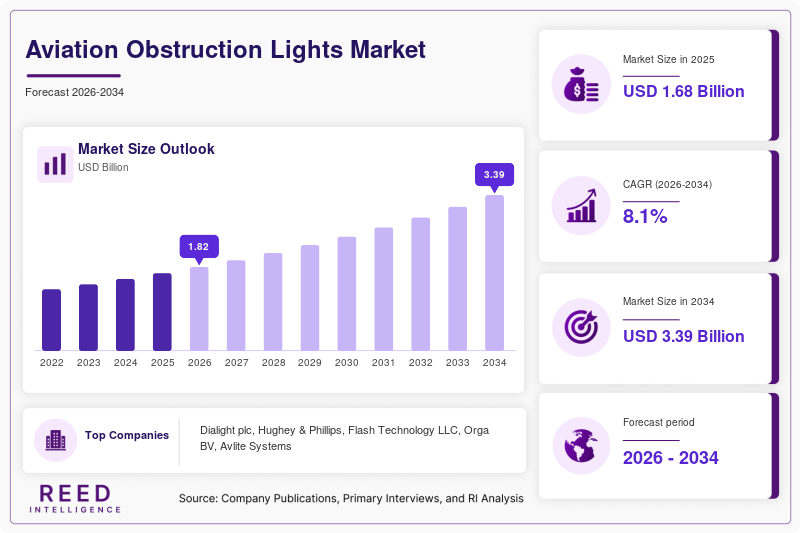
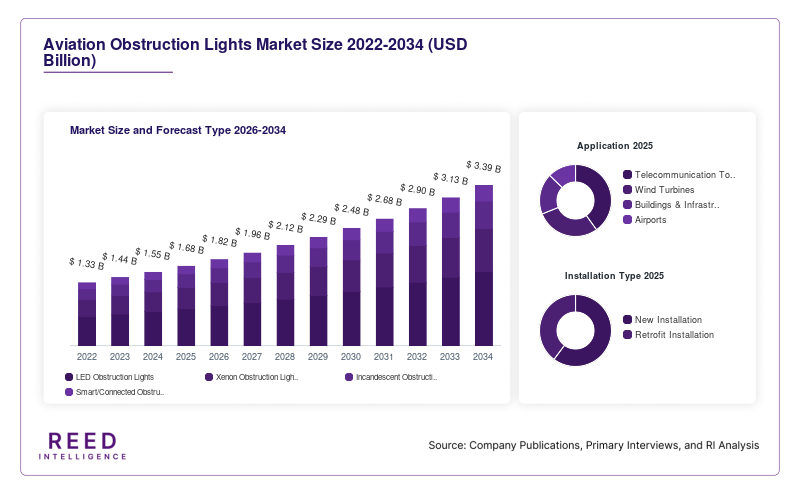
The global Aviation Obstruction Lights Market size was valued at approximately USD 1.68 billion in 2026 and is projected to reach USD 3.12 billion by 2034, expanding at a CAGR of 8.1% during the forecast period (2026–2034). The market continues to grow steadily due to the increasing need for aviation safety compliance across rapidly urbanizing regions. A key global factor supporting this growth is the expansion of vertical infrastructure such as skyscrapers, wind turbines, transmission towers, and telecommunication masts, all of which require obstruction lighting systems to ensure aircraft safety.
The Aviation Obstruction Lights Market has also benefited from advancements in LED technology, which has significantly improved energy efficiency and operational reliability. Regulatory bodies across multiple regions have introduced strict aviation safety mandates, compelling infrastructure developers and operators to adopt compliant lighting systems. This regulatory push, combined with the growing demand for smart and connected lighting systems, has strengthened market expansion.
Key Highlights
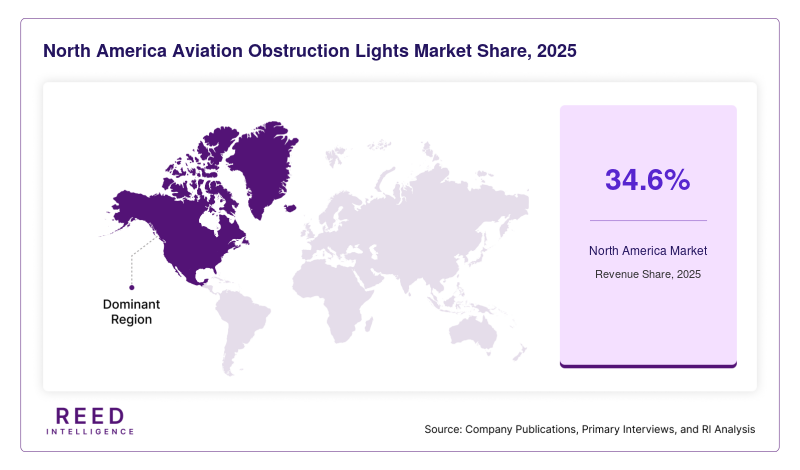
- North America dominated the market with a 34.6% share in 2025, while Asia Pacific is projected to grow at the fastest CAGR of 9.4% (2026–2034).
- By type, LED obstruction lights held the leading share of 62.3% in 2025, whereas smart/connected lighting systems are expected to grow at a CAGR of 10.2%.
- By application, telecommunication towers dominated with a 38.7% share, while wind turbines are forecasted to grow at a CAGR of 9.8%.
- The United States recorded USD 420 million in 2024 and USD 445 million in 2025, maintaining its dominant position.
Market Trends
Adoption of Smart and IoT-Enabled Lighting Systems
The integration of smart technologies into obstruction lighting systems has become a defining trend in the Aviation Obstruction Lights Market. These systems enable real-time monitoring, predictive maintenance, and remote control, significantly improving operational efficiency. With the increasing deployment of connected infrastructure, the adoption of IoT-enabled lighting solutions is expected to expand further, particularly in large-scale installations such as wind farms and telecom networks.
Shift Toward Energy-Efficient LED Lighting
Another notable trend is the transition from traditional lighting technologies to LED-based obstruction lights. LEDs offer enhanced durability, reduced power consumption, and longer operational lifespans. This shift is particularly evident in remote and offshore installations where maintenance costs are high. Government initiatives promoting energy-efficient solutions have further accelerated the adoption of LED systems across the Aviation Obstruction Lights Market.
Market Drivers
Growth in High-Rise and Infrastructure Development
The rapid increase in high-rise construction projects is a major driver for the Aviation Obstruction Lights Market. Urban expansion has led to the proliferation of tall structures that require obstruction lighting for aviation safety compliance. Regulatory frameworks mandate the installation of such systems, thereby ensuring consistent demand across residential, commercial, and industrial infrastructure projects.
Expansion of Renewable Energy Installations
The growing focus on renewable energy, particularly wind power, has significantly boosted the demand for obstruction lighting systems. Wind turbines, especially those located offshore, require reliable lighting solutions to ensure visibility for aircraft. This has encouraged the development of robust and weather-resistant lighting technologies, further driving market growth.
Market Restraint
High Initial Investment and Maintenance Costs
The Aviation Obstruction Lights Market faces challenges due to the high initial cost associated with advanced lighting systems. Installation in remote or offshore locations adds to the complexity and cost. Additionally, periodic maintenance requirements can increase operational expenses, limiting adoption in cost-sensitive markets.
Market Opportunities
Emergence of Smart Cities and Urban Air Mobility
The rise of smart city initiatives and urban air mobility systems presents new opportunities for the Aviation Obstruction Lights Market. As low-altitude air traffic increases, the need for efficient obstruction lighting systems will become more critical, creating demand for advanced solutions.
Expansion of Offshore Infrastructure
Offshore wind farms and oil & gas platforms represent significant growth opportunities. These environments require specialized lighting systems capable of withstanding harsh conditions, driving innovation and increasing demand for durable products.
Segmental Analysis
By Type
LED obstruction lights dominated the Aviation Obstruction Lights Market with a 62.3% share in 2025, primarily due to their energy efficiency and long lifespan. These systems have become the preferred choice across multiple industries.
Smart/connected lighting systems are projected to grow at the fastest CAGR of 10.2%, driven by increasing demand for remote monitoring and automation capabilities. Their ability to reduce maintenance costs and improve operational efficiency supports this growth.
By Application
Telecommunication towers held the largest share of 38.7% in 2025, as expanding telecom networks require obstruction lighting for safety compliance.
Wind turbines are expected to grow at a CAGR of 9.8%, supported by the rapid expansion of renewable energy projects. The need for durable lighting systems in harsh environments has accelerated innovation.
By Installation Type
New installations accounted for a 55.4% share in 2025, driven by ongoing infrastructure development projects worldwide.
Retrofit installations are anticipated to grow at a CAGR of 8.9%, as outdated systems are replaced with modern LED and smart lighting solutions to meet updated regulations.
By End-Use
Commercial infrastructure dominated with a 41.2% share in 2025, driven by urban development and high-rise construction.
The renewable energy segment is projected to grow at a CAGR of 9.6%, supported by global sustainability initiatives and increasing wind energy installations.
Regional Analysis
North America
North America accounted for a 34.6% share of the Aviation Obstruction Lights Market in 2025 and is expected to grow at a CAGR of 7.5% during the forecast period. The United States dominated the region due to strong aviation safety regulations and extensive telecom infrastructure. Continuous investments in modernization have further supported market growth.
Europe
Europe held a 27.2% market share in 2025 and is projected to expand at a CAGR of 7.8%. Germany led the region, driven by its focus on renewable energy and large-scale wind farm installations. Strict compliance requirements across the European Union have ensured stable demand.
Asia Pacific
Asia Pacific accounted for 21.5% of the market share in 2025 and is anticipated to grow at the fastest CAGR of 9.4%. China dominated the region due to rapid urbanization and infrastructure expansion. The growing number of high-rise buildings and renewable energy projects has significantly boosted demand.
Middle East & Africa
The Middle East & Africa region held a 9.1% share in 2025 and is expected to grow at a CAGR of 8.3%. The United Arab Emirates led the region, supported by large-scale construction projects and aviation infrastructure development.
Latin America
Latin America accounted for 7.6% of the market share in 2025 and is projected to grow at a CAGR of 7.9%. Brazil dominated the region due to increasing investments in telecom infrastructure and renewable energy projects.
Competitive Landscape
The Aviation Obstruction Lights Market is characterized by moderate competition, with key players focusing on innovation, regulatory compliance, and global expansion. Dialight plc remains a leading company due to its advanced LED-based solutions and strong distribution network. The company has recently introduced smart obstruction lighting systems designed for improved monitoring and durability.
Other prominent players such as Hughey & Phillips, Flash Technology LLC, Orga BV, and Avlite Systems continue to strengthen their market positions through product innovation and strategic partnerships. Companies are investing in research and development to introduce energy-efficient and technologically advanced solutions. Expansion into emerging markets and collaboration with infrastructure developers are key strategies adopted by market participants to enhance their competitive edge.
Key Players List
- Dialight plc
- Hughey & Phillips
- Flash Technology LLC
- Orga BV
- Avlite Systems
- Carmanah Technologies Corp.
- Obelux Oy
- Unimar Inc.
- TWR Lighting Inc.
- Delta Obstruction Lighting Ltd.
- Flight Light Inc.
- International Tower Lighting LLC
- Hunan Chendong Technology Co., Ltd.
- Shanghai Nanhua Electronics Company
- Shenzhen Anhang Technology Co., Ltd.
Recent Developments
- 2025 – Dialight plc Product Innovation
In 2025, Dialight plc introduced a new generation of smart aviation obstruction lighting systems equipped with IoT-based remote diagnostics and predictive maintenance capabilities. This launch focused on improving uptime for critical infrastructure such as telecom towers and offshore wind installations. - 2025 – Flash Technology LLC Digital Integration
In 2025, Flash Technology expanded its product portfolio by integrating cloud-based monitoring platforms with its obstruction lighting solutions. This advancement enabled operators to track performance data in real time and optimize maintenance schedules. - 2024 – Orga BV Offshore Lighting Enhancement
In 2024, Orga BV developed advanced corrosion-resistant obstruction lights specifically designed for offshore wind farms and marine environments. The new systems offered enhanced durability and compliance with evolving international safety standards. - 2024 – Carmanah Technologies Smart Lighting Upgrade
In 2024, Carmanah Technologies introduced solar-powered obstruction lighting systems with wireless communication features, targeting remote and off-grid installations. This development aligned with the increasing demand for sustainable lighting solutions. - 2024 – Hughey & Phillips Product Certification Expansion
In 2024, Hughey & Phillips expanded its product certifications to meet updated aviation safety standards, ensuring broader compatibility with international regulatory frameworks and strengthening its presence in global markets. - 2023–2025 – Industry-Wide Smart Technology Adoption
Between 2023 and 2025, manufacturers across the Aviation Obstruction Lights Market accelerated the adoption of smart monitoring systems, infrared-compatible lighting, and modular designs. These innovations improved system efficiency, reduced operational costs, and ensured compliance with evolving aviation safety requirements.
Aviation Obstruction Lights Market Segments
Type
- LED Obstruction Lights
- Xenon Obstruction Lights
- Incandescent Obstruction Lights
- Smart/Connected Obstruction Lights
Application
- Telecommunication Towers
- Wind Turbines
- Buildings & Infrastructure
- Airports
Installation Type
- New Installation
- Retrofit Installation
End-Use
- Commercial Infrastructure
- Industrial Facilities
- Renewable Energy Projects
Region
- North America
- Europe
- Asia Pacific
- Middle East & Africa
- Latin America
By Region
- North America
- Europe
- APAC
- Middle East and Africa
- LATAM