Avidin Market Size, Share & Demand Report By Type (Avidin, Streptavidin, Neutravidin), By Application (Immunoassays, Molecular Diagnostics, Protein Purification, Research & Development), By End-Use (Biotechnology & Pharmaceutical Companies, Academic & Research Institutes, Diagnostic Laboratories) By Region & Segment Forecasts, 2025–2034
USD 3950
Market Overview
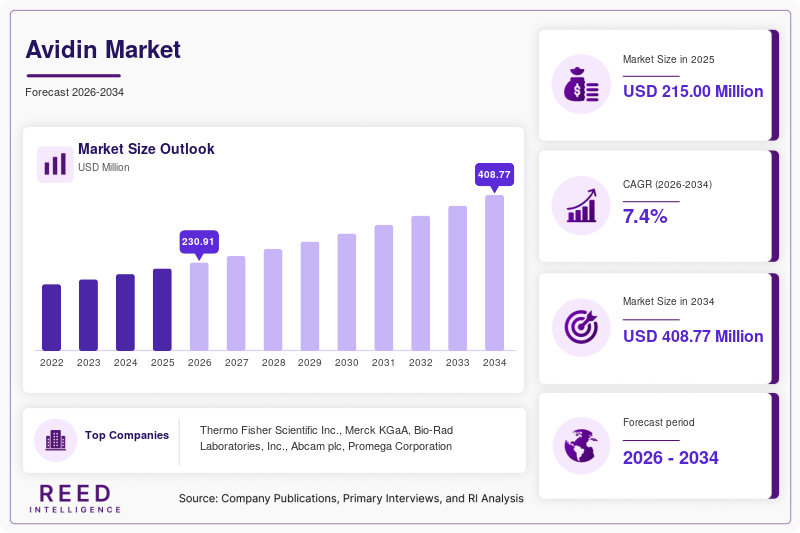
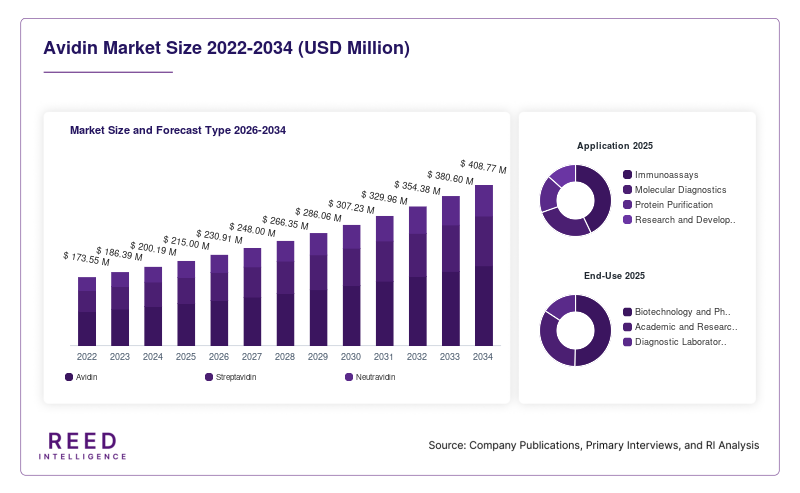
The Avidin Market size was valued at approximately USD 215 million in 2025 and is projected to reach USD 410 million by 2034, registering a CAGR of 7.4% during 2025–2034. Avidin, a glycoprotein commonly extracted from egg whites, has gained significant attention across biotechnology, diagnostics, and research laboratories due to its exceptionally strong binding affinity with biotin. This molecular property makes avidin highly valuable in immunoassays, purification processes, and targeted drug delivery applications.
Growing investments in life sciences research worldwide have played a central role in supporting the growth of the Avidin Market. Research institutions, pharmaceutical companies, and diagnostic developers are expanding their use of avidin-biotin technologies to improve assay sensitivity and accuracy. As biomedical research continues to expand, the demand for high-purity avidin reagents used in molecular labeling and biomolecule isolation has increased steadily.
Key Highlights
- North America dominated the market with approximately 38% share in 2025, while Asia Pacific will record the fastest CAGR of around 8.6% during 2025–2034.
- In the Type segment, Streptavidin accounted for the largest share at about 42%, while Neutravidin is projected to grow fastest at a CAGR of 8.9%.
- In Application, Immunoassays held the leading share of 35%, while Molecular Diagnostics will expand fastest at 9.1% CAGR.
- In End-Use, Biotechnology and Pharmaceutical Companies led with 40% share, while Diagnostic Laboratories are projected to grow fastest at 8.7% CAGR.
- The United States led globally with a market value of USD 72 million in 2025 and is estimated to reach USD 77 million in 2026.
Market Trends
Rising Adoption of Avidin-Biotin Technology in Molecular Diagnostics
One of the most visible trends shaping the Avidin Market is the expanding use of avidin-biotin binding systems in molecular diagnostic techniques. Diagnostic developers increasingly integrate avidin-based reagents into immunoassays, ELISA platforms, and nucleic acid detection systems due to their strong and stable binding properties. These systems enable higher assay sensitivity and reproducibility compared with traditional labeling methods. As molecular testing continues to evolve, laboratories are adopting advanced assay formats that rely on avidin interactions to improve detection accuracy. This trend has strengthened the role of avidin as a critical reagent in modern diagnostic workflows.
Expansion of Recombinant Avidin and Engineered Protein Variants
Another significant trend in the Avidin Market is the development of recombinant avidin and modified protein variants designed to enhance performance. Traditional egg-derived avidin can sometimes present challenges such as glycosylation-related interference or non-specific binding. To address these limitations, manufacturers are introducing engineered forms such as streptavidin and neutravidin that provide improved stability and reduced background noise in assays. These engineered proteins are increasingly preferred in advanced research applications, including proteomics and cell-based assays. The shift toward recombinant technologies is expected to reshape product development strategies across the market.
Market Drivers
Growth of Life Sciences Research Activities
The steady expansion of global life sciences research has been a major driver of the Avidin Market. Research laboratories involved in genomics, proteomics, and molecular biology frequently use avidin-based systems for biomolecule labeling and purification. The strong binding interaction between avidin and biotin allows researchers to isolate proteins, nucleic acids, and antibodies with high specificity. Governments and private organizations are increasing funding for biomedical research programs, which has resulted in higher demand for advanced laboratory reagents. As academic and commercial research institutions expand their experimental capabilities, avidin products are increasingly integrated into experimental workflows.
Increasing Demand for High-Sensitivity Diagnostic Assays
Another important driver supporting the Avidin Market is the growing demand for highly sensitive diagnostic assays. Healthcare providers and diagnostic developers are focusing on technologies capable of detecting diseases at early stages with greater accuracy. Avidin-biotin systems enable strong molecular binding that improves assay signal strength and detection performance. This capability makes avidin particularly valuable in immunodiagnostics, including enzyme-linked immunosorbent assays and chemiluminescent assays. As clinical laboratories adopt more sophisticated diagnostic platforms, the use of avidin reagents continues to expand.
Market Restraints
Availability of Alternative Protein Binding Technologies
Despite steady expansion, the Avidin Market faces challenges from the availability of alternative protein binding technologies used in biochemical research and diagnostics. Researchers have access to a variety of affinity systems such as antibody-based capture methods, protein-A or protein-G binding technologies, and engineered molecular tags. These alternatives may offer specific advantages depending on the experimental design or assay requirements.
In some cases, researchers prefer alternative labeling or purification methods that provide simpler workflows or reduced cost. For example, antibody-mediated capture systems can sometimes eliminate the need for avidin-biotin interactions in immunoassays. Additionally, certain experimental environments require specialized reagents with lower molecular weight or reduced steric hindrance.
Such factors may limit the widespread use of avidin-based reagents in certain niche applications. While avidin continues to provide strong binding efficiency, competition from alternative molecular interaction technologies may influence purchasing decisions among research laboratories and diagnostic developers. Addressing these challenges requires manufacturers to improve product performance and develop specialized avidin variants that deliver improved assay compatibility.
Market Opportunities
Expanding Role in Targeted Drug Delivery Research
Emerging drug delivery technologies are creating new opportunities for the Avidin Market. Scientists are increasingly investigating avidin-biotin interactions as part of targeted therapeutic systems. These systems use avidin molecules to bind biotinylated drugs or nanoparticles, enabling controlled delivery to specific tissues or cellular targets. This approach is gaining attention in oncology research and precision medicine initiatives. As pharmaceutical developers explore targeted therapies, the demand for specialized avidin reagents is expected to increase.
Growing Biotechnology Infrastructure in Emerging Economies
Another opportunity for the Avidin Market lies in the expansion of biotechnology infrastructure across emerging economies. Countries in Asia, Latin America, and the Middle East are investing heavily in life sciences research facilities, diagnostic laboratories, and biotechnology incubators. These investments are increasing the availability of advanced research tools and laboratory reagents. As new research institutions are established, demand for avidin-based reagents used in molecular assays and purification techniques will continue to grow. Manufacturers that expand distribution networks and local production capabilities may benefit from this expanding research environment.
Segmental Analysis
By Type
The streptavidin subsegment dominated the Type segment of the Avidin Market in 2025, accounting for approximately 42% of the total market share. Streptavidin is widely used in molecular biology and biochemical assays due to its strong affinity for biotin and improved stability compared with native avidin. Research laboratories frequently prefer streptavidin because it exhibits reduced nonspecific binding, making it suitable for applications such as ELISA assays, protein purification, and nucleic acid detection. Its compatibility with various assay formats has made streptavidin a commonly used reagent across academic and commercial research laboratories.
The neutravidin subsegment is expected to grow at the fastest CAGR of about 8.9% during the forecast period. Neutravidin has gained attention due to its neutral isoelectric point and lower nonspecific interactions with biomolecules. These characteristics improve assay accuracy and reduce background signals in experimental workflows. As research laboratories seek reagents that deliver higher precision in molecular assays, the demand for neutravidin products will likely increase. Growing interest in high-performance assay reagents is expected to support the expansion of this subsegment.
By Application
The immunoassays subsegment led the Application segment of the Avidin Market in 2025, representing approximately 35% of total revenue share. Immunoassays rely heavily on avidin-biotin interactions to enhance signal detection and improve assay sensitivity. These assays are widely used in research laboratories and diagnostic testing environments to detect proteins, hormones, and disease biomarkers. The strong affinity between avidin and biotin enables efficient labeling and signal amplification, making avidin a key component in many immunoassay platforms.
The molecular diagnostics subsegment is projected to grow at the fastest CAGR of about 9.1% through 2034. Molecular diagnostic techniques such as nucleic acid detection and gene analysis require highly reliable labeling systems. Avidin-biotin technologies are increasingly used in diagnostic platforms that detect genetic material or disease-associated biomarkers. The expanding use of molecular testing in healthcare settings will contribute to higher demand for avidin-based reagents used in advanced diagnostic assays.
By End-Use
The biotechnology and pharmaceutical companies subsegment held the largest share of the Avidin Market in 2025, accounting for approximately 40% of global revenue. These organizations frequently use avidin reagents in research and development activities involving drug discovery, biomolecule characterization, and therapeutic research. Pharmaceutical laboratories depend on avidin-based systems for protein purification and molecular labeling processes used in early-stage drug development.
The diagnostic laboratories subsegment is expected to expand at the fastest CAGR of about 8.7% during the forecast period. Diagnostic laboratories are gradually adopting advanced molecular testing platforms capable of detecting disease markers with higher accuracy. These platforms often integrate avidin-biotin interactions to improve assay sensitivity and detection efficiency. As healthcare systems increase investment in laboratory diagnostics, the demand for avidin-based reagents within diagnostic facilities will continue to grow.
Regional Analysis
North America
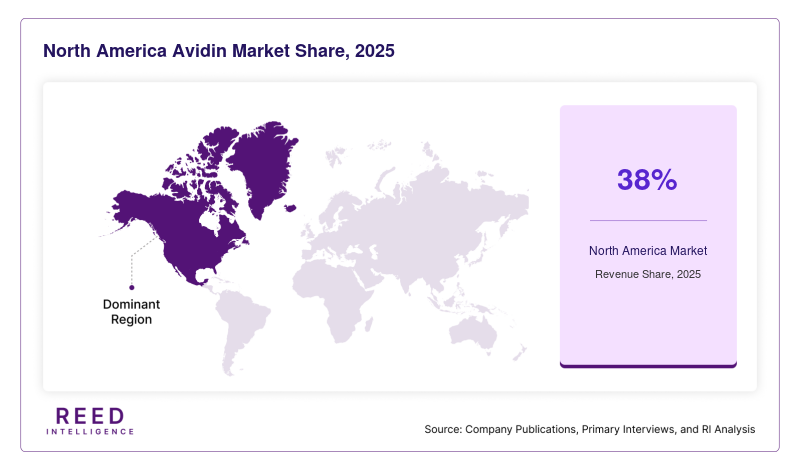
North America accounted for approximately 38% of the Avidin Market share in 2025. The region is expected to grow at a CAGR of about 6.9% during 2025–2034. Strong biotechnology infrastructure, high research funding, and widespread adoption of advanced diagnostic technologies have contributed to regional market expansion. The presence of numerous pharmaceutical companies and biotechnology research centers has supported consistent demand for avidin-based reagents used in molecular biology workflows.
The United States represented the dominant country in the regional market. Growth has been influenced by the strong presence of research universities and biotechnology startups developing innovative molecular diagnostics. Many academic laboratories rely on avidin-based systems for immunoassays, protein purification, and biomolecule detection. In addition, the expansion of precision medicine initiatives in the United States has increased demand for advanced molecular tools used in genomic and proteomic research.
Europe
Europe held around 27% share of the Avidin Market in 2025 and is projected to grow at a CAGR of approximately 7.0% through 2034. The region has maintained strong growth due to a well-established biomedical research environment and increasing collaboration between academic institutions and biotechnology companies. European research programs have focused extensively on developing advanced diagnostic technologies and therapeutic research platforms.
Germany emerged as the dominant country in the regional market. The country's biotechnology ecosystem includes numerous pharmaceutical research centers and diagnostic technology developers. German research institutions frequently use avidin-based reagents in molecular assays, immunodetection methods, and biochemical purification processes. Government support for biotechnology innovation and laboratory modernization has contributed to consistent demand for research reagents, including avidin.
Asia Pacific
Asia Pacific represented approximately 22% of the global Avidin Market in 2025 and is anticipated to grow at the fastest CAGR of about 8.6% between 2025 and 2034. The region is experiencing rapid expansion in biotechnology research infrastructure, supported by government initiatives and growing private investments. Countries across Asia Pacific are strengthening laboratory capabilities and expanding biomedical research programs.
China dominated the regional market. Growth has been supported by large-scale investments in biotechnology research and pharmaceutical development. Chinese universities and biotechnology companies are increasingly involved in genomics and molecular biology research, which has driven demand for avidin-based reagents used in protein isolation and diagnostic assays. The expansion of domestic biotechnology manufacturing capabilities has also improved access to laboratory reagents across the country.
Middle East & Africa
The Middle East & Africa accounted for roughly 7% of the Avidin Market share in 2025 and will grow at an estimated CAGR of 7.3% through 2034. The regional market has been gradually expanding as healthcare infrastructure improves and research institutions increase their adoption of advanced laboratory technologies. Universities and research centers are gradually incorporating molecular biology techniques that require specialized biochemical reagents.
Saudi Arabia represented the leading country in the region. Growth has been influenced by national programs focused on strengthening scientific research and biotechnology innovation. Universities and medical research centers have been expanding laboratory capabilities and adopting modern biochemical techniques. As research funding increases, demand for molecular reagents including avidin is expected to expand across academic and clinical research environments.
Latin America
Latin America accounted for approximately 6% of the global Avidin Market share in 2025 and is projected to grow at a CAGR of about 7.2% during the forecast period. The regional market has expanded gradually as research institutions adopt modern laboratory technologies and biotechnology industries gain traction.
Brazil emerged as the dominant country in the regional market. Growth has been supported by increasing investments in biotechnology research and pharmaceutical innovation. Brazilian research institutions are expanding capabilities in molecular biology, immunodiagnostics, and biotechnology development. These activities require advanced laboratory reagents, including avidin, for biomolecule detection and purification processes. Continued expansion of academic research infrastructure is expected to support regional demand.
Competitive Landscape
The Avidin Market features a moderately competitive landscape with several biotechnology reagent manufacturers offering specialized avidin products. Companies compete by expanding product portfolios, improving protein purity levels, and developing engineered avidin variants designed for advanced research applications.
Among industry participants, Thermo Fisher Scientific holds a prominent position due to its extensive portfolio of molecular biology reagents and strong global distribution network. The company provides multiple avidin derivatives designed for immunoassays, labeling, and protein purification workflows.
Other companies focus on niche applications or supply specialized avidin reagents to research laboratories and biotechnology firms. Continuous innovation in recombinant protein technologies and assay development is influencing competitive strategies across the market. Manufacturers are also investing in expanding production capacity and strengthening collaborations with research institutions to support product development and improve global accessibility.
Key Players
- Thermo Fisher Scientific
- Merck KGaA
- Vector Laboratories
- Abcam plc
- Bio-Rad Laboratories
- GenScript Biotech Corporation
- Creative Diagnostics
- Rockland Immunochemicals
- Promega Corporation
- BioVision Inc.
- RayBiotech Inc.
- Enzo Life Sciences
- Proteintech Group
- Cell Signaling Technology
- Sino Biological Inc.
- Jackson ImmunoResearch Laboratories
Recent Developments
- 2024: Thermo Fisher Scientific expanded its portfolio of streptavidin-based reagents designed for advanced molecular detection workflows.
- 2024: Bio-Rad Laboratories introduced optimized avidin conjugates aimed at improving immunoassay signal detection.
- 2023: Abcam launched new neutravidin products tailored for low-background biochemical assays.
- 2023: Merck KGaA expanded distribution of avidin reagents across emerging biotechnology markets.
- 2022: GenScript introduced recombinant streptavidin variants designed for high-purity laboratory applications.
Avidin Market Segments
Type
- Avidin
- Streptavidin
- Neutravidin
Application
- Immunoassays
- Molecular Diagnostics
- Protein Purification
- Research and Development
End-Use
- Biotechnology and Pharmaceutical Companies
- Academic and Research Institutes
- Diagnostic Laboratories
Region
- North America
- Europe
- Asia Pacific
- Middle East & Africa
- Latin America
By Region
- North America
- Europe
- APAC
- Middle East and Africa
- LATAM