Axle Counting System Market Size, Share, Growth & Industry Analysis Report By Component (Hardware, Software, Services), By Application (Railway Signaling, Train Detection, Predictive Maintenance, Traffic Management), By End-Use (Freight Rail, Passenger Rail, Metro Systems, High-Speed Rail) & Regional Forecasts, 2026–2034
USD 3950
Market Overview
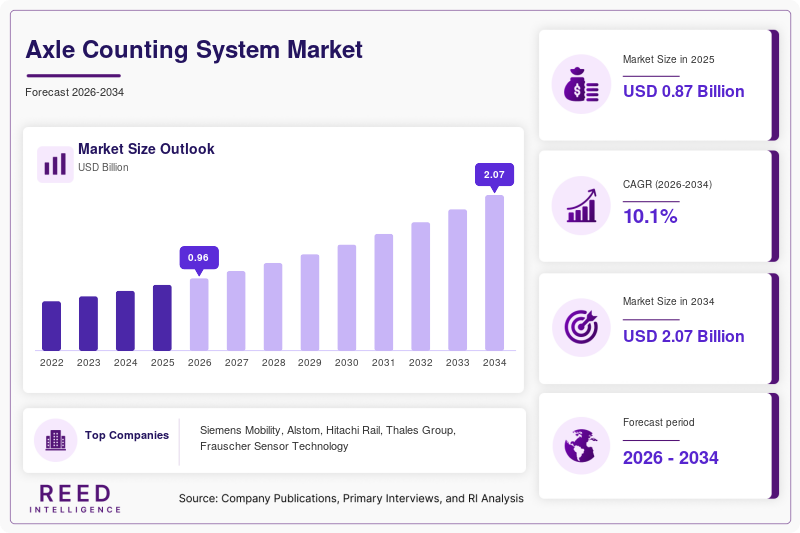
The global Axle Counting System Market size was valued at USD 0.865 billion in 2026 and is projected to reach USD 1.86 billion by 2034, expanding at a CAGR of 10.1% during the forecast period from 2026 to 2034. Axle counting systems are becoming an important part of railway signaling and train detection infrastructure due to their ability to improve operational safety, reduce track maintenance complexity, and support automated railway traffic management. These systems are widely used across passenger rail, metro rail, freight corridors, and high-speed railway networks where accurate train occupancy detection is required for efficient movement control and signaling reliability.
A major global factor supporting market expansion is the growing investment in railway modernization projects across both developed and developing economies. Governments and transportation authorities are increasingly focusing on digital rail infrastructure to improve passenger safety, reduce congestion, and support sustainable transportation goals. Axle counting systems are preferred over traditional track circuits in many projects because they are less sensitive to environmental conditions, require lower maintenance, and perform effectively in tunnels, bridges, and difficult terrain. Increasing urbanization, expansion of metro rail projects, and rising freight transportation demand are also accelerating adoption across regional railway networks.
Key Highlights
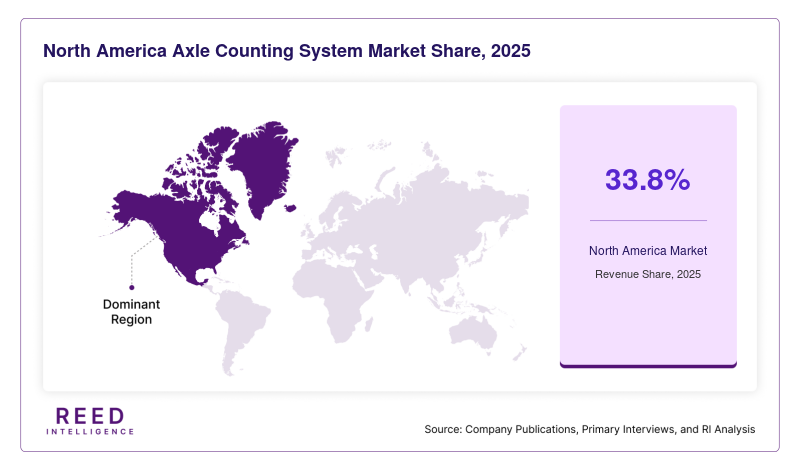
- North America dominated the market with a 33.8% share in 2025.
- Asia Pacific is expected to grow at the fastest CAGR of 11.7% during 2026–2034.
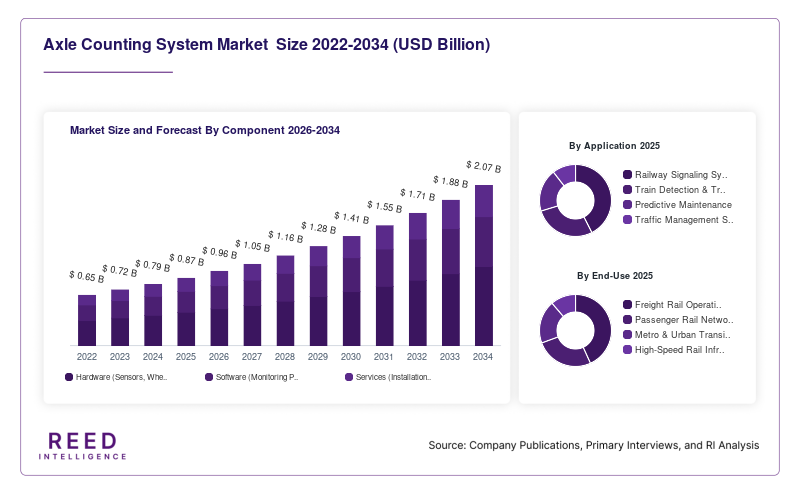
- By component, hardware accounted for the largest share of 44.6%, while software solutions are projected to grow at a CAGR of 12.9%.
- By application, railway signaling led with a 46.1% share, whereas metro rail systems are expected to expand at a CAGR of 12.2%.
- The United States remained the dominant country, with market values of USD 248 million in 2024 and USD 271 million in 2025.
Market Trends
Integration of Digital Railway Infrastructure and Smart Signaling Systems
Railway operators across global markets are increasingly integrating axle counting systems with smart signaling platforms and centralized traffic management infrastructure. This trend is driven by the need to improve operational visibility, optimize train scheduling, and reduce network disruptions. Modern axle counting systems are now being connected with Internet of Things platforms, cloud-based analytics, and predictive maintenance software to deliver real-time operational intelligence. Rail authorities are prioritizing automated train detection technologies that can support digital rail transformation programs and improve passenger safety standards.
The transition toward intelligent transportation infrastructure has also increased demand for advanced diagnostic capabilities in axle counting equipment. Railway operators prefer systems that offer remote monitoring and fault detection to reduce maintenance costs and improve reliability across large rail networks. High-speed rail projects in Asia Pacific and Europe are particularly encouraging the deployment of digitally connected axle counting technologies that can handle higher train frequencies and increasing traffic density efficiently.
Expansion of Urban Metro and High-Speed Rail Networks
Rapid urbanization and rising public transportation demand are contributing to the expansion of metro rail and high-speed rail projects worldwide. Governments are investing heavily in urban transit systems to reduce road congestion, lower emissions, and improve commuter mobility. Axle counting systems are becoming a preferred train detection solution in metro rail applications because they provide dependable occupancy detection without requiring insulated rail joints, making installation and maintenance more efficient.
The increasing development of intercity high-speed rail corridors is also supporting long-term market growth. These rail systems require advanced train detection technologies capable of operating accurately under high-speed conditions and varying environmental environments. Countries such as China, India, Japan, Germany, and France are expanding rail infrastructure investments, creating strong demand for reliable signaling and train control solutions. This trend is expected to strengthen as governments continue prioritizing sustainable transportation infrastructure development.
Market Drivers
Rising Investments in Railway Safety and Modernization Projects
Growing investments in railway safety modernization programs are significantly supporting the expansion of the Axle Counting System Market. Railway operators and governments are focusing on upgrading legacy signaling infrastructure to reduce operational risks and improve network efficiency. Traditional track circuits often face limitations in challenging weather conditions and high-maintenance environments, leading transportation authorities to adopt axle counting technologies as a more reliable alternative. These systems help improve train detection accuracy, reduce signaling failures, and strengthen operational safety across busy rail corridors.
Many countries are implementing long-term rail modernization strategies that include digital signaling, automatic train control systems, and intelligent monitoring infrastructure. Axle counting systems are playing a critical role in these upgrades because they provide stable performance in tunnels, bridges, and remote track sections. Increased freight transportation activity and growing passenger traffic are further encouraging investments in rail safety systems capable of supporting high-capacity railway operations with reduced downtime and maintenance requirements.
Growing Demand for Efficient Metro Rail Transportation
Urban population growth and increasing traffic congestion are encouraging governments to expand metro rail infrastructure in major cities. Metro rail networks require efficient train detection systems to maintain operational reliability and passenger safety in densely populated urban environments. Axle counting systems are widely adopted in these applications because they provide accurate train occupancy monitoring while supporting automated signaling and centralized traffic management systems.
The demand for sustainable public transportation is also accelerating metro rail investments across emerging economies. Countries in Asia Pacific, the Middle East, and Latin America are developing new urban transit corridors to reduce dependency on road transportation and lower carbon emissions. This infrastructure expansion is creating strong demand for signaling technologies that can support continuous operations with minimal maintenance interruptions. Vendors are increasingly offering compact and digitally connected axle counting systems designed specifically for urban metro applications and automated train operation environments.
Market Restraint
High Initial Installation Costs and Complex Integration Requirements
The Axle Counting System Market faces challenges related to high upfront installation costs and complex integration requirements associated with modern railway signaling infrastructure. Although axle counting systems can reduce long-term maintenance expenses, the initial deployment process often requires substantial investment in sensors, evaluation units, software platforms, and communication systems. Railway operators in developing regions may delay adoption because of budget limitations and competing infrastructure priorities.
Integration challenges also affect market growth, especially in older railway networks where legacy signaling systems remain operational. Many rail operators must upgrade multiple components simultaneously to ensure compatibility between axle counting technologies and existing traffic management platforms. The complexity of integrating digital signaling infrastructure can increase project timelines and implementation costs. In some cases, operators continue using traditional track circuits due to lower short-term investment requirements despite the operational advantages offered by advanced axle counting systems. These challenges are particularly noticeable in small regional rail networks where modernization budgets remain limited.
Market Opportunities
Development of Autonomous and Driverless Rail Operations
The growing development of autonomous and driverless rail systems is creating new growth opportunities for the Axle Counting System Market. Automated train operations require highly accurate train detection and occupancy monitoring technologies capable of supporting continuous communication with centralized control systems. Axle counting systems provide dependable performance in automated railway environments because they offer precise axle detection and real-time occupancy verification across complex rail networks.
Railway authorities are increasingly investing in driverless metro projects and intelligent transportation systems to improve operational efficiency and reduce labor costs. These projects require advanced signaling technologies integrated with digital communication platforms and automated control software. Vendors are responding by developing intelligent axle counting systems equipped with remote diagnostics, cloud connectivity, and predictive maintenance capabilities. As smart transportation infrastructure expands globally, demand for digitally integrated train detection technologies is expected to increase steadily during the forecast period.
Expansion of Railway Infrastructure in Emerging Economies
Emerging economies are investing heavily in railway infrastructure development to improve transportation connectivity and support economic growth. Countries across Asia Pacific, the Middle East, Africa, and Latin America are developing new freight rail corridors, metro systems, and intercity rail networks to strengthen logistics efficiency and urban mobility. This infrastructure expansion is generating strong opportunities for axle counting system manufacturers and signaling solution providers.
Governments in these regions are prioritizing rail transportation because it offers lower environmental impact and improved long-distance transportation efficiency compared to road transport. Large-scale railway development programs often include modern signaling and train detection technologies as part of broader digital rail transformation strategies. International funding agencies and public-private partnerships are also supporting infrastructure modernization initiatives, increasing procurement opportunities for advanced axle counting systems. Vendors capable of offering cost-effective and scalable solutions are expected to benefit significantly from these long-term infrastructure investments.
Segmental Analysis
By Component
Hardware emerged as the dominant subsegment within the component category and accounted for 44.6% of the market share in 2024. The segment includes wheel sensors, detection points, evaluation units, communication modules, and trackside equipment used in axle counting systems. Growing deployment of modern railway signaling infrastructure across passenger and freight rail networks has significantly increased demand for durable and high-performance hardware components. Railway operators prioritize reliable hardware systems that can withstand extreme weather conditions, heavy train traffic, and challenging track environments while maintaining operational accuracy.
The hardware segment also benefits from ongoing replacement of outdated track circuits in mature railway markets. Rail authorities are increasingly investing in robust detection equipment capable of reducing maintenance downtime and improving network reliability. Technological improvements in sensor durability and communication capabilities are further supporting hardware adoption across metro rail and high-speed rail applications. Increasing integration of intelligent monitoring functions within axle counting hardware is expected to sustain market expansion over the coming years.
By Application
Railway signaling represented the dominant application segment and accounted for 46.1% of the market share in 2024. Axle counting systems are widely used in railway signaling applications because they provide accurate train occupancy detection and improve operational safety across complex rail networks. Rail operators increasingly rely on axle counting technologies to manage train movements efficiently, reduce signaling errors, and support centralized traffic management systems. The segment continues to benefit from modernization projects aimed at upgrading aging railway signaling infrastructure across developed and emerging economies.
The growing deployment of digital interlocking systems and automatic train protection technologies is also strengthening demand for axle counting solutions within signaling applications. These systems offer operational advantages in tunnels, bridges, and electrified rail sections where traditional track circuits may face limitations. Freight rail operators and passenger transportation authorities are prioritizing reliable train detection technologies capable of supporting high-capacity rail operations while minimizing maintenance requirements and service disruptions.
By Railway Type
Conventional railways accounted for the largest share within the railway type segment, representing 52.4% of the market in 2024. Conventional rail networks continue to dominate global railway infrastructure due to their extensive use in passenger and freight transportation. Many national railway authorities are modernizing conventional rail systems to improve operational reliability and increase transportation capacity. Axle counting systems are widely deployed in these networks because they provide efficient train detection capabilities while reducing maintenance requirements compared to traditional track circuits.
The segment also benefits from rising freight transportation demand and increasing cross-border rail connectivity projects. Railway operators are investing in modern signaling technologies to support higher train frequencies and improve traffic management efficiency across long-distance rail corridors. Conventional rail networks in North America and Europe are particularly focused on upgrading legacy infrastructure with intelligent train detection systems capable of supporting digital traffic management platforms and predictive maintenance operations.
Regional Analysis
North America
North America accounted for 33.8% of the global Axle Counting System Market share in 2025 and is expected to maintain stable growth during the forecast period with a CAGR of 8.7%. The region benefits from advanced railway infrastructure, increasing freight rail activity, and continued investments in rail safety modernization. Railway operators across the United States and Canada are gradually replacing aging signaling systems with intelligent train detection technologies that improve operational reliability and reduce maintenance requirements. Increasing adoption of automated train control systems is also supporting market demand.
The United States remains the dominant country in the region due to large freight rail networks and ongoing investments in rail signaling upgrades. Government initiatives aimed at improving transportation safety and strengthening freight logistics are accelerating deployment of advanced axle counting systems. Rising investments in urban transit modernization and metro rail projects are also contributing to regional growth. The country’s strong focus on digital infrastructure integration continues to create opportunities for intelligent train detection technologies.
Europe
Europe represented 28.6% of the global market in 2025 and is projected to grow at a CAGR of 9.3% during the forecast period. The region has a well-established railway ecosystem supported by high-speed rail networks, cross-border rail connectivity, and strict transportation safety standards. European railway authorities are focusing on modern signaling infrastructure capable of supporting increasing train frequencies and sustainable transportation objectives. Axle counting systems are widely adopted across regional rail corridors because of their reliability in varying environmental conditions.
Germany remains the leading country within the European market due to its advanced railway engineering sector and ongoing rail modernization projects. The country continues investing in digital rail infrastructure and automated train operations to improve transportation efficiency and reduce emissions. Expansion of high-speed rail connectivity and freight transportation corridors is further encouraging adoption of advanced signaling technologies. Government support for sustainable mobility initiatives is also strengthening long-term demand for railway safety systems.
Asia Pacific
Asia Pacific held 24.7% of the global market in 2025 and is expected to register the fastest CAGR of 11.7% from 2026 to 2034. Rapid urbanization, large-scale railway expansion projects, and growing metro rail development are driving strong regional demand for axle counting systems. Governments across the region are investing heavily in rail transportation infrastructure to improve urban mobility and reduce road congestion. Increasing deployment of high-speed rail networks is also supporting the need for reliable train detection technologies.
China dominates the Asia Pacific market because of extensive investments in railway infrastructure and high-speed rail development. The country continues expanding metro systems and freight transportation corridors across major industrial regions. Strong government support for smart transportation infrastructure and digital rail modernization programs is accelerating deployment of intelligent signaling technologies. India and Southeast Asian countries are also emerging as attractive growth markets due to rising railway electrification and metro expansion initiatives.
Middle East & Africa
The Middle East & Africa region accounted for 7.1% of the global market share in 2025 and is projected to grow at a CAGR of 9.8% through 2034. Increasing investment in railway infrastructure and urban transit development is supporting regional market expansion. Governments across the Gulf region are focusing on transportation diversification strategies aimed at reducing dependency on road-based logistics. Railway modernization initiatives are creating demand for advanced train detection and signaling technologies that can operate effectively in harsh climatic environments.
Saudi Arabia remains the dominant country in the regional market due to ongoing investments in freight rail corridors, metro rail systems, and smart city infrastructure projects. Large-scale transportation initiatives linked to economic diversification programs are encouraging deployment of modern signaling solutions. Expansion of urban transit systems in cities such as Riyadh and Jeddah is also supporting demand for intelligent axle counting technologies designed for automated and high-capacity rail operations.
Latin America
Latin America captured 5.8% of the global market in 2025 and is expected to grow at a CAGR of 8.9% during the forecast period. Regional growth is supported by increasing investments in freight rail modernization and urban transit infrastructure. Governments are gradually focusing on improving railway efficiency to strengthen regional logistics capabilities and reduce transportation bottlenecks. Axle counting systems are gaining attention because they help improve operational safety while lowering long-term maintenance requirements for railway operators.
Brazil remains the leading country within the Latin American market due to expanding freight transportation activities and investments in rail connectivity projects. The country’s mining and agricultural sectors rely heavily on efficient freight rail infrastructure, encouraging modernization of railway signaling systems. Urban transit expansion in major metropolitan areas is also creating demand for advanced train detection technologies capable of supporting high passenger traffic volumes and improved service reliability.
Competitive Landscape
The Axle Counting System Market is moderately consolidated, with major players focusing on railway modernization projects, digital signaling technologies, and strategic partnerships with transportation authorities. Companies are investing in intelligent train detection systems equipped with remote diagnostics, predictive maintenance capabilities, and advanced communication integration to strengthen competitive positioning. Market participants are also expanding regional operations to address growing demand from emerging railway infrastructure markets.
Siemens Mobility remains one of the leading players in the market due to its extensive railway signaling portfolio and strong global presence. The company recently expanded its digital rail solutions portfolio by introducing integrated train detection platforms designed for automated railway operations and smart traffic management systems.
Key Players
- Siemens Mobility
- Hitachi Rail
- Alstom
- Thales Group
- Frauscher Sensor Technology
- Wabtec Corporation
- Honeywell International Inc.
- Mitsubishi Electric Corporation
- Bombardier Transportation
- Advantech Co., Ltd.
- Ansaldo STS
- Pintsch GmbH
- HIMA Group
- Phoenix Contact
- Scheidt & Bachmann GmbH
Recent Developments
- In February 2026, Siemens Mobility introduced a cloud-connected axle counting platform designed for predictive railway maintenance and real-time occupancy monitoring.
- In August 2025, Hitachi Rail signed a strategic agreement with a Southeast Asian metro operator to deploy intelligent axle counting systems across newly developed urban transit corridors.
- In November 2025, Frauscher Sensor Technology launched an advanced wheel detection sensor optimized for high-speed railway applications and harsh environmental conditions.
Axle Counting System Market Segments
By Component
- Hardware (Sensors, Wheel Detectors, Trackside Units)
- Software (Monitoring Platforms, Analytics Systems)
- Services (Installation, Maintenance, Integration Services)
By Application
- Railway Signaling Systems
- Train Detection & Tracking
- Predictive Maintenance
- Traffic Management Systems
By End-Use
- Freight Rail Operations
- Passenger Rail Networks
- Metro & Urban Transit Systems
- High-Speed Rail Infrastructure
By Region
- North America
- Europe
- APAC
- Middle East and Africa
- LATAM