Azodicarbonamide Market Size, Share, Demand & Growth Report by Type (Chemical-Grade Azodicarbonamide, Food-Grade Azodicarbonamide), by Application (Plastics and Polymer Foaming, Footwear, Synthetic Leather, Packaging, Rubber Processing, Others), by End-Use Industry (Construction, Automotive, Consumer Goods, Electrical & Electronics, Packaging Industry, Others), and Regional Forecasts, 2026–2034
USD 3950
Market Overview
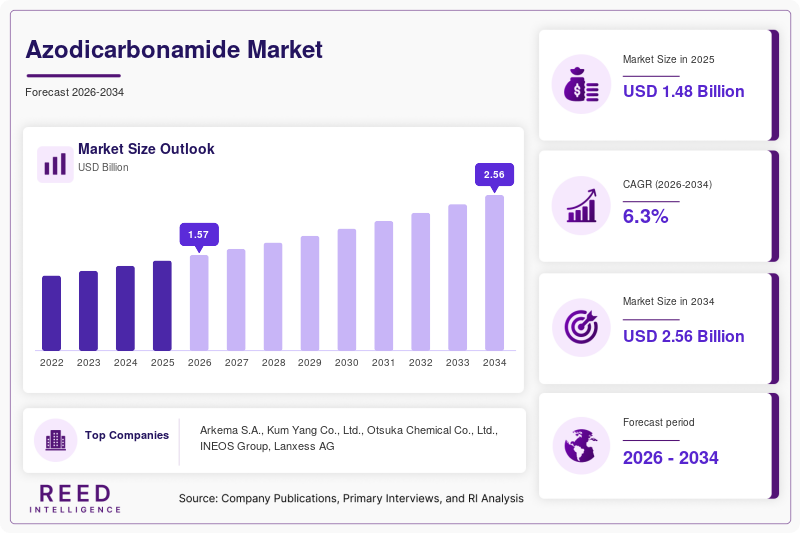
The global Azodicarbonamide Market size was valued at approximately USD 1.48 billion in 2026 and is projected to reach nearly USD 2.41 billion by 2034, expanding at a CAGR of 6.3% during the forecast period from 2026 to 2034. Azodicarbonamide is widely used as a chemical blowing agent in polymer and rubber processing applications, particularly in PVC, EVA, synthetic leather, insulation materials, footwear, and packaging products. The market continues to witness steady expansion due to rising industrial production, increasing construction activities, and growing demand for lightweight polymer-based materials across manufacturing sectors.
One of the major global factors supporting market growth is the rapid expansion of the plastics and polymer processing industry. Manufacturers across automotive, infrastructure, electrical insulation, and consumer goods sectors are increasingly adopting lightweight and durable polymer materials to reduce production costs and improve operational efficiency. Azodicarbonamide plays an important role in improving foam structure, insulation properties, flexibility, and product consistency. Growing urbanization in emerging economies has further accelerated the use of PVC flooring, synthetic leather, cable insulation, and footwear materials, which continues to create demand for azodicarbonamide-based compounds.
Key Highlights
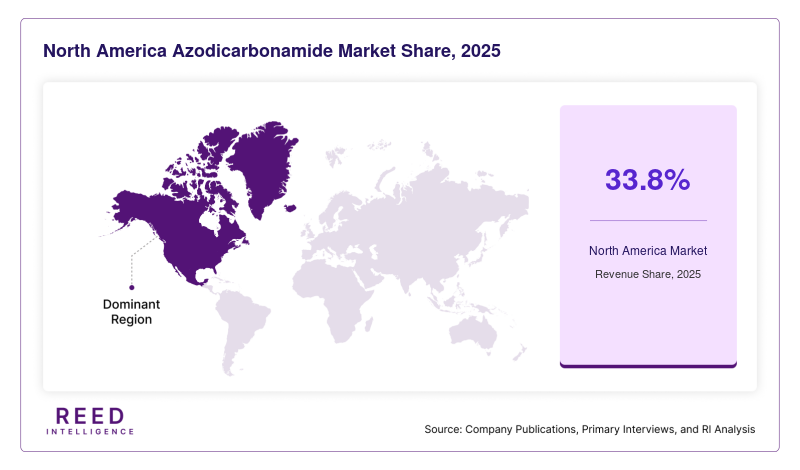
- North America dominated the market with a 33.8% share in 2025.Asia Pacific is expected to grow at the fastest CAGR of 7.8% during 2026–2034.
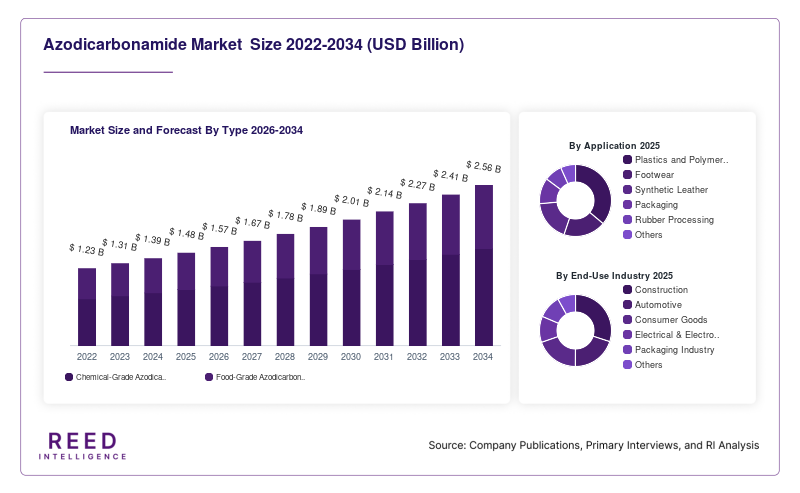
- By type, chemical-grade azodicarbonamide accounted for the largest share of 57.4%, while food-grade azodicarbonamide is projected to grow at a CAGR of 7.1%.
- By application, plastics and polymer foaming led with a 44.6% share, whereas footwear applications are expected to expand at a CAGR of 7.9%.
- By end-use industry, construction accounted for the largest market share of 36.1%, while automotive applications are projected to grow at a CAGR of 8.2%.
- The United States remained the dominant country, with market values of USD 392 million in 2024 and USD 417 million in 2025.
Market Trends
Rising Demand for Lightweight Polymer Foams in Automotive Manufacturing
The automotive industry is increasingly focusing on lightweight materials to improve fuel efficiency, reduce emissions, and enhance vehicle performance. This trend has significantly increased the use of polymer foams manufactured with azodicarbonamide as a blowing agent. Automotive manufacturers are using foam-based materials in seating systems, insulation panels, dashboards, headliners, and door trims to achieve weight reduction targets without compromising durability or comfort. The growing adoption of electric vehicles has also increased demand for lightweight interior materials and thermal insulation products, creating favorable conditions for azodicarbonamide consumption. Manufacturers are investing in advanced polymer processing technologies that improve foam consistency and structural strength, further supporting market growth across global automotive supply chains.
Expansion of Synthetic Leather and Footwear Manufacturing
The increasing production of synthetic leather products and sports footwear has become another important trend shaping the azodicarbonamide market. EVA and PVC foams produced using azodicarbonamide are widely utilized in shoe soles, cushioning materials, artificial leather, and flexible consumer products. Rising urbanization, changing consumer lifestyles, and growing disposable income in emerging economies have boosted demand for affordable and durable footwear products. Major footwear manufacturing countries in Asia Pacific are expanding production capacities to support export demand from Europe and North America. In addition, manufacturers are adopting improved foam processing technologies that enhance product flexibility, softness, and shock absorption. These developments are expected to sustain long-term demand for azodicarbonamide in footwear and synthetic leather applications.
Market Drivers
Growth in Construction and Infrastructure Development Activities
The expansion of construction and infrastructure projects worldwide continues to drive demand for azodicarbonamide-based polymer products. The material is extensively used in PVC flooring, insulation materials, wall panels, roofing sheets, sealants, and cable insulation systems. Governments across developing economies are investing heavily in transportation infrastructure, smart cities, residential housing, and industrial facilities, leading to increased consumption of polymer-based construction materials. Azodicarbonamide improves foam uniformity and thermal insulation properties, making it suitable for modern construction applications. The growing need for lightweight and energy-efficient building materials is encouraging manufacturers to incorporate advanced polymer foaming technologies into production processes. This trend is expected to create stable growth opportunities for the market throughout the forecast period.
Increasing Industrialization and Polymer Processing Capacity Expansion
Rapid industrialization in emerging markets has contributed significantly to the growth of polymer processing industries, thereby increasing demand for azodicarbonamide. Countries across Asia Pacific and Latin America are witnessing strong investments in plastic manufacturing facilities, rubber processing plants, and chemical production units. Manufacturers are expanding their production capacities to meet rising demand for consumer goods, packaging materials, electrical components, and industrial products. Azodicarbonamide is preferred because of its cost efficiency, compatibility with multiple polymers, and ability to produce consistent foam structures. Additionally, technological advancements in extrusion and injection molding processes are supporting wider adoption of chemical blowing agents. Growing industrial output and export-oriented manufacturing activities are likely to maintain strong market demand in the coming years.
Market Restraint
Regulatory Concerns Regarding Chemical Usage and Worker Safety
Regulatory scrutiny related to chemical handling and occupational safety remains a significant restraint for the azodicarbonamide market. Several countries have implemented strict regulations governing the use, transportation, and storage of chemical blowing agents due to concerns associated with respiratory exposure and processing emissions. Manufacturers operating in highly regulated regions must comply with stringent environmental and workplace safety standards, which increases operational costs and production complexity. In addition, some food industry applications involving azodicarbonamide have faced regulatory limitations and consumer concerns, leading companies to reformulate products and adopt alternative additives. These regulatory developments have encouraged some manufacturers to shift toward alternative foaming technologies with lower environmental impact. Smaller producers may face challenges in maintaining compliance with evolving standards, potentially limiting market penetration and slowing overall industry growth in certain developed economies.
Market Opportunities
Development of Advanced Low-Residue Blowing Agent Technologies
The increasing focus on cleaner production technologies is creating opportunities for manufacturers to develop advanced low-residue azodicarbonamide formulations. Industries such as automotive, electrical insulation, and medical packaging require high-performance polymer foams with minimal impurities and consistent cell structures. Producers are investing in research and development activities to improve thermal decomposition characteristics and reduce processing residues. These innovations help manufacturers meet strict industrial quality standards while improving production efficiency. The growing preference for precision-engineered polymer products is encouraging chemical companies to introduce customized blowing agent formulations for specific applications. As industries continue to demand higher-performance materials, advanced azodicarbonamide technologies are expected to gain wider commercial adoption across multiple sectors.
Rising Demand from Emerging Packaging and Consumer Goods Industries
The growing packaging and consumer goods sectors in developing economies present significant opportunities for the azodicarbonamide market. Flexible foam materials produced using azodicarbonamide are increasingly utilized in protective packaging, household products, sports equipment, and consumer accessories. Expanding e-commerce activities and rising demand for durable packaging materials are contributing to greater polymer foam consumption worldwide. Manufacturers are also developing lightweight packaging solutions to reduce transportation costs and improve logistics efficiency. Rapid population growth, urban expansion, and increasing consumer spending in emerging countries are expected to support the expansion of packaging production facilities. These factors are likely to create new revenue opportunities for azodicarbonamide manufacturers and suppliers over the forecast period.
Segmental Analysis
By Type
Chemical-grade azodicarbonamide dominated the market in 2024 with a market share of approximately 57.4%. This segment maintains a strong position due to its extensive use in polymer foaming, rubber processing, insulation materials, and industrial plastic applications. Chemical-grade products are preferred because they provide stable decomposition characteristics and consistent foam expansion properties during manufacturing processes. Industries such as automotive, construction, and electrical insulation continue to rely heavily on chemical-grade blowing agents to improve material flexibility and reduce product weight. The segment also benefits from growing investments in industrial polymer processing facilities across emerging economies. Increased demand for lightweight construction materials and advanced packaging products has further strengthened consumption levels within this segment across both developed and developing markets.
Food-grade azodicarbonamide is projected to witness the fastest CAGR of 7.1% during the forecast period due to increasing demand for controlled food processing additives in regulated industrial applications. Although regulatory restrictions exist in some countries, several emerging markets continue to utilize food-grade azodicarbonamide in flour treatment and bakery production processes. Manufacturers are focusing on improving product purity, processing consistency, and compliance with regional food safety standards. Growing packaged food consumption and expanding bakery industries in Asia Pacific and Latin America are creating opportunities for market participants. Additionally, food manufacturers are investing in production efficiency improvements, which supports demand for specialized additives capable of improving dough texture and baking performance across commercial-scale operations.
By Application
Plastics and polymer foaming represented the largest application segment in 2024, accounting for nearly 44.6% of the global market share. The segment continues to dominate because azodicarbonamide is extensively used in PVC, EVA, polyethylene, and rubber foam manufacturing processes. Manufacturers prefer azodicarbonamide because it enhances foam uniformity, thermal insulation, flexibility, and lightweight characteristics. Demand for polymer foams remains strong across automotive interiors, construction insulation, cable coatings, packaging materials, and consumer products. The rapid expansion of infrastructure development projects and increasing use of flexible polymer materials in industrial applications continue to support this segment’s growth. In addition, advancements in extrusion and molding technologies have improved foam quality and production efficiency, strengthening the adoption of azodicarbonamide-based blowing agents.
Footwear applications are anticipated to register the fastest CAGR of 7.9% during the forecast period owing to growing global demand for athletic shoes, casual footwear, and comfort-based consumer products. EVA foam materials produced using azodicarbonamide are widely used in shoe soles and cushioning systems because they provide shock absorption, flexibility, and lightweight performance. Expanding urban populations and rising disposable incomes in developing economies have significantly increased footwear consumption. Manufacturers are also adopting advanced foam processing technologies that improve durability and design flexibility. Asia Pacific continues to lead global footwear manufacturing activities, particularly in China, Vietnam, and India, which further supports the growth of this application segment. Export-oriented production facilities are expected to generate additional demand for high-performance polymer blowing agents.
By End-Use Industry
The construction industry emerged as the leading end-use segment in 2024, accounting for approximately 36.1% of the overall market share. The segment benefits from increasing use of polymer foam materials in insulation systems, flooring, wall panels, roofing materials, and piping applications. Azodicarbonamide helps manufacturers produce lightweight and durable construction materials with improved thermal and acoustic insulation properties. Rising investments in residential housing, commercial infrastructure, and industrial facilities continue to support market demand worldwide. Governments across emerging economies are prioritizing infrastructure modernization and energy-efficient building projects, which has increased the use of advanced polymer products. In addition, rapid urbanization and population growth are creating sustained demand for affordable and efficient construction materials across global markets.
Automotive applications are expected to grow at the fastest CAGR of 8.2% between 2026 and 2034 due to increasing demand for lightweight vehicles and electric mobility solutions. Automotive manufacturers are using polymer foams in seating systems, dashboards, thermal insulation, door panels, and interior trim components to reduce overall vehicle weight and improve fuel efficiency. The transition toward electric vehicles has accelerated demand for advanced insulation materials capable of improving battery thermal management and passenger comfort. Automakers are also focusing on sustainable manufacturing processes and material optimization strategies, which support the adoption of lightweight polymer technologies. Continuous innovation in automotive interior design and increasing production of electric vehicles across Asia Pacific, Europe, and North America are expected to strengthen segment growth throughout the forecast period.
Regional Analysis
North America
North America accounted for approximately 33.8% of the global azodicarbonamide market share in 2025 and maintained its position as the leading regional market. The region is projected to grow at a CAGR of 5.7% during the forecast period due to strong demand from construction, automotive, and polymer processing industries. The United States and Canada continue to witness stable investments in infrastructure modernization and industrial manufacturing activities, which support the consumption of polymer foam materials. Rising demand for lightweight automotive components and advanced insulation materials has also contributed to regional market expansion.
The United States remained the dominant country in North America due to its extensive polymer manufacturing capacity and well-established industrial base. A major growth factor supporting the country’s market is the increasing adoption of lightweight foam materials in electric vehicle production. Automotive manufacturers are incorporating advanced polymer foams into vehicle interiors and thermal insulation systems to improve energy efficiency and passenger comfort. The country also benefits from strong research and development investments focused on advanced chemical processing technologies and improved material performance.
Europe
Europe represented nearly 26.1% of the global azodicarbonamide market in 2025 and is expected to register a CAGR of 5.4% from 2026 to 2034. The region’s market growth is supported by stable demand for polymer foams across construction, footwear, automotive, and industrial applications. Countries such as Germany, France, and Italy continue to expand manufacturing activities related to automotive interiors, cable insulation, and engineered polymer products. The region’s emphasis on energy-efficient construction materials has also increased demand for foam insulation products produced using chemical blowing agents.
Germany emerged as the dominant country within the European market due to its advanced automotive manufacturing sector and strong industrial infrastructure. One unique growth factor driving the German market is the increasing production of high-performance automotive interiors designed for electric mobility platforms. Manufacturers are using lightweight polymer foams to improve cabin insulation and reduce vehicle weight. In addition, Germany’s extensive chemical industry supports continuous innovation in polymer additives and processing technologies, helping local manufacturers maintain competitive production capabilities.
Asia Pacific
Asia Pacific held approximately 24.7% of the global market share in 2025 and is anticipated to grow at the fastest CAGR of 7.8% during the forecast period. Rapid industrialization, urban development, and expanding manufacturing activities across China, India, Japan, and Southeast Asia continue to drive market demand. The region has become a major hub for footwear manufacturing, synthetic leather production, and plastic processing industries. Increasing investments in residential construction and transportation infrastructure projects are further accelerating the adoption of polymer foam materials across various industrial applications.
China dominated the Asia Pacific azodicarbonamide market owing to its large-scale chemical manufacturing industry and extensive export-oriented polymer production capacity. A significant growth factor supporting the Chinese market is the rapid expansion of domestic footwear and consumer goods manufacturing industries. The country continues to experience strong demand for EVA and PVC foam materials used in sports footwear, packaging products, and industrial insulation applications. In addition, supportive industrial policies and increasing investments in advanced manufacturing technologies are strengthening the country’s position within the global market.
Middle East & Africa
The Middle East & Africa region accounted for around 8.2% of the global azodicarbonamide market share in 2025 and is projected to expand at a CAGR of 6.1% through 2034. Growing investments in infrastructure development, industrial manufacturing, and construction activities are supporting regional demand for polymer-based materials. Countries across the Gulf region are focusing on diversification strategies that promote domestic manufacturing and chemical processing industries. Increasing demand for cable insulation, construction foams, and packaging materials is contributing to stable market expansion across the region.
Saudi Arabia emerged as the dominant country in the Middle East & Africa market due to its strong petrochemical industry and increasing investments in industrial infrastructure. One distinctive growth factor driving the Saudi Arabian market is the development of large-scale industrial cities and manufacturing zones under national economic diversification programs. These projects are increasing demand for insulation materials, polymer foams, and construction products that utilize azodicarbonamide. The country’s access to raw materials and expanding chemical processing capabilities also support long-term industry development.
Latin America
Latin America captured approximately 7.2% of the global market share in 2025 and is forecast to grow at a CAGR of 5.9% during the assessment period. Rising industrialization, increasing packaging demand, and growing construction activities are supporting market growth throughout the region. Countries such as Brazil and Mexico continue to witness expanding production of polymer products used in automotive parts, footwear, and infrastructure applications. Demand for flexible foam materials has also increased due to the growth of consumer goods manufacturing and urban housing projects.
Brazil remained the dominant country within the Latin American market due to its large industrial manufacturing base and expanding footwear production sector. A key growth factor supporting the Brazilian market is the increasing domestic demand for affordable footwear and synthetic leather products. Local manufacturers are expanding production facilities to meet rising consumer demand and export opportunities. In addition, infrastructure investments related to residential construction and transportation networks are creating additional demand for PVC insulation materials and polymer foam products across the country.
Competitive Landscape
The global azodicarbonamide market is moderately consolidated, with major chemical manufacturers competing through production capacity expansion, product innovation, and regional distribution strategies. Companies are focusing on developing high-purity and low-residue blowing agents to meet evolving industrial requirements and environmental regulations. Strategic collaborations with polymer manufacturers and footwear producers have become common among leading players seeking to strengthen market presence and supply chain efficiency.
Arkema S.A. emerged as one of the leading participants in the market due to its extensive specialty chemical portfolio and strong presence across industrial polymer applications. The company recently expanded its advanced polymer additive production capabilities to support growing demand from automotive and construction industries. Other major companies are also investing in research activities aimed at improving foam performance, decomposition control, and environmental compliance.
Key Players
- Arkema S.A.
- Kum Yang Co., Ltd.
- Otsuka Chemical Co., Ltd.
- Abtonsmart Chemicals Group
- Jiangxi Selon Industrial Co., Ltd.
- Weifang Yaxing Chemical Co., Ltd.
- Ajanta Group
- Paro Chemicals
- HPL Additives Limited
- INEOS Group
- Sundow Polymers Co., Ltd.
- Lion Specialty Chemicals Co., Ltd.
- Hangzhou Fuyang Jingcheng Chemical Co., Ltd.
- Rupali Industries
- Lanxess AG
Recent Developments
- Arkema S.A. expanded its specialty polymer additive production line in 2025 to improve supply capabilities for automotive and construction applications.
- Kum Yang Co., Ltd. introduced a new low-residue azodicarbonamide formulation designed for advanced EVA foam manufacturing processes in 2024.
- HPL Additives Limited increased its export distribution network across Southeast Asia and Latin America to strengthen regional market penetration in 2025.
- Otsuka Chemical Co., Ltd. invested in process optimization technologies focused on improving thermal decomposition control and foam consistency during industrial polymer processing in 2024.
Azodicarbonamide Market Segments
By Type
- Chemical-Grade Azodicarbonamide
- Food-Grade Azodicarbonamide
By Application
- Plastics and Polymer Foaming
- Footwear
- Synthetic Leather
- Packaging
- Rubber Processing
- Others
By End-Use Industry
- Construction
- Automotive
- Consumer Goods
- Electrical & Electronics
- Packaging Industry
- Others
By Region
- North America
- Europe
- APAC
- Middle East and Africa
- LATAM