Azotobacter Based Biofertilizer Market Size, Share & Demand Report By Formulation Type (Liquid Biofertilizers, Carrier-Based Biofertilizers, Consortium Biofertilizers), By Crop Type (Cereals & Grains, Fruits & Vegetables, Oilseeds & Pulses, Plantation Crops, Others), By Application Method (Seed Treatment, Soil Application, Fertigation, Foliar Application), By Region & Segment Forecasts, 2026–2034
USD 3950
Market Overview
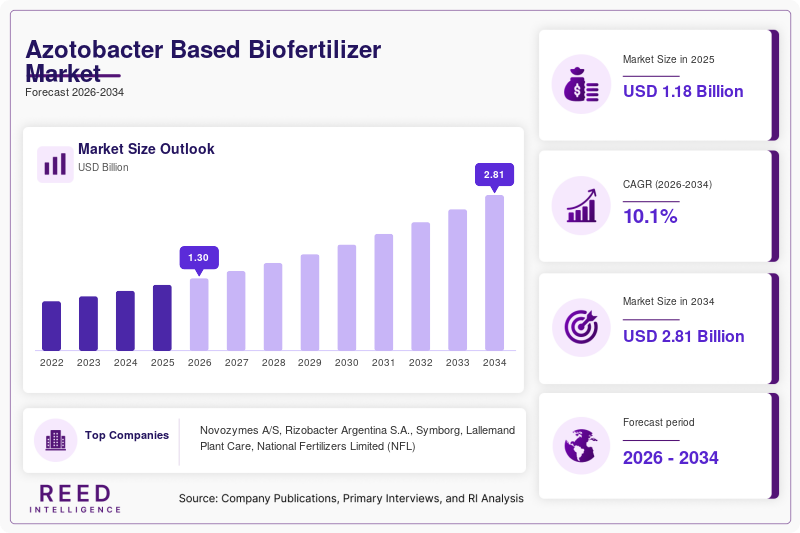
The global Azotobacter Based Biofertilizer Market size was valued at approximately USD 1.18 billion in 2026 and is projected to reach USD 2.54 billion by 2034, expanding at a CAGR of 10.1% during 2026–2034. The market is experiencing steady growth due to the increasing adoption of sustainable agricultural practices, rising concerns regarding soil degradation, and growing demand for environmentally responsible crop nutrition solutions. Azotobacter-based biofertilizers contain beneficial nitrogen-fixing bacteria that improve soil fertility, enhance nutrient availability, and support plant growth without causing adverse environmental effects associated with excessive chemical fertilizer use.
A major global factor supporting market expansion is the transition toward regenerative and organic farming systems. Governments, agricultural organizations, and food supply chains are encouraging farmers to reduce synthetic fertilizer dependency and improve soil health through biological inputs. Azotobacter biofertilizers contribute to nitrogen fixation, production of plant growth-promoting substances, and enhanced microbial activity in soil, making them an important component of integrated nutrient management programs. Increasing awareness among farmers regarding long-term productivity gains and cost optimization further supports product adoption.
Key Highlights
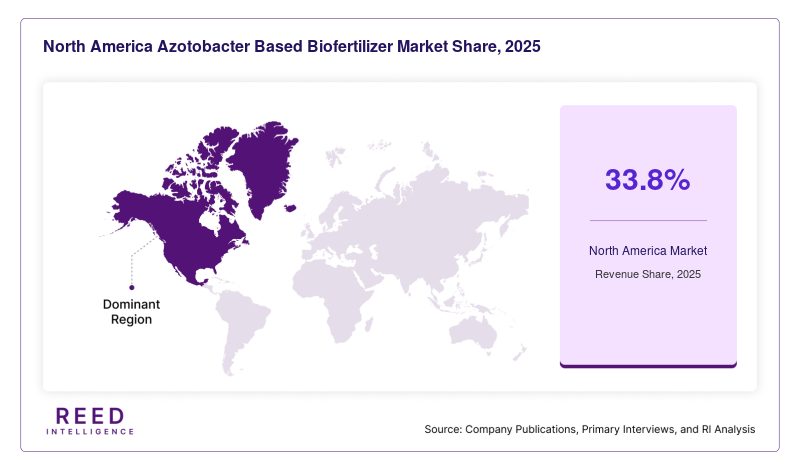
- North America dominated the market with a 33.8% share in 2025.
- Asia Pacific is expected to grow at the fastest CAGR of 11.8% during 2026–2034.
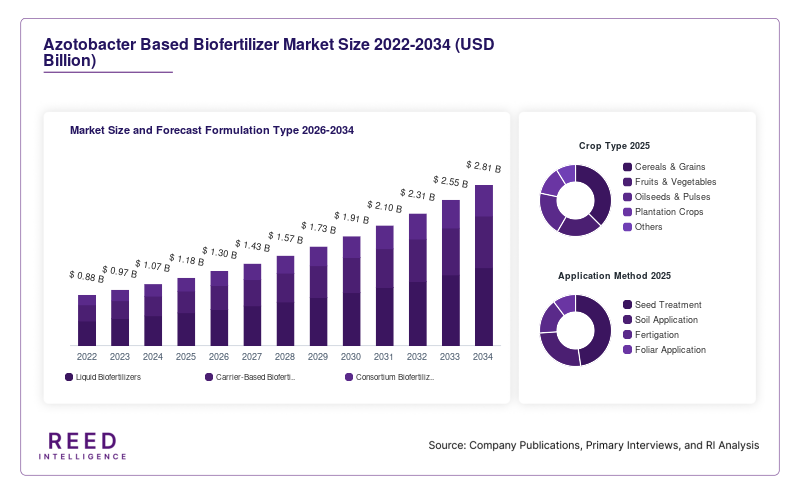
- By formulation type, liquid biofertilizers accounted for the largest share of 41.6%.
- while consortium biofertilizers are projected to grow at a CAGR of 12.3%.
- By crop type, cereals and grains led with a 44.2% share.
- whereas fruits and vegetables are expected to expand at a CAGR of 12.8%.
- By application method, seed treatment held the largest share of 46.1%.
- while fertigation application is anticipated to grow at a CAGR of 13.1%.
- India remained the dominant country, with market values of USD 182 million in 2024 and USD 201 million in 2025.
Market Trends
Growing Integration of Biofertilizers into Regenerative Agriculture Programs
Regenerative agriculture is becoming a central theme across global farming systems, creating strong momentum for Azotobacter-based biofertilizers. Agricultural producers are increasingly seeking biological solutions that improve soil structure, microbial diversity, and nutrient cycling while maintaining crop productivity. Azotobacter formulations align well with these objectives because they naturally fix atmospheric nitrogen and stimulate root development. Large-scale farms are incorporating biofertilizers alongside conservation tillage, crop rotation, and cover-cropping practices. This integration is helping reduce synthetic fertilizer consumption while improving soil resilience. As food manufacturers and retailers establish sustainability targets throughout supply chains, demand for biologically derived crop nutrition products is expected to rise steadily across commercial agriculture.
Expansion of Advanced Liquid and Microbial Consortium Formulations
Manufacturers are investing in advanced formulation technologies to improve field performance and storage stability. Liquid biofertilizers are gaining popularity due to ease of application, longer shelf life, and better microbial survival rates. At the same time, consortium products containing Azotobacter combined with phosphate-solubilizing bacteria and other beneficial microorganisms are attracting significant attention. These multi-functional formulations provide broader agronomic benefits and help farmers address multiple soil fertility challenges through a single application. Enhanced packaging technologies, microbial encapsulation methods, and precision application compatibility are improving adoption rates. As agricultural input suppliers expand their biological product portfolios, innovation in formulation development is expected to remain a major market trend.
Market Drivers
Rising Demand for Sustainable Crop Nutrition Solutions
Growing concerns regarding environmental degradation caused by excessive chemical fertilizer use are encouraging adoption of sustainable nutrient management practices. Farmers across major agricultural economies are seeking alternatives that improve soil fertility while reducing ecological impact. Azotobacter-based biofertilizers offer an effective solution by naturally fixing atmospheric nitrogen and supporting healthy crop growth. Their ability to reduce dependence on synthetic nitrogen fertilizers makes them increasingly attractive in regions facing soil quality deterioration and rising input costs. Government initiatives promoting sustainable agriculture and organic cultivation further strengthen market demand. As agricultural stakeholders prioritize long-term soil health and resource efficiency, biofertilizer utilization is expected to increase significantly throughout the forecast period.
Government Support and Expansion of Organic Farming
Many countries are implementing policies that encourage biological agricultural inputs and environmentally responsible farming practices. Subsidy programs, certification schemes, and awareness campaigns are helping farmers understand the benefits of microbial fertilizers. Organic farming acreage continues to expand globally, creating a favorable environment for Azotobacter-based products. These biofertilizers are widely accepted in organic production systems and contribute to improved nutrient availability without violating certification requirements. Public investments in agricultural research and extension services are also supporting commercialization and farmer education. The combination of regulatory support, rising consumer demand for organic food products, and increasing agricultural sustainability initiatives continues to drive long-term market growth.
Market Restraint
Limited Farmer Awareness and Product Performance Variability
Despite growing interest in biological agricultural inputs, limited awareness among farmers remains a significant challenge for the Azotobacter Based Biofertilizer Market. Many producers continue to rely heavily on conventional fertilizers due to familiarity, immediate visible results, and established distribution networks. Biofertilizer effectiveness can vary depending on soil conditions, temperature, moisture levels, microbial survival rates, and crop management practices. Inconsistent field performance may discourage adoption among growers who expect uniform outcomes. Small-scale farmers in developing economies often lack access to technical guidance regarding application methods and storage requirements. Furthermore, inadequate distribution infrastructure in remote agricultural regions restricts product availability. These factors collectively slow market penetration and create barriers for manufacturers attempting to expand into new geographic markets. Continuous farmer education, quality standardization, and improved formulation technologies remain essential for overcoming these limitations and supporting broader adoption.
Market Opportunities
Increasing Adoption Across High-Value Horticulture Crops
The cultivation of fruits, vegetables, spices, and specialty crops is expanding globally due to changing dietary preferences and rising consumer demand for nutrient-rich foods. High-value horticulture producers are increasingly focused on improving crop quality, yield consistency, and soil health while minimizing chemical residue concerns. Azotobacter-based biofertilizers support these objectives through enhanced nutrient uptake and improved root development. Horticulture crops often provide higher economic returns, enabling growers to invest in premium biological inputs. Additionally, export-oriented producers face stringent quality standards that encourage sustainable cultivation practices. As commercial horticulture continues to expand across Asia Pacific, Latin America, and Africa, significant opportunities are emerging for biofertilizer manufacturers targeting specialized crop segments.
Growth Potential Through Precision Agriculture Integration
Precision agriculture technologies are creating new opportunities for the deployment of biological crop nutrition products. Farmers increasingly use data-driven management tools to optimize fertilizer applications and improve resource efficiency. Azotobacter-based biofertilizers can be integrated into precision nutrient management programs to enhance productivity while reducing environmental impact. Advanced application systems, variable-rate technologies, and fertigation platforms enable more accurate delivery of microbial formulations. Agricultural technology providers are also developing digital advisory platforms that help farmers monitor soil health and select appropriate biological inputs. As precision farming adoption expands globally, biofertilizer manufacturers can leverage technology partnerships to improve product effectiveness, increase farmer confidence, and access new customer segments across modern agricultural operations.
Segmental Analysis
By Formulation Type
Liquid biofertilizers emerged as the dominant subsegment and accounted for approximately 39.8% of the market share in 2024. Their widespread adoption can be attributed to superior microbial viability, convenient application methods, and extended shelf life compared with conventional carrier-based products. Liquid formulations provide improved distribution of beneficial microorganisms within the soil environment and are compatible with various farming systems. Commercial growers increasingly prefer these products because they can be integrated into existing nutrient management programs with minimal operational adjustments. Growing awareness regarding application efficiency and product reliability has strengthened demand across both developed and emerging agricultural markets.
Consortium biofertilizers are projected to be the fastest-growing subsegment, expanding at a CAGR of 12.3% through 2034. These formulations combine Azotobacter with other beneficial microorganisms capable of phosphate solubilization, potassium mobilization, and plant growth promotion. Farmers are increasingly attracted to multifunctional products that deliver broader agronomic benefits through a single application. Continuous innovation in microbial compatibility, formulation technology, and carrier materials is supporting market expansion. Rising interest in integrated soil fertility management and sustainable crop production practices further contributes to the rapid growth of consortium-based biofertilizer solutions.
By Crop Type
Cereals and grains represented the dominant subsegment and captured approximately 44.2% of total market revenue in 2024. Major crops such as wheat, rice, maize, and barley require substantial nutrient inputs to achieve optimal productivity. Azotobacter-based biofertilizers help improve nitrogen availability while supporting healthy root development and enhanced nutrient uptake. The large cultivation area associated with cereal production creates substantial demand for biological nutrient management solutions. Government programs focused on sustainable staple crop production and food security further encourage adoption. Growing awareness regarding long-term soil health benefits continues to support utilization across cereal-producing regions.
Fruits and vegetables are anticipated to record the fastest growth, with a projected CAGR of 12.8% during the forecast period. High-value horticultural crops require efficient nutrient management to maintain yield quality and marketability. Producers increasingly adopt biofertilizers to improve nutrient efficiency, reduce chemical residues, and satisfy consumer demand for sustainably produced food. Export-oriented cultivation systems are particularly supportive of biological input adoption due to stringent quality requirements. Increasing investments in protected cultivation, greenhouse farming, and precision horticulture are creating favorable opportunities for Azotobacter-based products within this rapidly expanding crop category.
By Application Method
Seed treatment held the largest share of approximately 46.1% in 2024, making it the dominant application method across the market. This approach enables direct microbial colonization of plant roots during early growth stages, improving nutrient availability and supporting vigorous crop establishment. Farmers favor seed treatment because it requires relatively small product quantities while delivering measurable agronomic benefits. The method is particularly popular among cereal and pulse growers due to its simplicity and cost-effectiveness. Expanding awareness regarding early-stage plant nutrition and increasing availability of treated seed technologies continue to support market leadership.
Fertigation application is expected to emerge as the fastest-growing subsegment, registering a CAGR of 13.1% between 2026 and 2034. The increasing adoption of drip irrigation systems and precision agriculture technologies is creating favorable conditions for fertigation-based biofertilizer delivery. This method enables efficient distribution of beneficial microorganisms while reducing nutrient losses and improving resource utilization. Commercial horticulture operations and protected cultivation facilities are increasingly integrating microbial products into fertigation programs. Technological advancements in irrigation infrastructure and growing emphasis on water-efficient farming practices are expected to accelerate growth within this application segment.
Regional Analysis
North America
North America accounted for approximately 33.8% of the global market in 2025 and maintained its position as the leading regional market. The region benefits from widespread awareness regarding sustainable farming, advanced agricultural infrastructure, and increasing demand for biological crop inputs. The market is projected to expand at a CAGR of 9.4% through 2034 as farmers continue integrating environmentally responsible nutrient management strategies into commercial crop production systems. Regulatory emphasis on soil conservation and sustainable agriculture further supports market development.
The United States represents the dominant country within the region. Strong investment in agricultural biotechnology and growing adoption of regenerative farming practices support demand for Azotobacter-based products. A unique growth factor is the increasing participation of major food companies in sustainable sourcing programs. These initiatives encourage growers to reduce synthetic fertilizer usage and improve soil health metrics, creating favorable conditions for biofertilizer adoption across large-scale farming operations.
Europe
Europe held approximately 27.1% market share in 2025 and continues to demonstrate consistent demand for biological agricultural products. The region is forecast to register a CAGR of 9.7% during the assessment period. Stringent environmental regulations and policy frameworks supporting sustainable agriculture are encouraging farmers to adopt microbial fertilizers. Growing consumer demand for organic food products and increasing pressure to reduce agricultural emissions further strengthen market expansion throughout European countries.
Germany remains the dominant country within the European market due to its strong agricultural technology sector and extensive focus on sustainable farming. A unique growth factor is the implementation of nutrient management regulations aimed at reducing environmental pollution from synthetic fertilizers. These regulations encourage agricultural producers to explore biological alternatives that maintain productivity while improving environmental performance and long-term soil quality.
Asia Pacific
Asia Pacific represented nearly 24.6% of global revenue in 2025 and is expected to achieve the fastest growth rate with a CAGR of 11.8% through 2034. Rapid population growth, increasing food demand, and extensive agricultural activity contribute to strong regional market potential. Governments across the region are promoting biofertilizer utilization through subsidy programs and awareness initiatives. Rising concerns regarding soil degradation and declining fertility levels are further encouraging adoption of biological nutrient management solutions.
India dominates the regional market and serves as one of the largest consumers of Azotobacter-based biofertilizers globally. A unique growth factor is the government's emphasis on reducing chemical fertilizer dependence through sustainable agriculture initiatives. Extensive farmer training programs, increasing organic cultivation acreage, and strong domestic production capabilities are accelerating product adoption across diverse crop categories throughout the country.
Middle East & Africa
The Middle East & Africa accounted for approximately 7.4% of the global market in 2025 and is projected to grow at a CAGR of 10.2% during the forecast period. Agricultural modernization efforts and increasing investments in food security programs are creating favorable market conditions. Biofertilizers are gaining attention as effective tools for improving soil fertility and reducing production costs in regions characterized by challenging environmental conditions and limited agricultural resources.
South Africa leads the regional market owing to its relatively advanced agricultural sector and growing focus on sustainable farming. A unique growth factor is the increasing adoption of climate-resilient agricultural practices designed to improve productivity under water-stressed conditions. Farmers are increasingly exploring microbial inputs that enhance nutrient efficiency and support crop growth while reducing dependency on expensive synthetic fertilizers.
Latin America
Latin America captured around 7.1% of market revenue in 2025 and is anticipated to expand at a CAGR of 10.6% through 2034. The region's large agricultural base and growing export-oriented farming activities contribute to increasing demand for biological crop nutrition products. Rising awareness regarding soil health management and the need to improve agricultural sustainability are encouraging producers to incorporate Azotobacter-based solutions into nutrient management programs.
Brazil represents the dominant country within Latin America due to its extensive cultivation of soybean, maize, sugarcane, and other commercial crops. A unique growth factor is the increasing adoption of biological agricultural technologies among large commercial farming enterprises. These producers are actively seeking cost-effective solutions that improve soil productivity while meeting sustainability requirements associated with international agricultural trade.
Competitive Landscape
The Azotobacter Based Biofertilizer Market is moderately fragmented, with a mix of multinational agricultural input companies and specialized biological product manufacturers competing for market share. Companies focus on product innovation, microbial formulation improvements, strategic partnerships, and geographic expansion to strengthen their market positions. Increasing investment in research and development is enabling manufacturers to improve microbial stability, field performance, and compatibility with modern farming systems.
Novozymes A/S remains one of the leading participants due to its extensive expertise in microbial technologies and biological agricultural solutions. The company continues to expand its biofertilizer portfolio through advanced microbial research and collaborations with agricultural stakeholders. Other notable market participants are enhancing distribution networks and investing in farmer education initiatives to improve adoption rates. A recent industry development involved the introduction of next-generation consortium biofertilizers featuring multiple beneficial microbial strains designed to improve nutrient efficiency and crop resilience. Competitive dynamics are expected to intensify as demand for sustainable agricultural inputs continues to rise across global farming markets.
Key Players
- Novozymes A/S
- Rizobacter Argentina S.A.
- Symborg
- Lallemand Plant Care
- National Fertilizers Limited
- Gujarat State Fertilizers & Chemicals Limited
- T. Stanes & Company Limited
- Madras Fertilizers Limited
- Mapleton Agri Biotec
- BioWorks Inc.
- IPL Biologicals Limited
- Kiwa Bio-Tech Products Group
- Agri Life
- Biomax Naturals
- Green Vision Life Sciences
Recent Developments
- Novozymes A/S launched an enhanced microbial biofertilizer platform designed to improve nitrogen fixation efficiency across multiple crop categories.
- Several Indian biofertilizer manufacturers expanded production capacity during 2025 to meet increasing demand generated by government-supported sustainable agriculture programs.
- A consortium of agricultural research institutions introduced new Azotobacter-based formulations with improved shelf life and field stability for commercial farming applications.
- Leading biological input suppliers expanded distribution partnerships across Latin America to strengthen access to biofertilizer products among commercial crop producers.
- Multiple agricultural technology companies initiated precision farming collaborations aimed at integrating biofertilizer recommendations into digital nutrient management platforms.
Azotobacter Based Biofertilizer Market Segments
Formulation Type
- Liquid Biofertilizers
- Carrier-Based Biofertilizers
- Consortium Biofertilizers
Crop Type
- Cereals & Grains
- Fruits & Vegetables
- Oilseeds & Pulses
- Plantation Crops
- Others
Application Method
- Seed Treatment
- Soil Application
- Fertigation
- Foliar Application
By Region
- North America
- Europe
- APAC
- Middle East and Africa
- LATAM