Baby Monitor Market Size, Share Demand Report By Product Type (Audio Baby Monitors, Video Baby Monitors, Smart Wi-Fi Baby Monitors), By Connectivity (Wireless Monitors, Wi-Fi Enabled Monitors, Bluetooth Monitors), By Application (Residential Use, Daycare Centers, Hospitals and Neonatal Care), By Distribution Channel (Online Retail, Specialty Baby Stores, Supermarkets and Hypermarkets) By Region & Segment Forecasts, 2026–2034
USD 3950
Market Overview
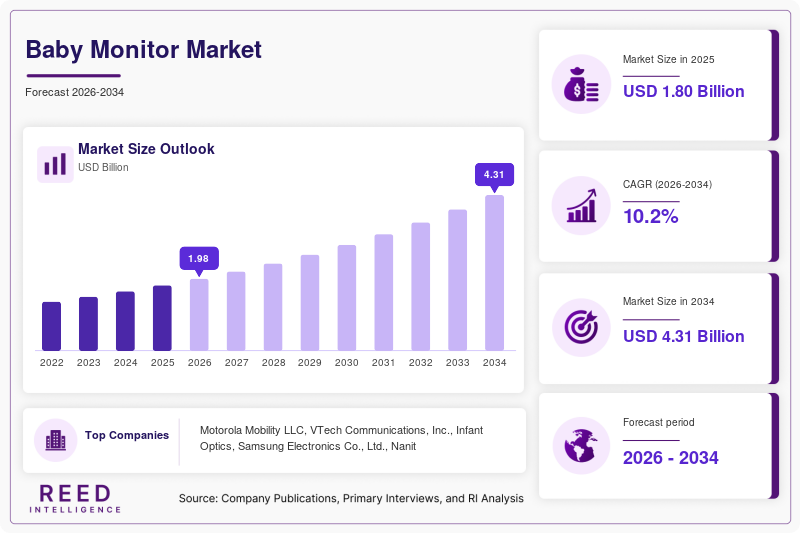
The global Baby Monitor Market Size was valued at USD 1.8 billion in 2026 and is projected to reach USD 3.9 billion by 2034, expanding at a CAGR of 10.2% during the forecast period from 2026 to 2034. The market growth has been supported by the rising global focus on infant safety, increasing urbanization, and growing adoption of smart parenting devices among millennial and Gen Z parents. Demand for connected childcare technologies has expanded steadily as families increasingly rely on remote monitoring systems that provide real-time video, audio, breathing, and sleep-tracking functions. The growing penetration of smartphones and home Wi-Fi networks has also strengthened the adoption of app-enabled baby monitoring systems across developed and developing economies.
The Baby Monitor Market has evolved from conventional audio devices into advanced AI-enabled monitoring ecosystems capable of delivering sleep analytics, room temperature tracking, motion sensing, and cloud-based alerts. Manufacturers are integrating machine learning capabilities and smart sensors into modern products to improve infant care and convenience for parents. In addition, rising disposable income and increased spending on premium childcare products have accelerated the demand for high-definition video monitors and wearable infant monitoring systems.
Key Highlights:
- North America dominated the Baby Monitor Market with a 36.8% share in 2025, while Asia Pacific is projected to register the fastest CAGR of 12.1% during 2026–2034.
- Video baby monitors represented the leading product segment with a 42.5% market share in 2025, whereas smart Wi-Fi baby monitors are expected to grow at a CAGR of 13.4% during the forecast period.
- Residential applications accounted for the largest share of 68.3% in 2025, while hospitals and neonatal care applications are projected to expand at a CAGR of 11.6%.
- Online retail remained the dominant distribution channel with a 48.7% share in 2025 owing to wider product availability and discount offerings.
- The United States Baby Monitor Market was valued at USD 480 million in 2024 and reached approximately USD 525 million in 2025.
Market Trends
Smart AI-Enabled Monitoring Systems
The Baby Monitor Market is witnessing significant transformation through the adoption of AI-powered monitoring systems. Manufacturers are integrating artificial intelligence technologies into baby monitors to provide advanced sleep tracking, breathing analysis, facial recognition, cry detection, and predictive alerts. Parents are increasingly preferring devices that can provide insights regarding infant sleep quality and wellness patterns. AI-enabled monitoring solutions also reduce false alarms and improve monitoring accuracy. This trend is expected to reshape premium product categories across developed regions.
Expansion of Wearable Infant Monitoring Devices
Wearable baby monitoring products are becoming increasingly popular across healthcare-conscious households. Smart socks, breathing bands, and wearable movement trackers are gaining traction due to their ability to continuously monitor infant vital signs. These devices are particularly appealing to first-time parents seeking enhanced safety assurance. The growing acceptance of wearable healthcare technologies and miniaturized sensor components is expected to support this trend across global markets.
Market Drivers
Rising Awareness Regarding Infant Safety
Growing awareness regarding infant health and safety has become a major driver for the Baby Monitor Market. Parents are increasingly investing in advanced monitoring solutions to ensure continuous supervision during sleep and playtime. Concerns regarding sudden infant health complications and sleep safety have accelerated demand for real-time monitoring systems. The increased preference for two-way communication, night vision cameras, and temperature monitoring functions has further supported product adoption across households.
Increasing Adoption of Smart Home Technologies
The rapid growth of smart home infrastructure globally has positively influenced the Baby Monitor Market. Consumers increasingly prefer interconnected devices that can integrate seamlessly with smartphones, tablets, and voice-controlled assistants. Wi-Fi-enabled baby monitors provide remote accessibility and instant notifications, making them highly attractive for working parents. The expanding ecosystem of IoT-enabled consumer electronics continues to strengthen demand for connected baby monitoring solutions.
Market Restraint
Data Privacy and Cybersecurity Concerns
One major restraint affecting the Baby Monitor Market is the increasing concern regarding data security and privacy breaches. Internet-connected baby monitors may become vulnerable to unauthorized access or hacking incidents if security standards are weak. Consumers are becoming cautious regarding cloud storage, remote access features, and live streaming capabilities. These concerns may limit adoption among privacy-sensitive households and create challenges for manufacturers regarding cybersecurity compliance.
Market Opportunities
Integration with Telehealth and Pediatric Monitoring
The growing intersection between digital healthcare and infant monitoring technologies presents a strong opportunity for the Baby Monitor Market. Manufacturers are exploring partnerships with healthcare providers to integrate telehealth capabilities into monitoring devices. Remote pediatric consultations supported by infant health tracking may create additional growth opportunities, especially in urban healthcare systems and neonatal care environments.
Growth of Subscription-Based Monitoring Platforms
Subscription-based services linked to smart baby monitors are creating new revenue opportunities for market participants. Companies are increasingly offering cloud video storage, sleep analytics reports, AI-generated parenting insights, and wellness tracking subscriptions. These recurring service models are expected to improve customer retention while expanding long-term revenue streams for manufacturers.
Segmental Analysis
By Product Type
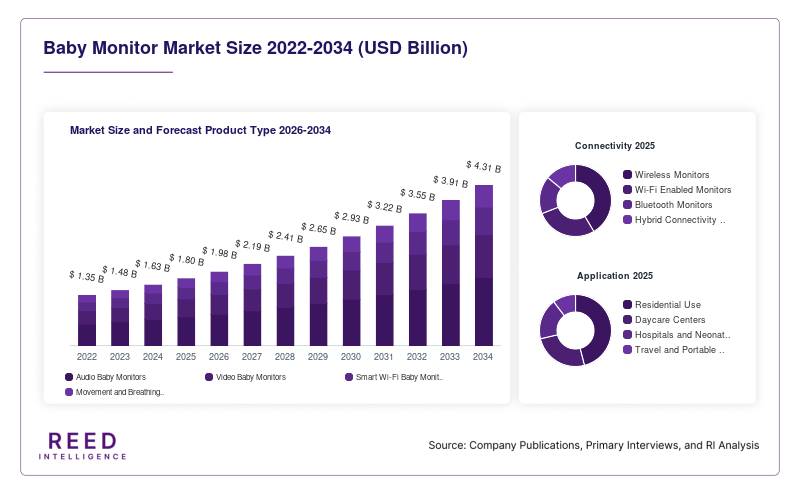
The Baby Monitor Market is segmented into audio baby monitors, video baby monitors, smart Wi-Fi baby monitors, and movement & breathing monitors.
Video baby monitors dominated the market with a 42.5% share in 2025. Consumers increasingly preferred visual monitoring solutions due to enhanced convenience, infrared night vision capabilities, and real-time surveillance functions. The growing popularity of portable video units with high-definition displays contributed significantly to segment growth.
Smart Wi-Fi baby monitors are projected to register the fastest CAGR of 13.4% during the forecast period. These products are expected to witness strong demand due to smartphone integration, cloud connectivity, AI-powered analytics, and remote access features. Increasing smart home penetration globally will continue to support segment expansion.
By Connectivity
Based on connectivity, the Baby Monitor Market is categorized into wireless monitors, Wi-Fi-enabled monitors, Bluetooth monitors, and hybrid connectivity monitors.
Wireless monitors accounted for the leading market share of 38.7% in 2025 due to their affordability and easy installation across residential environments. These products remained highly popular among households seeking reliable monitoring without internet dependency.
Wi-Fi-enabled monitors are expected to expand at the fastest CAGR of 12.9% during 2026–2034. Rising consumer preference for app-controlled monitoring systems and cloud-based accessibility is anticipated to strengthen demand. Integration with smart assistants and connected home platforms will further accelerate segment growth.
By Application
The Baby Monitor Market is segmented into residential use, daycare centers, hospitals & neonatal care, and travel & portable monitoring.
Residential use dominated the market with a 68.3% share in 2025. Increasing awareness regarding infant safety and growing adoption of connected parenting devices among households supported segment dominance. Parents increasingly invested in premium monitoring systems equipped with multiple safety features and remote accessibility.
Hospitals and neonatal care applications are projected to grow at a CAGR of 11.6% during the forecast period. Healthcare institutions are expected to adopt advanced monitoring systems to improve infant supervision and patient safety. Expansion of neonatal intensive care infrastructure will contribute significantly to future segment growth.
By Distribution Channel
Based on distribution channel, the Baby Monitor Market is divided into online retail, specialty baby stores, supermarkets & hypermarkets, and electronics stores.
Online retail emerged as the dominant segment with a 48.7% market share in 2025. Consumers increasingly preferred online platforms due to product variety, price discounts, convenience, and customer reviews. E-commerce expansion across emerging economies further strengthened this segment.
Specialty baby stores are expected to witness the fastest CAGR of 10.8% during the forecast period. Personalized product guidance, premium product availability, and growing consumer trust in specialized childcare retailers are expected to support segment growth.
Regional Analysis
North America
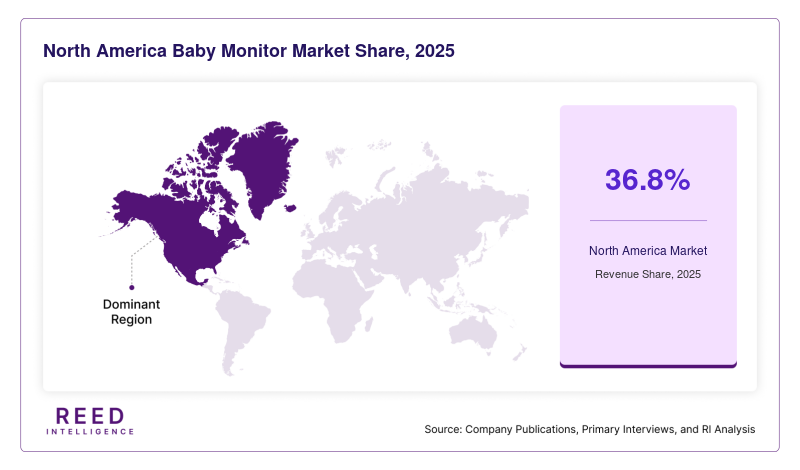
North America accounted for 36.8% of the Baby Monitor Market share in 2025. The region maintained strong demand due to high disposable income, widespread smart home adoption, and strong consumer spending on childcare technologies. Parents in the United States and Canada increasingly preferred premium monitoring devices equipped with HD video, motion detection, and smartphone integration. The United States dominated the regional market due to rising demand for connected parenting solutions and increased adoption of AI-enabled childcare devices. The regional market is projected to grow at a CAGR of 9.4% during the forecast period.
Europe
Europe represented 24.6% of the Baby Monitor Market share in 2025. The region experienced stable demand supported by growing awareness regarding infant safety standards and increased consumer preference for technologically advanced childcare products. Countries such as Germany, France, and the United Kingdom contributed significantly to regional revenue generation. Germany dominated the regional market due to strong demand for premium consumer electronics and expanding adoption of smart family devices. Europe is anticipated to register a CAGR of 8.9% during 2026–2034.
Asia Pacific
Asia Pacific held 27.3% of the Baby Monitor Market share in 2025 and is projected to witness the fastest CAGR of 12.1% during the forecast period. Rising urbanization, increasing birth rates in developing economies, and expanding middle-class populations are supporting market growth. China dominated the regional market owing to rising spending on infant care products and growing penetration of e-commerce platforms. The rapid adoption of smartphone-connected devices and increasing digital literacy are expected to strengthen future demand across the region.
Middle East & Africa
The Middle East & Africa accounted for 5.1% of the Baby Monitor Market share in 2025. Increasing urban household formation and rising awareness regarding advanced childcare products have contributed to market development in the region. The United Arab Emirates emerged as the dominant country due to high disposable income and increasing adoption of smart consumer electronics among young families. The regional market is expected to grow at a CAGR of 8.1% during the forecast period.
Latin America
Latin America captured 6.2% of the Baby Monitor Market share in 2025. The regional market benefited from increasing online retail penetration and growing consumer interest in connected home devices. Brazil dominated the regional market due to rising urbanization and expanding access to affordable smart childcare products. The Baby Monitor Market in Latin America is projected to grow at a CAGR of 8.7% during 2026–2034.
Segmental Analysis
By Product Type
The Baby Monitor Market is segmented into audio baby monitors, video baby monitors, smart Wi-Fi baby monitors, and movement & breathing monitors.
Video baby monitors dominated the market with a 42.5% share in 2025. Consumers increasingly preferred visual monitoring solutions due to enhanced convenience, infrared night vision capabilities, and real-time surveillance functions. The growing popularity of portable video units with high-definition displays contributed significantly to segment growth.
Smart Wi-Fi baby monitors are projected to register the fastest CAGR of 13.4% during the forecast period. These products are expected to witness strong demand due to smartphone integration, cloud connectivity, AI-powered analytics, and remote access features. Increasing smart home penetration globally will continue to support segment expansion.
By Connectivity
Based on connectivity, the Baby Monitor Market is categorized into wireless monitors, Wi-Fi-enabled monitors, Bluetooth monitors, and hybrid connectivity monitors.
Wireless monitors accounted for the leading market share of 38.7% in 2025 due to their affordability and easy installation across residential environments. These products remained highly popular among households seeking reliable monitoring without internet dependency.
Wi-Fi-enabled monitors are expected to expand at the fastest CAGR of 12.9% during 2026–2034. Rising consumer preference for app-controlled monitoring systems and cloud-based accessibility is anticipated to strengthen demand. Integration with smart assistants and connected home platforms will further accelerate segment growth.
By Application
The Baby Monitor Market is segmented into residential use, daycare centers, hospitals & neonatal care, and travel & portable monitoring.
Residential use dominated the market with a 68.3% share in 2025. Increasing awareness regarding infant safety and growing adoption of connected parenting devices among households supported segment dominance. Parents increasingly invested in premium monitoring systems equipped with multiple safety features and remote accessibility.
Hospitals and neonatal care applications are projected to grow at a CAGR of 11.6% during the forecast period. Healthcare institutions are expected to adopt advanced monitoring systems to improve infant supervision and patient safety. Expansion of neonatal intensive care infrastructure will contribute significantly to future segment growth.
By Distribution Channel
Based on distribution channel, the Baby Monitor Market is divided into online retail, specialty baby stores, supermarkets & hypermarkets, and electronics stores.
Online retail emerged as the dominant segment with a 48.7% market share in 2025. Consumers increasingly preferred online platforms due to product variety, price discounts, convenience, and customer reviews. E-commerce expansion across emerging economies further strengthened this segment.
Specialty baby stores are expected to witness the fastest CAGR of 10.8% during the forecast period. Personalized product guidance, premium product availability, and growing consumer trust in specialized childcare retailers are expected to support segment growth.
Competitive Landscape
The Baby Monitor Market remains moderately competitive with the presence of established consumer electronics manufacturers and specialized childcare technology companies. Leading companies are focusing on AI integration, product miniaturization, subscription-based analytics services, and strategic partnerships to strengthen their market position. Product innovation and smart home compatibility remain important competitive strategies.
Motorola Mobility LLC remained one of the leading participants in the Baby Monitor Market due to its strong global distribution network and broad portfolio of connected monitoring devices. The company recently expanded its smart baby monitor lineup with enhanced AI-powered sleep monitoring capabilities and smartphone-based parental alerts.
VTech Communications, Inc. continued strengthening its market presence through affordable video monitoring products and expanding digital connectivity features. Nanit focused on AI-based sleep analytics and cloud-enabled monitoring services. Owlet Baby Care Inc. emphasized wearable infant monitoring solutions, while Samsung Electronics Co., Ltd. leveraged its smart device ecosystem to expand connected childcare product offerings.
Key Players List
- Motorola Mobility LLC
- VTech Communications, Inc.
- Infant Optics
- Nanit
- Owlet Baby Care Inc.
- Samsung Electronics Co., Ltd.
- Philips Avent
- Angelcare Monitors Inc.
- iBaby Labs, Inc.
- Dorel Industries Inc.
- Babysense
- Summer Infant, Inc.
- Panasonic Corporation
- Lorex Technology Inc.
- Levana
- Hisense Ltd.
Recent Developments
- Motorola Mobility LLC introduced upgraded AI-powered monitoring devices featuring advanced cry detection and sleep tracking functions.
- Nanit expanded its subscription-based parenting analytics platform with enhanced wellness reporting capabilities.
- Owlet Baby Care Inc. launched a next-generation wearable infant monitoring solution integrated with smartphone health alerts.
- VTech Communications, Inc. introduced improved HD video baby monitors with expanded wireless range and temperature tracking.
- Samsung Electronics Co., Ltd. enhanced compatibility between its smart baby monitoring systems and connected home ecosystems.
Baby Monitor Market Segments
Product Type
- Audio Baby Monitors
- Video Baby Monitors
- Smart Wi-Fi Baby Monitors
- Movement and Breathing Monitors
Connectivity
- Wireless Monitors
- Wi-Fi Enabled Monitors
- Bluetooth Monitors
- Hybrid Connectivity Monitors
Application
- Residential Use
- Daycare Centers
- Hospitals and Neonatal Care
- Travel and Portable Monitoring
Distribution Channel
- Online Retail
- Specialty Baby Stores
- Supermarkets and Hypermarkets
- Electronics Stores
By Region
- North America
- Europe
- APAC
- Middle East and Africa
- LATAM