Baby Toys Market Size, Share & Trends Analysis Report by Product Type, Age Group, Material, Distribution Channel, and Region, Forecasts, 2026–2034
USD 3950
Baby Toys Market Size
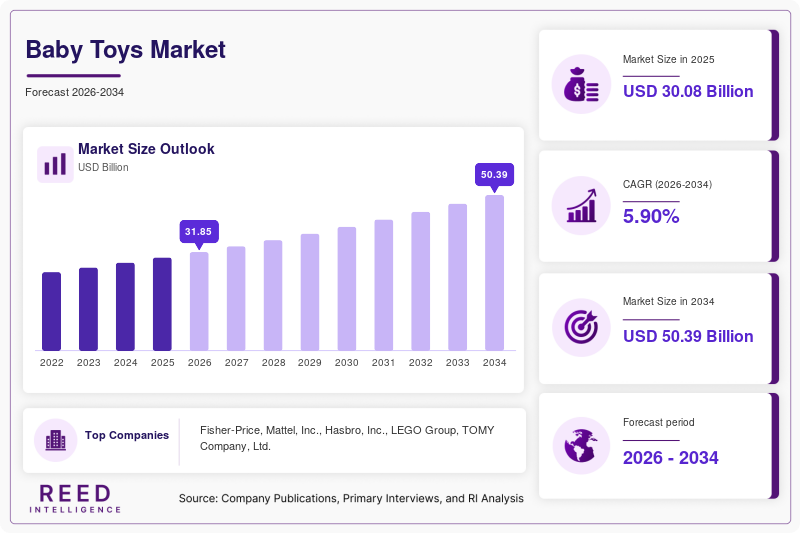
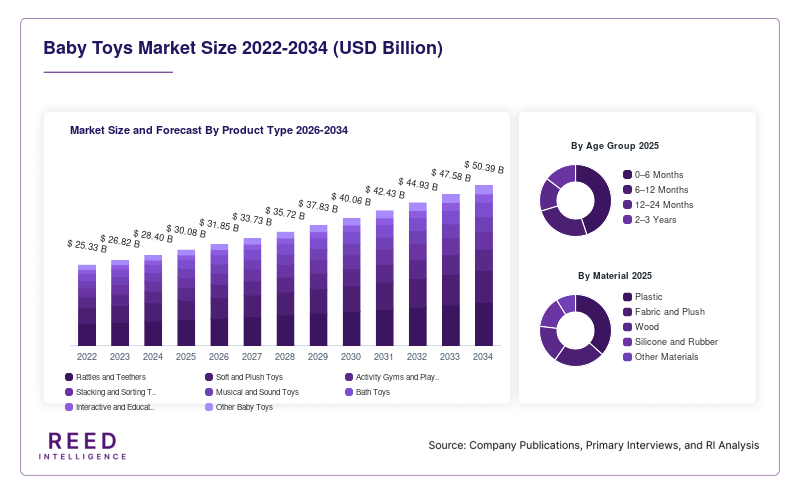
The global baby toys market is valued at USD 30.08 billion in 2026 and is projected to reach USD 50.39 billion by 2034, registering a CAGR of 5.90% during 2026–2034.
The baby toys market comprises toys and play products designed for infants and young children, supporting sensory stimulation, motor skill development, cognitive learning, and early childhood engagement. The market includes rattles, teething toys, soft toys, activity gyms, stacking toys, musical toys, bath toys, and interactive learning products. Demand is influenced by parental spending on early childhood development, increasing awareness of age-appropriate play, product safety, and the availability of toys designed to support developmental milestones.
Manufacturers are expanding product portfolios through sensory-focused designs, educational play features, sustainable materials, and products that combine entertainment with developmental benefits. E-commerce platforms and specialty baby stores are also expanding product accessibility, enabling parents to compare features, age recommendations, materials, and safety specifications. However, the market remains sensitive to product quality, regulatory compliance, pricing, and consumer confidence in child safety.
Baby Toys Market Drivers
Parents increasingly consider play an important part of early childhood development. Toys that encourage sensory exploration, grasping, coordination, and problem-solving can appeal to caregivers seeking age-appropriate developmental activities. This supports demand for educational toys, activity products, and sensory-focused designs.
Online marketplaces, baby product websites, supermarkets, and specialty stores provide multiple purchasing options. Digital retail allows consumers to compare product materials, age recommendations, reviews, and prices, while improving access to a wider range of brands and product categories.
Manufacturers are introducing toys with varied textures, contrasting colors, sounds, and interactive features. Product diversification across age groups and developmental stages allows companies to serve different consumer needs, from newborn sensory products to toys intended for toddlers.
Parents and caregivers pay close attention to the materials, construction, and intended age range of baby toys. Products designed to meet applicable safety requirements and communicate usage guidance clearly can address important purchasing considerations.
Baby Toys Market Restraints
Baby toys must account for risks such as choking, sharp edges, detachable components, harmful substances, and mechanical hazards. Compliance with applicable safety standards can require testing, documentation, quality control, and ongoing product monitoring, increasing operational complexity for manufacturers.
The market includes low-cost products, established toy brands, specialty manufacturers, and private-label offerings. Price competition can constrain margins, particularly for standardized products. Premium materials, safety testing, and product innovation may increase manufacturing costs that companies cannot always pass on to consumers.
Safety complaints, manufacturing defects, or inadequate product labeling can lead to recalls and reduced consumer confidence. Manufacturers and retailers must maintain quality-control systems, supplier oversight, and traceability to reduce potential product risks.
Some baby toys are used for a relatively limited developmental stage. As children grow, caregivers may replace products with toys suited to new abilities and interests. While this can generate repeat purchases, it also makes product relevance, pricing, and continued consumer engagement important.
Baby Toys Market Opportunities
Companies can expand products designed for specific developmental stages, including newborn sensory play, teething, grasping, crawling, and toddler learning. Clear age guidance and transparent explanations of intended play benefits can help consumers navigate product choices.
Manufacturers can explore responsibly sourced wood, durable textiles, and other materials suitable for baby products, subject to safety and performance requirements. Transparent material disclosures and packaging improvements can address consumer interest in sustainability without compromising product safety.
Direct-to-consumer websites, online marketplaces, and digital product demonstrations create opportunities to reach new customer groups. Detailed product descriptions, age guidance, safety information, and accessible customer support can improve the online buying experience.
Expanding access to organized retail and online shopping can create opportunities in markets where baby-product distribution is developing. Localized pricing, suitable product assortments, and reliable distribution can help manufacturers address differences in purchasing power and consumer preferences.
Baby Toys Market Segmental Analysis
By Product Type
Rattles and teethers serve needs associated with early sensory exploration and teething, while soft and plush toys provide tactile engagement and comfort. Activity gyms and play mats combine multiple sensory elements and encourage reaching, movement, and interaction. Stacking, sorting, musical, and educational toys support different play activities as children develop.
Interactive and educational products can address demand for toys that combine entertainment with developmental engagement. However, the dominant product category and fastest-growing product type cannot be established reliably from the supplied market-size figures alone. A consistent dataset providing comparable category shares and forecast CAGRs is needed to identify them quantitatively.
By Age Group
The 0–6-month category includes toys designed around visual stimulation, gentle sounds, and supervised sensory interaction. The 6–12-month category includes products supporting grasping, tactile exploration, and emerging mobility. Toys for ages 12–24 months can emphasize cause-and-effect play, stacking, and basic coordination, while products for ages 2–3 years can include more complex construction, matching, and early-learning activities.
Product suitability, developmental stage, durability, and safety considerations influence demand across these groups. The leading age group by market share and the fastest-growing age segment require comparable age-specific market data and cannot be confirmed from the supplied figures.
By Material
Plastic remains a material used across numerous baby-toy formats because it can support varied shapes, colors, and interactive features. Fabric and plush materials are common in soft toys, while wood is used in selected stacking and learning products. Silicone and rubber are used in products such as teethers, subject to appropriate material and product-safety requirements.
Material selection depends on intended use, cleaning requirements, durability, manufacturing cost, and safety standards. No verified comparable market-share or CAGR figures were provided to establish the dominant material or fastest-growing material segment.
By Distribution Channel
Online retail enables product discovery, price comparisons, customer reviews, and access to a broad assortment of baby toys. Specialty baby stores can provide category-focused selections and product guidance, while supermarkets, hypermarkets, and department stores offer access through broader retail networks.
Distribution strategies vary with brand positioning, consumer shopping preferences, logistics, and retailer relationships. The dominant channel and fastest-growing channel should be identified using comparable channel-share and forecast-growth data rather than inferred from general retail trends.
Baby Toys Market Regional Analysis
Baby Toys Market Competitive Landscape
The baby toys market includes established toy companies, baby-product specialists, educational-toy brands, and manufacturers selling through retail and online channels. Competition centers on safety, product design, age suitability, durability, pricing, brand reputation, distribution coverage, and innovation.
Companies may differentiate through sensory features, developmental play concepts, material choices, licensed designs, and product bundles. Retail partnerships and e-commerce presence can improve market access, while quality assurance and transparent product information are important in a category intended for infants and young children.
Key Market Players
- Fisher-Price
- Mattel, Inc.
- Hasbro, Inc.
- LEGO Group
- TOMY Company, Ltd.
- VTech Holdings Limited
- Kids II, Inc.
- Melissa & Doug
- Hape International
- Ravensburger AG
Baby Toys Market Recent Developments
- February, 2026 – VTech unveils its 2026 toy collection: VTech announced a new lineup at Toy Fair 2026 spanning early learning, imaginative play, music, and creative activities. The collection emphasizes sensory exploration and play-based learning, including products for infants and toddlers. This development reflects continued product diversification in development-focused and interactive toys.
- February, 2026 – LeapFrog introduces new educational toys: LeapFrog presented new learning toys and product-line extensions at Toy Fair 2026. Its announced collection combines interactive technology, imaginative role-play, early literacy, and foundational skill development for children from infancy through preschool. The announcement highlights continued investment in educational play products.
Baby Toys Market Segments
By Product Type
- Rattles and Teethers
- Soft and Plush Toys
- Activity Gyms and Play Mats
- Stacking and Sorting Toys
- Musical and Sound Toys
- Bath Toys
- Interactive and Educational Toys
- Other Baby Toys
By Age Group
- 0–6 Months
- 6–12 Months
- 12–24 Months
- 2–3 Years
By Material
- Plastic
- Fabric and Plush
- Wood
- Silicone and Rubber
- Other Materials
By Distribution Channel
- Online Retail
- Specialty Baby Stores
- Supermarkets and Hypermarkets
- Department Stores
- Other Distribution Channels
By Region
- North America
- Europe
- APAC
- Middle East and Africa
- LATAM