Bacillus Subtilis Market Size, Share & Trends Analysis Report By Form (Powder, Liquid, Granules), By Application (Animal Feed, Agriculture, Food & Beverage, Industrial Enzymes), By End Use (Livestock & Poultry, Crop Production), and By Region (North America, Europe, APAC, Middle East and Africa, LATAM) Forecasts, 2026–2034
USD 3950
Bacillus Subtilis Market Size
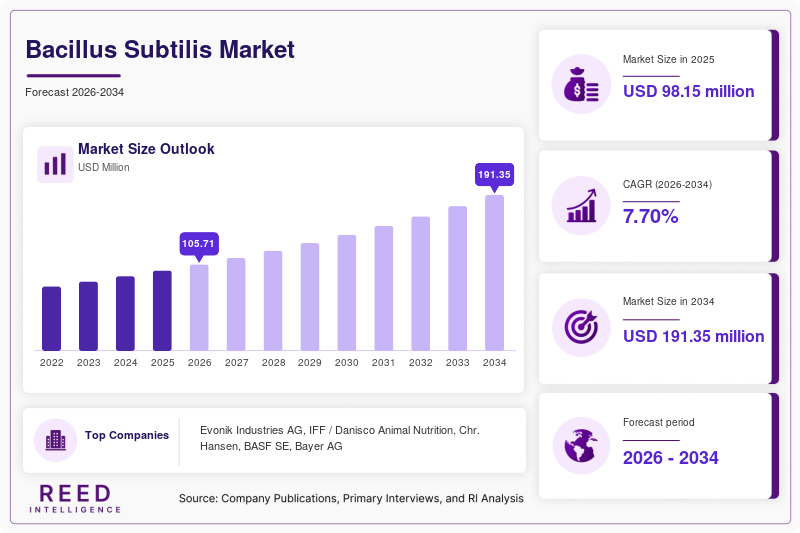
The global Bacillus subtilis Market was valued at USD 98.15 million in 2025 and is projected to increase from USD 105.71 million in 2026 to USD 191.90 million by 2034, registering a CAGR of 7.70% during 2026–2034.
Bacillus subtilis is moving beyond its traditional role as a laboratory microorganism into a commercially important platform for biological crop protection, animal nutrition, fermentation and enzyme production. Its ability to form stable spores is particularly relevant commercially because formulations can be designed for storage and incorporation into agricultural and feed products. The U.S. Environmental Protection Agency, for example, lists multiple Bacillus subtilis strains among registered biopesticide active ingredients, including GB03, MBI 600, QST 713 and several more recent strains.
Agriculture provides one of the clearest demand mechanisms. EPA documentation for B. subtilis MBI 600 describes seed-treatment use against several fungal diseases and notes that the organism forms spores that remain viable during storage before becoming active after planting.
Animal nutrition is another expanding commercial channel. EFSA has evaluated B. subtilis-containing feed additives for poultry, pigs and other species, while the European Commission's Joint Research Centre continues to process applications involving new B. subtilis strains for animal feed. In February 2026, the JRC published an assessment involving B. subtilis DSM 34755 for use as a zootechnical additive for aquatic species.
Bacillus Subtilis Market Drivers
Expansion of Biological Crop Protection Creates a Direct Demand Channel for Bacillus Subtilis
Agricultural applications provide a direct commercial pathway because specific B. subtilis strains can be formulated as microbial crop-protection products. EPA's active-ingredient database includes numerous B. subtilis strains, while its documentation for MBI 600 describes seed treatment for crops including cotton, beans, barley, wheat, corn, peas, peanuts and soybeans.
The market mechanism is stronger than a general shift toward sustainable agriculture: manufacturers can convert a characterized strain into a registered microbial product, and growers can incorporate it into seed-treatment or crop-protection programs. EPA also notes that biopesticides can form part of integrated pest-management programs and may reduce reliance on conventional pesticides.
This creates demand for production strains, fermentation capacity, formulation technology and distribution. Agriculture therefore represents a major addressable application. The counterbalance is that registration requirements and field-performance variability can delay commercialization, and efficacy is strain- and crop-specific rather than automatically transferable across all B. subtilis products.
Animal Nutrition Applications Are Expanding the Commercial Use of Bacillus Subtilis
The animal-feed channel is increasingly important because spore-forming Bacillus strains can be incorporated into feed and remain viable through processing and storage. EFSA's 2025 assessment of GalliPro Fit involved two B. subtilis strains and B. amyloliquefaciens for poultry, with the authority concluding that the additive was safe under the proposed conditions and had the potential to be efficacious as a zootechnical additive.
The regulatory pipeline also remains active. In February 2026, the European Commission's JRC published an application concerning B. subtilis DSM 34755 for all aquatic species, demonstrating that the application base is extending beyond conventional poultry and swine nutrition.
Commercially, this creates demand for strains that can survive feed manufacturing, maintain viability and deliver measurable animal-performance or gut-health benefits. Evonik currently markets B. subtilis DSM 32540 through GutPlus for poultry and swine, while IFF markets Bacillus-based probiotic solutions across animal categories.
The limitation is that feed-additive claims require evidence of safety and efficacy, making regulatory validation and strain selection critical.
Fermentation and Enzyme Manufacturing Increase the Value of Bacillus Subtilis as a Production Platform
B. subtilis is commercially useful not only as a finished microbial product but also as a biological manufacturing platform. Peer-reviewed research identifies its efficient protein-secretion system, genetic tractability and fermentation robustness as reasons for its use in producing enzymes, proteins and chemicals.
More recent research continues to focus on engineering B. subtilis for high-value bioproduction, including extracellular production of enzymes such as proteases, xylanases and other industrial proteins.
The market mechanism is therefore different from agriculture and feed: customers are purchasing a microbial production capability or fermentation-derived ingredient rather than necessarily purchasing live B. subtilis as the final active product.
This expands the addressable market into food processing, detergents, industrial biotechnology and pharmaceutical manufacturing. The main constraint is competition from alternative microbial hosts and engineered production organisms, particularly where another platform can deliver better productivity, downstream processing economics or product quality.
Bacillus Subtilis Market Restraints
Strain-Specific Performance Limits Broad Commercial Standardization
The market cannot treat B. subtilis as a single interchangeable commodity. EPA's database distinguishes individual strains such as GB03, MBI 600, QST 713, CX-9060 and newer registered strains, while feed assessments likewise identify specific strains by their DSM, ATCC or other identifiers.
This creates a commercial constraint because efficacy, safety, formulation stability and regulatory status must be demonstrated at the strain or product level. A manufacturer cannot necessarily transfer performance data from one strain to another.
The result is greater R&D and regulatory expenditure and longer commercialization cycles. Companies with proprietary strain libraries, fermentation expertise and established regulatory capabilities therefore have an advantage. At the same time, strain-specific development can create opportunities for differentiated products where a microorganism demonstrates superior performance in a defined crop, animal species or industrial process.
Regulatory Validation and Product Consistency Can Slow Commercial Adoption
Agricultural and animal-feed applications are subject to regulatory review. EPA states that pesticide products must undergo evaluation before marketing in the United States, while EFSA evaluates the safety and efficacy of microbial feed additives under European feed regulations.
The commercial mechanism is significant: regulatory approval determines which strains can be sold, for which uses and under which conditions. In the European feed sector, official control can also require validated methods for strain identification and enumeration, as illustrated by JRC assessments involving B. subtilis.
These requirements increase development costs and can delay market entry. They also favor suppliers capable of maintaining consistent microbial counts, purity and identity across production batches.
Bacillus Subtilis Market Opportunities
Precision Microbial Products Can Create Higher-Value Agricultural Applications
A major opportunity is the development of strain-specific agricultural products targeting particular crops, pathogens and application methods. EPA's active-ingredient database demonstrates that multiple B. subtilis strains have entered the regulatory system over several decades, including several strains registered in the 2020s.
The commercial opportunity comes from moving away from generic "beneficial bacteria" positioning toward products with defined biological functions and measurable field outcomes. Seed treatment is particularly relevant because the organism can be delivered directly to the developing root environment; EPA's MBI 600 documentation describes root colonization and suppression of certain fungal pathogens.
The opportunity is strongest where biological products can complement integrated pest management rather than requiring complete replacement of conventional crop-protection programs. Adoption can nevertheless be constrained by variable field conditions, regulatory requirements and the need for crop-specific efficacy evidence.
Aquaculture and Next-Generation Animal Nutrition Provide New Application Space
The regulatory pipeline suggests that B. subtilis applications are moving into broader animal categories. The February 2026 JRC assessment for DSM 34755 specifically concerns use as a zootechnical additive for aquatic species.
This creates an opportunity because aquaculture operators face requirements around feed efficiency, animal health and production consistency. A stable spore-forming microorganism can be incorporated into compound feed, creating a scalable delivery route.
The opportunity is reinforced by continuing commercial development of Bacillus-based animal-nutrition products. Evonik's 2025 China Feed Industry Expo announcement described Ecobiol as a feed-grade B. subtilis product introduced in mainland China through its Vland Biotech joint venture.
By Form Segment Analysis
Powder Represents the Largest Form Because It Fits High-Volume Feed and Agricultural Formulations
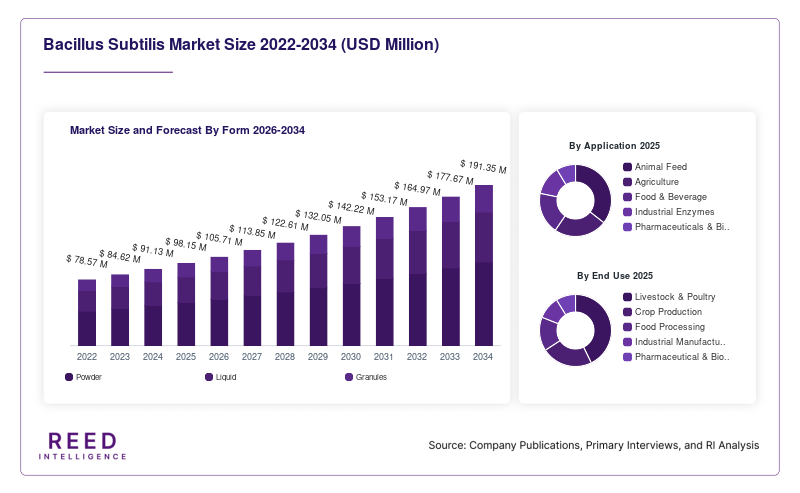
Market Share: 52% | approximately USD 51.04 million.
Powder represents the largest form in the internal market model because dry microbial formulations can be incorporated into feed, seed-treatment formulations and agricultural products while supporting relatively convenient storage and transportation. The commercial importance of spore formation reinforces this format because B. subtilis can be supplied as viable spores rather than requiring continuously active vegetative cells.
Animal-nutrition products demonstrate this model. Evonik's GutPlus is supplied as a dry, free-flowing granular product containing B. subtilis DSM 32540, with a specified minimum spore count.
Liquid Formulations Expand Through Agricultural and Bioprocess Applications
Market Share: 28% | approximately USD 27.48 million.
Liquid formulations serve applications where direct dosing, fermentation integration or compatibility with existing agricultural application systems is important. Their commercial advantage lies in ease of incorporation into certain processing streams and formulations.
The category is modeled to expand at approximately 8.1% CAGR, slightly above the overall market rate, as microbial products become more application-specific. However, liquid formulations face higher sensitivity to storage conditions and microbial viability compared with spore-based dry products.
By Application Analysis
Animal Feed Represents the Largest Application Because Spore Stability Supports Commercial Feed Delivery
Market Share: 30% | approximately USD 29.45 million.
Animal feed represents the largest application in the internal market model. The mechanism is the compatibility between spore-forming B. subtilis strains and industrial feed production. Commercial products can be incorporated into feed while retaining viable microorganisms, after which the strains are intended to support gut microbial balance or other zootechnical outcomes.
EFSA's assessments of B. subtilis-containing additives for poultry and pigs provide evidence of an established regulatory pathway, while commercial products from Evonik and IFF demonstrate continued product development.
Agriculture Expands Through Biological Crop Protection and Seed Treatment
Market Share: 32% | approximately USD 31.41 million.
Agriculture is modeled as the fastest-growing major application and accounts for approximately 32% of the 2025 market. EPA's registration database contains numerous B. subtilis strains used in microbial pesticide products, while MBI 600 documentation specifically identifies seed-treatment applications across multiple crops.
The commercial mechanism is the use of selected strains as biological tools against plant pathogens or to support plant establishment. This creates demand for strain development, fermentation, formulation and field-delivery technologies.
Regional Analysis
Asia-Pacific Represents the Largest Regional Market and the Fastest Expansion Opportunity
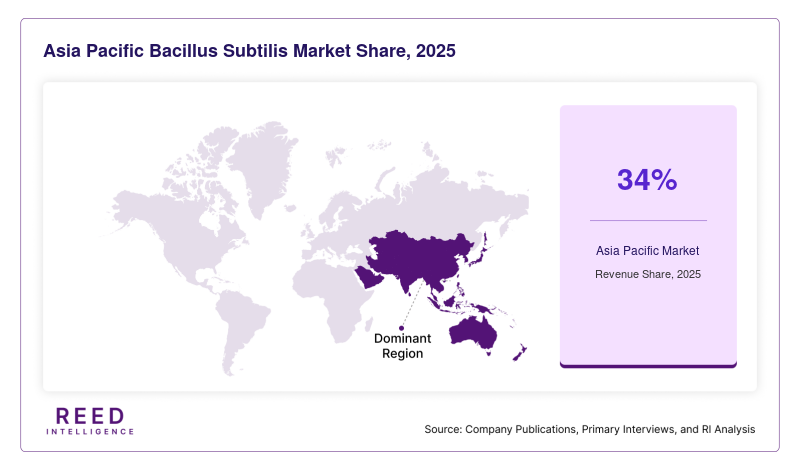
2025 Market share: 34% | approximately USD 33.37 million.
Asia-Pacific represents the largest regional allocation in the internal model. The region's position reflects the combination of agricultural applications, livestock production, feed additives, fermentation industries and expanding biotechnology manufacturing.
China is particularly relevant to the animal-nutrition segment. In 2025, Evonik announced the introduction of Ecobiol through its Vland Biotech joint venture as the first registered feed-grade B. subtilis product in mainland China.
The region also has substantial agricultural production, creating an addressable environment for microbial crop-protection products. The commercial mechanism is therefore diversified: agricultural biologicals create one demand stream while feed probiotics and industrial fermentation create others.
India and Southeast Asian markets provide additional potential through animal nutrition, crop production and industrial biotechnology. However, regulatory requirements and differences in agricultural practices mean that commercialization strategies must remain country-specific.
Asia-Pacific is modeled at approximately 8.6% CAGR during 2026–2034, making it the fastest-growing region in the internal model. This is an analytical allocation rather than an externally published regional forecast.
North America Maintains an Established Market Through Agricultural Biologicals and Industrial Biotechnology
2025 share: 25% | approximately USD 24.54 million.
North America represents the second-largest regional allocation. The region benefits from an established regulatory framework for microbial pesticides and a mature biotechnology ecosystem.
The U.S. EPA has registered multiple B. subtilis strains as biopesticide active ingredients, including strains with agricultural applications. This creates a direct regulatory and commercial pathway for biological crop-protection products.
The market also benefits from industrial biotechnology and animal-nutrition applications. Companies can leverage established fermentation infrastructure and distribution channels to commercialize microbial ingredients.
North America is modeled at approximately 7.1% CAGR, below Asia-Pacific because its commercial ecosystem is comparatively mature. Future expansion is therefore more dependent on new strains, differentiated formulations and additional application approvals than on basic market establishment.
Europe Represents a Regulation-Intensive Market With Strong Feed and Biological-Product Development
Europe represents approximately 23% of the 2025 market in the internal allocation. Animal feed is an especially important application because EFSA and the European Commission maintain formal processes for assessing microbial feed additives.
Recent regulatory activity illustrates continued product development. EFSA assessed a B. subtilis-containing poultry additive in 2025, while the European Commission's JRC has published technical assessments involving B. subtilis preparations for silage and other feed applications.
The regulatory environment can increase commercialization costs but also creates a clearer framework for products that successfully demonstrate identity, safety and efficacy.
Latin America Gains Commercial Relevance Through Agriculture and Livestock Production
Latin America represents approximately 10% of the market in the internal allocation. Agriculture and livestock production provide the primary commercial mechanisms because microbial crop-protection and feed products can be incorporated into existing production systems.
The strongest opportunity lies in agricultural biologicals where B. subtilis can be incorporated into seed treatment or integrated pest-management programs. EPA's documented MBI 600 use across several crop categories illustrates the underlying product mechanism.
The region is modeled at approximately 7.5% CAGR. Adoption can vary substantially by country because registration requirements, crop systems, distribution infrastructure and farmer familiarity with biological products differ.
Middle East & Africa Represents a Smaller Market With Targeted Agricultural and Feed Opportunities
Middle East & Africa represents the smallest regional allocation in the internal model. Demand is concentrated in applications where biological crop protection, animal nutrition and fermentation-based products provide a measurable operational benefit.
The commercial opportunity is particularly relevant to intensive agriculture and livestock systems where producers seek tools that can complement conventional crop protection and feed programs. The spore-forming characteristics of B. subtilis can also support formulation stability in commercial products.
The region is modeled at approximately 7.8% CAGR. However, fragmented regulatory systems, differences in agricultural practices and distribution limitations can slow product adoption.
Competitive Landscape
Competition in the Bacillus subtilis market is increasingly based on strain ownership, fermentation capability, regulatory approvals, formulation stability, application-specific efficacy and distribution, rather than simply the ability to manufacture generic bacterial biomass.
Evonik has developed a significant animal-nutrition position around B. subtilis probiotics. Its GutPlus product uses B. subtilis DSM 32540 for poultry and swine, while the company also commercialized GutCare based on DSM 32315. Its 2025 introduction of Ecobiol through Evonik Vland Biotech in mainland China strengthens its presence in the Asian feed market.
IFF competes through a broader Bacillus-based animal-nutrition portfolio. Its Enviva PRO platform uses multiple Bacillus strains, and the company extended the product to pigs in 2025. This expands IFF's competitive position beyond poultry into swine nutrition.
Key Market Players
- Evonik Industries AG
- IFF / Danisco Animal Nutrition
- Chr. Hansen
- BASF SE
- Bayer AG
- Syngenta Group
- Certis Belchim
- Koppert
- Novozymes / Novonesis
- Lesaffre
Recent Market Developments
- IFF announced in March 2025 that it had extended its three-strain Enviva PRO Bacillus probiotic to pigs. The development broadens the addressable customer base from poultry into swine production and strengthens IFF's position in multi-species animal nutrition.
- In April 2025, EFSA published its assessment of GalliPro Fit and GalliPro Fit 10, containing two B. subtilis strains and B. amyloliquefaciens. The application sought broader use across poultry and a higher-concentration formulation. EFSA concluded that the additive was safe under the proposed conditions and had potential efficacy as a zootechnical additive.
- In 2025, Evonik announced that its Vland Biotech joint venture would introduce Ecobiol as the first registered feed-grade Bacillus subtilis product in mainland China. The development strengthens the company's position in the Chinese animal-nutrition market and creates a commercial route for Bacillus-based gut-health products in one of the world's major feed markets.
- In February 2026, the European Commission's Joint Research Centre published an assessment concerning B. subtilis DSM 34755 as a proposed zootechnical additive for aquatic species. The development is commercially relevant because it extends the potential application base beyond terrestrial livestock into aquaculture.
Bacillus Subtilis Market Segments
By Form
- Powder
- Liquid
- Granules
By Application
- Animal Feed
- Agriculture
- Food & Beverage
- Industrial Enzymes
- Pharmaceuticals & Biotechnology
By End Use
- Livestock & Poultry
- Crop Production
- Food Processing
- Industrial Manufacturing
- Pharmaceutical & Biotechnology
By Distribution Channel
- Direct Sales
- Specialty Distributors
- Agricultural & Feed Distributors
- Online Channels
By Region
- North America
- Europe
- APAC
- Middle East and Africa
- LATAM