Baking Enzymes in Bread Application Market Size, Share & Demand Report By Type (Amylases, Proteases, Lipases, Others), By Application (White Bread, Whole Wheat Bread, Specialty Bread, Others), By Form (Liquid, Powder) By Region & Segment Forecasts, 2026–2034
USD 3950
Market Overview
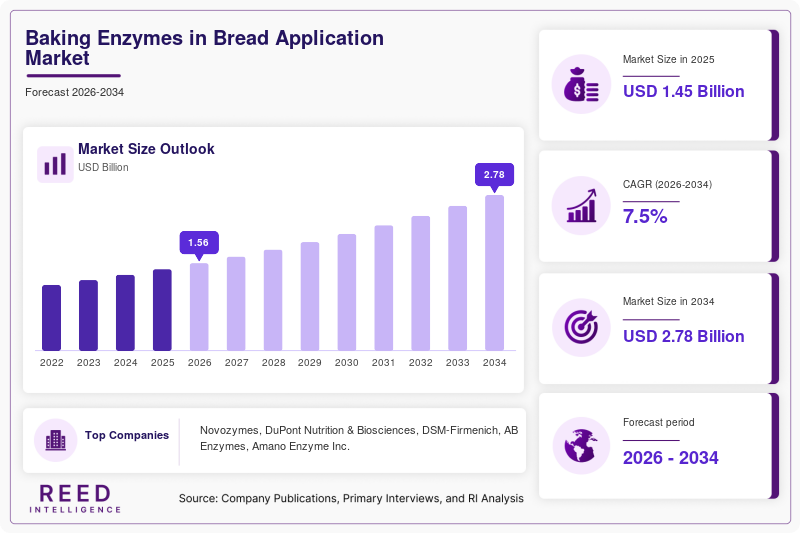
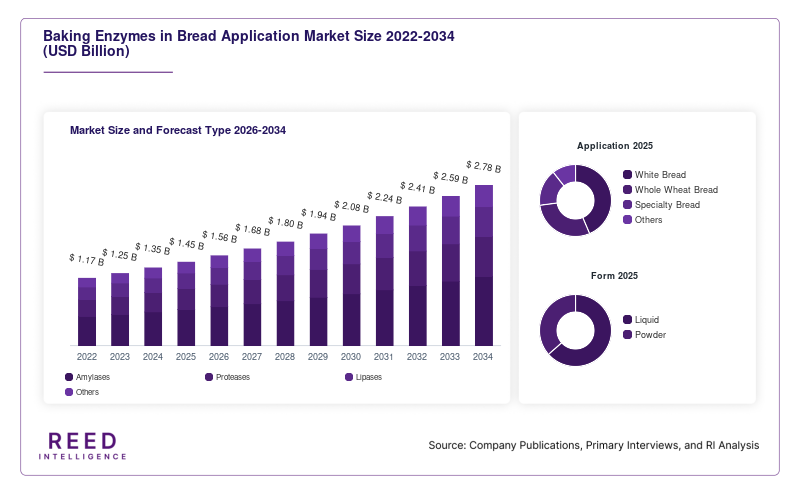
The Baking Enzymes in Bread Application Market size was valued at USD 1.45 billion in 2026 and is projected to reach USD 2.58 billion by 2034, expanding at a CAGR of 7.5% during the forecast period (2026–2034). The market has demonstrated stable growth due to increasing global consumption of bread and bakery products, along with the rising demand for clean-label and additive-free formulations. Baking enzymes, including amylases, proteases, and lipases, are widely used to improve dough handling, bread volume, shelf life, and texture, making them essential ingredients in modern industrial baking processes.
A key global factor supporting market expansion is the shift toward natural food processing solutions. Consumers are increasingly avoiding chemical additives, prompting manufacturers to replace emulsifiers and preservatives with enzyme-based solutions. This transition has accelerated the adoption of baking enzymes in both developed and emerging markets. Additionally, technological advancements in enzyme engineering have enabled tailored enzyme blends, improving performance across diverse flour types and baking conditions.
Key Highlights
- North America dominated the market with a 33.8% share in 2025.
- Asia Pacific is expected to grow at the fastest CAGR of 9.2% during 2026–2034.
- By type, amylases accounted for the largest share of 36.4%.
- while lipases are projected to grow at a CAGR of 8.3%.
- By application, white bread led with a 42.6% share, whereas specialty bread is expected to expand at a CAGR of 8.7%.
- The United States remained the dominant country, with market values of USD 480 million in 2024 and USD 515 million in 2025.
Market Trends
A significant trend shaping the Baking Enzymes in Bread Application Market is the growing preference for clean-label bakery products. Consumers are increasingly scrutinizing ingredient lists and favoring products with recognizable and natural components. Baking enzymes serve as effective alternatives to chemical additives, enabling manufacturers to maintain product quality without compromising labeling requirements. This trend is particularly prominent in developed markets, where regulatory frameworks and consumer awareness drive product reformulation. As a result, enzyme manufacturers are focusing on developing non-GMO and allergen-free enzyme solutions to align with evolving consumer expectations.
Another emerging trend is the integration of enzyme blends tailored for specific baking applications. Industrial bakeries are seeking customized solutions that enhance dough stability, improve crumb structure, and extend shelf life under varying processing conditions. This has led to the development of multifunctional enzyme systems that combine amylases, xylanases, and lipases. These advanced formulations reduce production variability and improve efficiency, especially in large-scale operations. The demand for such solutions is increasing in regions experiencing rapid urbanization and rising consumption of packaged bread products.
Market Drivers
The increasing consumption of bread and bakery products globally is a primary driver for the Baking Enzymes in Bread Application Market. Urbanization, changing dietary habits, and busy lifestyles have led to higher demand for convenient food options such as sliced bread, buns, and rolls. Baking enzymes play a crucial role in ensuring consistent quality and extended shelf life in these products. As bakery manufacturers scale production to meet growing demand, the use of enzymes becomes essential for maintaining efficiency and reducing waste.
Another important driver is the cost-effectiveness of enzymes compared to traditional additives. Enzymes enable improved dough handling and reduced reliance on expensive ingredients such as emulsifiers and stabilizers. They also contribute to process optimization by reducing mixing time and improving fermentation efficiency. This not only lowers production costs but also enhances product consistency. Small and medium-sized bakeries are increasingly adopting enzyme-based solutions to remain competitive in price-sensitive markets while meeting quality expectations.
Market Restraint
A key restraint in the Baking Enzymes in Bread Application Market is the sensitivity of enzymes to processing conditions and storage environments. Enzymes are biological molecules that can lose activity when exposed to high temperatures, extreme pH levels, or improper storage conditions. This instability can lead to inconsistent product quality, especially in regions where supply chain infrastructure is less developed. For example, inadequate temperature control during transportation can reduce enzyme effectiveness, resulting in suboptimal baking performance.
Additionally, the complexity of enzyme selection and formulation poses challenges for smaller bakery operators. Different flour types, baking methods, and environmental conditions require specific enzyme combinations, making it difficult for manufacturers without technical expertise to achieve optimal results. This can lead to hesitation in adoption, particularly among traditional bakeries that rely on conventional methods. The need for technical support and training increases operational costs, thereby limiting market penetration in certain segments.
Market Opportunities
The expansion of the artisanal and specialty bread segment presents a notable opportunity for the Baking Enzymes in Bread Application Market. Consumers are increasingly exploring diverse bread varieties, including whole grain, gluten-free, and sourdough products. These formulations often require precise enzyme applications to achieve desired texture and flavor profiles. Enzyme manufacturers have the opportunity to develop targeted solutions that cater to these niche segments, enabling bakers to innovate and differentiate their offerings.
Another promising opportunity lies in emerging markets where industrial baking is rapidly developing. Regions such as Asia Pacific and Latin America are witnessing increased investment in bakery infrastructure and automation. As these markets transition from traditional to industrial baking practices, the demand for efficient and scalable solutions is rising. Baking enzymes offer a practical solution for improving productivity and ensuring consistent product quality. Companies that establish strong distribution networks and technical support systems in these regions are likely to benefit from sustained growth.
Segmental Analysis
By Type
Amylases emerged as the dominant subsegment, accounting for 36.4% of the market share in 2024. These enzymes play a critical role in breaking down starch into sugars, which improves fermentation and enhances bread volume and texture. Their widespread application across various bread types makes them a preferred choice among manufacturers. Amylases also contribute to extending shelf life by reducing staling, making them essential for packaged bread products. The consistent demand for white and standard bread varieties further supports the dominance of this subsegment.
Lipases are expected to be the fastest-growing subsegment, with a CAGR of 8.3% during the forecast period. These enzymes improve dough stability and enhance crumb softness, making them suitable for premium and specialty bread products. The growing demand for clean-label formulations is a key factor driving their adoption, as lipases can replace chemical emulsifiers. Additionally, advancements in enzyme technology have improved their efficiency and compatibility with different baking conditions.
By Application
White bread accounted for the largest share of 42.6% in 2024, driven by its widespread consumption and affordability. Baking enzymes are extensively used in white bread production to improve dough handling, increase volume, and maintain softness over time. The high demand for packaged white bread in both developed and developing regions supports the dominance of this subsegment. Manufacturers rely on enzymes to ensure consistent quality and meet large-scale production requirements.
Specialty bread is projected to be the fastest-growing subsegment, with a CAGR of 8.7%. This includes whole grain, gluten-free, and artisanal bread varieties. The increasing consumer preference for healthier and diverse bread options is driving growth in this segment. Enzymes play a crucial role in overcoming formulation challenges associated with specialty ingredients, enabling manufacturers to achieve desired texture and taste. This trend is particularly strong in urban markets with high health awareness.
By Form
Liquid enzymes dominated the market in 2024, accounting for a significant share due to their ease of use and uniform distribution in dough formulations. They are widely used in industrial baking operations where precise dosing and consistency are critical. Liquid forms also offer better solubility, ensuring efficient enzyme activity during the baking process. Their compatibility with automated systems further enhances their adoption in large-scale production facilities.
Powdered enzymes are expected to grow at a CAGR of 7.9%, driven by their longer shelf life and ease of storage. These enzymes are particularly suitable for small and medium-sized bakeries that may not have advanced storage infrastructure. The ability to maintain stability under varying conditions makes powdered enzymes a practical choice in emerging markets. Additionally, ongoing advancements in encapsulation technologies are improving their performance and expanding their application range.
Regional Analysis
North America
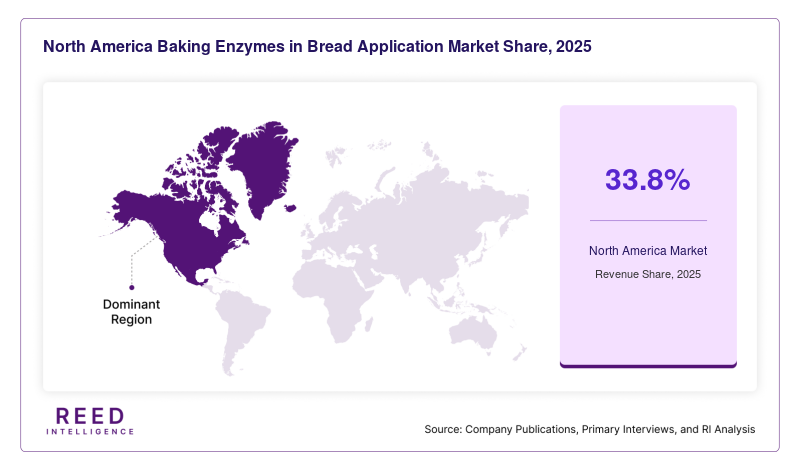
North America held a significant share of 33.8% in 2025 and is expected to grow at a CAGR of 6.8% during the forecast period. The region benefits from a well-established bakery industry and high consumption of packaged bread products. The demand for clean-label ingredients and functional bakery solutions continues to drive enzyme adoption. Manufacturers in this region focus on innovation and product differentiation, contributing to steady market growth.
The United States dominates the regional market, supported by advanced food processing technologies and strong consumer demand for convenience foods. A key growth factor is the increasing preference for healthier bread options, including whole grain and reduced-sugar variants. This shift encourages the use of enzymes to maintain product quality while reducing additives.
Europe
Europe accounted for 28.6% of the market share in 2025 and is projected to grow at a CAGR of 6.5%. The region is characterized by a strong tradition of bread consumption and a diverse range of bakery products. Regulatory support for clean-label ingredients further boosts enzyme adoption. Manufacturers prioritize sustainability and natural solutions, aligning with consumer preferences.
Germany leads the European market due to its large bakery industry and high consumption of bread varieties. A unique growth factor is the emphasis on traditional baking methods combined with modern technology. This creates demand for enzymes that can enhance quality without altering authentic taste and texture.
Asia Pacific
Asia Pacific is the fastest-growing region, with a CAGR of 9.2% during the forecast period and a 22.4% share in 2025. Rapid urbanization, rising disposable incomes, and changing dietary habits are driving demand for packaged bakery products. The region is witnessing significant investments in food processing infrastructure, supporting market expansion.
China dominates the regional market, driven by increasing consumption of Western-style bakery products. A key growth factor is the expansion of retail chains and supermarkets, which boost demand for packaged bread. This trend encourages the adoption of baking enzymes to ensure consistent quality and shelf life.
Middle East & Africa
The Middle East & Africa region held a 7.5% share in 2025 and is expected to grow at a CAGR of 7.1%. The market is supported by growing urban populations and increasing demand for convenient food products. The adoption of industrial baking practices is gradually increasing, creating opportunities for enzyme manufacturers.
South Africa leads the regional market, supported by a developing bakery sector and increasing consumer awareness of product quality. A unique growth factor is the rising demand for fortified and functional bread products, which require enzyme-based solutions for optimal performance.
Latin America
Latin America accounted for 7.7% of the market share in 2025 and is projected to grow at a CAGR of 7.3%. The region is experiencing growth in the bakery sector due to changing lifestyles and increased consumption of packaged foods. Enzyme adoption is rising as manufacturers seek to improve efficiency and product consistency.
Brazil dominates the market in this region, driven by a large population and strong demand for bread products. A key growth factor is the expansion of industrial bakeries and the increasing availability of modern baking technologies. This supports the use of enzymes to enhance production processes.
Competitive Landscape
The Baking Enzymes in Bread Application Market is moderately consolidated, with several global and regional players competing through product innovation and strategic partnerships. Leading companies focus on developing customized enzyme solutions to meet diverse baking requirements. Continuous investment in research and development enables these players to enhance enzyme performance and expand their product portfolios.
A prominent leader in the market is Novozymes, known for its strong focus on biotechnology and enzyme innovation. The company has recently introduced advanced enzyme blends designed to improve bread quality while supporting clean-label initiatives. Other key players are actively expanding their presence in emerging markets through collaborations and distribution agreements. Competitive strategies also include mergers and acquisitions aimed at strengthening market position and enhancing technological capabilities.
Key Players
- Novozymes
- DuPont Nutrition & Biosciences
- DSM-Firmenich
- AB Enzymes
- Amano Enzyme Inc.
- BASF SE
- Kerry Group
- Chr. Hansen Holding A/S
- Advanced Enzyme Technologies
- Biocatalysts Ltd.
- Enzyme Development Corporation
- Lesaffre Group
- Puratos Group
- SternEnzym GmbH
- Maps Enzymes Limited
Recent Developments
- Novozymes launched a new enzyme solution aimed at improving shelf life and softness in packaged bread products.
- DSM-Firmenich introduced a clean-label enzyme range designed to replace traditional emulsifiers in bakery applications.
- AB Enzymes expanded its production capacity to meet increasing demand in Asia Pacific markets.
Baking Enzymes in Bread Application Market Segments
Type
- Amylases
- Proteases
- Lipases
- Others
Application
- White Bread
- Whole Wheat Bread
- Specialty Bread
- Others
Form
- Liquid
- Powder
By Region
- North America
- Europe
- APAC
- Middle East and Africa
- LATAM