Ballistic Shields Market Size, Share & Demand Report By Type (Handheld Shields, Wheeled Shields), By Application (Law Enforcement, Military, Civil Defense), By End-Use (Government Agencies, Private Security, Commercial Sector), By Region & Segment Forecasts, 2026–2034
USD 3950
Market Overview
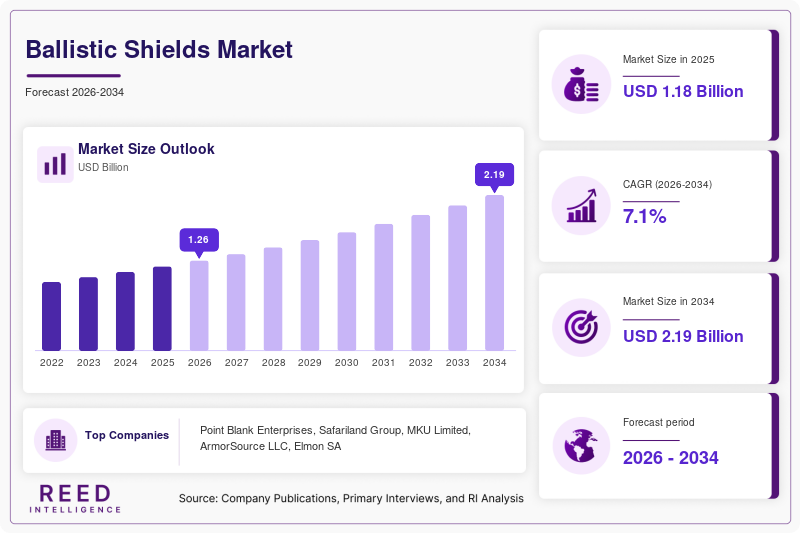
The Ballistic Shields Market size was valued at approximately USD 1.18 billion in 2026 and is projected to reach USD 2.05 billion by 2034, expanding at a CAGR of 7.1% during the forecast period (2026–2034). The market continues to gain traction due to the increasing need for advanced personal protection equipment across military, law enforcement, and private security sectors. Rising global security concerns, including urban conflicts, terrorism threats, and civil unrest, have driven consistent demand for ballistic protection systems. Governments across developed and developing economies are prioritizing investments in modern defense infrastructure, which has positively influenced procurement of lightweight and high-strength ballistic shields.
A major global factor supporting market growth is the advancement in composite materials such as ultra-high-molecular-weight polyethylene (UHMWPE) and aramid fibers. These materials enable the production of lighter shields with improved ballistic resistance, enhancing mobility and operational efficiency for users. Additionally, integration of ergonomic designs and modular features has improved usability, encouraging broader adoption across tactical operations.
Key Highlights
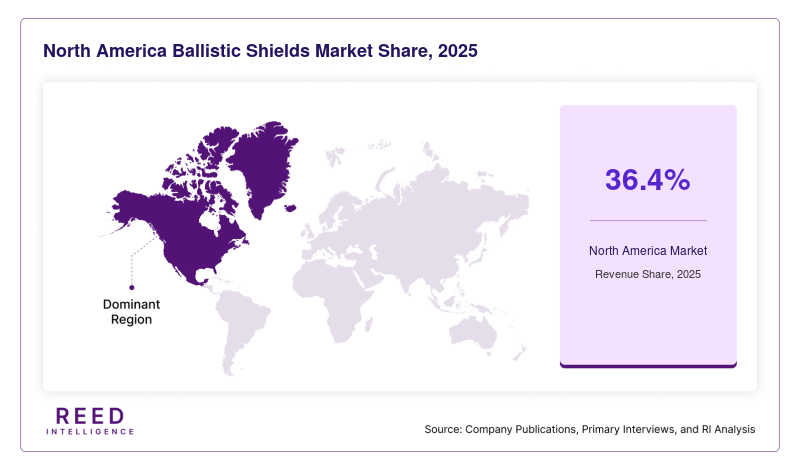
- North America dominated the market with a 36.4% share in 2025.
- Asia Pacific is expected to grow at the fastest CAGR of 8.3% during 2026–2034.
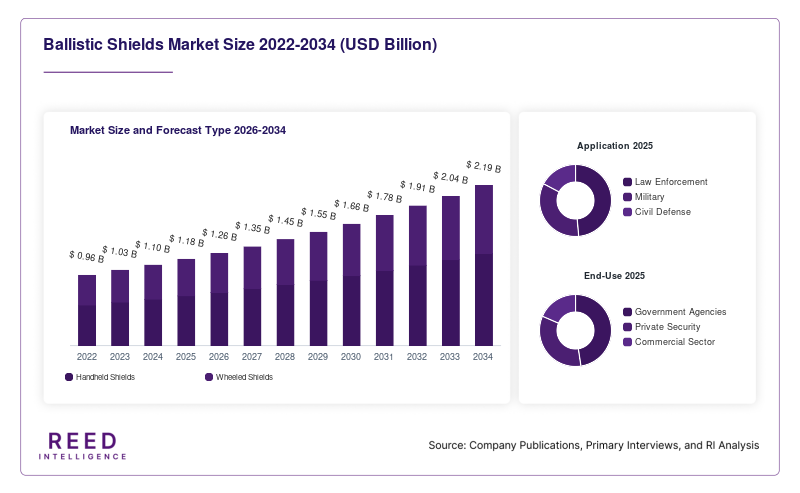
- By type, handheld shields accounted for the largest share of 44.6%, while wheeled shields are projected to grow at a CAGR of 8.7%.
- By application, law enforcement led with a 39.8% share, whereas military applications are expected to expand at a CAGR of 7.9%.
- The United States remained the dominant country, with market values of USD 430 million in 2024 and USD 465 million in 2025.
Market Trends
Increasing adoption of lightweight and composite ballistic shields
The market is witnessing a clear shift toward lightweight ballistic shields made using advanced composite materials. Traditional steel-based shields are being gradually replaced by solutions that incorporate UHMWPE, ceramics, and hybrid composites. These materials offer high impact resistance while significantly reducing weight, enabling improved maneuverability in high-risk situations. Law enforcement agencies and military units are increasingly prioritizing shields that do not compromise mobility, particularly for urban operations and close-quarter engagements. Manufacturers are focusing on ergonomic designs, including better grip systems, improved viewing ports, and reduced fatigue during prolonged usage. This trend is also influencing procurement policies, with buyers favoring solutions that balance protection and comfort, ultimately shaping the competitive landscape of the industry.
Integration of smart technologies and modular systems
Another emerging trend in the Ballistic Shields Market is the integration of smart features and modular capabilities. Modern shields are increasingly equipped with features such as built-in lighting systems, communication modules, and camera attachments that enhance situational awareness. Some advanced variants include transparent armor with anti-fog coatings and heads-up display compatibility. Additionally, modular shield systems allow users to customize configurations based on mission requirements, such as adding rifle rests or detachable panels. This trend reflects the growing demand for multifunctional equipment in tactical operations. As security threats become more complex, the ability to adapt equipment in real time is becoming a critical requirement, encouraging innovation across the industry.
Market Drivers
Rising global security threats and law enforcement modernization
The increasing prevalence of security threats worldwide has significantly contributed to the growth of the Ballistic Shields Market. Urban violence, organized crime, and geopolitical tensions have led governments to strengthen their internal security frameworks. Law enforcement agencies are undergoing modernization programs that emphasize enhanced officer safety and operational efficiency. Ballistic shields play a critical role in tactical operations such as hostage rescue, riot control, and counterterrorism missions. As a result, procurement budgets for protective equipment are expanding. Emerging economies are also investing in law enforcement infrastructure, further boosting demand. This driver is expected to sustain long-term market growth, as security concerns remain a priority across regions.
Technological advancements in ballistic materials and design
Advancements in material science have played a vital role in driving the adoption of ballistic shields. Innovations in composite materials have enabled manufacturers to produce shields that are not only lighter but also more durable and resistant to multiple ballistic impacts. The use of layered structures combining ceramics and polymers enhances energy absorption, reducing penetration risk. Additionally, improvements in manufacturing processes have lowered production costs, making advanced shields more accessible. Design innovations such as curved surfaces and improved transparency further enhance usability. These technological developments are encouraging end-users to upgrade existing equipment, thereby driving market expansion.
Market Restraint
High cost and limited accessibility in developing regions
Despite steady growth, the Ballistic Shields Market faces challenges related to high product costs. Advanced ballistic shields, particularly those incorporating composite materials and smart features, are significantly more expensive than conventional options. This cost barrier limits adoption in developing regions where defense and law enforcement budgets are constrained. Smaller agencies often rely on basic protective equipment, delaying the transition to advanced solutions. Additionally, maintenance and replacement costs further increase the financial burden. The high cost also affects procurement cycles, as organizations may prioritize other critical equipment. This restraint can slow market penetration in price-sensitive regions, creating disparities in adoption rates across different geographies.
Market Opportunities
Expansion of private security and commercial applications
The growing demand for private security services presents a notable opportunity for the Ballistic Shields Market. Corporate offices, financial institutions, and high-profile events are increasingly relying on private security personnel equipped with advanced protective gear. Ballistic shields are being adopted in scenarios such as VIP protection and emergency response planning. The rise in urbanization and large-scale public gatherings has further increased the need for effective security solutions. Manufacturers are developing compact and user-friendly shields tailored for private security use, expanding the market beyond traditional defense and law enforcement segments. This diversification is expected to create new revenue streams for industry participants.
Increasing defense spending in emerging economies
Emerging economies are significantly increasing their defense budgets, creating opportunities for ballistic shield manufacturers. Countries in Asia Pacific, the Middle East, and Latin America are investing in modernizing their military and law enforcement capabilities. This includes procurement of advanced protective equipment to enhance personnel safety. Government initiatives aimed at strengthening national security infrastructure are supporting market growth. Additionally, local manufacturing and partnerships with global players are improving accessibility and reducing costs. As these regions continue to prioritize defense modernization, the demand for ballistic shields is expected to rise, offering substantial growth potential for market participants.
Segmental Analysis
By Type
Handheld ballistic shields dominated the market with a 44.6% share in 2024, primarily due to their portability and ease of use in tactical operations. These shields are widely used by law enforcement agencies for riot control and close-range engagements. Their lightweight design and ergonomic features make them suitable for rapid deployment in high-risk situations. Additionally, advancements in materials have enhanced their durability and ballistic resistance, further driving adoption. The versatility of handheld shields allows them to be used in various scenarios, including crowd control and emergency response, contributing to their dominant position in the market.
Wheeled ballistic shields are expected to be the fastest-growing subsegment, with a CAGR of 8.7% during the forecast period. These shields provide enhanced protection and are suitable for prolonged operations where mobility can be supported by wheels. They are increasingly used in military applications and high-risk law enforcement missions. The ability to integrate additional features such as weapon mounts and communication systems makes them highly effective. Growing demand for advanced tactical equipment is driving the adoption of wheeled shields, particularly in developed regions.
By Application
Law enforcement applications held the largest market share of 39.8% in 2024, driven by the increasing need for protective equipment in urban policing. Ballistic shields are widely used in operations such as crowd control, hostage rescue, and counterterrorism missions. The rising focus on officer safety and operational efficiency has led to increased procurement of advanced shields. Additionally, government initiatives aimed at modernizing law enforcement infrastructure are supporting market growth.
Military applications are expected to grow at the fastest CAGR of 7.9% during the forecast period. The increasing complexity of combat scenarios and the need for advanced protection systems are driving demand. Ballistic shields are being integrated into tactical operations to enhance soldier safety. The adoption of lightweight and modular designs is further supporting growth in this segment.
By End-Use
Government agencies dominated the market with a 52.3% share in 2024, as they are the primary users of ballistic shields. This includes law enforcement and military organizations that require advanced protective equipment for various operations. The consistent allocation of budgets for defense and security infrastructure supports the dominance of this segment. Additionally, government procurement policies often prioritize high-quality and technologically advanced solutions, driving market growth.
Private security is the fastest-growing end-use segment, with a CAGR of 8.1%. The increasing demand for security services in commercial and residential sectors is driving adoption. Private security firms are investing in advanced protective equipment to enhance their capabilities. The growing need for VIP protection and event security is further supporting the expansion of this segment.
Regional Analysis
North America
North America accounted for a 36.4% share of the Ballistic Shields Market in 2025 and is expected to maintain steady growth with a CAGR of 6.8% during the forecast period. The region benefits from well-established defense infrastructure and consistent government spending on security equipment. High adoption of advanced technologies and strong presence of leading manufacturers further contribute to market stability. The demand for lightweight and smart ballistic shields is particularly strong among law enforcement agencies.
The United States dominates the regional market due to its extensive defense budget and continuous modernization initiatives. A key growth factor is the increasing focus on officer safety and tactical preparedness. Federal and local agencies are investing in advanced protective equipment, including modular ballistic shields. Additionally, frequent training programs and standardization of equipment usage support sustained demand.
Europe
Europe held a market share of approximately 24.7% in 2025 and is projected to grow at a CAGR of 6.5% through 2034. The region’s growth is driven by rising security concerns and collaborative defense initiatives among European nations. Governments are focusing on enhancing law enforcement capabilities to address urban security challenges. The adoption of advanced materials and ergonomic designs is gaining traction across the region.
Germany remains the dominant country in the European market, supported by strong industrial capabilities and defense investments. A unique growth factor is the emphasis on technological innovation and sustainability. European manufacturers are developing eco-friendly production methods and recyclable materials, aligning with regulatory requirements while maintaining high performance standards.
Asia Pacific
Asia Pacific is expected to be the fastest-growing region, with a CAGR of 8.3% during the forecast period, and accounted for 21.5% of the market share in 2025. Rapid urbanization, increasing defense budgets, and rising security concerns are key drivers of growth. Governments are investing heavily in modernizing law enforcement and military equipment, boosting demand for ballistic shields.
China leads the regional market due to its significant defense spending and expanding manufacturing capabilities. A unique growth factor is the emphasis on domestic production and technological self-reliance. The country is focusing on developing advanced composite materials and reducing dependence on imports, strengthening its position in the global market.
Middle East & Africa
The Middle East & Africa region held a market share of 9.8% in 2025 and is expected to grow at a CAGR of 7.2%. The region’s growth is influenced by ongoing geopolitical tensions and increasing investments in defense infrastructure. Governments are prioritizing the procurement of advanced protective equipment to enhance security forces’ capabilities.
Saudi Arabia dominates the regional market, driven by substantial defense spending and modernization programs. A unique growth factor is the focus on large-scale security projects and international collaborations. The country is investing in advanced technologies and forming partnerships with global manufacturers to improve local capabilities.
Latin America
Latin America accounted for 7.6% of the market share in 2025 and is projected to grow at a CAGR of 6.9%. The region’s growth is supported by increasing efforts to combat organized crime and improve public safety. Governments are gradually increasing investments in law enforcement equipment, including ballistic shields.
Brazil leads the regional market due to its large population and ongoing security challenges. A unique growth factor is the expansion of urban policing initiatives. Authorities are focusing on equipping law enforcement personnel with modern protective gear to address crime in densely populated areas, supporting market growth.
Competitive Landscape
The Ballistic Shields Market is moderately competitive, with several established players focusing on innovation and product development. Leading companies are investing in research and development to enhance material performance and integrate advanced features. The market leader, Point Blank Enterprises, maintains a strong position through its extensive product portfolio and global distribution network. The company has recently introduced lightweight composite shields designed for enhanced mobility and protection.
Other key players are focusing on strategic partnerships and regional expansion to strengthen their market presence. Companies are also emphasizing customization to meet specific customer requirements. The competitive landscape is characterized by continuous innovation and efforts to improve product performance while reducing costs.
Key Players
- Point Blank Enterprises
- Safariland Group
- MKU Limited
- ArmorSource LLC
- Elmon SA
- Baker Ballistics
- Protech Tactical
- ATS Tactical Gear
- Damascus Gear
- Hellweg International
- Advanced Blast & Ballistic Systems
- Mehler Vario System
- Hard Shell FZE
- Sioen Ballistics
- VestGuard UK Ltd
Recent Developments
- A leading manufacturer launched a new series of lightweight ballistic shields using advanced composite materials to improve mobility and durability.
- A defense company entered a strategic partnership with a regional distributor to expand its presence in Asia Pacific.
- A major player introduced modular ballistic shields with integrated communication systems to enhance tactical operations.
Ballistic Shields Market Segments
Type
- Handheld Shields
- Wheeled Shields
Application
- Law Enforcement
- Military
- Civil Defense
End-Use
- Government Agencies
- Private Security
- Commercial Sector
By Region
- North America
- Europe
- APAC
- Middle East and Africa
- LATAM